Showing posts with label CBS. Show all posts

Monday, November 30, 2020

The Doris Day Radio Show


On The air, the Encyclopedia of Old-Time radio by John Dunning describes the 30-minute program in one sentence: "Singer Doris day with such guests as Danny Thomas, Kirk Douglas, Jack Smith, and Jack Kirkwood." Then it notes Sam Pierce as the producer and director. The Doris Day Show program lasted a whole 60 weeks, slightly less than 14 months; from March 28th, 1952, to May 26th, 1953.. The Les Brown orchestra played the theme "It's Magic" on every episode. Despite mixed reviews that film helped Doris transition Doris from a band leader to an actress. Doris was the host as you'd imagine, and announcer opened every episode with some variant of: 

"From Hollywood with ____ as her guests it's the Doris Day show! Yes, from Columbia Square in Hollywood here's Warner Brother's lovely singing star Doris Day!"

In Episode 50 the Announcer, Don Wilson, slipped his own name in there. The other announcers Johnny Jacobs and Roy Rowan didn't insert themselves into the script. But honestly they didn't have the name recognition to bother. But Wilson has been on the Jack Benny show, Kraft Music Hall, Glamour Manor, and the appallingly bad Fanny Brice's Baby Snooks. He'd been around the block a few times having made his radio debut in 1933 so we'll forgive his hubris. 

That theme is an interesting pick as it was first recorded by Doris Day in her 1948 Warner Brothers film debut, Romance on the High Seas; alternately titled It's Magic" in the UK. It's interesting because she did not pick Sentimental Journey, a song known as her signature tune. The record debuted on the Billboard chart March 29th, 1945, and occupied the number one spot for nine of those weeks back.  Les Brown and His Band of Renown had been performing the song on tour with Doris but were unable to record it because of the 1942–44 musicians' strike. When they recorded it for Columbia that single started Doris's career. The hit was so big that Doris & Les recorded a total forty-two songs between November 1940 and August 1946.


I suspect that Doris picked the studio orchestra. Her connection with Les Brown went way back. She started singing with Les Brown and his Band of Renown, in 1940 when she was only 18.  (Some sources say 16) Les was ten years older than her which may be why he always considered himself some kind of surrogate father figure to Doris. So in the tabloid versions of her life story he often figures prominently trying to extricate her from one bad relationship or another. 

While we're on that topic lets also note that Doris was born Doris Marianne von Kappelhoff. One can see why she'd shortened it to the stage name of Doris Day. Alternate accounts state that bandleader Barney Rapp changed her name either because it was "too Jewish" or "too long" but either way the new surname was for the tune "Day After Day" sang on a contest at WLW in Cincinnati in 1938. It composed by Richard Himber and Bud Green. She probably knew it from the Artie Shaw Orchestra version sung by Helen Forrest. More here

The format of the program was already kind of old fashioned for 1952. Doris sang a couple tunes, did a little Q&A, talked with the band, and broke for commercial.  It was broadcast on CBS initially sponsored by the Rexall drug company as a summer replacement for Amos 'n' Andy. It was later sponsored by CBS-Columbia, Incorporated, the manufacturing subsidiary of CBS. You can hear some here.


Monday, August 19, 2019

The Case of the Mysterious Cardigan Radio Script


I recently found a small trove of 1970s radio scripts. But in that pile are some anachronisms. OTR, Digital Deli, Archive.org and Radio Echos each list most of the known episodes of General Mills Radio Adventure Theater.  Many post the audio. You can refer to that material HEREHEREHERE and HERE. This script purports to be from that series but it is included in no known list; not by author, and not by name and the introductory text is unique compared to all the episodes I can find.

You can easily find the original script's source material. It's the tale of a swashbuckling young American colonialist named Michael Cardigan. He was the eponymous subject of Cardigan, a young adult novel written by Robert W. Chambers published in 1901. You can read those details HERE. Some of his work was serialized in magazines but I don't think this one was. Chambers wrote mostly in the romance and science fiction genres and list one clearly belongs to the former.

The script itself is 40 pages long and bears all the stains and yellow oxidation you'd expect from a 40-year-old typewritten manuscript. The stables and paperclips have rusted which is also consistent with it's vintage. Consistently with other episodes, Tom Bosley acts as host and it would be produced by Himan Brown. The introductory paragraph is structured similarly to that of other known episodes and like those, the text varies slightly to account for the individual story, and it's historical context. If you don't know the gravelly tone of Tom Bosley the radio voice actor, you do probably know him for playing Howard Cunningham on the 1970s ABC sitcom "Happy Days" from 1974 to 1984.

But let's get back to Roberts W. Chambers work. More than a few of his works were converted into radio dramas. Another of his books, The Cambric Mask, published in 1899, was re-worked into the episode "Turning to Marble" in the South African radio horror anthology series Beyond Midnight. It aired September 26th 1969 on the SABC station Springbok Radio.

More impressively, his 1906 collection of short stories Tracer of Lost Persons was transformed into series titled "Mr Keen, Tracer of Lost Persons" which aired on NBC Blue then CBS. It ran from October 1937 to April of 1955. The show ran long enough that the protagonist Mr Keen was voiced by three different actors: Bennett Kilpack, Arthur Hughes and Phil Clarke. As far as I know Mr. Keen's sidekick Mike Clancy was always voiced by Jim Kelly for all 726 episodes. The incredibly long-lived series Episode Log was canonized as the book Mr. Keen, Tracer of Lost Persons: A Complete History and Episode Log in 2004 by Jim Cox. In 2003 that lineage had also begat a 3-issue miniseries comic book of the same name by Lee Ferguson and Justin Gray. More here.
Chambers full bibliography is 80+ books deep. Some were compilations of his short stories published in magazines such as McCalls or Cosmopolitan but that number speaks volumes to his prolificacy. But in that context Cardigan wasn't particularly notable. It was just one of his four books set around New York state: Cardigan, The Maid-At-Arms, The Hidden Children, and The Reckoning: which are sometimes referred to collectively as "The Cardigan series".  These are historical romances all set during the war of Independence, and do share a few characters. But so far as I know, none of the others became radio dramas. But it's further supporting evidence that any other works by Chambers have been used in radio dramas. It would be anachronistic if Chambers was a total unknown with a small body of unremarkable work, with no other radio texts.

Robert W. Chambers is better remembered today for his contributions to science fiction, in particular a book of short stories entitled The King in Yellow published in 1895. In the 2019 Big Book of Short Stories some of his works were reprinted but comically editor August Nemo referred to The Yellow King as "Art Nouveau." (It's not but the font on the cover arguably was.) But it is a classic in the field of the supernatural, and was influential for early sci-fi writers like H.P. Lovescraft. For that we give our thanks. I have uploaded this script to Archive.org. You can download it for free...


Friday, October 31, 2014

Bolling Advanced Base Radio

You can't grow up to be an explorer anymore. Our species, long obsessed with exploration for the purposes of fun and commerce has managed to visit every hilltop, island, valley, crevasse, and mud hole on the entire planet. Admiral Richard E. Byrd was probably the last of the explorers. But he was unique. He was fixated on being the first person to visit very cold places... ostensibly to check the wind speed. In 1919 he flew over the arctic for the navy, in 1925 he flew over the Greenland icecap, in 1926 the north pole, in 1928 the south pole, and was back in the Antarctic in 1933 again. We all know he was a pilot, but in that era, pilots had to be quite skilled with their radios.

In 1933 He traveled to the Antarctic and he decided to winter there inland from a base called Bolling Advanced Base. This was a difficult journey from the somewhat more robust base on the Ross Ice Shelf "Little America."  He was to do "Meteorological and Auroral work." to quote his 1937 book Alone. Originally he had planned that this base would be staffed by three men: two weather observers and a radio operator. But later supply issues meant that only one person could man the inland base. Byrd stayed there alone, in a "base" that was little more than a tunnel under the snow. His chief radio engineer John Dyer had to quickly teach him how to make repairs, and the basic operation of the radio set. His troubles foretold future problems  
"Whenever I I looked at the complications of tubes, switches, and coils, my heart misgave me. I scarcely knew the Morse code. Fortunately Little America could talk to me by radio telephone. So I wasn't obliged to decipher hot outpourings of dots and dashes from skillful operators. but reply I must in dots and dashes, and that I doubted I could do."
Little America used the call sign KFZ and the inland base used the call sign KFY. He was sometimes an hour late because his antenna was blown down. Little America broadcast a "special program" to the Chicago World's Fair and Byrd added his own greeting in Morse Code "Antarctic Greetings." But weeks later the exhaust of the generator powering the radio clogged with ice and the back pressure nearly killed him with carbon monoxide. Little America continued to make weekly broadcasts to the United States which were received by CBS.  This was critical as they were sponsored by General Mills who was using then as part of a radio advertising campaign. They even had a CBS radio Correspondent on staff at Little America, Charles Murphy. Earlier trips required communication strictly in Morse code. But by 1933 they could broadcast voice and even music with a Collins shortwave radio.


Byrd continued to survive at the inland base despite the wee problem with carbon monoxide poisoning until the generator broke down. He had an emergency hand-powered radio set. but they were intended to be worked by two men. one to crank... one to key and transmit. He described it as harder than rubbing your gut while patting the top of your head.  Later even that set failed him because of a simple loose connection to the antenna lead. In the end, he survived because his erratic broadcasts alerted the men at Little America. They rescued him and he recovered enough to later serve in WWII and to try three more Antarctic expeditions. 

Wednesday, July 16, 2014

The Sears Radio Theater


Sears Radio Theater was a weeknight 1-hour radio drama series that debuted at the end of the 1970s, in the twilight of the the golden era when radio dramas were not endangered but doomed. Starting in February of 1979 a rotating set of hosts: Vincent Price, Andy Griffith, Lorne Greene, Cicely Tyson and Richard Widmak ushered in the last of radio theater. But as John Dunning wrote in the book The Encyclopedia of Old-Time Radio, "It succeeded only in proving the sad fact that radio's day in the sun was over."

The first season on CBS ran into August airing comedies, mysteries, love stories, drama action and westerns  then went into re-runs. It was the last attempt to revive radio theater as serious ratings-producing network fodder. It failed. But it wasn't for lack of trying. Both Norman Corwin and Arch Oboler write scripts. Sears underwrote the first season of 130 episodes with a budget of $1.2 million dollars that's a $3.5 million budget today if you correct for inflation.

In 1980, Sears dropped out and the program moved to the Mutual Broadcasting System as Mutual Radio Theater. Richard Widmak was replaced by Howard Duff and then by Leonard Nimoy. The Mutual Network broadcast Sears re-runs until September of 1980. Then they tried their hand at a half-season of new episodes. Not even the digital deli has a good accounting of those last scripts. [source] In December of 1981 Mutual threw in the towel for good.

It was a very tumultuous time for Mutual. They unprofitable, and recognizing the problem, they were sold by Amway in 1983 to Doubleday broadcasting. The program seems to have come about int eh first place due to the influence of old radio talent, writers, programmers and other taste makers. These were people who knew better.. but were blinded by idealism.. possibly even romanticism for the golden era. But they were not alone. At it's peak the series was heard on 320 stations.. at the time it was over a third of the entire Mutual network.

Friday, December 28, 2012

The Prudential Family Hour

The Prudential Family Hour was a music and variety program that ran from 1941 to 1948 on CBS and also re-broadcast on AFRS. It starred Gladys Swarthout, a soprano from the Metropolitan Opera and the Al Goodman Orchestra. The 45 minute light classical music program aired on Sundays at 5:00 PM. It had a big budget and production was top notch for the era.

As you might imagine, the variety part of the program wasn't slapstick and redneck jokes. They aired carefully scripted sketches on the lives of composers like Beethoven and Schubert. Prudential Insurance hadn't done much in radio prior to the Family Hour. It sponsored the short-lived Jack Berch Show, and possibly a soap opera in the 1930s. I've not confirmed that yet.

You probably have never heard of Gladys Swarthout. Born in 1900, she studied at the Bush Conservatory of Music in Chicago and started out at the Chicago Civic Opera Company.  She debuted at the Metropolitan Opera in 1929. In the 1930s she began appearing in films. She guested on many radio programs including "What's My Line?," "The Railroad Hour,""Firestone Theater," "Palmolive Beauty Box Theater," "Camel Caravan", "Ford Symphony" and many others. More here.
After eight years the audience had diminished significantly. Wholesome programming like these music programs were on the wane and both FM radio and TV were on the rise. In 1948 they tried to revive the  program with a reboot as The Prudential Family Hour of Stars, mixing in appearances by Hollywood celebrities and more dramatic segments. Swarthout was not included. The new show had appearances by Humphrey Bogart, Ginger Rogers, Bette Davis and Barbara Stanwyck among others. It wasn't enough. The program was cancelled in 1949. Swarthout later retired to Italy, and died in 1969. More here.
Thursday, December 06, 2012

OWI Radio

The OWI was the United States Office of War Information. It only existed from 1942 into 1945. These three years were also the peak years of U.S. involvement in WWII. They distributed some information for general safety like warning against hoarding,or shortages, but mostly they produced patriotic, jingoist content  for print and radio. Without rendering any judgement over the ethics of the program as a whole I can say they produced a huge volume of programming, and some was even popular.

So starting with with Roosevelt's Executive Order 9182 on Jun 13th, 1942 things changed.  In July 1942 William B. Lewis was appointed as head of it's radio bureau. He had been serving as head of the Domestic Radio Bureau of the Office of Facts and Figures since he left CBS. Lewis came to radio from the J. Walter Thompson advertising agency. He made a good impression at an interview with William Paley and ended up as Director of Programming even though he'd had zero prior experience. His work at CBS is legendary and will get it's own post another day. But his connections and experience made the programming strong. It was so strong that in 1943 when they closed 53 branch offices there was a brouhaha in radioland. Billboard ran more than two pages of comments from radio program directors kvetching about the loss of service. More here.
Under Lewis the Radio Bureau became the dominant arm of the OWI at home. Abroad it had other goals but domestically it cleared network content, and created it's own for syndication. Ostensibly this was to prevent the careless leaking of sensitive information. This obvious censorship mechanism operated invisibly, clearing scripts with authority only to advise, not to stop production.however, there was also an Office of Censorship and if the OWI disliked some programming... calls could be made. But in a war couched as one between freedom and fascism, little persuasion was required. More here.

Despite the available muscle, Lewis wasn't big on overt propagandizing. He believed that "Radio propaganda must be painless."  He developed the Network Allocation Plan (NAP). Under his plan, propaganda programs ran either bimonthly or weekly. No programs ran daily. To that end The OWI directly produced several radio series'.  The long list includes This is Our Enemy, Hasten the Day,  An American in England, An American in Russia, Passport for Adams, Uncle Sam and many others.  The popular and free programming led  to conflicts between broadcasters getting dibs. Eventually the OWI began scheduling the broadcasts coordinating with multiple networks to line up air times.

It was quiet at first, but the "war messaging" was in obvious conflict with commercial programming. It was doing harm to what had been the booming tech sector of that era. Commercial sponsors were not happy.  They didn't have to wait much longer though. The Germans surrendered in Berlin in May, then Japan in September. OWI ceased radio operations that month. After it was all over Lewis went back to advertising. 

Tuesday, October 13, 2009

Wanna Buy a Duck?

You probably have no idea who Joe Penner was. But he was voted radio's top comedian in 1934. His career really began with a guest appearance on the Rudy Vallée Show on July 13, 1933. It was a quick rise to the top and a long painful slide into obscurity. This episode of the Rudy Vallée show was recorded and strangely even Wikipedia has a clip.
Joe was born Joe Pinter in Hungary and emigrated with his parents at the age of nine in 1914. they settled in Detroit. He went into vaudevilel on a lark. His first appearance on radio was in 1929 on the Paramount-Publix radio hour on WABC carried on CBS. Paramount-Publix was an early variety program that ran every week. It's off topic, But interesting to note that the Paramount-Publix Corporation owned theaters, made movies and distributed them. Sam Katz founded the group in 1925. In January of 1933 they went into receivership. Creditors ate them alive, the radio program did not survive the reorganization.

After Rudy Valee Penner scored his own NBC Variety program in October 1933. Literally only three months had passed since he guested on The Rudy Valee program. "The Baker's Broadcast" began on the NBC Blue Network on October 8th 1933. But sudden fame led to a suddenly big ego. Penny Quit his own show in 1935 in a dispute with the shows ad agency over the show's format. He took the opportunity to move to CBS and start the "The Joe Penner Show" which first aired October 4th, 1936 on CBS. It was sponsored by Cocomalt and widely referred to already as his "come-back." More here.Everything Penner touched turned to gold.. after he stopped touching it. The Bakers Broadcast remained on air with a new host, Robert Ripley, of Ripley's Believe it or Not. The programs band leader and it's singer were none other than Ozzie and Harriet who went onto even greater fame. More here.

His catchphrase was "Wanna Buy a Duck?" Maybe it made sense in the zany comedy of the 1930s.. but it's lost on me today. Penner died of heart failure in Philadelphia, PA in 1941.

Tuesday, September 15, 2009

School of the Air

Is this College Radio? it's not really what we mean today with the term but it was a series of educational courses conducted over the radio waves. On February 4, 1931 the American School of the Air was launched. The Encyclopedia of Old-Time radio described it thusly:
"Perhaps the most outstanding show in educational radio, offered as a teaching supplement; the equivalent of a half-hour course, often dramatized by radio's top actors."
It began in 1930 with little fanfare, but quickly gained popularity with schools. Positive reviews from 35 early-adopting schools helped spread the word. It was the first educational program designed for schools. It was a 30 minute program that ran on Tuesdays and Thursdays weekly. the program was not made up of voice actors. it was comprised of educators. It taught classes in history, literature, civics, art, music, and biology. A program might explain how pearls are formed, or folk music, or life in a foreign country. The equivalent today might be screening a documentary in civics class. More here.

In 1940 the events of WWII compelled supervisor Sterling Fisher to syndicate the program abroad. It made it to atleast 15 other countries. Although it was not overtly political, newsmen like Edward R. Murrow guested on the program. It ran for 18 years only ending it's run in 1948.

While purely educational programming was rare, the "School of the Air" branding was used by a number of stations individually. Florida and Oregon has state-funded programs with the same name, as did stations WHA, WCAL, WOSU, and WLW, all broadcast programs hitching a ride off the successful branding and CBS let them. But the CBS School of Air was the leader. Late in the game they rebranded as "the American School fo the Air" to better distinguieh the program.

But it ultimately why the confusion arose becomes clear. In 1924, when general Mills lanched a cooking show on the radio it was called the "Betty Crocker Cooking School of the Air." In 1930, the branding was already in use. It was never theirs to be co-opted. It was stolen, or else the terminology had already entered some kind of general usage.

Thursday, May 21, 2009

CBS KNX postcard


Above, an artifact of a very different era: Colorpicture Ltd. of Boston made Plastichrome Postcards. I know nothing of post cards but would guess this is from the 1960s. Antiqueradio.com has a similar one that seems to be from the 1950s. At that time one would guess that a vacationer would care enough about an AM radio station to send home a postcard just because they had stopped there.

In comparison, this week R&R started cutting Clear Channel stations from their reports because they are no longer locally programmed. They are essentially sat-casters, zombies. They cannot serve their market, they can barely remain on air, their ratings will falter, they will likely fail to convey information in an emergency. If you have no local staff, no local marketing.. how are you better than an Ipod?

The back of the postcard reads:
"Holllywood Calif. Built around a verdant forecourt, these studios are the spot where most CBS West Coast broadcasts originate.

Tuesday, May 19, 2009

Sing-a-long with Mitch Miller

Mitch Miller hated rock n' roll and disliked that radio was often now marketed and programmed for teenagers. He was a curmudgeon, and rather than change himself, he took a chance. In 1958 he stood behind the podium at the first annual disk jockey convention and said that rock n' roll barely qualified as music. Strangely nobody at Columbia Records thought that this was a short-coming for a head of A&R. He ran off Sinatra, passed on Buddy Holly, passed on Elvis... in short, he was a colossal screw up. In his defense I can say that he picked a string of successful pop vocalists in the 60s (Ray Coniff, Johnny Mathis, Guy Mitchell) but he was dead weight by 1970.

But he was a bull-headed screw up. Without flinching he launched a sing-a-long show. In 1953 he started his own program on CBS: Sunday Night with Mitch Miller. It was modeled somewhat after the Landt Trio who had been performing on the NBC Blue Network . It was a throwback to smaller sing-a-long groups and traditional military choruses. It broadcast live from Sardi's. It did very well. But CBS passed on it for TV. NBC went for it, and his TV program took off. Mitch became quite famous and even appeared in print ads for various products.

He did a sing along album. Miller's group was a 25-member all-male chorus. A Minneapolis DJ named Howard Viking played the record to death. The album tied into Mitch Millers radio program and sales took off. By 1961 when his TV show debuted, Mitch had made another 10 sing-a-long albums. They sold over 4 million copies. Mitch needed so much time for his programs and performances he had to cut back on his A&R work.

The radio show ran for three and a half years on NBC. Those sing-a-long records were the best selling catalog in music until the Beatles bumped him from the top spot. His TV program ran for 4 years, and was still rated very highly when it was canceled. To his consternation, the cancellation was over demographics, he skewed to "mature adults" and advertisers were looking to targe tthe youth market...

Wednesday, January 14, 2009

Raymond Scott on the Radio

Today Raymond Scott is best remembered for later interpretations of his songs by Warner Brothers for use in hundreds of cartoons. His pieces became theme music for Bugs Bunny, daffy Duck and even more recently, Ren & Stimpy. He was a Brooklyn native a composer, orchestra leader, pianist, radio engineer, recording studio maverick, and electronic instrument inventor.

"The composer must bear in mind that the radio listener does not hear music directly. He hears it only after the sound has passed through a microphone, amplifiers, transmission lines, radio transmitter, receiving set, and, finally, the loud speaker apparatus itself."
—Raymond Scott

In 1936, while at CBS, he recruited a band from among his colleagues, calling it the "Raymond Scott Quintette." The quintet was actually a sextet technically, but Scott was concerned what the prefix "sex" might do to his listeners.

In 1942 Scott was appointed music director of CBS radio. His studio band was the first racially integrated band in radio. He had hired saxophonist Ben Webster, trumpeter Charlie Shavers, and drummer Cozy Cole. In 1948, Scott formed another six member "quintet," for the CBS radio program, Herb Shriner Time. That band also made some studio recordings, which were released on Scott's own Master Records label.

Radio came to Raymond through his brother, Mark Warnow, a conductor, and violinist. Brother Mark also happened to be the musical director for the radio program Your Hit Parade. The program was sponsored by Lucky Strike Cigarettes, and broadcast on radio from 1935 to 1955 on NBC.

When his Mark Warnow died in 1949, Scott succeeded him as orchestra leader on the show. He stayed on when they transitioned into television and stayed until 1957. It was picked up by CBS in 1958, but the program could not survive without him and was canceled in 1959.

Monday, November 10, 2008

The Blue Coal Radio Revue

I should admit now that The Shadow's history is messy.  It jumped from pulp fiction magazines to radio. It was on 3 different networks, had 2 different producers and 5 different lead voices. We all eventually get to the infamous evil laugh. The radio programs ran for hundreds of episodes and the main sponsor throughout was Blue Coal. The program and the product were tightly tied in the beginning. More here.

Blue Coal was the trade name of the coal sold by the DL&W Coal Mine. [SOURCE]. They actually dyed the coal blueish with a dyed fuel oil. DL&W stood for Delaware, Lackawanna and Western. When Antitrust actions forced DL&W to slim down, Glen Alden bought out their coal titles. DL&W focused on it's rail lines but remained the exclusive retailer of coal mined and processed by the Glen Alden Coal Company. In the great depression coal sales tanked. Output dropped from 11 million tons annually to under seven million.
In 1953 it was sold to the Moffat Coal Company. Glen Alden Coal suffered through declining demand and the stockholders liquidated the company when it floundered. But that was 4 years after The Shadow was canceled. In 1966 they sold it's remaining titles to the new "Blue Coal Corp."

The program had launched in July of 1930 as the Detective Story Hour. Radio listeners tuned to CBS and heard "The Shadow" as played by James La Curto. Street and Smith publishers sponsored the program. They were the publishers of the pulp fiction magazine "The Shadow, A Detective Monthly." The tie-in was big for them but they dropped the program after about a year. 

In September 1931,The Blue Coal Radio Revue relaunched it. The Shadow was played by Frank Readick, Jr. and The Shadow was the narrator. The introduction.. after the laugh went like this "Your neighborhood Blue Coal dealer brings you the thrilling adventures of The Shadow. Creative camps in the writers and producers found it out with the sponsor continually. In some regards the early radio Shadow, the later radio Shadow and the one of Pulp Fiction were different characters. In The Detective Story Hour was a participant, not the narrator.

In 1932 the program moved to NBC, but stuck with Blue Coal as the sponsor. Readick was usually the shadow but sometime La Curto still was the voice. In 1937 The Mutual radio Network picked up the series. It is that network that transitioned the Shadow into a part of the tales. The Shadow had secret identities. On Radio it was Lamont Cranston and on Mutual that became Orson Welles. (In print it had been Kent Allard. ) But most of the many different voices that played the part still were playing Cranston. In 1938 that was Bill Johnson, the in 1943 it was Bret Morrison.

Blue Coal struggled and dropped it's sponsorship for most of 1938 but returned later that year. They held on until 1949. After that the program passed form sponsor to sponsor sometimes having more than one, sometimes none. The program was cancelled in 1954.


Thursday, October 30, 2008

After War of the Worlds

Tonight many stations will run the traditional re-run of the Orson Welles version of the War of the Worlds radio play from the Mercury Theater. On rare occasion stations re-create it completely. I read somewhere that another brave station is attempting it this year. In my pre-senile dementia I have forgotten who. I could tell you the story of the panic... but what' more interesting is the legal mumbo jumbo that followed.

October 30th 1938 Orson unleashed his version of the H.G. Wells classic tale. His version interspersed faux programming with news bulletins, and live feeds. It drove listeners into a panic. It seems absurd, but in an area centering around Princeton, Trenton and Grovers Mill New Jersey there was actual mass hysteria. But people beleive Fox news too. The mob is maleable.

When he signedd off the program police, newsmen, were waiting for him. An irate mayor from a midwestern city was on the phone. He was in doo doo. some staff his in the bathroom. Other staff set abotu destroying scripts and tapes to get rid of the evidence. It was then that Orson was told that some listeners had actually comitted suicide in sheer terror over his tale. He left out the backdoor.

Orson Welles was 23 years old when he decided to make a radio play of the H.G. Wells' classic, "War of the Worlds." He was by all reports, amused and pretty pleased with himself over the chaos. Through CBS he issued a statement of regret. But by November he was bragging about the telegrams he got from listeners that loved it.

H.G. Wells was still alive at the time and he issued a statement suggesting the format of the radio drama violated the license for it's use. he didn't actually pursue legal action of course. He was just seeking to distance himself. The City Manager of Trenton, Paul Mornton complained directly to the FCC. The drama had been set in his city, and used some of it's real landmarks and locations. It was there that the worst panic occurred. Orson had to do a press conference to chill out the irritated mobs of gullible idiots and irritated bureacrats. Some accounts claim that one FCC offical called Orson a "Radio terrorist" but I have NO COMTEMPORARY SOURCE.. so let's call that apocryphal.

The FCC in the end tacitly agreed that peopel are idiots and gave CBS a little swat on the wrists. But there was one single concession:
"In order that this may not happen again the program department hearafter will not use the technique of a simulated news broadcast within a dramatization when the circumstances of the broadcast could cause immediate alarm to the listeners."
Radiolab did a version this March. Download here.
LA Theatre Works did one in May. Download 15-minute clip Here.

Friday, October 10, 2008

Radio Artifact #43

I bought this LP for 50 cents and found out why a few hours later. Inside the sleeve was not an obscure radio program, it was a monophonic Lawrence Welk best-of. So I lack audio this time. I get screwed, we all get screwed. It's listed here for $66. That ain't happening. On May 4th 1965, WTAX-AM held a centennial observance of the President Abraham Lincoln's funeral. The date commemorates neither his birthday, or his assassination. He died April 15th 1865 after being shot April 14th. His wife Mary Todd Lincoln did remain a tenant of the White House until May, but I doubt that's intentional. The important part is that they recorded thsi program and RPC (Recorded Publications Company) custom pressed an unknown number of LPs. There is no insert, and the back is blank. The whole of what I know is on the cover.

In 1923, WTAX-AM was founded in Streator, Illinois by the Williams Hardware Company. they began with only 50 watts on 1210 AM. Today it operates at 1,000 watts. In 1930 Jay Johnson moved WTAX to Springfield, housing it's studios in the Abraham Lincoln Hotel. That was the missing link.

At that time, they shared the 1210 position on the dial with WCBS-AM. In 1941 that was rectified, and the FCC approved a move to 1240 AM. In 1943 Pittsburgh Post-Gazette editor Oliver Keller bought the station and they became a CBS affiliate. Currently it's owned by Saga Communications. They no longer occupy the Abraham Lincoln Hotel. I can't nail down a date for that, but it appears to be in the mid 1930s.
I did find one interesting source that grazes the topic. I found an interview of an early WTAX owner, Shelby Harbison from 1973. The interviewer is Kay McGuire. Shelby actually worked selling radio time at the station while they were located in the hotel. The interviewer asks about the record. Read below, or click on the pdf. Man I want to hear this thing.

Q: Why does a radio station make a record on Lincolns funeral?
A: Well, because the radio station was owned by Oliver Keller and Keller was a historian, this was his key hobby. Keller was also a Lincoln worshiper. He knew Lincoln, studied him. Keller was very active in historical circles, the Civil War round table. Keller really revived the current interest in the Abraham Lincoln Association... Keller also, when it came around to the one-hundredth anniversary of Lincoln's burial, went back researched it and authentically wrote up this playlet...

Friday, May 23, 2008

War Bonds Radio

Corrected for inflation (to 2007 dollars) the cost of WWII was 3.2 trillion dollars. Compare this to the cost of the Iraq/Afghanistan War 698.5 billion dollars. We survived WWII and exited it with a booming economy. But Bush's boondoggle has made us go bust. Why? War bonds.

WWII was partly funded with war bonds. In 1941 on the cusp of the great depression there was no way the Roosevelt administration could have funded such a large war effort on it's own. So On May 1, 1941, the first Series E U.S. Savings Bond was sold. War bonds were sold through 1946,a total of $185.7 billion dollars. that's almost 2 trillion in 2007 dollars. More than 85 million Americans had invested in War Bonds, a number unmatched by any other country. This required a lot of marketing and at that time that meant print and radio.

The War Advertising Council was created. They designed a maelstrom of radio advertising. Listeners could not escape the message. It was more pervasive than the Geico gecko, Tony the Tiger, or the damn Taco Bell Chihuahua. The message wasn't just to buy war bonds. It was also to conserve everything. How to stretch out bar soap, food rationing, and our first large scale recycling efforts for aluminum and other metals. The tag line was Food Fights for Freedom - Produce, Conserve, Share, Play square. That last part was about discouraging black markets.

Singer Kate Smith used her radio program to tap into her 23 million listeners. She pulled in an average of 1 to 4 million per show in a series of Red Cross drives. Then CBS held War Bond day on September 21st 1943. In just one 18-hour marathon she topped all previous efforts making almost 40 million dollars worth of bonds. Other artists made the effort as well through radio Gene Autry, who wore cowboy boots with his uniform, brought his radio show to the Scottsbluff air base to entertain troops and sell bonds. Radio manufacturers like RCA, Sonora, and Argus pimped war bonds in their print ads. But more importantly radio networks donated time.

One of the most successful single events was a 16-hour marathon radio broadcast on CBS, during which nearly $40 million worth of bonds were sold. The marathon featured singer Kate Smith, famous for her rendition of "God Bless America." Patriotism and the spirit of sacrifice could be expressed with war bond purchases. Millions jumped aboard the war bond effort.

But it never stopped. After WWII was over and the allies started feuding over the rights to Nazi scientists we renamed them Victory Bonds, then eventually Defense Bonds. The War Advertising Council changed it's name to the Advertising Council.

Monday, December 24, 2007

Burl Ives is the Antichrist

100000watts.com informs me that there are 427 radio staitons playing all-xmas today. Inside radio tells me that thsi is slightly less than last year which came in at a total of 431. Music tracking companies like BDS and Mediaguide tell me that Burl Ives classic song "Holly Jolly Christmas" is the most played Christmas song in radio... again.

I do not like Christmas music. Most of it ranges from cheesy to schmaltzy. There are a few punk rock songs that manage to enter the arena mockingly and exit cleanly, but they are few. But worse than laying off your DJs for 6 weeks is trying to do the 50/50 split. Modern pop and rock music does not blend with Christmas classics. I actually heard a CHR/Pop station play the Dean martin version of "Silent Night" immediately after Fergie's original version of "My Humps." I actually heard the Irving Berlin version of "what Christmas" followed by "Freaky Gurl" by some dude named Gucci Mane. It's atrocious. Please stop.

The only upside of Burl is that he's an ex-radio man. He dropped out of school to travel across America in the 1930s like Woody Guthrie; unemployed and unwashed. He did whatever day labor came his way but also played banjo wherever possible. He was actually jailed in Utah for playing a slightly naughty song named Foggy Dew. He took it as a sign and went back to school.

It was 1931 and he enrolled at Indiana State Teachers College (now Indiana State University) in Terre Haute. He worked at a drug store and played a few gigs. Later that year he landed a show on 640 WBOW-AM. It was an affiliate of the ABS Network owned by Samuel Insull. Jay Stewart of American bandstand also spent some time on WBOW. The radio gig didn't last for Burl and he blew town to attend Juliard.

Ten years later after a little fame and growing fortune he returned to radio. Ives began his own radio show on the CBS network called The Wayfaring Stranger. It was named for a popular folk song. he also used the title for his first book, published in 1948. More here.
But, Burl did not write "Holly Jolly Christmas." That "honor" goes to Johnny Marks who also cursed us with "Silver and Gold", "Jingle, Jingle, Jingle," "The Most Wonderful Day of the Year", and "We are Santa’s Elves". Burl was not even the first Troglodyte to record it. That class act was the Quinto sisters. More here.

Thursday, November 01, 2007

Vincent Price Radio

Leonard Maltin called his voice "one of the most famous in all of radio." But most people have forgotten that he evan did radio. Today Vincent price is best remembered for his voice over in Michael Jackson's famous song, "Thriller." Previous to that his voice over in Alice Cooper's "Black Widow." He's the perfect radio man to profile on Halloween...


Vincent Leonard Price was actually Vincent Leonard Price Jr. his father was also Vincent Leonard Price. his grandfather was also Vincent Price, but his middle name was Clarence. Grandpa was the inventor of "Dr. Price's Baking Powder", the first cream of tartar baking powder, and secured the family's fortune. That fortune paid the way for Jr. to attend Yale and the Courtauld Institute in London.

He became active in radio, and became a voice actor on Suspense, a CBS series. He did his first episode for them in 1943 "The Strange Death of Charles Umberstien." And continued to do parts until 1959. In 1947 on another CBS series he picked up a much more central role as Simon Templar, the main character of The Saint. The Saint made its debut on radio in 1940, with Price taking over for Terence De Marney. Price left the series in 1950 after almost a hundred episodes. Mutual pulled the plug, as radio dramas were all moving to TV and the golden age was over. Little sample below:


Wednesday, January 24, 2007

Mary Margaret McBride

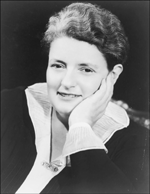
The year was 1934 and Mary McBride was working a gig at WOR in New York City. Her on air name was Martha Deane, and she was the host of a daily women's-advice show. Her angle was as a kind and witty grandmother figure with a Missouri-drawl. It aired into 1940. Simultaneously she worked at the syndicate Newspaper Enterprise Association as the women's page editor.


In 1937, she launched on the CBS radio network the first of a series of similar and successful shows, under her own name, as Mary Margaret McBride. She interviewed figures well known in the world of arts and entertainment, and politics. Topics discussed on her show included prostitution, unwed mothers, marriage in the modern world, and pioneering women. For women of that era it was an alternative to the afternoon radio soaps. It's success proved that women’s interests ranged beyond cleaning tips and recipes. She forged the very crucible from which Oprah and all the others proceeded.

A radical liberal for her time, she had African American guests as early as WWII.  This was so unusual at the time that the practice was called "breaking the color line."  Those high-profile guests included civil rights figures such as Zora Neale Hurston, and Grace Nail Johnson. In the fall of 1948, she and NBC attempted to lure her across the street to debut on television, but wasn't interested. 

She had a good deal at ABC, accepting advertising only for products she was prepared to endorse from her own experience, and turned down all tobacco or alcohol products. She eventually did cross the street to NBC in 1940 but still on the radio. Her NBC show in the 1940s had broad range of guests, from politicians to generals to movie stars. During the run of the program, she interviewed over 1200 people, including even then President Harry Truman. A little more than ten years later she branched out, picking up her own syndicated newspaper column for the Associated Press. She also wrote for such magazines as Cosmopolitan, The Saturday Evening Post, and Good Housekeeping. Amidst all this multitasking she even wrote two books for teen girls.

As radio hosts do, her popularity waned and she appeared in smaller radio media markets. At the end of her life she was still broadcasting three times a week from the living room of her home in upstate New York. She died April 7, 1976. Click here for an MP3.

In 1984 RKO General, Inc., donated the complete archives of WOR. The collection offers thousands of hours of programming but more importantly, the Mary Margaret McBride NBC Collection.http://www.coutant.org/mcbride.html

Wednesday, August 23, 2006

WOMEN OF RADIO WEEK pt3

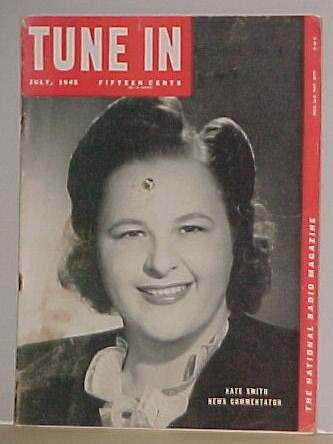
Kate Smith was born May 1, 1907, in Greenville, Virginia. It was a poduck town then as it is now. She went from there to being called “The First Lady of Radio. By the New York times. Just to get a hint of her massive appeal, remember during WWII, her on-air appeals for war bonds topped $600 million. [$7,984,257,195 in todays dollars.] Kanye west couldn't get that much even when he sang "George Bush don't like black people" in a Katrina victims fund raiser...

She began in vaudeville as many radio people did in that era. But unlike the others, she moved on to Broadway. It was there she got the attention of Columbia Records vice president Ted Collins who decided to put her on the radio. “The Songbird of the South” made her broadcast debut in 1931. http://katesmith.org/

During the 1930s, she became radio’s number one attraction, due not only to her evening show, but also to her appearances on Kate Smith Speaks, a popular weekday show where she offered homespun advice on current topics. It proved so popular that NBC gave her a prime-time show on Wednesday evenings, The Kate Smith Evening Hour.

In 1938, she introduced Irving Berlin’s “God Bless America” in the film This is the Army. It became so popular it was followed by another 2,000 recordings. among her biggest hits were River, Stay 'Way From My Door (1931), The Woodpecker Song (1940), The White Cliffs of Dover (1941), I Don't Want to Walk Without You (1942), There Goes That Song Again (1944), Seems Like Old Times (1946), and Now Is the Hour (1947). About 20 of those managed to sell a million copies EACH! She switched to LPs in the sixties and released five between 1963 and 1967.

Her popularity ran so deep, that even at the age of 65 while television was entering it's golden era she got her own show. Her last TV series was CBS's The Kate Smith Show, a weekly half-hour musical series in 1960. Her guest appearances put Oprah to shame. She made appearances on top TV shows, such as The Ed Sullivan Show, The Tennessee Ernie Ford Show, The Jack Paar Show, The Dean Martin Show, The Smothers Brothers Comedy Hour. Smith’s final radio program aired on the Mutual Network in 1958. She died in Raleigh, NC, June 17, 1986.

Friday, May 26, 2006

A History of Vinyl

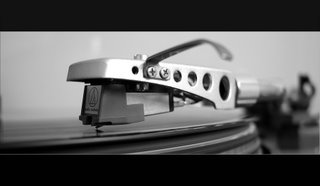
It was the year 1950 that improvements in the manufacture of Polyvinyl Chloride (also called PVC or vinyl finally spelled the death of Shellac records. Here.

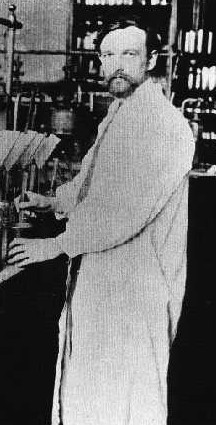
Vinyl was initially discovered by was discovered by French physicist Henri Victor Regnault, and it's first practical production process designed by Fritz Klatte (pictured) in 1912. He discovered that the reaction between acetylene and acetic acid could be catalyzed to produced vinyl chloride. This predated it's use in media by such a long period of time that his patent expired in 1925. One year later it was rediscovered by Waldo Semon, who recognized its potential and patented it for the second time. His employers at B.F Goodrich used it for insulation, raincoats, shower curtains and gaskets. More here.
After it's benefits were demonstrated, (durability, flexibility and longevity) it was adopted as the new material for record production. On June 26th 1948 in New York CBS called a press conference to announce the introduction of the LP or long player. 12 inches wide, turning at 33 1/3 and using the innovation of vinyl had resulted in a record that could hold up to 30 minutes of music per side! It was called "microgroove" technology.

RCA retaliated by bringing their own vinyl medium to the market, a 7-inch 45 rpm micro-groove vinyl single and compatible turn table.

By 1954 45 rpm singles were out on vinyl making available a higher fidelity single and then about 8 years later RCA debuted the stereo LP, an innovation that would have been impossible on shellac.