Showing posts with label shortwave radio. Show all posts

Monday, April 09, 2018

Radio Kurzwellen


I was reminded of Karlheinz Stockhausen's work Kurzwellen by a passage in the book Recombo DNA by Kevin C. Smith. The book is ostensibly about the band Devo, but delves so deeply into krautrock, and 1970s protopunk that it also serves as a fine treatise on all three topics. Smith walked himself backwards to Stockhausen from Holger Czukay, a founding member of the German band Can.
"In 1967 Czukay attemded a performance of his mentor's Kurzwellen, which consisted of five musicians playing shortwave radios as well as traditional instruments. Before inviting American expatriate singer Malcolm Mooney to join the band in 1968, Can incorporated random shortwave frequencies into their sets instead. "
The quote is out of context; Smith was writing about Can's exposure to electronic music. He saw the radio as a route to that destination. For our purposes, Can is using Radio as a musical instrument which is a rare thing indeed. [LINK] Excluding the theremin, I can only think of a few composers who also has done so: John Cage, Brian Eno, and more recently Robin Rimbaud and Marc Leclair aka Akufen. More here.

In this small pantheon, Cage experimented with radio first. His works Radio Music and Speech and from 1955 and 1956 respectively. His work Imaginary Landscape No. 4 was actually from 1951 and was composed for 12 radios. But his first radio-based composition was from 1942 "Credo in US" which was scored for a pianist, two percussionists and a fourth performer operating a radio and phonograph. [SOURCE]

Firstly, Kurzwellen is German for "Shortwaves." So the title is a reference to the instrumentation. The worked debuted on May 5th, 1968 in the television studios of Radio Bremen. Bremen only began broadcasting in 1945 during the post-war Allied occupation of Germany, originally on 6190kHz. The station was under American command. In 1949 it's management was handed over to ARD, (German Public Radio). It's appropriate then that Radio Bremen transmitted on 936kHz medium wave until March of 2010.

Kurzwellen is part of a series of works by Stockhausen dating from the 1960s that he called "process" compositions. It was a focus on form over content. In the sheet music he used plus, minus, and equal symbols instead of standard notation. The plus means higher or longer (in duration) or louder or more rhythmic segments; minus means lower or shorter or softer or fewer segments; the equal sign just means no change. So the instruction requires some interpretation. Unsurprisingly even the 1968 and 1969 recordings differ greatly. Today's avant garde enthusiasts still debate their relative merits. [LINK]

It is widely assumed that Stockhausen got the idea of using radios from Cage, though their implementations were different. All of their radio works were dependent on random, unrepeatable inputs from radios. By the 1960s Cage had moved on to different instrumentation entirely. Stockhausen stuck with it and his next three works also features shortwave radio: Spiral, Pole and Expo. His experiments were well-received and he was appointed Professor of Composition at the Hochschule für Musik Köln in 1971, where he taught until 1977. He died in 2007.

Monday, March 23, 2015

Bzzzzzzzzzzzzzzzzzzzzzzz

The shortwave radio bands certainly have their share of oddities. The station known as UVB-76 is one of my favorites. It's not a numbers station per se.. but it's still interesting. Even it's call sign is a non-sequitur. In September 2010, the station moved and has since used the identification MDZhB, meaning that perhaps the correct calls are UZB-76.  But these are not assigned call letters. UZB-76 was a abbreviates in cyrillic Moscow Military District and MDZhB is a callsign for Western Military District of the Russian Federation.  But geeks that are into these sort of topics seem to favor the original calls.

The station broadcasts in AM on 4625 kHz from inside the Russian Federation. It broadcasts a short, monotonous buzzing sound repeating at a rate of approximately 25 tones per minute 24 hours a day. This pattern is only interrupted by exceedingly rare voice transmission in Russian. There is endless speculation online about it's origin and purpose. More here, here and here.

Many sources claim the original transmission site was in Povarovo, near Moscow. In 2010 following a reorganization of the Russian military, it's district was expanded into the Western Military District instead of just the Moscow area. To "serve" this larger region, it uses two transmission sites, one in Kerro, near St.Petersburg and another in Naro-Fominsk, near Moscow. Supposedly the Buzzer source is fed to the shortwave site by phone relay.

 The first reports were made of a station on this frequency in 1982. What I find most interesting is that thanks to the Coronet project we knwo that not only has it changes calls, but it has also changed the nature of it's buzz tone. Currently it broadcasts a cycle of 1.25 seconds buzzing, then 1.85 seconds of silence.  But prior to November of 2010 its buzz tone lasted slightly, and the gaps slightly shorter. It's also been stated that in the past, it used to change to a continuous buzz one minute before the hour. You can hear samples here.

Notably, there are two other Russian stations with similar "formats." One is nicknamed "The Pip" and the other is "The Squeaky Wheel". Like the Buzzer, they both transmit noises in a tight pattern and on rare occasion interrupted that pattern to broadcast coded Russian voice message. 

Wednesday, December 10, 2014

Ferrell's Confidential Frequency List

The Confidential Frequency List was first compiled then Oliver Perry Ferrell and, later, by Geoff Halligey, then finally Kevin Nice. Ferrell is rumored to have died in a car crash on I-95 in Connecticut before 1997. Robert B. Grove compiled a Confidential Frequency List for Gilfer Associates first in 1972 and at least through 1976, which went into multiple editions. It is unclear how so it may be connected to the Ferrell series. It is possible the series actually began with Grove.back to that in a second.

Gilfer Associates in Park Ridge, NJ published the books until Ferrell's death prior to 1997.  It's also worth noting that via Gilfer Ferrell also published other books, Guide to RTTY frequencies, collection of Radioteletype Frequencies. Ferrell was also the CEO of Gilfer associates. It seems impossible that he'd deliberately launch one series of Confidential Frequency lists then another co-branded with his surname. I assume for that reason that Grove edited the first two editions, then Ferrell took over and eventually put his name on the tin.

The book featured a very short introduction and a bit of information on the mechanics of shortwave radio and gear. The rest of the book for hundreds of pages was just a frequency directory by frequency, focused on HF activity between about 4 KHz and 28 KHz. More here. Below is a list of what I believe to be the correct years for the various editions and authors.
  • First Edition -1972 - Gilfer Associates by Robert B. Grove
  • Second Edition - 1976 - Gilfer Associates by Robert B. Grove
  • Third Edition - 1979 - Gilfer Associates by Oliver P. Ferrell
  • Fourth Edition - 1980 - Gilfer Associates by Oliver P. Ferrell
  • Fifth Edition - 1982 - Gilfer Associates by Oliver P. Ferrell
  • Sixth Edition - 1986 - Gilfer Associates by Oliver P. Ferrell
  • Seventh Edition -1988 - Gilfer Associates by Oliver P. Ferrell
  • Eighth Edition - 1992 - Gilfer Associates by Oliver P. Ferrell
  • Ninth Edition - 1994 - Gilfer Associates by Oliver P. Ferrell
  • Tenth Edition - 1997 - PW Publishing by Geoff Halligey
  • Eleventh Edition - 1999 - PW Publishing by Geoff Halligey
  • Twelfth  Edition - 2001 - PW Publishing by Kevin Nice
  • Thirteenth Edition - 2003 - PW Publishing by Kevin Nice


In the UK, Bill Laver printed at least eight editions of his own Short Wave Listener's Confidential Frequency List. This complimented his other directories of Marine, VHF/UHF, and RTTY frequencies. Laver threw in the towel in 1994. By all reports the Ferrell's own series ended in 2003. There is no comparable modern publication, even the Klingenfuss Guide to Utility Stations has been out of print for a few years. [SOURCE] In some ways this has been supplemented by lists and boards online, but the lack of a canonical source limits their utility. The Farrell's books remain interesting historically, and some of these old stations still operate. Copies of most editions can get picked up used on eBay for just a couple bucks.


Friday, October 31, 2014

Bolling Advanced Base Radio

You can't grow up to be an explorer anymore. Our species, long obsessed with exploration for the purposes of fun and commerce has managed to visit every hilltop, island, valley, crevasse, and mud hole on the entire planet. Admiral Richard E. Byrd was probably the last of the explorers. But he was unique. He was fixated on being the first person to visit very cold places... ostensibly to check the wind speed. In 1919 he flew over the arctic for the navy, in 1925 he flew over the Greenland icecap, in 1926 the north pole, in 1928 the south pole, and was back in the Antarctic in 1933 again. We all know he was a pilot, but in that era, pilots had to be quite skilled with their radios.

In 1933 He traveled to the Antarctic and he decided to winter there inland from a base called Bolling Advanced Base. This was a difficult journey from the somewhat more robust base on the Ross Ice Shelf "Little America."  He was to do "Meteorological and Auroral work." to quote his 1937 book Alone. Originally he had planned that this base would be staffed by three men: two weather observers and a radio operator. But later supply issues meant that only one person could man the inland base. Byrd stayed there alone, in a "base" that was little more than a tunnel under the snow. His chief radio engineer John Dyer had to quickly teach him how to make repairs, and the basic operation of the radio set. His troubles foretold future problems  
"Whenever I I looked at the complications of tubes, switches, and coils, my heart misgave me. I scarcely knew the Morse code. Fortunately Little America could talk to me by radio telephone. So I wasn't obliged to decipher hot outpourings of dots and dashes from skillful operators. but reply I must in dots and dashes, and that I doubted I could do."
Little America used the call sign KFZ and the inland base used the call sign KFY. He was sometimes an hour late because his antenna was blown down. Little America broadcast a "special program" to the Chicago World's Fair and Byrd added his own greeting in Morse Code "Antarctic Greetings." But weeks later the exhaust of the generator powering the radio clogged with ice and the back pressure nearly killed him with carbon monoxide. Little America continued to make weekly broadcasts to the United States which were received by CBS.  This was critical as they were sponsored by General Mills who was using then as part of a radio advertising campaign. They even had a CBS radio Correspondent on staff at Little America, Charles Murphy. Earlier trips required communication strictly in Morse code. But by 1933 they could broadcast voice and even music with a Collins shortwave radio.


Byrd continued to survive at the inland base despite the wee problem with carbon monoxide poisoning until the generator broke down. He had an emergency hand-powered radio set. but they were intended to be worked by two men. one to crank... one to key and transmit. He described it as harder than rubbing your gut while patting the top of your head.  Later even that set failed him because of a simple loose connection to the antenna lead. In the end, he survived because his erratic broadcasts alerted the men at Little America. They rescued him and he recovered enough to later serve in WWII and to try three more Antarctic expeditions. 

Monday, August 04, 2014

ARPSC

The term "ham radio" was originally an insult, like ham-fisted. Around two million people worldwide are "hams" with 700,000 of those being in the U.S.  Technically, all early radio experimenters were in fact amateurs. What makes today's amateurs into Hams was WWI. Their radio broadcasting was suspended in 1917, and restored in 1919. This process was re-played in WWI. But in some ways it was that cessation and rebooting that codified what was ham and what was commercial by separating the services into casts.

In other ways it was its limited wartime use that let to it's modern function in emergency services. The first edition of the ARRL's (American Radio Relay League) Emergency Communications manual came out in 1940. But this was preceded slightly and less formally by a 1938 article in QST  titled 'When emergency Strikes." These ideas coalesced into formal policy and eventually a body of law. Hence the start of the ARPSC (Amateur Radio Public Service Corps). Their function is as follows:
"[To] maintain and continue to train and educate Amateur radio personnel interested in the advancement of communications and safety of citizenry in whatever systems may be available and in use within the Local, State and Federal Structure of ARES (Amateur Radio Emergency Service) and RACES (Radio Amateur Civil Emergency Services."
But what are they. the 1969 ARRL book describes them as a voluntary organization of licensed amateur radio operators sponsored by the ARRL.  Back then RACES was specifically for "civil defense communications." Some early documents give a dotted line to the Red Cross with reference to a memorandum. But modern versions of that document omit the ARPSC. It appears that in the early 1980s the ARRL quietly subsumed the ARPSC into ARES services. But the nomenclature lived on. There was already 5 decades of inertia behind that acronym.

There are a number of ARPSC groups still left across the country.Most have updated their paperwork to describe a continued connection to ARES, GEMO (Governmental Emergency Management Organization)  EMHSD (Emergency Management and Homeland Security Division) and any other vaguely federal sounding acronyms. they are still all volunteer amateur radio operator organizations committed to providing supplemental emergency communications as they always have.

Thursday, April 01, 2010

QSL Finland

For your browsing enjoyment: A set of QSL cards from Finland. This batch stretches from 1976 to 1981. Most of these appear to still be active today.


Tuesday, November 03, 2009

Tangier Island CQ

In 1954 the tiny Island of Tangier found themselves without a doctor. After 37 years their resident doc had retired. A Japanese Doctor, Mr. Kato was moved by the islands plight and moved there to serve for 4 years. So in 1958, the island was without a resident physician once again. This time they took extra measures. I'll quote directly from the account of William A. Warner in the book "Beautiful Swimmers, Watermen, Crabs and the Chesapeake Bay."
"This time the islanders decided to take a more dramatic approach. They invited a boatload of amateur radio operators from Richmond to come to the island and broadcast a continuous "CQ" or call to anyone listening... These actions led to the culminating event a well known television commentator took up the cause and invited a delegation of islanders to plead their case on a national TV network."
The New York times reported it as "The electronic and Elizabethan eras converged here this weekend as this tight little island broadcast a shortwave appeal around the world for a doctor." Alas it failed. After a med student racks up a quarter million dollars in student loans, it's hard to lure them to a small rural island in the Chesapeake.

View Larger Map

Monday, November 02, 2009

Short-wave Radio Listening REDUX

This is a revisit to a post from October 19th.
It took me a week but I scanned the whole thing, all 96 pages.

You can get all 42 MB if you
DOWNLOAD HERE

Monday, October 19, 2009

The Fun of Short-wave Radio Listening

It was just a dollar in 1965. "The Fun of Short-wave Radio Listening" was written by Len Buckwalter and published by Editors and Engineers, Ltd. Despite it's 40-year vintage, it's content woudl hardly need updated for modern use. The cat's whisker was long gone and solid-state hardware was extant if only brand new.At least this part of the Skillfact™ Editors and Engineers, Ltd published a number of cheap hobbyist engineering books aimed at the amateur gearhead. The earliest of which "The Radio Handbook" I find published in 1947. I find works by Edward M. Nole, Louis Dezettel, Frederick Bricker, Donald Herrington, Jack Darr, and many others. Not that they were limited exclusively to radio and electronics, they also had works about astronomy and even concrete pouring. Buckwalter also wrote " ABCs of Citizen's Band Radio" and "The Wonderful World of CB Radio" Their catalog seems to end abruptly in 1984.

Unexpectedly I see their pamphlets cited as sources in text books. Uniquely of that group I see frequent contributions from Dezettel. He wrote frequently fro Editors and Engineers, but also for Audels and even Radio Shack. Interestingly this Skillfact™ book ends with a list of shortwave stations circa 1965, many of these of course no longer exist.

Monday, November 12, 2007

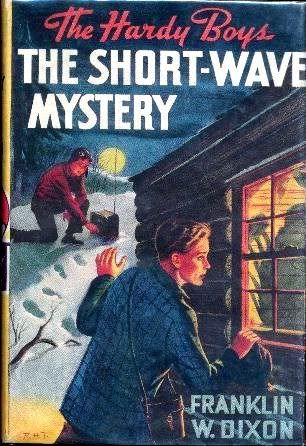
BOOK WEEK Pt. 1: The Hardy Boys

...Yes, a whole week dedicated to the use of radio in juvenile literature. It's a new peak in the obscurity of Arcane Radio Trivia.

The Hardy Boys Mysteries first appeared in 1927 at the veritable dawn of the golden age of radio. They like many other forms of print media eagerly incorporated themselves into the ephemera of radio. The plot outline is the same every time. The perpetual teenagers, Hardy brothers Frank and Joe discover and solve a mystery that even the police cant solve. Today new stories are still being produced almost a century later.

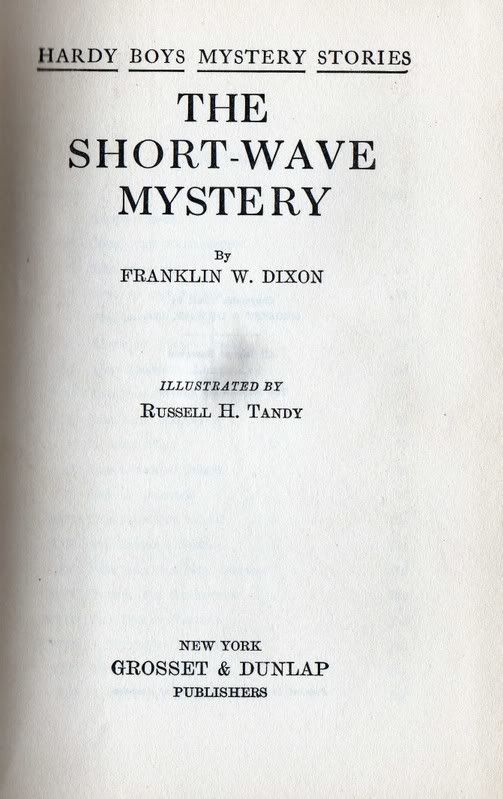
While Frank Dixon is credited on almost all Hardy Boys books, he too is a fictional character. It's a pseudonym. There is no Frank W. Dixon, and several people wrote under the name. In the case of this particular radio-centric book Leslie McFarlane was the author.

Mr. McFarlane a native Canadian was probably the best-known of the Dixon ghost writers and is attributed with authorship for the bulk of the Hardy Boys catalog. He wrote a total of 21 of the Hardy Boys books. But he also wrote over a dozen more manuscripts for the Stratemeyer Syndicate's Hardy Boys-clones including Dave Fearless and Dana girls. Later in life he became a respected screen writer.

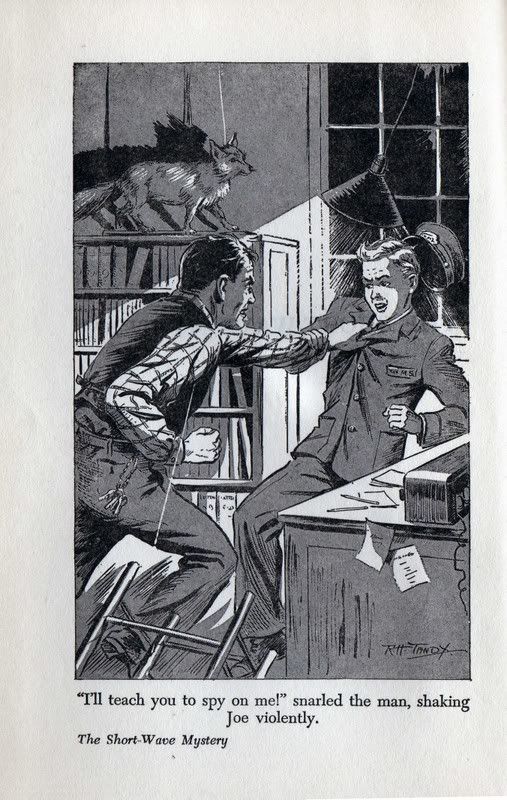
In this Hardy Boys The Shortwave Radio Mystery brothers Frank and Joe and their friend Chet have Amateur Radio calls VN16J and VY84Y. The story involves the theft of radio parts and how they are craftily hidden inside taxidermied animals.

I was surprised to find that another radio man, Richard McVicar already reviewed the book for us. He had also noticed that their description a radio wave is painfully wrong.
"Think of lightning. You know how jagged that is sometimes." "You mean it's not a straight line? It goes up and down and has lots of points to it?" asked Jimmy.
"That's right. Well, radio waves are like that, only you can't see them," said Frank.

"The more points they have and the narrower the line is, the farther the waves can travel."

Richard McVicar also points out something I'd never have known otherwise. Later revisions of the book rewrite that and other passages. They replace the completely inaccurate lightning analogy with a more technically accurate piano analogy. They also update the call letters to match contemporary nomenclature. VN16J and VY84Y are replaced by N2XEJ and N2XOB.

Apparently this was all changed in a 1966 edition. Interestingly enough the modern calls are are available according to this. But here an issue of the Radio Hill Gazette informs me that other versions of the book also use the WB2XEJ call sign.

Upon further examination I notice other significant changes. Chapter names are changed, passages excised and others added. The books modern pressing opens with the dots and dashes of Morse code. The theft of radio parts is changed to the theft of stuffed animals, and the radio element in reincorporated as the embedding of "bugs" hidden inside the animals.

The 1945 version opens on chapter I with the following text:

"Try him again, Frank! He ought to answer any minute." "It's eleven o'clock. he's probably in bed asleep." "Try him once more." "All right, but I'll bet we don't get him. Chet Morton wouldn't stay up this late. You know how he likes to sleep." Frank hardy re-tuned the short-wave transmitter. His brother Joe crouched beside the receiver, listening. Weird hums, squeals and screeches echoed through the attic. For more than half an hour the boys had been trying to contact their chum, Chet Morton. It had been Chet's idea that the Hardys fix up their old shortwave sets, and he assured them that his own would be in operation that night.
"VN16J calling VY84Y. . . calling
VY84Y . . . VN16J calling VY84Y," droned Frank.

The 1945 version opens on chapter I with the following text:
DIDAHDIT . . . dahdahditdit . . . didididahdah . . . daidahdit. . . Frank Hardy's fingers deftly pounded out the CW-key sign- off: "R" 73 C U AGN AR WB2EKA DE
WB2EKA SK." Then the dark-haired eighteen-year old ham operator jotted an entry into a black logbook. "Coming in clear tonight Joe." "Sure is, let's see what else we can pick up." Joe hardy, blond and a year younger, flicked the phone switch and played the transceiver dial along the 2-meter band. The Hardy brothers, both licensed radio amateurs, were enjoying an hour of short-wave hamming in their newly equipped attic "shack". Static and bits of conversation crackled over the speaker. Suddenly a weird garble of nonsensical voice-like sounds broke in.

To the credit of the revision, the jargon is much improved. But to it's detriment the books barely resemble each other. the net effect being that it's hard to consider it a revision.

Wednesday, August 01, 2007

Number Stations

If you listen to Shortwave you're already familiar with number stations. For the uninitiated, these are shortwave radio stations of unknown origin lacking Calls or ID that broadcast just sequences of numbers. The number are read clearly and occur in many languages. Voices can be male female or even computer generated.

Reports of Number Staitons date back to World War I and continue to this day. It is suspected that the broadcasts are coded messages used for communication with spies. Though no nation cops to this, I know of at least one trial where come cubans were prosecuted for espionage in relation to a numbers shortwave broadcast.


While the sequences are usually all numeric they can include words, or letters. They are sometimes apparently random, and other times organised. In the 90’s, amateur radio enthusiasts tracked the source of one number station to a US military base. The FCC refused to comment, duh.

The Conet Project: Recordings of Shortwave Numbers Stations is a four-CD set of recordings of numbers stations, mysterious shortwave radio stations of uncertain origin believed to be operated by government agencies to communicate with spies "in the field". The collection was released by England's Irdial-Discs record label in 1997, based on the work of number station enthusiast Akin Fernandez. You can download it all free here: http://irdial.hyperreal.org/

Friday, May 04, 2007

Shortwave Music

No post today, instead I refer you to the posts of another radio man.

Music on Shortwave radio is not a hi-fidelity stereo experience. Its mono, it's noisy, it's marginaly listenable actually. yes some stations perservere, perhaps obstinately in their regular programming. It's often from thousands of miles away, and almost exclusively DX.

Myke Weiskopf records, collates, contextualizes and posts semi-regulay about it here:
http://shortwavemusic.blogspot.com/

He's got clips from VOIRI, Radio Kuwait, FEBA Radio, HCJB, Radio Cairo, VOA, All India, KJES, NHK, and many more. Of particular interest is his taste for the way that Shortwave decimates, rearranges and alters the sound of even recognizable songs. He has a version of CCRs Suzie Q that sounds like it passed through a broken Moog, but really it just bounced off the atmosphere...

Sunday, April 23, 2006

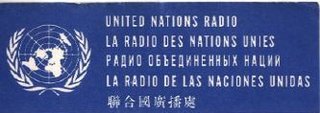
United Nations Radio

Yes, Even the United Nations have radio stations. Seems counter intuitive since they are not a nation of any kind. So where did they put it?

The United Nations Radio programs are carried on short-wave, distributed by satellite and broadcast by national and regional radio networks in most parts of the world. Information about United Nations Radio, the short-wave broadcast schedule and about partner radio stations in different regions and other production languages can be obtained from the Audio-Visual Promotion and Distribution Unit (AVPDU): fax (212)-963-6869, telephone (212)-963-1807.

In 1946, the United Nations was mandated to disseminate information on radio broadcasts. Since then the United Nations has been continually produced radio programmes. At this time they produce 29 weekly and monthly radio programs in 15 languages. these are broadcast in 180 countries and territories.

These programs vary in length and style and cover a wide range of issues. Some are traditional News casts others are more like documentaries. These radio programmes are available in cassette and are accompanied by a script or blurb to radio broadcasters only.

For the life of me I cant find a list of the damn stations anywhere just jpegs of hard to read QSL cards. If I get something specific, I'll update this post.