Showing posts with label WOR. Show all posts

Monday, June 01, 2026

The Midnight Jamboree WEVD (part 2)

Gene King, left. very camera shy.


In 2012 I wrote an article about the Midnight Jamboree which debuted on 1300 WEVD-AM in 1936. I did not expect I would need to write a Part 2 at the time. I used the sources I had available at the time and it felt fairly complete. A recent comment from a reader [HERE] pointed out that personal letters between Ev Suffens (stage name for Raymond Nelson) and writer Ayn Rand, describe Suffens as the host of Midnight Jamboree. The problem is that multiple sources also name Gene King as the host. Someone on the internet was wrong, and it might be me; so I revisited the subject.

Back in 2012 I rarely cited sources. It seemed unnecessary with informal writing like a blog.  It was my readers questions (and even researchers questions) which drove me to cite sources initially for my own use. I think my original source was the Arnold Passman book The DeeJays. [SOURCE] It does not specifically say that King is the host but Passman refers to the program as Gene King's; full apostrophe S. In 1942 the Ohio state University Monthly [SOURCE] specifically stated:

"...[King] started announcing for WEVD, became after a time, chief announcer and conducted the tremendously popular "Midnight Jamboree," New York's all-night recorded music program, to which an estimated 300,000 turned for nocturnal entertainment."

The Chief Announcer claim is corroborated in the 1939 Radio Annual. [SOURCE] The book Music in the Air also lists him as the host. "New York contemporaries of Symphony Sid included Gene King, whose Midnight Jamboree on WEVD (Eugene V. Debs) featured
current bands and vocalists...
" [SOURCE]

Gene King, probably U. Ohio grad pic

The earliest I can place King by citation, at WEVD, was August of 1937. He's named, alongside Bill Resnick as station staff in an issue of Billboard. [SOURCE] This aligns pretty well with the date from that Ohio State publication stating that he was in Spain "..when the Franco revolt broke out..." that would be July 1936. That's a good source but I had more.  The UC Law Journal of Race and Economics [SOURCE] mentioned King at WEVD in a foot note referencing a New York Daily News article in November of 1939. Maybe the most important citation I found is Broadcasting Vol. 19, No. 8 of October 1940 [SOURCE] which specifically states:

"Gene King has resigned as conductor of the daily program Jamboree on WEVD, New York, from midnight to 4 a.m. to preside over a daily record series on WOR, Newark, entitled Danceland, which started Oct. 14, 3-3:30 p.m"

 
So it's clear that Gene King was the host of the Midnight Jamboree for a period of time, starting in 1936 and ending in 1940. But we also know the program ran into 1942, so clearly King was not the only host. Was he the first? 

The first Ayn Rand letter to Ev Suffens is dated April 6th. [SOURCE] Notably this is before King returned from Europe. Dismuke.org cites this as well. [SOURCE] But the answer is back in those Ayn Rand letters. In her June 10th letter [SOURCE] she complains about the new announcer of the Midnight Jamboree. She does not name him, but does criticize his playing of Jazz. (Gasp!)  So Ed Suffens was only the host prior to June of 1936. How much earlier did the program begin?

The Daily Worker reported the radio schedule of WEVD, WEAF, WOR, WABC, and WJZ daily from 1924 through 1936. So in reviewing those schedules, we can say with confidence that February 20th, 1936 was the first episode of the Midnight Jamboree. [SOURCE] Prior to that time, the midnight slot was held by a dance program, and usually preceded by an opera program. Ev Suffens was only host from February to June of 1936, a period of about 6 months. 

The DJ name Ev Suffens only appears rarely outside in the letter of Ayn Rand. The name appears in Variety in October of 1933 as the former director of the Provincetown Playhouse, then launching a drama and Opera studio. [SOURCE]. Then in the 1938 Radio Annual he's listed as the chief announcer at WEVD. [SOURCE] He seems to stop using the name after that. But a Raymond E. Nelson starts directing TV programs in the early 1940s and that may be him. That Ray Nelson later became the VP of the NTA film network. 

But who then was hosting the Midnight Jamboree after King left in 1940? There is a little disambiguation. There was a Gene King at KCTO in Columbia, LA in the late 1960s and another at WPCH in 1932. [SOURCE] Neither of these is our Gene King. King went on to WOR, and then WCOP as reported in Part 1. After King left the program, it's profile declined significantly. You might think it ended but for two references... 

One of the last references to the Midnight Jamboree was in a September 1942 issue of Broadcasting Magazine. [SOURCE] It does not name the host. It's also mentioned in Radio Daily. [SOURCE] They both probably got the same press release for Carl Post's piano gig on the show. But a 1941 issue of Billboard lists the host as David Niles.

 "Those stayer-uppers who tune into Station WEVD here for the nightly dance music kicks offered by the titularly swing-tinted Midnight Jamboree must think they have the wrong wave-length, unless they're used to the clever introduction given the show by its conductor, David Niles, who is also the station's chief announcer."

I had thought that was the end of it but a 1958 issue of Downbeat lists the show still on air. [SOURCE] The formerly 4-hour weeknight program had become just a 3-hour Sunday special. In1947, Ernest Tubb's Midnite Jamboree on WSM had overshadowed it, absconding with the name. David Niles obituary in the New York times [SOURCE] states that he started his career on WMCA in 1933 after a career in the stage and silent movies. He was the chief announcer at WEVD for 37 years. Sources confirm his presence at the station well into the 1960s. Billboard describes him as the News Director in 1966. [SOURCE]

You can hear Niles voice on a transcription disc from 1948. [LINK] Billboard confirms Niles was the Jamboree host, as early as 1940. [SOURCE]  Note that it's absent from this radio schedule [LINK] which otherwise places Niles on a talk program.  I suspect he took the Jamboree over from King directly. But there could have been a gap, and the earliest reference I can cite is this very critical July 1941 quote in Variety. [SOURCE]

"Manhattan has five stations on the air 'till 4 a.m., WHOM, WHN, WEVD, WNEW and WOR. After four o'clock just WNEW and WOR fight it out; WHN quits at three. But it plays the loudest records, positively. If a disk is just wild that's not enough for WHN, it's got to be frantic... Sunday nights David Niles (WEVD) has New York to himself from three to four. And what does he do with it? Nothing. Davey ought to change that maudlin paragraph Introducing his final 15-minutes in which he 'rests, relaxes, and reminisces.' Hear it twice and it starts to take on a comedy angle, But Davey must like it because he serves it regularly at 3:45."

It seem like Suffens started the Midnight Jamboree, and Gene King built it into a popular jazz-inflected program. Then Niles went back to a very mellow classical playlist. Rand would have been pleased but apparently popular listeners were not.

Monday, October 13, 2025

Matinee with Bob and Ray


Somehow I missed the memo on Bob and Ray. They were on the air for 50 years and I completely missed the boat, discovering them only post-mortem, in the form of a beat up paperback with an introduction by Andy Rooney. Bob and Ray were Bob Elliott (1923–2016) and Ray Goulding (1922–1990). My own mother often said "Write if you get work!" as people left the house. It took me decades to realize she was quoting Bob & Ray.

Elliott and Goulding began as radio announcers. Elliott and Goulding were both on 850 WHDH-AM in Boston. Elliot was an announcer and Goulding a DJ with a morning show. (Some biographies switch the roles and describe Elliot as a DJ and Goulding as a newscaster.) The book Bob and Ray: Keener Than Most Persons by David Pollack gives another version where Elliot presented a demo for Back Bay Matinee he based on an AFRS program. The Music Director Ken Wilson put him on air every afternoon from 2:00 to 4:00. Then Wilson paired him with Goulding to improvise banter as a fill-in when Red Sox baseball broadcasts rained out. Elliott and Goulding (not yet known as Bob and Ray) would improvise and joke around with the studio musicians. It was a comedy recipe you see to this day on late night programs; from Johnny Carson through Jimmy Kimmel. The duo started writing skits to make it work.

Their shtick was a slight twist on the old vaudeville routine. It wasn't a matter of which one was the Straight man. They were both the straight man; something Elliott conceded to Mike Sacks, for the book Poking a Dead Frog: Conversations With Today’s Top Comedy Writers.  “We were both sort of straight men reacting against the other.” Every punchline is silly but completely deadpan, prefiguring Stephen Wright but without the irony. Their trademark sign-off was "This is Ray Goulding reminding you to write if you get work"; "Bob Elliott reminding you to hang by your thumbs." 

After a few months WHDH gave them a morning show simply called Bob & Ray in 1946.  The program started as a 15-minute slot and then expanded to half an hour. The show continued to expand. In the fall of 1947, the pair were given a daily half hour at 1:00 PM called Matinee with Bob and Ray. In 1949 WHDH increased power from 5,000 watts to 50,000 watts and wildly expanded it's coverage and the audience for the duo. After 5 years in Boston, they got a 13-week contract with NBC and started a one hour Saturday Night program in 1951. By 1952 they also had an early morning show on WNBC as well. More here.

In 1955 they signed a new contract with WBZ: Matinee with Bob and Ray but by April of  1956 they terminated their taped WBZ program because they were so busy with their network schedule. Alan Dary got the spot. Bob & ray continued to do daily shows for the Mutual network from 1955 to 1957, then CBS from 1959 to 1960, and on New York station WINS. In 1962 they moved to WHN to start an afternoon show and in 1973 WOR doing a 4-hour afternoon drive program.  In their final incarnation they started a program on NPR: The Bob & Ray Public Radio Show. That ran until 1987. They won three Peabody Awards for their radio work and were inducted into the National Association of Broadcasters Hall of Fame in 1984 and the National Radio Hall of Fame in 1995.


Goulding died in 1990. Born in 1922 he was 68. Many assumed the 67 year old Elliot might retire but instead he became a cast member of Garrison Keillor’s American Radio Company of the Air,  which briefly replaced A Prairie Home Companion on NPR.  Then he started making appearances in movies, and commercials something deeply ironic for a man who had made so many fake advertisements. Ellior once said "By the time we discovered we were introverts, it was too late to do anything about it.”

Monday, March 17, 2025

Lake Fred Radio


The popularity of the name Fred has been in decline since 1888. Despite titular Fred's like Fred Flintstone, Fred from Scooby Doo, Fred Durst, Fred Savage, DJ Fred Allen, Fred Schneider, Fred Armisen, Fred Astaire and the Honorable Fred Hampton there are just fewer Freds than there used to be. The Fred thing really got me interested so we're going to have to talk about Fred before we walk about WLFR.

Lake Fred is not technical a lake, but actually a series of interconnected, artificial ponds in New Jersey. It was created somewhere between 1860 and 1880 in the peak Fred years for cranberry farming. [LINK] Dammed for use by a sawmill around 1900.  at the time it was simply called "Saw Mill pond. When Stockton university took over the property in 1971, they initially referred to the property as Lake Stockton but by 1972, through machinations still not fully understood today... it had become Lake Fred. By 1985 there were already inquiries on the origin of the name. More here

Like any good mythology, every origin story contains some conjecture. There are stories of the name originating with people named Fred: local residents, neighbors, students, and professors. But my favorite is about the famous DJ, Jean Shepard. Jean Shepherd, used the then common slang “Fred” as a generic name for someone who was a goof or a slacker. The term was popular enough in the moment to appear in the The Dictionary of American Slang 1998 edition and a possibly related entry in the New Hackers Dictionary 3rd edition of 1996.

But in the 1950s and 60s Shepard was pretty famous for his radio show on New York City’s WOR. In the evening he told strange, long-winded by funny tales. He used a lot of hipster slang and in his stories, there was always a Fred. Fred was his John Smith. So the lake was named for Jean Shepard's Fred.  Fred lake was really just a disused cranberry bog i.e. not really a lake.  In Shepherd’s usage Fred was a fraud or a fake. So there you have it: Fake Lake.  


So in 1984 when WLFR first signed on, they used the call letters stand WLFR for Lake Fred Radio. But WLFR wasn't the first campus station at Stockton. The roots of the station start in a small cabin on the shore of Lake Fred in 1974 with a Radio Club. The station was called WSSR - Stockton State Radio. This was a low budget carrier current radio station which had 2 QRK turntables, 2 cart machines, a Revox 77 reel-to-reel and a 4-channel RCA mixing board. Some of that gear was built by student Paul Glaser. Glaser once said that it "really just played a lot of Grateful Dead music." One of the early General managers, Olen Soifer, formerly of WMCJ (now WMCX) at Monmouth also mentioned the Grateful Dead which certainly paints a picture.


Early records for WSSR are few. The Federal Register records a request for $41,524 by Stockton state college in March of 1984 to extend the signal of WSSR. This had to have been filed before WLFR was granted call letters indicating that WSSR was still at least nominally active. A February 1980 issue [SOURCE] of the Argo describes a "newly organized" WSSR. The station was at least 5 years old at that time. So perhaps they only meant that the station was decidedly disorganized before 1980? But it also refers to an existing radio station in the library. Regardless, GM Jeff Louis seemed to have big plans. The 1976 IBS radio annual lists the station with no metadata. A simple entry: "WSSR, Richard Stockton State College" But in November of 1983 Michelle Mclelland managed to submit a chart to CMJ. For once the Grateful Dead were not in heavy rotation. But the inclusion of both Leo Kottke and Spandau Ballet speak to their tradition of free form radio. [SOURCE].


Purportedly it was the mischievous Professor Claude Epstein who completed a hydrological survey of the area, and on his maps in 1972, he labeled that bog "Lake Fred." Epstein equivocated when asked about the etymology decades later, but he also named a tributary stream Cedick Run (“see Dick run”)  inspired by the Dick and Jane readers of the 1930s thru the 1960s. Epstein definitely had a particular sense of humor.

In one interview, Epstein told a story about Jean Shepherd, It was after Shepherd had been fired from WOR, when he was hosting a TV show in the 1970s on the New Jersey Network, Shepherd’s Pie. In 1977 Shepherd encouraged viewers to send in common items for a the “People’s Bicentennial Time Capsule,” and Stockton students sent in a t-shirt from one of the early and popular Lake Fred Folk Festivals. On the next episode Shepherd held up the t-shirt and exclaimed, “It figures there would be someplace named Lake Fred in New Jersey.”  The name had stuck.  Epstein's memory may be off. Jean Shepard did a Time Capsule event in 1977; but it was while he was still on WOR. There's even a recording. [SOURCE]  The Lake Fred Folk Fair started as early as 1974 so the timeline still works. [SOURCE].

WLFR celebrated it's 35th anniversary in 2019, The Atlantic City Press covered the event, but not their 40th anniversary in 2024. [SOURCE]  The campus publication, The Argo did of course. [SOURCE]. The station remains devoted to it's free form format. As I listen to WLFR now, the DJ is playing the Kinks "Sunny Afternoon" on a chilly but in fact sunny day.

Monday, December 16, 2024

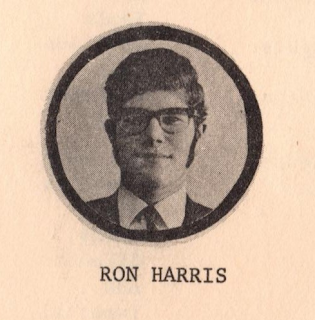
Ron Harris - Interview (Part 1)

Ron Harris is not a household name but when you read a lot of radio history sometimes you run across the same name multiple times. It makes sense that you'd see famous names repeatedly. It makes a lot less sense when they are not famous names.  It gets downright mysterious sometimes. 

I've come to believe that some people were almost famous, maybe even meant to be famous. These people had some kind of inertia that the rest of us lack and they veered off of that trajectory at the last second, perhaps for reasons only they understand.  After the sixth or seventh time I saw his name  I tracked down Mr. Harris and he was very giving of his time to answer my questions ...even the ones I didn't know to ask. What followed where tales of creatively liberated equipment, FCC violations, rock stars, Russian profanity, and an unexpected intersection with Rush Limbaugh... 

He had so many stories I'm just going to go ahead and call this "Part 1." I know I'll be back for more questions and answers.

JF - WCPR was the student-run radio station at Stevens Institute of Technology, in Hoboken, NJ. How did you end up becoming the music director?

RH: Well, I started my freshman year at Stevens on Sept. 14, 1969. WCPR was looking for DJs, and I became active both as a DJ and doing some production there. When the Music Director position opened up I volunteered for it.

JF: WCPR was a carrier current station at that time. 

RH: WCPR broadcast via carrier current on 740 kHz for much of its existence. Carrier current transmitters worked by coupling into each building's power lines, which served as weak antennas. Evidently not weak enough, because it turned out that the 740 kHz transmitter in one dorm could cause interference, or beat's against another one in a nearby dorm. So WCPR decided to change some to 750 kHz. In those days there were very few (if any) AM radios that could show the exact tuning like today's digital ones, so the frequency difference was pretty much transparent to the dorm listeners. Just for fun, we started calling it "The Sporty 7-40 and the Nifty 7-50" and the slogan stuck
 

JF: Is there any truth to the story about WCPR increasing it's range using the SS Stevens, the ship the college bought to use as a floating dormitory?

RH:That was a year or two before I got there. The ship had been built in 1944 as a military attack transport, the USS Dauphin. After World War II it was sold and converted into a cruise ship, the SS Exochorda. Stevens bought it in 1967 to use as a floating dormitory and renamed it the SS Stevens. The WCPR engineers installed a carrier current transmitter aboard the ship (the metal hull basically blocked all the commercial radio stations, making our signal the only one that could be picked up in the cabins). 

It turned out the AC power circuit they used fed the dorm cabins, and also the string of lights that spanned the length of the ship, on typically tall masts. Evidently that string of lights acted as a terrific antenna, and the station could be heard all over the eastern seaboard and beyond. Whether that was deliberate or accidental is not known (I mean, we were a science and engineering school!). Things were great until the Dean of Students received a letter from the FCC informing him that it was a very illegal situation! That was the end of our semi-national broadcasting experience!

A few years later, they installed a low power FM transmitter on top of the Stevens Library, pretty much in the center of the campus dorms. I don't know the story about why it was taken down, but I suspect the same government agency might have become involved.

JFK There was also a WCPR pirate radio station in Brooklyn in 1976. Was the WCPR staff involved with that at all?

I think I heard something about it, but it had no connection with us. Stevens Tech was on what's known as Castle Point in Hoboken, NJ, hence Castle Point Radio. It's literally a stones throw from the Hudson River, across from West 4th St. in Manhattan. The original call letters were WSRN ("Stevens Radio Network"), but they were changed in the 1960s.

[Confirmed with multiple references: Radio Daily-Television Daily refers to the station as WSRN in 1957, the Stevens Indicator in 1962, and Billboard as late as 1966.]

JF. Back in the early 1970s you were reporting airplay to the Billboard "Campus Programming Aids."  What was that like and how did it work?


RH: As Music Director, I wanted to increase our record company service, so, being a 15-minute PATH/subway ride from the Billboard offices, I became friends with Bob Glassenburg, the College Radio editor for Billboard. I was also sending out our playlist every other week to every record company I could find, and I had a talented classmate drawing a radio-related cartoon on each one to help it stand out . I also got to know the major record company promotion guys in NYC, and those contacts and connections increased the number of promo records we received [free!] to something like 50+ singles and 20+ albums each month (I don't remember the exact number, but it was probably higher than that). The promo guys at the record companies would call me to hype their current product. All in all, it was a really successful project and I was respected at the station and by the record companies. A side benefit was getting comp tickets to shows at the Fillmore East and other local venues!

Stevens being a science and engineering school, our Top 40 chart was called "The WCPR Slide Rule Survey." Yeah, I know it's a groaner, but back then every student was required to have  a slide rule!!

JF: You won a "Campus Humor" contest with some kind of with a satirical production about the kidnapping of a college Dean. Can you tell me about that and does that audio still exist? 


RH: The Gillette Company, makers of men's shaving items, released a new product, a hairspray for men called The Dry Look. One of their promotion ideas was a national college campus push. They went to some 30 or 40 colleges and offered the student radio stations a chance to participate in a contest. Each station would have several people or teams create different audio vignettes about some aspect of college life. The vignettes would be played on the station, and there would be a vote by the students for their favorite vignette. When they voted, they'd also be given a can of The Dry Look. The winning creative producer/team received a $100 prize. 

Then, the first place vignette from each school would be submitted for judging by several professional broadcasters, as well as the College Radio editor at Billboard. The judges included NBC TV and radio drama critic, Leonard Probst, and kids' show host comedian Soupy Sales. 

I wrote a script for "The Kidnap" a satirical take on the unrest and protests taking place at campuses across America. I enlisted our Chief Engineer, Mike Ferriola, to co-produce it with me, and we each did some of the voices, and utilized some station members and even one of the campus security officers for additional voices. I added some sound effects and music, and it was voted #1 by the students at Stevens.

Now, I knew we were up against much bigger schools (I think Dartmouth and Harvard were among them), so I didn't have very high expectations. As all of the local winning creations were being judged by the professional panel, I got a call from my friend, Bob Glassenburg at Billboard, saying "Ron, you S.O.B.! I'm not supposed to tell you this, but no one even came close to what you created! Just please act surprised when they contact you!"  Both Mike and I couldn't believe it, but it was true! Our prize was $1,500 and an all-expense-paid week's trip to New York City, plus $1,000 for WCPR

Of course, since we both lived on campus right across the river from NYC, the "trip" consisted of a few subway tokens, but Gillette did put us up in the Loew's Midtown Motor Inn in Times Square, and set up meetings with ad agencies and radio and TV stations! We also were guests on the Joe Franklin radio show, and Joe played our winning entry on the air on WOR during the program! It was a truly exhilarating and heady experience for us both! 

[I have heard "The Kidnap" audio and can confirm what Ron and Mike did with 1/4" tape and cart machines is amazing.  I have posted it on Youtube HERE]

JF: In 1973 you moved to Illinois to attend Southern Illinois U. What drove that change?  

By the middle of my junior year at Stevens I realized my heart wasn't in computer science or electrical engineering, but rather in radio broadcasting and production. During the first semester of my junior year I was spending all my time at WCPR, and went to something like two classes and took one exam, an open-book test on which I got a grade of 24 (out of 100). Then, as the semester was drawing to a close, around the beginning of December, I was summoned to the Dean's office. The conversation started out, "Ron, I know you're not happy here at Stevens...", and my reply was "Dean, I LOVE it here at Tech, and especially WCPR!" But the decision had been made: I should transfer to another school. As the semester was virtually over, I asked the Dean if I could get grades of "W" for "Withdrew" instead of what I should have gotten, "WF" for Withdrew-Failed.WF grades for every class that semester would have made it tough to transfer to any college, and no school meant I'd lose my deferment from military service. This being the time of the war in Vietnam, I really needed that deferment. The Dean agreed to bend the rules for me, and so my grades that semester were all "W"s. 

I went to the Stevens Library and looked at the college catalogs on file (Stevens was a very hard school, and I wasn't the first to need to look for an alternative). The one that stood out to me was Southern Illinois University-Edwardsville, a recently-opened satellite campus from the main one in Carbondale, IL. They had a brand new 50,000 watt public radio station, WSIE-FM, and that clinched the deal for me! Their classes started on January 3rd, 1972, giving me about three weeks to apply to transfer there. I was accepted right before Christmas, 1971, and so on New Year's Day 1972, I loaded up my car and drove to Illinois without having any idea what the school and station would be like. I graduated a year and a half later with a Bachelor of Science degree in Mass Communications/Broadcasting.

JF:  You were also a DJ at WSIE-FM. That's mostly a Jazz station today, what was that like in your tenure? 

In those days, WSIE was a mix of pop, classical and opera. I was working on the air on Saturdays and Sundays doing a show called, "Swing Easy" featuring light pop and big band jazz, as well as the show "Masters of the Opera" (no easy task, as I knew nothing about opera nor how to pronounce most of the names!). I was also doing production at the station, and was a teacher's helper in the Radio Production courses. There were some talented people there. Two who had graduated before I got to the school were Peter Maer, who went on to become a reporter for the Mutual Broadcasting System, and Bill Plaschke, senior sports columnist for the Los Angeles Times. I also worked part time at a country music station, WGNU in Granite City, IL (part of the St. Louis market), and I spent a full semester earning academic credit as an intern at KIRL radio in St. Charles/St. Louis.

JF. You started in commercial radio in 1973 at KGMO, did that overlap with WSIE or was that after graduation?

I graduated in June, 1973, and sent out about 10 aircheck audition tapes to stations around the Southeast Missouri and Southern Illinois areas. KGMO AM/FM was the first station to reply, and so I started on-air doing 8:00 PM to 1:00 AM in mid-August. I was on KGMO-FM only, as the AM was a daytimer. DJs on the AM/FM simulcast were paid $100 a week salary, but those of us on only FM started out as hourly employees for much less money. Well, a month later I came down with mononucleosis, and had to recuperate for a few weeks. KGMO had a reputation for not wanting to wait for a sick DJ to return, and I fully expected to be let go. To my surprise, the station manager called me and said they liked my work  so much they were moving me to afternoon drive on both AM and FM, and even more surprising, they made it effective for even the time I was sick, paying me the $100 weekly salary for the month I was out! Interesting fact: the DJ who was doing afternoon drive and had left before I got there was a guy whose air name was "Rusty Sharpe" and he was pretty good. I guess he might have gotten his  job at least in part because his father was part owner of the station, one Mr. Limbaugh. And "Rusty Sharpe" was his son, Rush Limbaugh, who would go on to have the number one conservative network radio talk show for many years!

JF: What was KGMO like 40 years ago?  I think it was an AM/FM simulcast at that time. 

The station was in a building with a metal Quonset hut-type add-on as the studio. The air conditioning broke down fairly often, and it would get extremely hot in there. Of course, the service company deal was a trade out where KGMO gave them lots of free advertising in lieu of having to pay them for repairs, so when the AC died, we were way down on their priority list! I did many shows in that blazing inferno wearing just my briefs!

JF: By the mid 70s you seem to have mostly left on-air roles and become primarily a production engineer. Was that a difficult change?

Well, I had always been interested in radio station jingles, and had collected a large number of them from stations all over the U.S. and the world. The major companies that produced jingles were in Dallas, TX (thanks to favorable union agreements with the singers and players). I was friends with the two biggest and best known jingle "collectors" who ended up working for the two biggest jingle production companies. Jon Wolfert was at PAMS Productions, and Ken Justiss was at TM Productions, both in Dallas. Ken was looking for someone to work with him in production, and had heard a lot of my KGMO production work. He offered me a job at TM, and I didn't hesitate a second! Even though I had pretty much experience using only basic mono and stereo equipment, I was determined to become proficient at using the 16-trck multi-track recorders and other studio gear. Being the new "hotshot kid" it took me a while to gain the confidence and respect of the other engineers at TM, but I did. And although TM and PAMS were competitors, Jon, Ken and I stayed great friends, and I still stay in touch with them 50 years later!
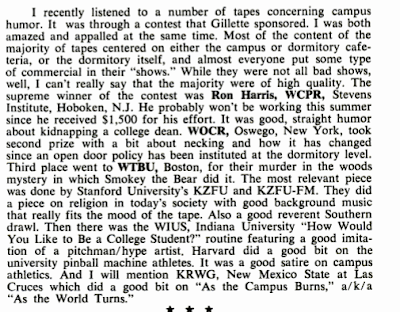
Bob Glassenburg's Billboard column - 1973 (excerpt)

JF: You moved to Los Angeles and went on to be a production engineer at Westwood One radio Networks for decades.

Yes! In 1981, I went for an interview with Norm Pattiz, founder and CEO of the Westwood One Radio Networks. I started there as a production engineer in April, 1981, and would stay there for the next 31 years! In that time, I produced some of Westwood One's top radio programs, like Casey Kasem's  countdown shows; Scott Shannon' Rockin' America Top 30 Countdown and Randy Jackson's Hit List shows (Randy, in addition to being a top music producer and former member of Journey, was one of the original judges on American Idol); and I was Technical Director and board op for many live concert broadcasts, as well as "Radio USA For Africa" and a 90-minute Larry King interview special with then-President Bill Clinton in our studio! I assembled a 54-hour show called "The Rock Years, Portrait of an Era," a history of album rock! One of the first live concerts I board-op'ed was the Moscow Music Peace Festival, a major production involving several satellite hand-offs for a concert coming live from Russia. It was going well until an American band front man decided to teach the Russian crowd how to say "F__K!" in English! This was before we had digital delays to cut out obscenities, so I had to try to anticipate the word and mute the feed to try to avoid having Russian youth gleefully screaming you-know-what on a high-profile broadcast all across America!

Westwood One merged with another radio network in 2011. One of the stated goals was to combine the best people from each company for the new incarnation. But, the day the merger was approved by the Justice Department, the powers that be laid off something like 98% of the Westwood One employees! I lasted another few months, and then on February 6, 2012, it was my turn. I was 60 years old, and after 31 years of doing what I loved and more, often in 14-hour days, 6 or 7 days a week, I was ready to retire! The irony of it was that they ended up having to hire three people to take over all the work I'd been doing!

As I write this almost 15 years later, I really can't complain at all. I've had an incredible life, from my DJ days to working with presidents and rock stars, as well as learning and developing new skills, doing things I never imagined I would be able to learn and do. I'm still one of the only Chief Engineers who can't solder worth a damn, but hey, there are people for that! For a kid from West Caldwell, New Jersey, who flunked out of his first college, I've done pretty darn well!

Monday, September 23, 2024

The Lost Lost World

I'm reading the book The Loneliness of the Long-Distance Runner. It's not about running. It's a book by Alan Sillitoe about the bleak working class life in Nottingham, England; published in 1959. It's not about radio. (It's not about music either, though Sillitoe has inspired both The Smiths and the Arctic Monkeys.) My copy is a very crumbly Signet paperback which may not survive this reading. It's not about radio. But there was a passing reference which is relevant to our on-going radio theme here:

"The governor would have a fit if he could see me sliding down the bank because I could break my neck or ankle, but I can't not do it because its the only risk I take and the only excitement I ever get , flying flat out like one of them pterodactyls from the 'Lost World' I once heard on the wireless..."

This seemed to be a reference from life. Alan Sillitoe, having been born in 1928 could have heard the Lost World on the BBC either as a youth or an adult, or both. The reference even contextualizes the time and place of the novel.But which broadcast was he referring to?

The Lost World was written by Arthur Conan Doyle and first published in 1912, [LINK]. So it wasn't new, but already becoming a classic when Sillitoe was a young man. The Lost World has been translated into a radio drama many times. Ever popular, "Lost Worlds" have become their own sub-genre of science fiction. Because of that timeline, we have the interesting question of which version Sillitoe was referring to. Sillitoe would have been about sixteen in 1944, the same age as the fictional protagonist Colin Smith. For that reason I favor the first two broadcast versions, and generally the 1944 BBC broadcast. Sillitoe would have been 21 for the 1949 version and already on a military pension in France recovering from tuberculosis.

I've collated multiple sources which describe various radio versions of the Lost World, those include: the Conan Doyle website, and the books Carbon Dates by Donald F. Glut, and  Dinosaurs by the Decades by Randy Moore. The sources all reference different but largely overlapping catalogs of the different radio adaptations. The three  that predate the Sillitoe book are from 1938, 1944 and 1949. That first 1938 radio script of Lost World was written by the playright Mervyn Mills and broadcast by the BBC as six, 45-minute episodes from 2 November, 1938 on Wednesday. (Mills also wrote the pulp novel Long Haul.) 


Title Episodes
Station/Release
Year
Link
 The Lost World 6
BBC
 1938
N/A 
The Lost World 6
BBC
1944
N/A 
The Lost World 6
BBC Light Programme
1949 N/A
The Lost World 5
BBC
1952
N/A 
The Lost World 1
BBC
1958
N/A 
Dinosaurs!
4
MGM/Leo the Lion Records
1966
 LINK
The Lost World 3
 BBC Radio 4 Classic Serial)
1975
LINK
The Lost World 1
 BBC1 (BBC for Schools)
1975
LINK
The Lost World 3
(RNZ) Radio New Zealand
1980
N/A
The Lost World 3
Audio book & VHS
1997
LINK
The Lost World 2
BBC Radio 4 Classic Serial
2011
LINK


In 1944 BBC Secretary Peggy Wells wrote a six, 25-minute episode version, which was broadcast live in April and May that year. Wells contributions to radio are under-appreciated, she adapted world by Noel Coward, H.E. Bates, A.A. Milne, Jane Austen, Graham Greene, Hugh Williams, Thomas Anstey Guthrie and she also contributed works to the program Saturday Night Theater plays on BBC into the 1970s. There is no complete source for her contributions though she appears multiple times in the book Women Writers Dramatized by H. Philip Bolton. She started at the BBC before 1945, and by the 1970s her name literally appeared in the BBC Handbook. More here.  

That 1944 version was a dramatic reading starring Carr as the sole narrator, playing the part of all characters. Carr is better known today as a writer of detective novels. Born in the US in 1906, he relocated to England in the 1930s. There became an author, and in addition to his 52 detective novels, also wrote radio plays. His scripts appeared in the Suspense series, and other works for the BBC. In the 1940s he even hosted the series Murder by Experts, which was broadcast on WOR for the Mutual network. More here.

Carr was a genuine fan of Doyle. In 1945 he wrote radio adaptions for two other Doyle tales: The Adventure of the Speckled Band, and Silver Blaze. Later in 1948, Doyle's son, Adrian granted Carr access to family papers so that he could write an official biography of Arthur Conan Doyle published in 1949: The Life of Sir Arthur Conan Doyle. 

Peggy Wells revised her 1944 script in 1949 for producer Ayton Whitaker for a live October broadcast on the BBC Light Programme. The cast included with narrator Richard Williams, and actors: Abraham Sofaer, Ivor Barnard, Lewis Stringer, Cyril Gardiner.  In 1952 an adaptation by John Keir Cross was broadcast in five 20-minute episodes. (He was the author of Angry Planet) More here. According to Robert Lewis Taylor, writing for the New Yorker in 1951, [SOURCE] Adrian Doyle specifically requested that John Dickson Carr act in an advisory capacity for the1944 radio adaptation. Carr's biography, The Man who Explained Miracles, by Douglas Greene does not credit Whitaker or Wells leading to some dubious attribution in secondary sources.

The 1958 version is poorly documented. But the basic facts are known and documented on the BBC website. It was broadcast on Thursday January 2nd, 1958 at 5:00 PM on BBC Home Service Basic, on the program Children's Hour. Generally described as "excerpts" it was adapted by Marion MacWilliam and Ian G. Ball. The cast included: Olive Shapley as host, Hilda Lewis, Effie Morrison, Joan Fitzpatrick, Cuthbertson Leonard Maguire, David Webster and Eileen McCallum.

In 1975, Barry Campbell was commissioned to revise Peggy Wells' 1944 scripts and convert them into three, 55-minute episodes. But by then Well's 2nd episode script was already lost. It had to be creatively reconstructed before the broadcast. That versions cast included Francis de Wolff, Gerald Harper, Kevin McHugh, and Carleton Hobbs. Campbell adapted enough fiction into radio dramas that he has his own Discogs page.

I have also read that a second radio adaptation was released in 1975 as part of the "BBC for Schools" program which was not the same. The BBC Schools series aired from 1957 into 1983. But this specific broadcast does not seem to be well documented. Beyond being highly plausible, all I've found is a passing reference in an issue of Educational Television International magazine. 

The 1980 RNZ broadcast an adaptation produced by Peggy Wells and Barry Campbell. Peggy Wells would have to have been in her late 60s at this point in her career and without a doubt the most experienced adapter of the text. Campbell had revised the text only 5 years earlier for his version. The team up is interesting, clearly they knew each other from their time at the BBC. This version starred Terrence Cooper as Professor Challenger and was complete with incidental score and dinosaur audio effects. (Some sources incorrectly cite the broadcast date as 1982.) More here.


Terrence Cooper died in 1997 and likely missed the next popular adaptation aka the New Zealand version. This adaptation differs from the original version significantly. It was produced by The Alien Voices, a radio drama company and they performed live with a full team of foleys for sound effects. Alien Voices was founded by Star Trek actors Leonard Nimoy and John de Lancie. All the characters are played by actors from the Star Trek TV series. You can actually buy an audio book version of this one which I do recommend. 

The most recent version was on the BBC in 2011. That versions cast included Jamie Glover, Brian Robb Jonathan Forbes, Jasmine Hyde, Jane Whittenshaw, Nyasha Hatendi and Vinicius Salles. More here. Out of all those 11 versions, somewhat inexplicably the only one which was officially endorsed by the estate of Arthur Conan Doyle was the 1966 LP version (CH-1016) that came out in 1966 on MGM/ Leo the Lion records. It was narrated by Basil Rathbone. More here.

Thursday, August 22, 2024

Radio House Books

This is more obscure than it probably should be. I found a book on the imprint "Radio House Books." It's publisher was George W. Stewart, Inc. His operated from at least 1936 and 1951. The earliest book I found was The Stewart Simplified Method of Mimicry and Parlor Amusement. I suspect that's a different Stewart. The other works are all primarily from the 1940s and also primarily non-fiction: history, criticism, economics, sociology and a little bit of English drama. The address in the book plate is 67 W. 44th Street, New York, NY. Note on disambiguation: there was a well-published professor at the University of Iowa by that name, a few notable military men, and a newspaperman. These are all different George Stewarts.

But then there is our George W. Stewart. He was the author of "I Have a book" published in 1940. I found a copy of the Who What Why Is radio text scanned on line. [SOURCE] It refers to the Jerome Still book as "Still in preparation."  


In the introduction of The Radio Station, Jerome Still thanks Robert J. Landry which is an interesting connection. Landry even writes the introduction to the book. Landry himself is a mystery. In 1963 - 1979 the editor of Variety was a Robert J. Landry. He also wrote a book This Fascinating Radio Business, published by Bobbs-Merrill in 1946. Back in the 1940s he was the Director of Program writing at CBS.  The 2004 Encyclopedia of Radio confirms they are one and the same. Jerome Sill also thanks Sherman Marshall at WOLF, Nathan Lord of WAVE, and Joseph Creamer of WOR, all unknown radio men today.

Title Author
Year
link
 Who, What, Why Is Radio?
 Robert J. Landry
1942
 LINK
 All Children Listen
 Dorothy Gordon
1942 N/A
The Radio Station: Management, Function, Future
Jerome Sill
1946
 LINK
Time For Reason About Radio
Lyman Bryson
1948
LINK

The three books are all rare, but none more so than the Dorothy Gordon text. She was the moderator of The New York Times Youth Forum, a weekly radio and television program on WQXR. It aired from 1943 to 1960. In 1960 it was picked up by WNBC-TV and aired until her death in 1970. The program brought together a panel of high school AND/or college students and an adult guest in discussion. Gordon won a McCalls Golden Mike award in 1952 [SOURCE] and a Peabody award in 1963 [SOURCE]. In 1942 the book some classroom discussion guides mention Gordon's book. All together she wrote at least 7 books.

  • Sing It Yourself - 1928
  • Around The World In Song - 1930
  • Dorothy Gordon's Treasure Bag Of Game Song 1939
  • Come To France 1940
  • Knowing The Netherlands - 1940
  • All Children Listen 1942
  • You And Democracy - 1951

The Jerome Sill book is easier to find, and will cost half as much as the Gordon text. I saw one with the dust jacket on eBay. This appears to be his only book, thought it's widely quoted in other radio station management texts. A similar Jerome Sill worked in advertising in the 1930s into 1940s writing for Advertising & Selling magazine. There was  Jerome Sill of WMLO Milwaukee who led an independent station revolt in 1947 against a new NAB code. Jerome Sill pops up as the Promotions director of WNEW in 1944, formerly of the Aarons, Sill & Caron an ad agency in Detroit. I think these are all the same man. His letter of protest was widely quoted:

"Should this code be adopted in it's preset form, we might be in the position of being forced to withdraw from the NAB or be dishonest in our tacit acceptance of a code to which we could not sincerely subscribe. We would choose the former course."
If it's him he appears as the general manage of WMIL in Milwaukee in 1953, part owner of WREX in Duluth. He founded WAGE-TV in Greenbay in 1954. There was a Jerome Still who owned WFPG in Atlantic City, New Jersey 1960 and 1961, perhaps the same man. as the primary share-holder of WFPG Inc. he acquired the station in 1956,


The interval between the book publishing dates is peculiar. Two books the first year, then none for 3 years, and then one for another two. The Lyman Bryson book does advertise the prior three titles but it's unlike them in other ways. The first three books analyze radio management, and radio programming. Bryson's book is a transcript from a series of talks on CBS from the series "Time For Reason."  The show ran for 27 weekly episodes airing Sunday afternoons from December 1946 to June 1947. Bryson went on to become a frequent guest on the radio game show Information, Please. 

Bryson had been a teacher at Columbia University, but he also moderated The American School of The Air, Invitation to Learning and from 1938 to 1946 he hosted the publish affairs program The Peoples Platform. In many ways it was the adult version of Youth Forum, assembling a panel of laypeople to discuss areas of national interest. Publishers Weekly wrote a review in 1948 in advance of it's February 19th release date.

Some mysteries persist. There was never a fifth book in the series and George W. Stewart seems to stop operating in the early 1950s. The latest books are in a new series, a "Cookery Library" with a series of specialized cook books on coffee and cheese and a random Bible Quiz. In 1951 he published a book about war propaganda and by all appearances, nothing after that.

Monday, April 10, 2023

Winter Garden on WOR


This was another tough topic to research. WOR-AM has been operating since February of 1922. So we have a solid 100 years of history to sort through to rediscover this radio program.  I eventually found the right answer, but let me take you down the wrong research path as far as I got.

"Winter Garden" is another term with complex disambiguation. There is a town of Winter Garden in Aapopka, FL; A restaurant in London; a Winter Gardens Orchestra until about 1921, a Theater in New York City, a brand of vegetables in the 1950s, a Florida citrus cooperative in the 1970s, a Theater in Seattle, and ones in Baltimore Houston and Yankton. It's the name of a Social society in Edinburgh in the 1800s, a motel in Alabama in the 1950.  There are half a dozen novels by that title, and a litany of gardening advice. I began to have doubts. That wooden box lid could be just another bit of faux kitchen kitsch.


I have no solid contemporary references to a Winter Garden program on WOR or anywhere else. But I have a theory.  Winter Garden was built in 1896 at 1634 Broadway. That's between 50th & 51st Streets. Originally used as a horse exchange, it was converted and began to show musicals in 1911. Al Jolson starred here in a series of hit musicals from 1911 through 1925, including La Belle Paree (1911), Sinbad (1918) and Big Boy (1925). [SOURCE] Al Jolson is one of the few indirect connections to WOR. His recording"April Showers" was the first record played on WOR when it debut on February 22nd, 1922.

It was refurbished and redecorated in 1922, and again in 1928 to convert into a movie house. It still exists today link.  But that 1922 refurbishing was very big. It was actually a complete remodel by Herbert J. Krapp. They even redid the whole 7th Avenue facade and the interior was re-outfitted to 1,600 seats. In that re-launch I can imagine them trying to use radio to advertise the freshly outfitted venue. But evidence is slim. I have a tiny bit of evidence. In Radio News of August 1923 is a reference to the broadcasting of plays

"MANY PLAYS ALREADY BROADCAST - The musical comedy artists seem to feel the strain less than the others, and will play just as high if Mr. Gus Edwards is reported in the house as they will for a radio audience.The first play to be broadcast in this fashion was "The Gold Fish" in which Miss Marjorie Rambeau was starred last year. Since then a great number have traveled far through the air, among them such popular attractions as “The Old Soak," "Sally, Irene and Mary,” “The Dancing Girl" from the Winter Garden..  The majority of these have broadcast only a portion of the play, but some of them have gone out in their entirety..."

This is the best evidence I had for that theory. The problem with this theory is that the wooden box lid actually reads "Winter Garden Brand" which sounds more like canned vegetables than musical theater. There was a brand by that name based in California, and it was initially unclear how they would be connected to WOR in New York City. But the font matches...  sigh.  Sometimes you get pretty far down the road of wrong before you find the right answer.

My confirmation came in the index to the book It's One O'clock and Here is Mary Margaret McBride by Susan Ware. It lists "Sponsors, (specific)" Then lists off a laundry list of radio program sponsors: Wesson Oil, W.H. Nahigian Oriental carpets,  Dolly Madison Ice Cream, E - Z - Cut Ham , Friend's Baked Beans, B&M Brown Bread, and Winter Garden Carrots among others. There it was. Nobody suspects a root vegetable.  That rectangle of wood was probably from a produce crate, in all likelihood full of carrots. 

Mary Margaret McBride was so big in radio for 40 years she has her own 1,300 word Wikipedia article.  I wrote about her in 2007 [LINK]. I went back and fixed the typos if you want to take a gander. In 1946 Mary Margaret McBride was sponsored by Winter Garden Carrots. They were far from her first sponsor. She had already been in radio for over 12 years, having first started at WOR in New York City, in 1934.  She never actually retired from radio. 

In 1954 she and her partner Stella Karn left New York for West Shokun, NY in the Catskill Mountains. There she broadcast her program from her home three times a week carried on 920 WGHQ-AM in Kingston, NY; until she died in 1976. She had been on air 20 years longer than the station itself. WGHQ only signed on in 1954 as WSKN.

Monday, July 13, 2020

American Labor Party Radio Broadcasts of 1950


You can be forgiven if you have never heard of the American Labor Party (ALP). It was established in 1936, splitting from the Socialist Party of America (SPA). It's political activity was almost exclusively limited to the state of New York. In 1956, the party was terminated by its New York state committee. So unless you are a New Yorker, and over the age of 65, you'd have to read a lot of history to bump into the ALP.  (Note the SPA only existed from 1899 - 1972)


In 1948, the ALP wasn't going to support Harry Truman. So they backed Progressive Party candidate Henry A. Wallace. Wallace won a whopping 2.4% of the vote, which was more than Teddy Roosevelt, but also obviously a loss for the Progressive Party and the ALP. However, they re-elected Vito Marcantonio in the United States House of Representatives. They also elected Leo Isacson to fill a vacant seat in a Bronx district but lost in the general election that November. Let's take a look at the candidates.

Candidates:
  • W. E. B. DuBois for U.S. Senate 
  • Vito Marcantonio for U.S. Senate  
  • Janet Scott, for U.S. Senate  
  • Dr. Clementina Paolone, for Lieutenant Governor
  • John T. "Jack" McManus, for NY State Governor
  • Frank Scheiner, NY State Attorney General 
  • Paul L. Ross, for NYC Mayor
  • Michael Jiminez, for Comptroller
  • Harriet Wolff, for State Assembly
  • Dorothy Bloom, for State Assembly
  • Frances Smith, for State Assembly
  • Scott K. Gray, Jr.,
  • Nicola Rossi 

The problem might have been the Communists. The Communist Party USA openly endorsed the Progressive Party. By connection, some of the ALP staff were Marxists, and some Progressive Party candidates that the ALP supported were alleged communists. Notably among them was Lee Pressman who was not allegedly a communist. He was exposed in 1948 by HUAC as a paid spy for Soviet intelligence. Lee was a member of the Progressive Party (not the ALP) but the stink was smeared all over the left-wing parties during the red scare. Nonetheless the ALP ran real candidates in 1950, even if things were looking grim. The State of New York even managed to kick Wolff, Gray, Rossi and Bloom off the ballot before election day. More here and here.

By October The candidates were getting on-air to promote their campaigns. You can see that not all the candidates hit the airwaves. Wolff, Gray, Rossi and Bloom were already gone. DuBois appeared the most often, but Ross and Paolone were able to make multi-lingual appeals. Most appearances were on WMCA even though WEVD, was literally founded by the Socialist Party of America. But The Jewish Daily Forward had taken an increasing control over programming moving the station toward the center. According to Nathan Godfried's oft-cited but rarely read text, Legitimizing the Mass Media Structure, the SPA at least had turned to NBC and other channels to make its political message heard. 

There is little to corroborate most of the appearances listed on the schedule. But the DuBois appearances are well-documented, with audio, video and even personal papers known in the DuBois Papers held at the University of Massachusetts, Amherst [LINK]. But the below list is not complete. DuBois own papers include a speech by candidate Frances Smith given at WMCA on October 27th.


DATECALLSTIMECANDIDATE
10-09-1950 WMCA 9:30 - 9:45 PM  Dr. W. E. B DuBois
10-12-1950 WMCA 9:30 - 9:45 PM  John T. "Jack" McManus
10-15-1950 WEVD 3:00 - 3:15 PM  Paul L. Ross (Yiddish)
10-16-1950 WMCA 9:30 - 9:45 PM  Paul L. Ross
10-19-1950 WMCA 9:30 - 9:45 PM Dr. W. E. B DuBois
10-22-1950 WEVD  3:00 - 3:15 PM  Paul L. Ross (Yiddish)
10-22-1950 WOR 9:15 - 9:30 PM DuBois & McManus
10-23-1950 WMCA 9:30 - 9:45 PM McManus & Dr. Paolone
10-25-1950 WMCA 7:30 - 7:45 PM Cong. Vito Marcantonio
10-26-1950 WMCA 9:30 - 9:45 PM Dr. W. E. B DuBois
10-29-1950 WEVD 3:00 - 3:15 PM  Paul L. Ross (Yiddish)
10-29-1950 WHOM 4:00 - 4:15 PM  Dr. Clementina Paolone (Italian)
10-30-1950 WMCA 9:30 - 9:45 PM Paul L. Ross
10-31-1950 WMCA 9:30 - 9:45 PM Dr. Clementina Paolone
11-01-1950 WMCA 8:30 - 8:45 PM Jack McManus
11-02-1950 WMCA 7:30 - 7:45 PM Cong. Vito Marcantonio
11-03-1950 WMCA 9:30 - 9:45 PM Dr. W. E. B DuBois
11-05-1950 WEVD 3:00 - 3:15 PM  Paul L. Ross (Yiddish)
11-05-1950 WHOM 4:00 - 4:15 PM  Dr. Clementina Paolone (Italian)
11-05-1950 WJZ 6:45 - 7:00 PM  McManus & Dr. Paolone
11-06-1950 WMCA 9:15 - 10:00 PM DuBois, McManus, Ross &  Paolone

By the 1950s, the ALP had lost much of its support to the rival Liberal Party of New York, in part because of accusations of communist influence in the ALP.  In the end, most of the Republican ticket was elected. Only the incumbent U.S. Senator, Herbert H. Lehman [D], managed to retain his seat. DuBois only won 3.93% of the vote for the U.S. Senate, losing out to incumbent Herbert H. Lehman [D], and trailing well behind Joe R. Hanley [R].

The New York stations they appeared on are an interesting mix: WMCA, WEVD, WHOM, WJZ and WOR. There are easily dozen large New York City AM stations which were on air in 1950. My guess is that they focused their budget on Manhattan.

There were also Television broadcastsbut all of them were on WPIX. WPIX-TV only signed on in 1948 as Channel 11(VHF.)  From 1948 to 1965, WPIX produced Three Star News, a 6:30pm newscast that ran for half an hour. So the speeches would have aired shortly afterward.

DATECALLSTIMECANDIDATE
10-08-1950 WPIX 7:15 - 8:00 PM Dr. W. E. B DuBois
10-15-1950 WPIX 7:15 - 8:00 PM Dr. Clementina Paolone
10-22-1950 WPIX 7:15 - 8:00 PM Paul L. Ross

The sheet also had a section for their Upstate radio schedule. (below) Not all of these statison even exist anymore. WXKW operated on 850 kHz from 1948–1953 signing off after litigation around some engineering issues. Sounded the same year was 1150 WRUN in Utica. They changed calls to WUTI after a sale in 2008. 590 WROW was founded in 1947, still on air today they switched from Mututal to ABC in 1950. WEVT there is a typo, that has to be 1280 WVET, which also which also launched in 1947. They kept those calls until 1961, currently they are WHKT. 950 WARC also was founded that year, they changed calls to WBBF in 1953. 1260 WNDR predates them by one year, starting in 1946 just like 1450 WKAL in Utica. 620 WAGE started in 1941, and flipped the calls to WHEN after a sale in 1954.

DATE CALLS CITY TIME CANDIDATE
10-22-1950 WROW Albany 9:15 - 9:30 PM  DuBois & McManus
10-22-1950 WEBR  Buffalo 9:15 - 9:30 PM  DuBois & McManus
10-22-1950 WEVT Rochester 9:15 - 9:30 PM  DuBois & McManus
10-22-1950 WNDR Syracuse 9:15 - 9:30 PM  DuBois & McManus
10-22-1950 WKAL Utica-Rome 9:15 - 9:30 PM  DuBois & McManus
11-05-1950 WXKW Albany 6:45 - 7:00 PM Paolone & McManus
11-05-1950 WKBW Buffalo 6:45 - 7:00 PM Paolone & McManus
11-05-1950 WARC Rochester 6:45 - 7:00 PM Paolone & McManus
11-05-1950 WAGE Syracuse 6:45 - 7:00 PM Paolone & McManus
11-05-1950 WRUN Utica-Rome 6:45 - 7:00 PM Paolone & McManus

It appears that 970 WEBR was the most established station on the upstate list, having signed on in 1924. Those calls moved to 1440 in 2012, and the 970 stick became WDCZ. They even predate 1380 WKBW which was founded in 1926, they had been on 1520 kHz for decades even by this broadcast in the fall of 1950. So here we see old stations, new stations... just what appears to be a budget-driven slice of the radio dial. Charitably one could argue that by design, a random looking selection might represent a random selection of the electorate. So I consulted the Mighty Fybush, and even he agreed it appeared to be "stations where you could buy a block of time inexpensively."

After the 1950 drubbing, the ALP regrouped and in 1952, they endorsed Progressive Party candidate Vincent Hallinan for President and Corliss Lamont for US Senate. Thaty went nowhere. In the 1954 election, the ALP failed to garner 50,000 votes for any of its candidates and it lost its place on the New York ballot. They ceased to exist shortly thereafter. Maybe they should have got time on 1010 WINS?