Showing posts with label radio play. Show all posts

Monday, August 19, 2019

The Case of the Mysterious Cardigan Radio Script


I recently found a small trove of 1970s radio scripts. But in that pile are some anachronisms. OTR, Digital Deli, Archive.org and Radio Echos each list most of the known episodes of General Mills Radio Adventure Theater.  Many post the audio. You can refer to that material HEREHEREHERE and HERE. This script purports to be from that series but it is included in no known list; not by author, and not by name and the introductory text is unique compared to all the episodes I can find.

You can easily find the original script's source material. It's the tale of a swashbuckling young American colonialist named Michael Cardigan. He was the eponymous subject of Cardigan, a young adult novel written by Robert W. Chambers published in 1901. You can read those details HERE. Some of his work was serialized in magazines but I don't think this one was. Chambers wrote mostly in the romance and science fiction genres and list one clearly belongs to the former.

The script itself is 40 pages long and bears all the stains and yellow oxidation you'd expect from a 40-year-old typewritten manuscript. The stables and paperclips have rusted which is also consistent with it's vintage. Consistently with other episodes, Tom Bosley acts as host and it would be produced by Himan Brown. The introductory paragraph is structured similarly to that of other known episodes and like those, the text varies slightly to account for the individual story, and it's historical context. If you don't know the gravelly tone of Tom Bosley the radio voice actor, you do probably know him for playing Howard Cunningham on the 1970s ABC sitcom "Happy Days" from 1974 to 1984.

But let's get back to Roberts W. Chambers work. More than a few of his works were converted into radio dramas. Another of his books, The Cambric Mask, published in 1899, was re-worked into the episode "Turning to Marble" in the South African radio horror anthology series Beyond Midnight. It aired September 26th 1969 on the SABC station Springbok Radio.

More impressively, his 1906 collection of short stories Tracer of Lost Persons was transformed into series titled "Mr Keen, Tracer of Lost Persons" which aired on NBC Blue then CBS. It ran from October 1937 to April of 1955. The show ran long enough that the protagonist Mr Keen was voiced by three different actors: Bennett Kilpack, Arthur Hughes and Phil Clarke. As far as I know Mr. Keen's sidekick Mike Clancy was always voiced by Jim Kelly for all 726 episodes. The incredibly long-lived series Episode Log was canonized as the book Mr. Keen, Tracer of Lost Persons: A Complete History and Episode Log in 2004 by Jim Cox. In 2003 that lineage had also begat a 3-issue miniseries comic book of the same name by Lee Ferguson and Justin Gray. More here.

Chambers full bibliography is 80+ books deep. Some were compilations of his short stories published in magazines such as McCalls or Cosmopolitan but that number speaks volumes to his prolificacy. But in that context Cardigan wasn't particularly notable. It was just one of his four books set around New York state: Cardigan, The Maid-At-Arms, The Hidden Children, and The Reckoning: which are sometimes referred to collectively as "The Cardigan series".  These are historical romances all set during the war of Independence, and do share a few characters. But so far as I know, none of the others became radio dramas. But it's further supporting evidence that any other works by Chambers have been used in radio dramas. It would be anachronistic if Chambers was a total unknown with a small body of unremarkable work, with no other radio texts.

Robert W. Chambers is better remembered today for his contributions to science fiction, in particular a book of short stories entitled The King in Yellow published in 1895. In the 2019 Big Book of Short Stories some of his works were reprinted but comically editor August Nemo referred to The Yellow King as "Art Nouveau." (It's not but the font on the cover arguably was.) But it is a classic in the field of the supernatural, and was influential for early sci-fi writers like H.P. Lovescraft. For that we give our thanks. I have uploaded this script to Archive.org. You can download it for free...


Monday, August 07, 2017

Samuel Beckett’s Radio Plays

Samuel Beckett was born in 1906, lived most of his early life in Ireland, with stops in London and a long well-hidden stay in the South of France in WWII, before settling in Paris. He is remembered best for his avant-garde fiction, and in particular an absurd play titled Waiting for Godot. (But if you think that was absurd you should read How It Is.) Beckett is not remembered for his works written for radio, but there were several and all worthy of note. Some of his radio plays are not considered  to be radio plays in formal bibliographies on dubious grounds. I'll explain. More here.
  • All That Fall (broadcast 1957) 
  • From an Abandoned Work (broadcast 1957) 
  • Molloy (broadcast 1957) 
  • Embers (broadcast 1959) 
  • Words and Music (broadcast 1962) 
  • Cascando (broadcast:1963)
  • Krapp's Last Tape: 1972
  • Rough for Radio I (published 1976) 
  • Rough for Radio II (published 1976) 
In 1955 the BBC saw some appeal in the then young playwright, Samuel Beckett was getting for his new play Waiting for Godot.  At the BBC he was championed by Donald McWhinnie, Barbara Bray, Martin Esslin, and John Morris. The BBC invited Beckett to write a radio play to be broadcast on the BBC Third Programme. Beckett was hesitant, but wrote to his friend Nancy Cunard:
"Never thought about radio play technique but in the dead of t’other night got a nice gruesome idea full of cartwheels and dragging of feet and puffing and panting which may or may not lead to something."
Over the next 20 years, his cartwheels ultimately led to five plays specifically intended for radio, and arguably a few others.  His radio debut was in 1956 All That Fall. You can hear it here. The play was written in English, specially for the BBC well after he began to write primarily in French. The piece was directed by his drinking buddy, Don McWhinnie. This is well described in the book Directing Beckett by Lois Oppenheim. It was first broadcast on the BBC Third Programme, January 13th of 1957, It featured actors Mary O'Farrell and J. G. Devlin. Patrick Magee and Jack MacGowran had minor parts. (It was later broadcast as Tous ceux qui tombent on RTF/ORTF in Paris, on February 25th, 1963.) A "modernized version" was broadcast on June 4th, 1972. Directed by Donald McWhinnie.

That play was followed by From An Abandoned Work, which had been previously published in the Trinity News, June 7th 1956. [SOURCE] The play began as a novel he started in 1954 but had abandoned.  It was first broadcast on BBC Radio 3’s Third Programme on December 14th, 1957 together with a selection from his 1951 novel Malloy.  The first person narrative was delivered by Patrick MacGee, directed by McWhinnie. In later listening to a rebroadcast, Beckett was so taken with MacGee's performance that it inspired him to write what he then called "MacGee's Monologue". This later became the play Krapp’s Last Tape, a work sometimes even described as a "meditation for radio." Inexplicably, most bibliographies do not consider Krapp's Last Tape to have been a radio play. This is likely because it debuted in Theater, then moved to BBC2 television.

Also written in 1957 was Embers, but it wasn't broadcast until June of 1959. McWhinnie directed again and the protagonist was played by Jack MacGowran, for whom the play was specially written. Supporting case included Kathleen Michael and Patrick Magee. It was First broadcast on the BBC Third Programme on June 24th, 1959. You can hear it here. The play won the RAI prize at the Prix Italia awards later that year.

A decade passed before Beckett returned to the radio medium.  Rough for Radio I is a short radio play written in in French in 1961 as as Esquisse Radiophonique and first published in Minuit, issue 5 in September 1973. Its first English publication as Sketch for Radio Play was in 'Stereo Headphones' issue 7, in spring 1976. Plans for a BBC production, with Humphrey Searle providing the music amounted to nothing in the 1960s, but a French version was produced by ORTF in 1962.

Rough for Radio II was also first published in Minuit, this time issue 16, November 1975. It was written in French in 1961 as Pochade Radiophonique and published in Minuit 16, November 1975. The BBC beat RTE to it this time and Beckett translated the work into English for its debut broadcast on BBC Radio 3 on April 13th, 1976, his birthday The program also included Dante and the Lobster from his collection of short prose More Pricks than Kicks and a variety of live recordings from the National Theatre: From an Abandoned Work, Malone Dies, Murphy, Watt, Malloy, Still, The Unnamable, Cascando, First Love, Texts for Nothing and a selection of his poems.

Also written in the 1960s was his radio play, Words and Music assumed to have been written between November and December of 1961. It was recorded and broadcast on the BBC Third Programme on 13 November 1962. It was acted by Patrick Magee and Felix Felton. His cousin, John S. Beckett provided
music.

Most lists completely exclude The Old Tune from Becketts radio resume. After Embers, but before Rough for Radio, Beckett translated and re-wrote Robert Pinget’s 1960 play La Manivelle for the BBC. Its first radio broadcast was August 23rd, 1960. Barbara Bray directed and actors Jack MacGowran and Patrick Magee voice the parts. It's worth noting, as his interest in radio came in distinct phases. The lone exception being a 1972 recording of selections from How It Is, probably taped  at the same time as the Krapp’s Last Tape BBC sessions. It was released as a 7-Inch by J&B Recordings.

His last work for radio was Cascando, a radio playwritten in French in December of 1961. It is subtitled 'Invention radiophonique pour musique et voix.' It was first broadcast on France Culture (RDF) on October 13th 1963 with actors Roger Blin and Jean Martin. The first English-language production was on October 6th, 1964 on BBC Radio 3 with Denys Hawthorne and Patrick Magee (of course).

Shortly before his death in 1989, the Beckett Festival of Radio Plays, including productions of all of Beckett's extant plays for radio, was recorded and produced at the BBC Studios, London on January 1988. It was distributed  in the U.S. by APR (American Public Media). It was intended to be broadcast in it's entirely on his 80th birthday, April 13th 1989. It was carried on NPR, Pacifica,  RIAS, ZDF and  other networks. Hopefully the life-long, iconic pessimist was at least moderately pleased.

The year 2006 was the 100-year anniversary of Beckett's birth. A complete run of all Beckett’s radio plays was presented by RTE Radio 1. Also notably BBC Radio 3 revisited Krapps Last Tape, and then Embers in 2006 with a new cast under director Stephen Rea. The productions were rebroadcast on BBC Radio 3 on May 16th 2010 as part of a double bill.

The question remains why are his radio works so obscure?  In Katherine Worth's essay, 'Beckett and the Radio Medium' she explains "The plays Beckett wrote for radio have had considerably less attention than his stage plays. No doubt this is largely as Martin Esslin suggests, because there have been few opportunities to hear them." The book Samuel Beckett and BBC Radio by David Addyman, Matthew Feldman, Erik Tonning goes a step further quoting a 'tirade' by Beckett himself "If we can't keep our genres more or less distinct, or extricate them from the confusion that has them where they are, we might as well go home and lie down."

Tuesday, October 27, 2009

Radio Plays for Children

First published in 1947 by the H.W.Wilson Company "Radio Plays for Children" is no children's book. The manual weighs in at a hefty 285 pages in hardback. Watson adapted stories by R.L. Grimes, and K. Seredy as radio plays for a total of 26 scripts. The wording used in advertisements of the era was 'selected and arranged." It gives instructions on how to get air time, and the plays are indexed by the age group appropriate for each. Of course a Librarian would have an index.

Katherine Williams Watson was not a DJ. She was the head of the children's department of the Denver Public Library. She previously wrote the book "Once Upon a time; Childrens Stories retold for Broadcasting. That one was published in 1942 and presented a set of 8 radio plays that were all first presented on WHAM in Rochester. It was also published by the H.W.Wilson Company.

I know next to nothing about her except that she was interested in radio, and based in Denver. Her connection to WHAM, and Rochester in general... remains a mystery.

Monday, January 22, 2007

The Chickenheart that ate Arch Oboler

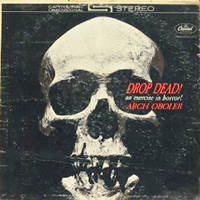
Have you ever heard the Bill Cosby Routing on the Chicken heart that ate New York City? Its a joke.. but what many younger people dont realize.. is that it's a spoof of a real radio play by a man named Arch Oboler. In the golden age of radio, Arch Oboler was radio's king of horror and science fiction.

If you don't know what I'm talking about please visit the Blog of Mr. Snuh and download the audio of both Bill and Arch. We can all proceed on equal footing afterwards.

Oboler sold his very first radio scripts while still in his Chicago high school in the 1920s. He was prolific. While at the University of Chicago he cranked out more than fifty plays! His career in radio took off when he took over the NBC horror anthology Lights Out in 1936. The show was already a sensation because of creator Wyllis Cooper's dark and violent content. If anything, Oboler trumped him. http://www.bmonster.com/scifi5.html

Each episode of Lights Out began like this:
"This is Arch Oboler bringing you another of our series of stories of the unusual, and once again we caution you: These Lights Out stories are definitely not for the timid soul. So we tell you calmly and very sincerely, if you frighten easily, turn off your radio now. "

In 1939, Oboler started a second program Arch Oboler's Plays, which ran on the competitor CBS. He had felt restrained in the horror-only format of Lights out. Lewis Titterton gave him a shot to branch out. Here he wrote tragedy, comedy and of course.. more horror. But in Oboloers Plays the horror content was less horrific, more topical. The content was still horror, but much less gothic, often focusing on WWII in Europe. You can hear an episode here, and another here. Many of these plays are flat out anti-Nazi. As such, stars like Joan Crawford and Alla Nazimova begged to be casts. The program ran opposite the Jack Benny show which eventually killed it. arch Oboloers plays ended in March, 1940. But It re-appeared again on the Mutual network in 1945 as a summer series. It was re-done as re-issues into the early seventies with a much older Oboler introducing each episode.


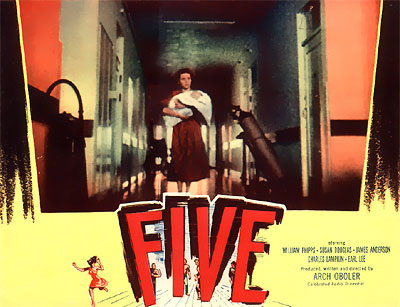
By 1950 Oboler was called to Hollywood to do feature scripts for RKO. Oboler being Oboler this material was as ghastly as ever including the first post nuclear apocalyse film titled Five. He went on to do TV, write books, more screen plays, records and even a strange number of 3-D features. He died in 1987.