Showing posts with label Radio Courses. Show all posts

Monday, August 25, 2025

Wisconsin College of the Air

Madison radio station WHA had already been on the air for about ten years when an experiment arose to see if radio could be used in education. In 1930, WHA tried teaching music and current events to grades 6 through 8 in rural schools in Dane County. The ten-week music program was taught by Professor Edgar B. "Pop" Gordon, who had been offering a music appreciation program on WHA as early as 1922. I uploaded a high res scan to the Internet Archive [LINK].

970 WHA-AM was founded as 9XM in 1922 by Earle M. Terry and operated by the Department of Physics at the University of Wisconsin. It is unfortunate but worth noting that Mr. Terry's widow discarded his research notes and personal papers after his death. It is due to that decision that there are certain gaps in the early record for WHA. But due to the research of Randall Davidson there is at least one great print source to reference on 9XM, his 2007 book 9XM Talking. 


I have written about Radio Courses before. [LINK] Some were generally educational, with the aspirational verve you find in early broadcasting. But there were a few that were real-deal college courses produced by real deal colleges and universities.  But even in that group, Wisconsin College of the Air was special. It was one of the most civic-minded efforts to build an educational tool out of broadcasting. This particular document below is from 1951.

The Jose Fritz Library

The Wisconsin School of the Air debuted the week of October 5, 1931, on WHA. It grew from that one station into a state-wide network. It continued to expand for decades. Even this 1951 pamphlet lists eight stations and two more "future" stations which I've identified tentatively as WHHI and WHSA. The 1952 Wisconsin Blue Book [SOURCE] appears to confirm confirm my assessment. Their respective 1952 sign on dates fit well with the geography of the map and the time of publication. The Wisconsin Public radio network today includes 31 stations and 8 translators. [SOURCE]  In other words this public radio network has quadrupled in size over the last 70+ years. Below is a list of the stations on that graphic for readability:

CALLS FREQ CITY Year
WHA-AM 970Madison X
WHA 88.7 Madison X
WHAD 90.7 Delafield X
WLBL-AM 930 Wausau X
WHKW 89.3 Chilton X
WHRM 91.9 Wausau  X
WHWC 88.3  Menomonie X
WHLA 90.3  La Crosse X
*WHSA 89.9 Brule  1952
*WHHI 91.3 Highland 1952

Very few of these 1952 stations have changed call signs. WHA-FM in Madison is now WERN, but is still owned by the University of Wisconsin and airs classical music 24/7. WHKW in Chilton is now WPNE, it only changed calls in 1973 when WHKW moved its stick to the WPNE-TV transmitter site in Green Bay. 

The Wisconsin Blue book goes on to confirm that the radio network broadcast 16 hours a day from 7:00 AM to 11:00 PM.  But it further lists two stations transferred to the State Radio Council: 930 WLBL Auburndale which was founded in 1922 as WPAH which is in the area of Steven's Point. It operated then as a 5,000 watt daytimer. 


Programs each weekday were designed for use in school classrooms around the state. It was thought the programs would be of particular value to the rural one-room schools in the state, numbering over 6,500 at the time. [SOURCE] The College of the Air taught courses on music, art, literature, nature, health and safety and according to Davidson, boasted 70,000 students by 1938. Some schools would actually move a radio into the classroom like your teacher might have borrowed a projector or TV from the AV room. These were not "failed experiments" as some critics have written. However, it is generally true that educational radio courses declined in popularity in the 1950s. 

I'll reference the Davidson book one more time. He wrote about some of the most popular programs on Wisconsin College of the Air, including Journey In Musicland hosted by Edgar Gordon, Let’s Draw, Afield with Ranger Mac, and Rhythm, Games with Mrs. Fannie Steve, Aline Hazard's home maker program and many more. 

Wednesday, December 19, 2012

The Last of the Broadcasting Schools


There actually is big money in radio, just generally not in being a DJ. I've written several posts about radio schools over the years and it occurred to me that there were still a scant few left operating who deserved a bit of credit. Below is a list of every broadcasting school still operating in America that I am aware of.

Broadcasting school may be an old idea, maybe even one that has really passed by but there are still a few educational institutions living the dream. This list excludes known scams and also universities that offer broadcasting or radio courses within a department or as a focus within their curriculum. But I do include ham schools because they are so few. This list should not be taken an an endorsement, tacit or otherwise of any of these schools individually, or of broadcasting schools as a whole. My personal recommendation is to go to a college or university with it's own radio station, get your feet wet, and go suffer through some grueling internships.

Academy of Radio & Television Broadcasting - www.abradio.com

Alpha Pacific Institute - www.alphapacificinstitute.com

American Broadcasting School - www.radioschool.com

Atlanta Broadcasting Institute - www.radiotvschool.com

Broadcast Center of St. Louis - www.broadcastcenterinfo.com

Broadcasting Institute of Maryland - www.bim.org

Broadcasters Mentoring Group - www.broadcastingschool.com

Carolina School of Broadcasting -  www.csbradiotv.edu

Centro Radio & TV Center - www.centrotvandradio.com

Columbia School of Broadcasting - www.csbdream2destiny.com

Connecticut School of Broadcasting - www.gocsb.com

Eastern Connecticut Radio Academy -  www.beonairtoday.com

Gordon West radio School (ham)-  www.gordonwestradioschool.com

Ham Radio School .com - www.hamradioschool.com

International College of Broadcasting - www.icbcollege.com/

Radio Connection - www.radioconnection.com

Radio 1 Broadcast School - www.radio1school.com

Specs Howard School of Media Arts - www.specshoward.edu

Tuesday, September 15, 2009

School of the Air

Is this College Radio? it's not really what we mean today with the term but it was a series of educational courses conducted over the radio waves. On February 4, 1931 the American School of the Air was launched. The Encyclopedia of Old-Time radio described it thusly:
"Perhaps the most outstanding show in educational radio, offered as a teaching supplement; the equivalent of a half-hour course, often dramatized by radio's top actors."
It began in 1930 with little fanfare, but quickly gained popularity with schools. Positive reviews from 35 early-adopting schools helped spread the word. It was the first educational program designed for schools. It was a 30 minute program that ran on Tuesdays and Thursdays weekly. the program was not made up of voice actors. it was comprised of educators. It taught classes in history, literature, civics, art, music, and biology. A program might explain how pearls are formed, or folk music, or life in a foreign country. The equivalent today might be screening a documentary in civics class. More here.

In 1940 the events of WWII compelled supervisor Sterling Fisher to syndicate the program abroad. It made it to atleast 15 other countries. Although it was not overtly political, newsmen like Edward R. Murrow guested on the program. It ran for 18 years only ending it's run in 1948.

While purely educational programming was rare, the "School of the Air" branding was used by a number of stations individually. Florida and Oregon has state-funded programs with the same name, as did stations WHA, WCAL, WOSU, and WLW, all broadcast programs hitching a ride off the successful branding and CBS let them. But the CBS School of Air was the leader. Late in the game they rebranded as "the American School fo the Air" to better distinguieh the program.

But it ultimately why the confusion arose becomes clear. In 1924, when general Mills lanched a cooking show on the radio it was called the "Betty Crocker Cooking School of the Air." In 1930, the branding was already in use. It was never theirs to be co-opted. It was stolen, or else the terminology had already entered some kind of general usage.

Tuesday, December 18, 2007

Career Academy School of Famous Broadcasters

I found these two LPs at a flea market. They both had identical sleeves, only the labels differ. Pictured on the jackets are Howard Miller, John Cameron Swayze, Robert St. John, Ulmer Turner, Fran Allison, Westbrook Van Voorhis, and Earl Gillespie.

I had no idea who any of these people were, but according to the jacket they were all famous. I have two of the LPs and The Transmitter, the newsletter of Library of American Broadcasting here tells me there are a total of 36 LPs in the series.

"St. John’s work as the Dean of the Directing Faculty of the Career Academy Division of Famous Broadcasters is represented by thirty-six LP records containing home study lessons and a copy of his textbook Encyclopedia of Radio and Television Broadcasting (The Man Behind the Microphone)."

Side A disc one was the program introduction. which told me that Robert St. John was the dean. He was born in 1902,and grew up in Chicago, Illinois. At the age of 16 he lied about his age and enlisted in


World War I. Upon returning home he enrolled at Trinity College where eventually he was expelled over an article he wrote for the Hartford Courant. He later became a writer for the Chicago Daily News and co-founded the Cicero Tribune. Al Capone bought out his partner and mobsters beat and hospitalized him over an anti-gangster article.

He survived the ordeal and he started working for the AP as a war correspondent in the Balkans. But AP writers were not allowed to publish books, so he secured a job at NBC Radio. We heard his voice on NBC on D-day, he stayed in the studio for 117 hours. He was fired from NBC for merely being mentioned in "Red Channels" an anti-communist mag. He had been using them as a source for one of his books. It didn't' stop him, he wrote another twenty books and used whatever sources he damn well pleased. He died in 2003 at the age of 101. It seems impossible he'd have had the time to be the dean of anything. But then I found a single collaborating reference.

Gary Knapp wrote the book "Building the American Dream".

"The mock broadcast studio at the school even had it's own call letters and was referred to as WCAB radio, named after Career Academy of Broadcasting, and used to identify our school station. the academy had both morning and afternoon classes; I was in the morning session. ...We were informed our school had a prestigious board of directors made of such dignitaries as Robert St. John, a world famous news correspondent for NBC news, an advertising expert John Cameron, Swayze from the famous TV watch commercial, (it takes a licking and keeps on ticking), and children's host Fran Allison from Kulka Fran and Ollie, to name a few. our Class got to meet Robert St. John one day as he stopped by the class on new journalism and he signed our broadcast textbooks. "

That's an affirmative. Knapp goes on to describe other visits by St. John and other staffers, field trips to the FCC and his later employment at KGPC. Other students that I've found include authors Robert Lewanski and Robert Zuraw. Jimmy Jet from KYA-AM, Rick Thomas of Kissin' Country and Elijah Mondy of KJIW-FM all were also graduates.

For a broadcasting school that apparently had branches in half a dozen cities that seems like a small crop. There's a lot more to this mystery. If any reader knows more, feel free to enlighten me.

***UPDATE***

This short post is one of the most popular ones I've ever posted. In the years since a few Facebook groups have popped up and the comments section here has become a genuine class reunion. I do recommend you read the comments, you might find people you know.

Tuesday, December 12, 2006

college courses by radio

Only recently have college course taken over the internet gained any level of legitimacy. When I was very young I clearly recall people earning degrees by mail. The quality of these diplomas is debatable of course, but it's the application of media that interests us here aye?

There was also a time when college courses were taught by radio. One of the first was the station AMRAD in Boston,MA. But it was WGI that was the very first radio station to offer college courses by radio. In the year 1922, they began a series of twice weekly lectures by Tufts University faculty.

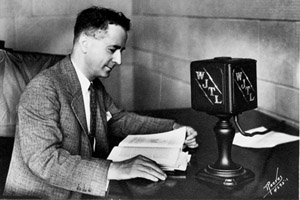
In the 1930s Oglethorpe University fostered many innovations among which was the "University of the Air" experiment, which broadcast college courses by radio in the 1930s. It was not the first, since WGI beat them to it, but it was a notable experiment, which lasted about five years, broadcasting college credit courses on the air waves. At the very least it gained widespread attention to their campus radio station, 1400 WJTL-AM. 

Incidentally it's named after benefactor John Thomas Lupton. Sadly only a few years later in 1935, WJTL was purchased by a private organization and moved to downtown Atlanta. The call letters were changed to WATL-AM and eventually WCOH-AM. To quote William Bianchi:

"From roughly 1929 through 1945, two network SOAs flourished: NBC's Music Appreciation Hour (MAH) and CBS’s American School of the Air (ASA). At their peak, they reached a combined weekly audience of approximately two million students, about 7% of the nation’s K-12 school children."
 

Today there do not appear to be any active college courses by radio in the US. But in Australia the RADIO AUSTRALIA has a lifelong learning program that carries college courses by radio. 

[I notice in s related licensing fandango, 2nd adjacent 1420 WATB-AM is moving to 1430... is the relatively under-powered 1400 stick moving back to Atlanta?] 

**Apparently not. WATB ultimately remained on 1420 and in Decatur.  But it did change calls to WWSZ-AM in 2018. WATB had been issued a construction permit from the FCC to change its operating frequency to 1430 kHz and increase its daytime power to 50,000 watts and nighttime power to 174 watts directional. But this change was dependent on WGFS-AM  in Covington, GA moving from first adjacent 1430 kHz to 1220 kHz. They did not. But they did change calls in 2019 to WYKG.