Showing posts with label Vinyl. Show all posts

Thursday, August 28, 2014

How Vinyl Records Are Made

I've posted before on how records are made but this is a nice modern production line. This baffling revival of vinyl has led to the re-activation and even new construction of record production facilities in America. So far this year total record sales are down almost 9% but sales of LPs, those 12-inch vinyl discs are up 33%. that meteoric rise is just s capstone on the 250% increase since 2002.

Amazing no?  I still believe that it's the last gasp of a doomed format. But in the mean time I will enjoy picking up high-quality re-pressings of Jazz sides I'd never otherwise own in mint condition. Thank you sentimental hipsters. As Claire Suddath quipped..."These people probably also eat kale."

PART 1


PART 2


Wednesday, January 22, 2014

Muzak and Vinylite 4 Ever

A commenter on this blog recently suggested that the upside of Muzak was that they created the vinyl record. This is not conjecture. In fact, according to Muzak’s own website, in 1933 they “began transmitting music over phone lines. Central studios played records – the first 33 1/3 rpm records and the first ever done on vinylite rather than shellac.” This is a claim to have made used and broadcasted the first vinyl records in existence. But extraordinary claims require extraordinary evidence. More here.

In 1948 Columbia records began marketing the 7-inch, 45-rpm vinyl discs we now refer to as 45s. In that era, they were described as being made of "vinylite." The first 45 rpm record players were actually developed by Philco in 1938; ten years earlier. But a WWII vinyl shortage and continuing success with shellac 78s. 

But these were not the first vinyl records. Let's back up. Polyvinyl chloride (PVC) what we call vinyl was first invented in 1838, by Henri Victor Regnault. It was invented again by Eugen Baumann in 1872. Neither  ever applied for a patent. So when Emile Berliner invented the record in 1888 and chose to use vulcanized rubber it wasn't because of patent infringement. There were two reasons. PVC is too soft for the mechanical playback devices  from that era. Their amplification was powered by friction. In 1913, Friedrich Klatte took did patent PVC but only in Germany. That's all beside the point, it wasn't until 1926 that Waldo L. Semon invented plasticized PVC.  This plastic had far greater utility, the Navy began using it as wire insulation. It's only after this date that we can seriously entertain vinyl records.
Sure enough it's only a few years later, in 1930 that RCA Victor vinyl long-playing records. these were marketed as "Program Transcription" discs. They were 12 inches in diameter and spun at 33.3 rpm. Roland Gelatt's book The Fabulous Phonograph, attributes the commercial failure of the device to the financial strain of the great depression. It was not a good time to debut a new media format with new playback devices. RCA's deluxe line of electric phonographs such as the RAE-59 were designed to handle playback. They were made of a plastic they called "Vitrolac" and it was made of PVC.  These were unquestionably the first vinyl records. You can argue that Muzak as an early adopter helped the format, but arguing that they were the fist to broadcast them requires that we believe no one else tried it for 3 years. Dubious.

Thursday, October 18, 2012

Plastic Precursors

Oh plastic, how you both simplify and complicate our lives. We don't use it in baby bottles anymore because maybe it leaches hormone-mimicking chemicals. But it's still the chassis of virtually every electronic device, and certainly every portable radio. People are going back to glassware for food storage over similar fears, but it still coats all electrical wiring everywhere. Where would I be without saran-wrap and wiffle bats?  From the aglets of our shoe laces to the bezel of the car stereo... plastic is everywhere. Real modern plastics are over 100 years old. Below is a list of landmarks in plastics for better or worse.

The modern word plastic originates in the Latin word "plasticus" from the Greek "plastikos" meaning moldable in the sense that clay and mud are moldable. The modern definition of the word plastic dates to 1905 from it's use by Leo Baekeland the inventor of Bakelite. Interestingly source cite his use prior to his invention...  The idea surely came from the popular use of vulcanized rubber invented by Goodyear in 1839. Before that little in the home was elastic. Thomas Hancock stole his patent in the UK. But we didn't coat wires in it. We only had started using gutta-percha after it's 1843 discovery by William Montgomerie. Nothing else was even slightly flexible. All we had was shellac and lacquer (cellulose acetate). More here.

The first real plastic was Polystyrene. It was discovered in 1839 by Eduard Simon. His early attempt rendered it from a natural resin. But it's commercial scale manufacture was only developed by BASF in the 1930s. Xylonite and Parkesine were invented in the 1860s and reinvented as Celluloid in 1863 by John Wesley Hyatt. But it wasn't a good insulator; too flammable. real modern plastics start in 1872 with PVC. Below is a list of the highlights.
  • 1839 - Ploystyrene - Eduard Simon (first sold in the US in 1937)
  • 1872 - PVC (Polyvinyl Chloride) - first created by Eugen Baumann 
  • 1894 - Rayon - Charles Frederick Cross, Edward John Bevan 
  • 1908 - Cellophane - Jacques E. Brandenberger 
  • 1909 - Bakelite (Phenol-Formaldehyde) - Leo Hendrik Baekeland 
  • 1926 - Vinyl (plasticized PVC) - Walter Semo
  • 1933 - Saran Wrap (Polyvinylidene chloride)  - Ralph Wiley, at Dow
  • 1935 - LDPE (Low-density polyethylene)- Reginald Gibson and Eric Fawcett
  • 1936 - Acrylic (Polymethyl Methacrylate) -Otto Rohm
  • 1937 - Polyurethane - Otto Bayer
  • 1938 - Teflon (Tetrafluoroethylene) - Roy Plunkett, at DuPont
  • 1939 - Nylon and Neoprene - Wallace Hume Carothers
  • 1941 - PET (Polyethylene Terephthalate) - Whinfield and Dickson 
  • 1951 - Polypropylene - Paul Hogan and Robert Banks 
  • 1954 - Styrofoam - Ray McIntire, at Dow
  • 1970 - Mylar (Thermoplastic Polyester) - DuPont
  • 1978 - LLDP (Linear Low Density Polyethylene) - ICI corp.
  • 1985 - Kevlar (Liquid Crystal Polymer) - Stephanie Kwolek, at DuPont
The plastic we use in electrical insulation in wiring is PVC, aka vinyl. This is not because it is best at resisting the electrical potential. There are quantifiable qualities to electrical wiring that pushed the world into PVC. Firstly, wiring has to be flexible. A rigid wire would never be able to get from the circuit breaker to your stereo on the 2nd floor. A rigid wire would also be impossible to loop across a circuit board. It's nice for it to be fire resistant too.

But after that we quickly get to electrical qualities. We measure it's electrical insulating properties as volume resistivity or dielectric strength. Volume resistivity is expressed in terms of sample resistance, which is measured in ohms. All very dry and scientific. Dielectric strength is more fun. It is expressed in terms of destruction of test samples by various voltage magnitudes. Ceramic has excellent dielectric strength, but is entirely inflexible. Polypropylene, Polystyrene and Polyethylene all have superior resistivity but fail on the fire test. Teflon is superior to all of them in resistivity but it's famous non-stick slipperiness allows things like gaskets to creep out of position. the result is that each application has an ideal plastic with no sole single right answer. More here.

Thursday, April 29, 2010

VINYL UP CLOSE!

Chris Supranowitz, a researcher at The Insitute of Optics at the University of Rochester has taken an excruciatingly close look at the grooves of a vinyl record using the institute's electron microscope. These are magnified up to 1000 times so even particles of dust look like a greyhound bus parked in the groove. MORE HERECREDIT: I originally found this on the Posterous page of Reckon.

Friday, December 04, 2009

Tuesday, April 28, 2009

The mythical LP typewriter key

I had always thought it was a myth. When Columbia Records debuted the vinyl Long Play record they held an international contest to name the format. All submissions were rejected and it was crowned formally with the term it'd held in house informally all along: the LP.
They were unable to patent the format as it contained no new technology, but they could trademark the name LP. So they did. I have written often of the ostentatious platter. Here & here. The story is that in the late 1950s Columbia had the office typewriters re-keyed to have an LP key. I have confirmed this somewhat by the single reference in the book "The Label: the story of Columbia Records" by Gary Marmorstein put it back on the table.

Gary asks the question I have asked myself "Which key was removed to make room for it?"

Wednesday, April 08, 2009

Radio Artifact #71

Technically it's not a radio artifact. It was a warning label attached to each of the LPs at the Torrance Public Library. The LPs were not played at any radio station, but I like it.

Note the typewriter font, and the hand-drawn sweating sedan. This is not clip-art. This a sincere warning to the misguided that improperly store vinyl.

The inside of a car can be easily 20 degrees hotter than the outside. If it's hot enough to kill children and small dogs it definitely will warp your records. Vinyl should be stored at a temperature no warmer than 70 degrees. A car can get warmer than that on a cloudy day in March.

Friday, January 23, 2009

180 grams

You see the term "180 gram!" bandied about by audiophiles. Beside the premium collectors double LP edition are the words "180 G Audiophile Vinyl" or perhaps 120, 150 and even 200 gram vinyl. But what does this mean really? Is a radioman even the right person to ask? Well no, the fidelity of radio is pretty much crap due to the compressed dynamic range but that's beside the point. Here are the basics:

NORMAL VINYL
120-140 gram is "normal." Today this is standard for any commercial pressing. If it fails to specify this is the likely range.

MID-GRADE VINYL
140 - 160 grams vinyl is the middle ground. That said, the middle ground is largely unoccupied. Vinyl tends to be either cheap or marketed to audiophiles. This range will usually be older pressings from the 1960s and some contemporary European pressings.

AUDIOPHILE VINYL
180- 200 gram is the holy grail in vinyl. When a classic record is repressed and re-released this is often the format. This is what they market to those big-spending audiophiles.

The basic measurement behind those grams is thickness. The diameter obviously is standardized. The thickness is not. So the idea is that a thicker record is less prone to warping. There are also less credible claims to auditory improvement. It's been said to be less noisy which really has more to do with the grade of vinyl. But there is some substance to the claim of better bass response. A deeper record groove is able to record a lower tone. This has certain limits due to the standardized record needles and response limits of stereo systems and that old standard we call human hearing. (An old engineer once told me about a prog-rock band that put out a record that was half an inch thick anyone remember this?)

As I often say.. just clean your records, treat them well and they will sound fine. Vinyl grading is mostly bogus.

Tuesday, April 22, 2008

MOVIE NIGHT

How Vinyl records are made...

PART 1:


PART 2:


Friday, May 26, 2006

A History of Vinyl

It was the year 1950 that improvements in the manufacture of Polyvinyl Chloride (also called PVC or vinyl finally spelled the death of Shellac records. Here.

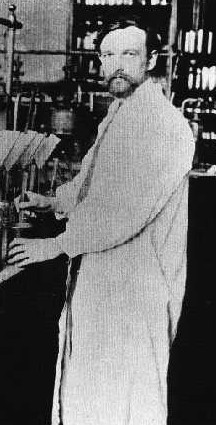
Vinyl was initially discovered by was discovered by French physicist Henri Victor Regnault, and it's first practical production process designed by Fritz Klatte (pictured) in 1912. He discovered that the reaction between acetylene and acetic acid could be catalyzed to produced vinyl chloride. This predated it's use in media by such a long period of time that his patent expired in 1925. One year later it was rediscovered by Waldo Semon, who recognized its potential and patented it for the second time. His employers at B.F Goodrich used it for insulation, raincoats, shower curtains and gaskets. More here.
After it's benefits were demonstrated, (durability, flexibility and longevity) it was adopted as the new material for record production. On June 26th 1948 in New York CBS called a press conference to announce the introduction of the LP or long player. 12 inches wide, turning at 33 1/3 and using the innovation of vinyl had resulted in a record that could hold up to 30 minutes of music per side! It was called "microgroove" technology.

RCA retaliated by bringing their own vinyl medium to the market, a 7-inch 45 rpm micro-groove vinyl single and compatible turn table.

By 1954 45 rpm singles were out on vinyl making available a higher fidelity single and then about 8 years later RCA debuted the stereo LP, an innovation that would have been impossible on shellac.