Showing posts with label WNEW. Show all posts

Thursday, August 22, 2024

Radio House Books

This is more obscure than it probably should be. I found a book on the imprint "Radio House Books." It's publisher was George W. Stewart, Inc. His operated from at least 1936 and 1951. The earliest book I found was The Stewart Simplified Method of Mimicry and Parlor Amusement. I suspect that's a different Stewart. The other works are all primarily from the 1940s and also primarily non-fiction: history, criticism, economics, sociology and a little bit of English drama. The address in the book plate is 67 W. 44th Street, New York, NY. Note on disambiguation: there was a well-published professor at the University of Iowa by that name, a few notable military men, and a newspaperman. These are all different George Stewarts.

But then there is our George W. Stewart. He was the author of "I Have a book" published in 1940. I found a copy of the Who What Why Is radio text scanned on line. [SOURCE] It refers to the Jerome Still book as "Still in preparation."  


In the introduction of The Radio Station, Jerome Still thanks Robert J. Landry which is an interesting connection. Landry even writes the introduction to the book. Landry himself is a mystery. In 1963 - 1979 the editor of Variety was a Robert J. Landry. He also wrote a book This Fascinating Radio Business, published by Bobbs-Merrill in 1946. Back in the 1940s he was the Director of Program writing at CBS.  The 2004 Encyclopedia of Radio confirms they are one and the same. Jerome Sill also thanks Sherman Marshall at WOLF, Nathan Lord of WAVE, and Joseph Creamer of WOR, all unknown radio men today.

Title Author
Year
link
 Who, What, Why Is Radio?
 Robert J. Landry
1942
 LINK
 All Children Listen
 Dorothy Gordon
1942 N/A
The Radio Station: Management, Function, Future
Jerome Sill
1946
 LINK
Time For Reason About Radio
Lyman Bryson
1948
LINK

The three books are all rare, but none more so than the Dorothy Gordon text. She was the moderator of The New York Times Youth Forum, a weekly radio and television program on WQXR. It aired from 1943 to 1960. In 1960 it was picked up by WNBC-TV and aired until her death in 1970. The program brought together a panel of high school AND/or college students and an adult guest in discussion. Gordon won a McCalls Golden Mike award in 1952 [SOURCE] and a Peabody award in 1963 [SOURCE]. In 1942 the book some classroom discussion guides mention Gordon's book. All together she wrote at least 7 books.

  • Sing It Yourself - 1928
  • Around The World In Song - 1930
  • Dorothy Gordon's Treasure Bag Of Game Song 1939
  • Come To France 1940
  • Knowing The Netherlands - 1940
  • All Children Listen 1942
  • You And Democracy - 1951

The Jerome Sill book is easier to find, and will cost half as much as the Gordon text. I saw one with the dust jacket on eBay. This appears to be his only book, thought it's widely quoted in other radio station management texts. A similar Jerome Sill worked in advertising in the 1930s into 1940s writing for Advertising & Selling magazine. There was  Jerome Sill of WMLO Milwaukee who led an independent station revolt in 1947 against a new NAB code. Jerome Sill pops up as the Promotions director of WNEW in 1944, formerly of the Aarons, Sill & Caron an ad agency in Detroit. I think these are all the same man. His letter of protest was widely quoted:

"Should this code be adopted in it's preset form, we might be in the position of being forced to withdraw from the NAB or be dishonest in our tacit acceptance of a code to which we could not sincerely subscribe. We would choose the former course."
If it's him he appears as the general manage of WMIL in Milwaukee in 1953, part owner of WREX in Duluth. He founded WAGE-TV in Greenbay in 1954. There was a Jerome Still who owned WFPG in Atlantic City, New Jersey 1960 and 1961, perhaps the same man. as the primary share-holder of WFPG Inc. he acquired the station in 1956,


The interval between the book publishing dates is peculiar. Two books the first year, then none for 3 years, and then one for another two. The Lyman Bryson book does advertise the prior three titles but it's unlike them in other ways. The first three books analyze radio management, and radio programming. Bryson's book is a transcript from a series of talks on CBS from the series "Time For Reason."  The show ran for 27 weekly episodes airing Sunday afternoons from December 1946 to June 1947. Bryson went on to become a frequent guest on the radio game show Information, Please. 

Bryson had been a teacher at Columbia University, but he also moderated The American School of The Air, Invitation to Learning and from 1938 to 1946 he hosted the publish affairs program The Peoples Platform. In many ways it was the adult version of Youth Forum, assembling a panel of laypeople to discuss areas of national interest. Publishers Weekly wrote a review in 1948 in advance of it's February 19th release date.

Some mysteries persist. There was never a fifth book in the series and George W. Stewart seems to stop operating in the early 1950s. The latest books are in a new series, a "Cookery Library" with a series of specialized cook books on coffee and cheese and a random Bible Quiz. In 1951 he published a book about war propaganda and by all appearances, nothing after that.

Saturday, July 15, 2017

DJ Cat Olsen


A version of this story even appears in the Hank Harrison book The Dead. In their October 23, 1975 issue, Jet magazine published an article as well.  I have read three versions and the three are so different that they could be taken to be different events. 

So what was the truth about the Cat Olsen incident? What really happened at 1130 WNEW-AM in 1975? So let's start with the evidence.  In the archives at the Paley Center for Media is a 30-minute tape made in September 14th, 1975 at WNEW-AM. They list a summary that understates the unusual nature of this tape.

"This radio program features an on-air telephone conversation between disc jockey Scott Muni and a man named Cat Olson, who is in the process of holding up a bank. Olson called the radio station during Muni's regular program and demanded to talk to the disc jockey about the robbery and the hostages he is holding. Topics discussed include the following: the reason the bank alarms are not being turned off, despite Olson's request for peace and quiet; the reason he released some of the hostages; the number of people that are still being held inside the bank; Olson's other requests; the reason he has withdrawn from society and refuses to trust anyone; Olson's greetings to people via radio; whether the bank robber wants Muni to be a negotiator between the police and other officials at the scene; Olson's desire to speak with a woman named Mouse; Muni's decision to go down to the bank to meet Olson and try to talk him out of the hostage situation; Mouse's insistence that Olson give himself up; and Muni's departure from the radio station before the end of his shift so he can meet the bank robber face to face. The program concludes with a news, weather, traffic, and sports report. Includes a commercial."
All of the above is true but incomplete. A man named Ray "Cat" Olson (spelled Olsen in the Harrison version and NY times) took hostages at a bank and demanded airtime on WNEW with DJ Scott Muni. Jet magazine identifies the bank as Bankers Trust Bank in Greenwich Village, in New York City.

Hostage situations aren't covered in broadcasting school. And nothing in his resume at WAKR, WMCA, WORWABC or Radio Guam prepared him for this. But much to his credit, Muni kept his cool. In his 2004 New York Times obituary, they summarized the incident in one sentence. "In the early 1970's, a bank robber named Cat Olsen, who was holding hostages at a bank, demanded to speak to Mr. Muni and hear some Grateful Dead. He helped defuse the situation." The Grateful Dead?  Well yes. This reference largely corroborates the Harrison version of events. Published in 1980, some five years after the incident, Harrison wrote:
"Naturally, the police, when they finally arrived on the scene, asked this rather disheveled man wearing bright floral pattered shirt, sneakers, and an army jacket, what his demands might be. He replied, not money, not power, not any of the normal things a normal bank robber asks for; instead good old Cat wanted only to hear three consecutive hours of Grateful Dead music played on the AM radio with an additional three minutes allocated to he, himself, for his message."

Against all odds, the demands were met. Olsen spoke at length with Scott Muni on air about the Grateful Dead, about Jerry Garcia, Patty Hearst, the Symbionese Liberation Army and also about the plight of blacks in America and about James Brown. The Harrison version skips this part but Jet was all over it. Olsen asked to speak with James Brown. Brown was contacted and he did offer to fly from Los Angeles to help the police. But before Muni, or Brown, or Jerry Garcia ever spoke with Olsen, the police fulfilled another demand. More here.

Olsen swapped 10 hostages for a six-pack of beer. He drank it all, and took a nap and was then easily subdued by his captives. After 31 years on WNEW, Muni was fired in 1998 as part of a veteran DJ purge. Brown cancelled his New York flight and instead appeared on the Johnny Carson show that night as scheduled. Olsen went directly to Rikers.

**UPDATE**

It has been said that either Cat Olsen inspired Dog Day Afternoon, or that he was inspired by the film. The movie debuted September 21st, 1975.  Oddly that's exactly one week before Cat Olsen walked into WNEW. It's certainly possible. It's also possible that Olsen was inspired by the 1972 Brooklyn bank robbery that inspired the film. But it may also just be that the events occurred near each other and people just connect the events. Something that might be amplified by the Press making the comparison as Time did in 1977. There is a great word for that phenomenon: Apophenia.

Friday, July 31, 2015

WTC Antenna

I was not aware of this exhibit until today. The Newseum continues to impress. Starting in the Summer of 2011, they began exhibiting the upper section of the 360-foot antenna mast from the World Trade Center North Tower.


The backstory is the story every American knows. Terrorists conducted suicide attacks using commandeered aircraft to target U.S. landmarks including the World Trade Towers in New York City. Aircraft collided with two WTC buildings, which collapsed and resulted in the deaths of 2,606 people at WTC including all 19 terrorists, 246 passengers, 72 law enforcement officers, 343 firefighters, and 55 military personnel.

The Radio and TV dial in New York city had a lot of dark spaces that day as many area stations broadcast from WTC. Nine TV and four FM radio stations were knocked off the air including WPIX-TV, WCBS-TV, WABC-TV, WNBC-TV, WNEW, WFAN and WPAT.  [SOURCE] On the new WTC structure, a mast was built that could support the whole of the NYC radio band. More here.

Wednesday, April 01, 2015

The Nightbird

Alison Steele was a New York DJ on 102.7 WNEW-FM. ON air she was known as "The Nightbird". To understand her career you need to hear her voice. Writers who miss all kinds of details of her career still manage to dwell on it's particular qualities: sultry, smoky, soft, sexy, syrupy, and "could melt butter" get repeated over and over. It's all true, but there was much more to her life than her provocative delivery.  In 1976 she became first woman to receive Billboard Magazine's "FM Personality of the Year" award. Did I mention the Jimi Hendrix song "Night Bird Flying" was inspired by her?

A Brooklyn native, at the age of 14 she broke into the biz running errands for a TV station. While Steele was at the peak of her career she was also a single mother. At the age of 19, she married orchestra leader Ted Steele, (of the Chesterfield Supper Club) who was twenty years older than her. It didn't last, and she had to add young single mother to her list of responsibilities.

In 1966 she got her big break. The FCC issued a rule making that but an end to the long time practice of AM/FM simulcasts. WNEW-FM decided to debut "Sexpot Radio" and hired an all female airstaff. the idea crapped out in under 2 years and Steel was the lone survivor. They segued into a free-form progressive rock station and she had to learn what the hell that meant. Management wasn't helpful to say the least. They buried her show in a 2:00 AM to 6:00 AM shift.  It was only when they discovered she was rated number one in the slot the moved her show back to start at 10:00 PM.  As for the voice?  Well she played it up. In a 1971 interview she was quoted as saying
"I'm a night person," she said in 1971, when she was with WNEW, where she worked on AM and FM for about 14 years. "I think it has a mysterious quality. I never get lonely up here."

She left the station in 1979 and worked at a few other New York area stations: WNEW-AM, WPIX, and even CNN as a correspondent. She was an announcer on the TV soap opera, Search for Tomorrow and even was the voice of an in-flight audio entertainment channel on board Trans World Airlines. Her last gig in radio was on WXRK from 1989 to 1995 where she was on Monday through Friday from 2 to 6 AM, like the shift that made her famous. She only left the show due to illness, in 1995. She died that year of stomach cancer.

Wednesday, January 30, 2013

Metalshop


Metalshop debuted on 102.7 WNEW in January of 1984, at what may have been the peak of commercial metal in America. In that era WNEW was still an AOR station, and they were mixing in what they at least then called 'metal' but it was the popular fodder. On the program Metalshop they played metal and only metal. It was probably the biggest metal radio program in America and it aired on a 6,000 watt FM radio station serving the New York City metro.It was the only syndicated metal show in America for years. This is such an unlikely outcome let me give you a bit of back story.  More here.

WNEW flipped to progressive rock in 1967, abruptly leaving it's MOR format behind. The new station did a lot of things right to cultivate a rock audience. They championed Bruce Springsteen's rise, and the grateful dead and Emerson Lake & Palmer both visited the station often. In the 70s they were quick to play new wave artists like the Police. It kept the format up to date while steering to avoid the disposable disco singles that were popping up every week. Then in 1983 WPLJ transitioned from AOR to CHR and WNEW reaped the benefits. They became the last AOR station in new York and scooped up some of their DJs, notably carol Miller. This entrenched them as the preeminent rock station in NYC in that moment, and that's when Charlie Kendall made his move.

Kendall was formerly a classic rock DJ with a long resume. But if he hadn't also been the PD Metalshop still probably wouldn't have happened. Charlie championed the show personally... and I quote:
"In 1984 I told a couple radio program producers named John McGhan and Denny Somach that metal was about to explode. I laid out the program for them and told them that the first person back with a great pilot would get the show on my station which was WNEW in New York. John McGhan didnt' do a pilot. He took MJI broadcasting owner Josh Feigenbaum to a Judas Preist concert at Madison Square garden. It was a sold out show. Josh was blown away... John came to me and said I was the only person in radio who even knew what metal was and I had to host the show."

At it's peak the Metalshop program ran for a full two hours late Friday nights and was syndicated old-school, with sending LPs by mail. These albums are very collectible. There are even a few on Discogs. Since Metalshop lasted until 1995 it covered a lot of ground in the history of the genre. They began airing a lot of what was very commercially palatable to the AOR audience. A sub-genre of metal often now called glam, or dismissed as "hair bands."  To a modern ear these were still distinctly rock bands albeit with a lot of face-paint and hair care product. The idea of Glam was more about presentation than a clear and distinct genre. The bands included: Ratt, Saxon, Foreigner, Whitesnake, Dokken, Def Leopard, Cinderella, AC/DC, Mötley Crüe, Queensryche, Accept, Judas Priest, Styx, Dio, Twisted Sister, Quiet Riot, Kiss and others. Metalshop played all of them. Later on they played more Metallica, Anthrax, Motorhead, and Megadeth. But by 1990 the landscape had changed. They were now spinning Danzig and Rage Against the Machine. The program kept up with the times and prospered even in times when the rest of WNEW didn't. You can hear some archived shows here.

The show lasted until 1995.  The number of affiliates had dropped to less than 50 from a high of over 250. They changed the name of the program from Metalshop to just "the Shop." Consultants were adding alternative rock and trying to shake the metal out of it. WNEW adopted a new AAA playlist and Metalshop was no more. Charlie Kendall went on to WQMA, a small-market station near greenwood, MS. He stayed there until 1998 and then reappeared on KSLX in Phoenix doing a morning show starting in 2003. He also spent time at WBVX, KDKB, WSHE, WMMR, WBCN, KWST, KZEW, WMMS, and WNAP just to name a few.He is a legend with or without Metalshop.

Friday, September 14, 2012

Hollywood Walk of Fame: S - Z

At long last this research project has come to an end. I have asked the question repeatedly why these people are famous within radio and the answer appears to be that some of them were not. Though the walk even includes some misspelled names, cartoon characters and animals, there are no erroneous inclusions. There is always a reason, it's just not always apparent, though it is sometimes a parent. No doubt these oddities will spawn many future posts.(and corrections)

Julia Sanderson - Julia Sanderson and her husband Frank Crumit were a comedy and singing duo in 1928 on CBS as the "Singing Sweethearts" even though they were already divorced. In 1930 they started co-hosting a quiz show called "The Battle of the Sexes", which ran 13 years.

Vin Scully
- starting out at WFUV as a student DJ, he graduated and got a job filling in at WTOP. He did well enough there to get a better job doing college football coverage on the CBS Radio Network. He currently does Play-by-play for the Los Angeles Dodgers on KLAC.

Ryan Seacrest
- An internship at WSTR turned into an overnight shift which inexplicably parlayed into a Hollywood career hosting vapid reality TV programs. In 2004 he took over American Top 40 from a retiring Casey Casem, and later that year starting doing "On Air With Ryan Seacrest" mornings on KIIS.

Dinah Shore
- By all reports her radio debut was actually on the Grand Ole Opry on WSM-AM with a Vanderbilt singing troupe. She left for New York and began singing on WNEW. There she sang with Frank Sinatra and for Xavier Cugat which began her recording career.

Ginny Simms
- She was in the Kay Kyser band circa the Kollege of Musical Knowledge. The Ginny Simms show ran from 1941 to 1942 on CBS went thru a couple changes becoming the Purple Heart Show, and Talent Theater around 1945. She sang on many other programs including The Pause That Refreshes, The Bob Burns show, and others.

Penny Singleton
- He fame originate in one character, Blondie of the comic strip of the same name. She played opposite Arthur Lake (as Dagwood) starting in 1939 on their radio show until it ended in 1950. In 1967 she famously led the Rockettes in a strike against Radio City Music Hall.

Red Skelton - His first appearance on the Rudy Valee show was in 1937. the appearance went so well that in 1938 1938, Skelton replaced Red Foley as the host of "Avalon Time" on NBC. He started doing MGM films and did another radio show "The Raleigh Cigarettes Program" starting in 1941. It lasted until 1953. He moved on to a 3-year syndicate deal with Ziv radio. He was inducted into the Radio Hall of Fame in 1994

Smilin' Jack Smith
- (Not to be confused with "Whispering" Jack Smith) He first appeared on KFRC with Anson Weeks and His Hotel Mark Hopkins Orchestra. More radio work followed and he guested on The Kate Smith Show, and The Prudential Hour. Jack got his own radio show in 1945 and it lasted until 1952. He moved into TV afterwards.

Kate Smith
- See previous post here.

Phil Spitalny
- See previous post here.

Hanley Stafford - His most popular role was as Lancelot Higgins on The Baby Snooks Show. He also played parts on several classic programs such as Popeye, Flash Gordon, Calling All Cars, Jungle Jim, and "The Shadow of Fu Manchu."
Jo Stafford

The Real Don Steele - As a Boss Jock he became nationally-known during his run on KHJ which lasted from 1965 to 1973. (He hosted a TV version from 1965 to 1975 on KHJ-TV.) He also spent time on KIQQ, KTNQ, KRLA, KODJ, KCBS-FM and KRTH.

Bill Stern - Known by me only for announcing the nation's "first" remote sports broadcast. He started out doing play-by-play in 1925 on WHAM-AM. Then was hired by NBC Blue in 1937 to host The Colgate Sports Newsreel as well as Friday night boxing on radio. It ran until 1956. He later did sports commentaries for Mutual. He was inducted into the National Radio Hall of Fame in 1988.

Cliffie Stone - See previous post here.

Ezra Stone - His biggest role was as Henry Aldrich in t"The Aldrich Family" which ran 1939-1953. The Aldrich family sketch started out in a stage show, then was reworked to a bit for both Rudy Vallée and Kate Smith's shows. NBC brought it in to develop into a 30 minute program. He went on to direct programs.

Gale Storm - She beat all the odds and won a 1939 "Gateway to Hollywood" radio contest and got a 2-year contract with CBS. She appeared on variety programs like The Pat Boone Chevy Showroom, Lux Radio Theater, Family Theatre, My Little Margie and a number of feature films.

Igor Stravinsky - (There are multiple alternate spellings) I can fine no records of live radio broadcast US performances. His inclusion appears to be dubious.

Alec Templeton - He played with several orchestras and played on piano on The Rudy Vallée Show, The Chase and Sanborn Hour, Kraft Music Hall and The Magic Key of RCA. His own program, Alec Templeton Time ran from 1939 to 1941.

Jay Thomas - Best known for a reoccurring role on Mork & Mindy he started in radio as a high school football announcer. He went on to KPWR, WXLO, WKTU and many others. Billboard magazine like to refer to him as semi-legendary. He now hosts the Jay Thomas Show on XM/Sirius.

Lowell Thomas - In 1930 he became a news commentator with the CBS radio. He switched to NBC and in late 1930 he hosted the first-ever television-news broadcast. He came back to CBS in 1947. He retired in 1976. He was inducted into the National Radio Hall of Fame in 1989.

Bill Thompson - Starting in 1934, he was a regular on Don McNeill's morning show "The Breakfast Club" He was also in the choir on "The Sinclair Weiner Minstrels" in 1937. He was also a regular in the cast of "Fibber McGee and Molly." In the 1950s he was in several episodes of CBS Radio Workshop. He went on to do voice over for Walt Disney cartoons.

Tommy & Betty Lou Riggs - In 1931 Riggs was running a poultry business and Tommy was a pianist-vocalist on WCAE-AM. Then they began doing the Tom and Betty bit together on WCAE's. Tommy voiced both himself and a 7-year old girl... which is creepy. the program moved to KDKA, then WTAM then WLW in 1937. They did a stretch on Rudy Vallée's Royal Gelatin Hour. they also did the Kate Smith Show and were a summer replacement for Burns and Allen in 1942. In 1950 Tommy Riggs and Betty Lou ran for one season on CBS.

Arturo Toscanini - He conducted Operas and led the NBC Symphony Orchestra. In 1963, NBC Radio broadcast a weekly series of programs entitled Toscanini: The Man Behind The Legend, commemorating Toscanini's career. Like Stravinski this is a dubious inclusion. The series was rebroadcast by PBS radio in the late 1970s.

Charlie Tuna - See previous post here.

Lurene Tuttle - Another claimant to the title of "The First Lady of Radio," she was reputed to be appearing in 15 programs a week at her peak. She did play virtually every female character "The Adventures of Sam Spade" in addition to appearing on The Adventures of Ozzie and Harriet, and the Great Gildersleeve. She was in a slew of soap operas, The Red Skelton Show, Hollywood Hotel, The Restless Gun, Dragnet, Lux Radio Theater, The Screen Guild Theater, Suspense... the list seems to go on forever.

Vera Vague - Barbara Jo Allen got her star in the name of a fictional spinster-type character she created and portrayed on radio and in film. After Vera was introduced in 1939 on "NBC Matinee," she became a regular on Bob Hope's show around 1941. In 1937, she had debuted in network radio as Beth Holly on NBC's "One Man's Family." She also did roles in "Death Valley Days," "I Love a Mystery" and others. In 1952, still in the role of Vera, she hosted her own television series "Follow the Leader" on CBS.

Rudy Vallée - See previous post here.

Harry von Zell
- His first radio gig was as an announcer for the Paul Whiteman Orchestra program, then he relocated to New York There he got a job as a CBS staff announcer and announced for Fred Allen, Phil Baker, Eddie Cantor, Eddy Duchin, Ed Wynn and others. He later headlined his own show "The Smiths of Hollywood" which lasted 1946 - 1947.

Mark Wallengren & Kim Amidon
- In 1986, Mark Wallengren and Kim Amidon debuted their new eponymous morning show on KOST. Following a 2007 purchase by Clear Channel Amidon left the show and was replaced. Amidon was last known to be doing fill-ins on KTWV.

Jimmy Wallington
- He was the announcer for several popular NBC radio shows including Carnation Contented Hour, Eddie Cantor, Fred Allen, the Screen Directors Playhouse, Jimmy Durante, The Big Show, and many others. He also announced for Voice of America for years.

Fred Waring
- See previous post here.

Willard Waterman - His biggest role was in replacing Harold Peary as the title character of The Great Gildersleeve from 1950 to 1957. At the same time he had a recurring role as Mr. Merriweather in "The Halls of Ivy." Prior to all that he was on soap operas and a variety show called Chicago Theater of the Air .

Jack Webb - See previous post here.

Orson Welles
- See previous post here.

Paul Whiteman
- He started on the Old Gold Hour in 1930 but Whiteman had several radio shows, including The Philco Hour, Kraft Music Hall, the Chesterfield hour and Paul Whiteman's Musical Varieties on WJZ. He semi-retired in the late 1940s but He continued to perform on air and was also the music director for the ABC Radio Network.

Dick Whittinghill - He spent 30 years as a DJ at KMPC-AM starting in 1950. He also later did a the afternoon drive slot at KPRZ. He had previously DJ'd at AFRN, KPFA in Helena, MT, KIEV and KGFJ.

Tex Williams - His last appearance on radio was by phone from his hospital bed on Bill Aken's radio program "The Country Call Line" two days before he died. He was a western swing musician who had appeared on WSM at the"Grand Ole Opry," "The National Barn Dance" and Gene Autry's Melody Ranch. Williams also hosted his own radio program, "Riverside Rancho" in 1949.

Meredith Willson - A conductor and songwriter who in 1929 became the concert director for radio station KFRC then became the musical director for the NBC radio. He also appeared on on Good News, Maxwell House Coffee Time, Burns and Allen, and The Big Show. He later hosted his own variety show, the Musical revue which ran 1935-1953.

Don Wilson - Probably best remembered as the fat guy who announced on The Jack Benny show. But his career went back further than Benny's. Don started out singing on KFEL-AM in Denver in 1923. He had also been a sportscaster doing the Olympics in 1932. He also announced for Alan Young, Bing Crosby, Ginny Simms, Music by Gershwin and Baby Snooks.

Marie Wilson - Starting on Broadway she gained national prominence playing the lead role of a dumb blonde in My Friend Irma on film, TV and radio. The TV show and the radio show ran concurrently. The radio series ran from 1947 to 1954.

Paul Winchell - A ventriloquist, singer and comedian, whose he had many guest appearances on various radio programs starting in 1936, on Major Bowes' Original Amateur Hour. He had a season as WOR-AM in 1943, then again as 1948 Summer fill-in. He later did voice over on numerous cartoons and had a TV program where the ventriloquist thing makes more sense.

Walter Winchell - See previous post here.

Charles Winninger - A vaudeville actor who got typecast as a a riverboat captain and eventually ended up playing it on the NBC Maxwell House Show Boat program. He also made appearances on Lux Radio Theater.

Ed Wynn - He was the host of The Fire Chief on NBC from 1938 to 1949. In 1933 he founded his own radio network the Amalgamated Broadcasting System, which lasted only five weeks. He moved onto television. Also notable that He was once knocked unconscious by W.C. Fields with a pool stick.

Alan Young - His biggest roles were in television playing Wilbur Post in the television series Mister Ed, and as was the voice of Scrooge McDuck. He actually started out on the CBC in Canada, then in 1944 did a summer fill-in show, The Alan Young Show on NBC which was a hit. It ran for nine years 1944-1949 and then crossed over to television.

Carleton G. Young - He played many roles on may different soap operas such as "The Heinz Magazine of the air." He also played parts in some classic mystery and suspense programs. He played the character Phillip Galt on the suspense series "The Whisperer" in 1951, and "Jim Laughton" in Hollywood Mystery Time.

Robert Young - He always seemed to be playing doctors. He acted in "The Doctor Fights" in 1944, and played ones on TV as well. His biggest roles was as Jim Anderson, in "Father Knows Best" which ran on NBC radio1949 - 1953. Prior to that he acted on the CBS Studio One program, which ran 1947 - 1948 and "Passport for Adams which started back in 1944.

Friday, January 13, 2012

American Negro Theatre

The ANT was formed in 1940 by Abram Hill, Frederick O'Neal, and some versions also include Virgil Richardson and  (more on Virgil here) It's Headquarters was set up at the public library at 103 West 135th Street, New York City. In 1942, ANT began its Studio Theater training program for beginning actors. In 1945 The American Negro Theater became the first Black Theater Company with a weekly radio program.This series was produced by Ted Cott, a radio veteran. This was a really big deal. Time magazine wrote up the event in September of 1945 [HERE]:
"Manhattan's independent WNEW last week signed an all-Negro company to do a 13-week series of radio dramas, starting Sept. 16. WNEW said that it hired the group because it was good, not because it was Negro. One proof that the company, the American Negro (repertory) Theater, is indeed able: its Anna Lucasta is now in its second year on Broadway."
According to one source WNEW-AM auditioned 70 black performers and in what was then surely a rakish move also hired one player who was also half-Mexican. The American Negro Theater has both stage productions and a separate radio program. You'd recognize a lot of he names that came from this theater group: Sidney Poitier, Harry Belafonte, Frederick O’Neal, Ruby Dee and even James Earl Jones. Their performances included On Striver’s Row by Abram Hill (September 1940), Natural Man by Theodore Browne (May 1941), You Can’t Take It with You by Moss Hart  (August 1946), Rope by Eugene O’Neill (July 1947),  and Freight by Kenneth White (February 1949). You can see a complete list here

While the plays were being offered, the company was also presenting opera on Sunday afternoons also on WNEW. Of course, drama was more common on radio in that era. WNEW for example had seven different drama segments on their schedule in 1945: Manuel Komroff, American Negro Theater, American Theater Wing, Easy Aces, Isn't It A Crime?, New York In A New World, and Side Street. In 1946 they cut that down to Five: American Negro Theater, Adventures Of The Spirit, So You Think You Know People, and High School Hour. Only two of them had sponsors. In 1946 Billboard curtly said that WNEW was unable to get sponsors because nobody could peddle that content to advertisers anymore. WHN in that same year cut all their drama programs entirely. It didn't bode well.

Despite the relative success that got them a slot on on WNEW, and the big Broadway success of a Anna Lucasta, ANT stopped production by the early 1950s.  Notably, founder Frederick O'Neal went on to more political and civic roles off stage.

Monday, February 22, 2010

The Big Broadcast

"The Big Broadcast" is a radio Show on WFUV in New York City. When I lived in the City, it was a station I listened to on a daily basis. Rich Conaty hosted the program spinning vocal pop and jazz from the 1920's and 1930's. It's not the only Big Broadcast, but you have to start somewhere.What I find most interesting abotu The Big Broadcast program. is it's duration. Rich started the program 35 years ago. That's before WBGO even began airing Jazz. Now strangely in 1992 Conaty left WFUV in an attempt to take the program to a commercial venue, 1560 WQEW-AM. Conaty himself actually claimed that the gig was for less money. He goal was to reach a bigger audience. Ultimately it didn't work out. Commercial radio is narrow, unforgiving and always under pressure to sell ads. In 1997 he came back home to WFUV. A year later WQEW dropped their under performing Nostalgia format and became a Radio Disney Station.

I tell you all this because "The Big Broadcast" is has a great etymology. In 1932 it was the name of a feature film (series of films actually) There was a Big Broadcast film in 1936, 1937 and 1938. They were films about radio variety Shows. The 1938 version Stars Bob Hope as the Radio host Buzz Fielding on New York radio Station WADX.

Inexplicably There is also a Big Broadcast at WAMU in Washington D.C. This one is hosted by Ed Walker but mixes in more oldies to the playlist reaching as far up at the 1950s. That program dates back to 1964, but only picked up the "Big Broadcast" name in 1990. It's also the name of an encyclopedia of radio history by Frank Buxton known to contain a number of errors. (hello kettle)

Tuesday, February 02, 2010

Transcription Mystery Disc #88

There was a cardboard box on a door laid across two sawhorses at a fleamarket. In the box was a 4 disc set of Edith Piaf 78s and two transcription recordings. At the time I didn't connect them I just bought the box. Now upon hearing them, and hearing that they are in french I am considering the possibility that Mrs. Piaf is somehow connected to this. She lived until 1963 so it's entirely possible, if not improbable.

The disc appears to be of French make: It's labeling is as follows: "Studio d'Enrigistrement." "Palais de la radio et du disque. Pour l'audition de ce disque l'emploi d'une aiguille speciale est absolument indispensible. I don't speak French but with a little work I make that out to mean "To hear this disc a special needle is absolutely indispensable" Studio d'Enrigistrement just means "Recording Studio. " That doesn't sound too specific but it's got a serial number: 85011. I wish it had a date.

On side 1 The narrator identifies himself as Art Ford and he directly addresses a man he calls Maurice Hart. There were radio hosts on 1130 WNEW-AM by those two names in the early 1950s. That cannot be a coincidence. they're plugging a movie called "Arc de Triomphe" which came out in 1948 approximately dating the recording. Side 2 is a voice test by some woman speaking in French. Maybe some skilled bilingual cal explain the gist of that to me.

SIDE ONE:
SIDE TWO:

Friday, July 31, 2009

Amateur Night in Harlem

The Apollo Theater is located at 253 West 125th Street. In 1934 it was an all-white, mostly Irish neighborhood. The Apollo was an all-black theatre. You can imagine at the time there was a little tension. Morris Sussman managed the theatre, and Sidney Cohen's ownership. They hired Ralph Cooper away from the Lafayette Theatre to emcee.Ralph went Rogue and got permission for a crazy idea. He wanted to do a live talent show once a week out of the Apollo. It launched in 1934. In 1936 WMCA-AM began carrying the program called "Amateur Night in Harlem" The program ran at 11:00 PM on WMCA-AM in New York. There is some date confusion here but Radio logs clearly date it to 1936. Schedules in New York Daily News take it back it 1934 on WABC which is possibly a simulcast.

Potential contestants had to audition Monday night. There were cash prizes for those that survived the initial screening process. Screening was merciless, with booing, and an official "executioner" who removed some from the stage manually. Then the survivors returned Wednesday night.

The Benny Carter Band woudl begin to play the show theme "I may be wrong" and then Ralph Cooper called the dancers, singers, comedians and others to stage one at a time by name. Some of these names included Bessie Smith, Billie Holiday, Luther Vandross, Pearl Bailey, Nat King Cole, Prince, the Jackson Five, Sarah Vaughan, Aretha Franklin, Stevie Wonder, Bill Cosby, Sammy Davis Jr., and Ella Fitzgerald. Amazingly because of time limitations the radio show concluded before the competition had ended! Listeners woudl swamp the theatre with calls asking who won.

Down the Block was the competing Harlem Opera House. It's owner Frank Schiffman opened his own Harley Amateur Night to compete. It aired on WNEW-AM, but only or about a year. The WMCA program ran for 15 years, and eventually was syndicated on the ABC Network as "The Original Harlem Amateur Hour" hosted by Dizzy Gillespie. In 1935, After Sidney Cohen died of a heart attack the venues merged and the Opera House became a movie theatre.

Schiffman ran both until 1961 and his son Bobby took over. In 1976 the theatre went bankrupt and was bought out by Percey Sutton, ironicly it's first black owner. It celebrated it's 50th aniversary in 1985. Ralph Cooper died in 1992 at the age of 80.

Friday, July 24, 2009

Milkman's Matinee


The Milkman's Matinee started out in 1935 running 2:00 AM - 7:00 AM. It was an all request program on WNEW-AM. It's host Stan Shaw ran the whole show with an engineer and an assistant named John Flora who really just made coffee. People sent him requests via Western Union telegram and he read them on air. He was a Kansas City native, an Ex-psychology teacher and an ex-orchestra leader. Now he played records.

In 1939 Time magazine described it's listenership thusly:
"Dunkers in all-night coffee pots and diners, cabbies dozing on the late-trick hack lines, night watchmen, charwomen, belated motorists, bakers, lighthouse keepers, lobster-trick pressmen, the boys in the bars and all the other sun dodgers standing the great night watch in Manhattan and all along the eastern seaboard have one companion that never goes to sleep on them. "
The program ran six nights a week, and bridged the overnight gap that made 1130 WNEW the first station to run 24 hours a day. It was the golden era of the DJ. In 1940 the long-standing ASCAP dispute had ended and music again reigned on the airwaves. In response to the success of Milkman's Matinee similar shows popped up all over America. On KJBS (for example) it was the Alarm Klok Klub.

Art Ford took over the program in 1942, then in 1954 Jack Lazare took over the program.. In 1960 Bob Howard took over Sunday nights but Lazare kept the week. In 1961 Lazare moved to 1010 WINS-AM leaving the Milkman's Matinee in the lurch. They moved up the Dick Partridge Program and scooted back the slot to 1:00AM to 6AM.

It signed of November 30th 1984. The enigmatic character tallboyyyy posted the sign off audio on Youtube.

Wednesday, June 10, 2009

WNEW Jingles

After contacting me about WNEW-AM, a mysterious figure named tallboyyy was kind enough to post a series of WNEW-AM jingles on Youtube. His sampling runs for almost nine minutes! I share it here


Wednesday, October 08, 2008

The Radio say's it's sorry

Some people might tell you that an apology is a sign of weakness. This may or may not be so. But to do so in broadcasting is definitely not. Whoever has the mic is in charge and do not forget that. until the mic is handed over, apologies are meaningless.

I recently picked up the book "My Bad" and found an entire chapter of radio apologies. Below are a few of my favorites. I implore you to read the book. Note the weasle words, the non-apologies and the truly vile deeds. The chapter is long and detailed.. I may have to do a part II eventually.
"WNEW regrets the unfortunate incident that took place. We apologize to anyone who has been offended, and have taken measures to ensure that it does not happen again."
-Ken Stevens, GM WNEW (New York, NY) after DJs Opie & Anthony spurred a couple to have sex in St. Paticks cathedral on air.

"It's an instance we would like to put behind us."
-Beverly Rice, GM of WDEZ (Wassau, WI) after DJ Terry T asked listeneres to call in and tell Auschwitz death camp jokes.

"Unfortunately I used inappropriate words in describing my concerns. These concerns, especially when taken out of context, sound insensitive and unfeeling. that was never my intent."
-DJ David Gold KLIF-AM (Dallas, TX) after suggesting that a boxcar of illegal aliens that suffocated in a box car enroute to America "gor what they deserved."

"We would like to say publicly that employees involved were told then: this incident was inappropriate and unacceptable. The promotion could be viewed as ofensive and derogatory. We sincerely apologize to our employees and anyone else for any offense that has been taken."
-Steve Bornstein, President ABC broadcasting after KLOS (Los Angeles, CA) DJs Mark Thompson and Brian Phelps gave away garden tools referred to as "Black Hoes" both over the air and to black co-workers spurring a sexual harassment lawsuit.

Thursday, November 08, 2007

Disc Jockey Etymology

Everybody says that the term “disc jockey” was coined in the 1940s, but nobody wants to own up to coining the term. The guilty party turns out to be Walter Winchell, a writer for the New York Daily Mirror and radio host. Winchell's column appeared in almost 2,000 newspapers And on the air he dished gossip at a purported average of 197 words per minute.

He started out writing jokes free-lance for Billboard. He must have been funny because he ended up as a columnist for the The Vaudeville News. By the 1920s he was a professional Journalist writing a gossip column 'Your Broadway and Mine'' dedicated to harassing vaudeville entertainers. He himself had been a vaudeville entertainer with the Gus Edwards Newsboys Sextet as was his wife. Apparently he left the stage somewhat bitter. I'm not sure where in there he Americanized his real name from Walter Weinschel.

Walt made his radio debut in 1930 on WCBS-AM. His big move came two years later on the NBC’s Blue Network when he was shuffled onto The Jergens Journal, a popular news program. That program mixed in entertainment news with hard news giving him the opening to start talking trash. While his column was at the peak of it's popularity in 1937. (some sources cite 1934) He was used it to refer to fellow radioman Martin Block as a "Disc Jockey". Block spun records on the program "the Make Believe Ballroom" on WNEW. Block played up the the illusion that the program was broadcast from a ballroom. Martin Block went on to become a wildly popular DJ. The Make-Believe Ballroom idea was actually stolen from another DJ named Al Jarvis.


By the 1960s Winchell's career was in the tank. He's mistakenly supported McCarthy and it stained him for life. His radio show was canceled, and the daily Mirror went under. Ed Sullivan and Jack Paar were openly mocking him and his son committed suicide. He died a recluse of cancer in 1972. Id' also like to note that he exchanged correspondence for decades with America's most famous republican cross-dresser, J. Edgar Hoover. More here. Winchell was inducted into the radio hall of fame in November, 2004.

Tuesday, July 31, 2007

Oddball ID collection

Some people collect recordings of station identification. The reputable tophour.com is collecting them systematically for example. But you already know about them.

But I found on Youtube some dude in Honolulu making odd actionless station ID videos. He holds up a station logo (if anything) and appears to record the ID live in that moment. He's posted dozens. You can examine his unending quest here.

What it reminded me of was that stagnant cardshow WNEW-AM ad I posted a few weeks back. Anyway I found it a very entertaining bastardization of the service.

Monday, July 23, 2007

Radio on the TV

Radio advertises on television and vice versa. TV seems to survive the exchange pretty well. but radio, lacking entirely in visuals fails to make the translation. Radio shows make very poor TV programs. Howard Sterns TV show is terrible, and Rush was so bad he got cancelled. Locally even my ads for WMMR are truly terrible. They look awkward and dated. Despite all the research availabel today, these peopel have no idea what thsi ad does to their image. I'm ghaving trouble deciding ifit's better or worse than this spot is for 1130 WNEW-AM from the 1980s.

In In 1992, WNEW-AM became WBBR-AM running the buisness news format under the Bloomberg brand as it still does today.

Monday, November 20, 2006

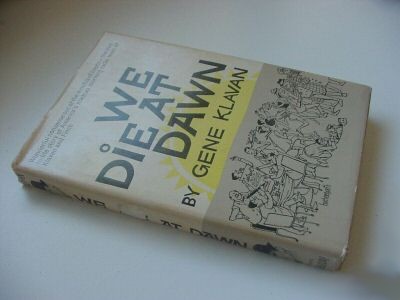
We Die at Dawn!

Gene Klavan was one-half of the 1960s morning radio show "Klavan and Finch." He died on April 8 2004 from complications of multiple myeloma. He was 79 and you've probably never heard of him.

Klavan actually launched his radio career at WTOP-TV in Washington D.C. It was the opposite of the normal media transition. He moved to New York in 1952 to join Dee Finch on the 1130 WNEW-AM morning show. Finch was the straight man to Klavan's wacy jokes. For the next 14 years, the duo improvised the popular four-hour program. Dee Finch retired in 1968, leaving Gene Klavan to do the AM Drive alone. He stuck with the solo act for another 9 years finally ditching WNEW for a gig at WOR-AM

He was voice of the afternoon drive time for another three years. Then he returned to WNEW for weekends in 1986. I do recommend reading his NY Times Obit. In his own way he was an early shock jock. It's tame by today's standards but his way of antagonizing his sponsors with his zany humor was considered risque at the time. It peaked when he threatened to fire a popular but fictional guest traffic reporter Trevor. WNEW was deluged with calls.

But Klavan only semi-retired. He hosted American Movie Classics on TNN and worked as a columnist for Newsday. In his career he found time to published two books: "We Die at Dawn" and "Turn That Damn Thing Off." We Die At Dawn is a cult classic among morning men, and required reading for those that have lived through the daily grind that is morning zoo. It's hard to find a readable copy for less than $100 these days.

There's an aircheck of gene here. Audio courtesy of airchexx.com. You should visit them, they are truly an amazing.

Monday, May 29, 2006

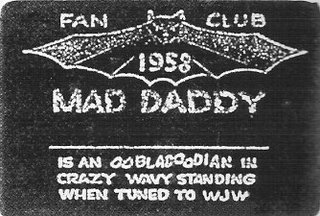
Mad Daddy on WJW

Pete “Mad Daddy” Myers was in fact the DJ that took the place of Alan Freed's time slot when he left WJW in Cleveland for WINS and the big time in New York. The San Francisco–born Myers gained his first broadcasting experience in psychological warfare for the Army during the Korean War.

Pete "Mad Daddy" Myers was overshadowed by big names such as Alan Freed and Dick Biondi and unfortunately has been overlooked by most rock and roll history. He was one of the strangest DJs in the north-east during his time at WHKK-AM, WJW-AM and WHK-AM in cities like Akron Cleveland and Detroit in the mid 1950s. He had a frenetic, rapid-fire patter delivered usually in rhyme. He is the man who coined the 1960s phrases still used today such as "wavy gravy" "mellow jello". His playlist was an eclectic mixture of rock and roll and R&B numbers featuring such oddities as "The Greasy Chicken" "Ghost Satellite" ...and he even wrote his own rhyming advertisements. http://www.recordsbymail.com/madDaddy.php

In January 1958, Pete "Mad Daddy" Myers joined the station from WHK-AM 640 in Akron, his program was heard nightly from 8 p.m. to midnight. He left briefly for WJW-AM, lasting less than a year before he split for a gig at WHK-AM. At the time, WHK was establishing itself as the Top 40 powerhouse in Cleveland. Here's where you get a hint at how nutty the guy was. WJW-AM enforced a 90-day non-compete clause, (as is so damn common now) and "Mad Daddy" could not be heard on WHK until August 10. To get a little attention during the downtime, Maddaddy did a bit of a publicity stunt. He parachuting from a Piper Cub 2200 feet over Lake Erie, and composed a poem on his way down.

After he was fished out of the water he handed out copies of the 45 record "Zorro" to hundreds of fans who greeted him on shore. At the "peak of his popularity at WHK-AM he hosted record hops and live after-midnight shows dressed in Dracula costume. In the summer of 1959 he moved to WHK's sister station in New York, WNEW-AM 1130 AM, where "Mad Daddy" was not well received. So in New York he had to be Pete Myers and ditch the Dracula routine. He did not like the gig. That went on for three grueling years, until 1963, when he moved to WINS-AM and resumed the "Mad Daddy Show." This show was syndicated to other stations until WINS-AM flipped format to all-news in 1965. (FYI: still all news today) Mad Daddy hung his head and dragged his feet all the way back to WNEW-AM. Again, he became Pete Meyers, at least while on air. This went on for three more year, when on November 4, 1968, when he killed himself with a shotgun shortly after he had been let go at WNEW. Dead dog records carries a disc of some airchecks here.

Although Mad Daddy left us for the on-air studio in rock and roll heaven almost 40 years ago, his spirit lives on in Cleveland. On weekdays at 4 pm, listeners tuning in to 830 WKTX-AM, can hear the son of Mad Daddy, Waxin' Mad Daddy Jackson doing a show in Mad Daddy's character, playing the music from Mada daddy's peak era: early rock, R&B and "Wavy Gravy" hot rod, monster, novelty and instrumental songs.

Monday, March 13, 2006

Radio for Women

Active rock was a boone to radio programers and advertisers alike. Their demographic cup overflowed with 18-20-somethings males. But before then and since the hunt has been on for the magic format that does the same for women.
In October 560 KLZ-AM put out a press release stating they were ditching their music format: "chosen by women for women" and going ESPN sports talk. At one time KLZ-AM was possibly the only station of its kind. It was a Hot AC/Classic hits hybrid resembling jack with a shorter playlist. But the chatter had a keen feminist edge. Yeah. On Friday nights their big feature program "songwriters live" hosted live (female only) song writers.

But the format wasn't working for KLZ. Company head Don Crawford Jr. said: "I don't know why the women of Denver didn't embrace it... Qualitatively, it worked, but quantitatively, it didn't." Regardless the format reappeared on KUTR-AM 820 a new CP circa 2005. http://www.utaham820.com/ I guess somebody likes it.

WNEW attempted essentially the same thing in 2003, the city leaned further left politically, but "Blink" still didn't work. They re-branded a few months later.

But the idea goes back even further....
Back In 1955 Sam Phillips of Sun Records launched 1430 WHER-AM, the “All-Girl Radio Station” in Memphis, TN. Phillips hired a staff of all female DJs, sales and admin to run the station. The experiment went on for seventeen years, their format didn't change until 1971. Today it's WOWW... another Radio Disney outlet. NPRs lost & found sounds did a nice long form program on WHER-AM. It's online here: http://www.npr.org/programs/lnfsound/stories/991029.stories.html

For those readers interested in feminist radio, I recommend you check out The feminist radio fun. An international project involving women in broadcasting and media politics.
http://www.womensradiofund.org/

Side note: While working in Seattle I met a retired sea captain names Philipe Jacque who's lifetime dream was to open an all-women radio station in Pt. Reyes, California. He's even tried to buy a decommissioned lighthouse for the job... but he couldn't get the investors together. Too bad.