Showing posts with label WHK. Show all posts

Monday, November 04, 2019

The History of LGBT Radio (Part 1)

The program The Gay '90s aired on 1420 WHK-AM in Cleveland, OH starting in 1993 and lasting over 6 years. Clevelandhistorical.org goes as far as to call it "The nation’s first gay and lesbian talk radio show."  It was certainly one of the earliest, but probably not the very first. But some of the nuance here may be ontological.

One of the most famous homosexual authors of all time is William Burroughs, who famously said “I have never been gay a day in my life." But host Buck Harris opened the program with the following words “Good evening Cleveland… Welcome to The Gay 90s, the voice of Northeast Ohio’s gay and lesbian community. It is the intent of this show to provide programming that represents the diversity of our gay and lesbian community..." This was a LGBT focused radio program. There was no ambiguity.

The name was a pun. The Gay Nineties is an nostalgic term which refers to the decade of the 1890s, though popularized only retroactively in the 1920s. (The modern usage of the word gay shows up around the same time in a work by Gertrude Stein.) The book Queer Airwaves: The Story of Gay and Lesbian Broadcasting by Phylis W. Johnson and Michael C. Keith had only a little to say about the The Gay '90s.
"In March 1993 another commercial outlet began to experiment with gay talk. Cleveland's talk radio WHK-FM initially aired The Gay '90s on Friday nights, 9:00 PM to 11:00 PM, but soon moved it to Monday nights to reach more young people. Despite the shows success with listeners and advertisers, Program Director Paul Cox believed that syndication was not in it's near future. Cox didn't think America was ready for a gay talk show, adding that "it would take a lot of GMs and PDs with a hell of a lot of courage" to syndicate a gay talk show in the United States."
Mr. Keith also mentioned the program in his book Radio Cultures: The Sound Medium in American Life but sadly the call sign is typoed in the one line reference of my 2008 printing as WHF. The program aired on Friday nights, starting at 9:00 PM. The two-hour show later moved to Mondays. Buck Harris had a background in public health policy, not broadcasting. In 1984 he was appointed by Cleveland Governor Dick Celeste as a Gay Health Consultant to the Department of Health. As he set up AIDS programs in the state, he did radio and TV interviews which elevated his public profile, and also gave him the experience he would later need for his own show. He certainly had the voice for it. More here and here.

Harris did some fill in at WHK-AM and liked it so much that he offered to buy airtime and get his own advertisers. When the show debuted on March 26th, 1993 the radio station was greeted with a bomb threat. The threat was taken seriously, after the broadcast, police escorted Harris and station staff to their vehicles. There was no bomb, though Harris continued to get death threats. The radio program continued uninterrupted for another 6 years. Except for in 1995, when the show was pre-empted twice when the Cleveland Indians made the World Series. Subsequently Harris moved the show to 1300 WERE-AM. More here.

The final program was on July 11th, 1999. The program had hosted Congressmen, Grammy Award winners, singers, songwriters, artists, civil rights activists, and radio call in talk like no program ever before. I think what distinguishes the show the most is what a commercial success it was. Buck said in a 1996 interview that he didn't make money on the program. But The Gay 90s proved that the potential was there. The show was one bold syndication away from national success. Buck Harris died in September of 2018 from complications of lung cancer. He was 70 years old.

Monday, June 22, 2015

The Planters Pickers

At first, all I found was a single program announcement in an issue of the The Evening Independent newspaper dating to November 19th 1929.
 "Southern melodies, talking picture theme songs and negro spirituals will be blended by Billy Artz's Orchestra and the Hallelujah Singers, a negro male quartet, in the Planters Pickers program to be heard over the NBC system tonight at 10 o'clock from WEAF."
An issue of the Reading Eagle newspaper revealed that the program debuted on WEAF on October 25th that year. Even that first episode was featuring the Billy Artz's Orchestra and the Hallelujah Singers. Those two groups together were the "Planters Pickers."  The same announcement for the 30-minute program was carried by The Evening Independent newspaper out of St. Petersburg, FL. I also found an issue of the Bradford Era newspaper in listing a 7:00 PM performance on 1390 WHK-AM. At that time, the station was a member of the NBC network... and this was a syndicated program. The show either had moved to 10:00 PM on Fridays or it's a misprint.


Under the name Billy Artz Orchestra, the group cut at least 2 sides that were pressed on Oriole records the cut at few others on Banner, Perfect and Romeo. Later he led the strangely named Henry and George Orchestra. That was his recording career in a nutshell from 1929 to 1931. The Planters Picker just had the one season on NBC in the Fall of 1929. The Billy Artz Orchestra later ended up as the studio band for a few short-lived programs:  The Royal Vagabonds in 1932, the Bob Burns show in 1941, on WABC-AM solo in 1942, and house band on "Blondie," a radio sitcom based on the comic strip which aired in 1946.

Unfortunately I have no information on the Hallelujah Singers quartet. The name was used by different black singing groups going back to at least 1875. It could very well be members of a known group. The Hallelujah Quartet for example was a gospel group of similar description who performed on a number of radio stations around 1929-1931. It may have been them.

Wednesday, September 21, 2011

WHK, WKNR & WHKW

Frequency swaps have become a regular event for those of us that dabble in radio metadata.  The FCC, for all their omniscience doesn't care. To them all that moved was a brand name and a format, maybe a callsign. If that be the case all that needs filled out is the correct paperwork. The channel and the engineering data remain unchanged so there's no heavy lifting.

Just a week ago WEEI-FM, WVEI-FM, did a shuffle across New England, to the loss of WMKK and the debut of and WWEI-FM.  In the deal WLOB-FM became WPPI-FM, simulcasting WPEI-FM. It got me thinking about larger swaps; the unusual swaps. In July of 2001 there was a 3-company, 7-station swap that all went down inside the confines of the Cleveland metro.

Salem Communications moved the WHK-AM calls off 1420 and moved it's religious format to 1220-AM.  this displaced the WKNR-AM calls from 1220 which then moved to 850 along with it's sports-talk format. Salem then sold the new 1420 WHK-AM to Radio Seaway who changed the calls to WCLV-AM with a new format of Adult standards.

At the same time Seaway moved the WCLV-FM calls from 95.5 to 104.9. This displaced WAKS-FM, a Clear channel station who then moved to 96.5 in Akron! (This was a huge coup for Clear Channel,104.9 was a Class A in Lorraine, and 104.9 blanketed Cleveland, Akron and most of Canton.) In trade, Clear Channel's WKDD on 96.5 in Akron moved to 98.1 in Canton. Salem had owned 98.1 but in ceding it to Clear Channel displaced Salem's WHK-FM. Which was then just moved that to the available 95.5 that WCLV hopped off in Lorraine, OH.

Here's why they did that big RF square dance. After WHK-AM landed on 1220, it started simulcasting religious programming on WHKW-AM on  1440. Before that simulcast started they'd kept the stick dark, and parked the WFHM-AM calls on it which they now could traded to Salem who branded it on 95.5 which was now Christian Con. Obviously a WFHM-AM and a WFHM-FM could have co-existed, but not under different companies with different programming too much brand confusion.


There' s a bit of post-script on this one. Four years later Salem bought 1420 back from Radio Seaway and changed it's calls to WHK-AM. They relaunched 1440 as a simulcast of WHK-AM as WHKZ-AM which continued through today.  then they changed the WHKZ-AM calls to WHKW-AM a week later.

As nutty as that sounds it was all sort of caused by a tight ownership cal problem started way back in 1998 by Jacor. In 1997 Jacor bought 850 WKNR-AM  from Cablevision Systems. It had previously been running a mix of sports and talk. Jacor spun off the live sports contracts to WTAM-AM. But that's all they wanted it for, they immediately flipped the station and sold it to Capstar as an even trade for WTAE-AM in Pittsburgh. But then in 1999, Chancellor Media merged with Capstar Broadcasting to form AMFM. So in 2000 AMFM sold WKNR back to Salem! At that time AMFM was trying to merge with Clear Channel and the justice department requires some divestiture and WKNR-AM was what got the ax. 

In 2007 Salem sold it again this time to Good Karma Broadcasting. I have no doubt it'll be back.


Monday, May 29, 2006

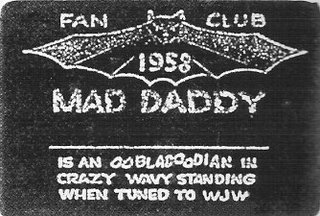
Mad Daddy on WJW

Pete “Mad Daddy” Myers was in fact the DJ that took the place of Alan Freed's time slot when he left WJW in Cleveland for WINS and the big time in New York. The San Francisco–born Myers gained his first broadcasting experience in psychological warfare for the Army during the Korean War.

Pete "Mad Daddy" Myers was overshadowed by big names such as Alan Freed and Dick Biondi and unfortunately has been overlooked by most rock and roll history. He was one of the strangest DJs in the north-east during his time at WHKK-AM, WJW-AM and WHK-AM in cities like Akron Cleveland and Detroit in the mid 1950s. He had a frenetic, rapid-fire patter delivered usually in rhyme. He is the man who coined the 1960s phrases still used today such as "wavy gravy" "mellow jello". His playlist was an eclectic mixture of rock and roll and R&B numbers featuring such oddities as "The Greasy Chicken" "Ghost Satellite" ...and he even wrote his own rhyming advertisements. http://www.recordsbymail.com/madDaddy.php

In January 1958, Pete "Mad Daddy" Myers joined the station from WHK-AM 640 in Akron, his program was heard nightly from 8 p.m. to midnight. He left briefly for WJW-AM, lasting less than a year before he split for a gig at WHK-AM. At the time, WHK was establishing itself as the Top 40 powerhouse in Cleveland. Here's where you get a hint at how nutty the guy was. WJW-AM enforced a 90-day non-compete clause, (as is so damn common now) and "Mad Daddy" could not be heard on WHK until August 10. To get a little attention during the downtime, Maddaddy did a bit of a publicity stunt. He parachuting from a Piper Cub 2200 feet over Lake Erie, and composed a poem on his way down.

After he was fished out of the water he handed out copies of the 45 record "Zorro" to hundreds of fans who greeted him on shore. At the "peak of his popularity at WHK-AM he hosted record hops and live after-midnight shows dressed in Dracula costume. In the summer of 1959 he moved to WHK's sister station in New York, WNEW-AM 1130 AM, where "Mad Daddy" was not well received. So in New York he had to be Pete Myers and ditch the Dracula routine. He did not like the gig. That went on for three grueling years, until 1963, when he moved to WINS-AM and resumed the "Mad Daddy Show." This show was syndicated to other stations until WINS-AM flipped format to all-news in 1965. (FYI: still all news today) Mad Daddy hung his head and dragged his feet all the way back to WNEW-AM. Again, he became Pete Meyers, at least while on air. This went on for three more year, when on November 4, 1968, when he killed himself with a shotgun shortly after he had been let go at WNEW. Dead dog records carries a disc of some airchecks here.

Although Mad Daddy left us for the on-air studio in rock and roll heaven almost 40 years ago, his spirit lives on in Cleveland. On weekdays at 4 pm, listeners tuning in to 830 WKTX-AM, can hear the son of Mad Daddy, Waxin' Mad Daddy Jackson doing a show in Mad Daddy's character, playing the music from Mada daddy's peak era: early rock, R&B and "Wavy Gravy" hot rod, monster, novelty and instrumental songs.