
Showing posts with label remote control. Show all posts
Showing posts with label remote control. Show all posts
Friday, January 30, 2015


Wednesday, February 13, 2013
Marilyn Monroe's Drones
Increasingly often I see the press giving coverage to drone warfare. It's good. The issue is morally ambiguous and worthy of public debate. But the use of drones aka radio controlled pilot-less aircraft is nothing new. Nikola Tesla patented radio controlled vehicles in 1898 with a small boat. In a 1915 dissertation on the concept of unmanned flight, Nikola Tesla described an armed, pilot-less aircraft capable of defending the USA. That makes this idea almost a century old.
 But the first real-world military use of drones was in 1935. Reginald Denny, Hollywood actor and former WWI British gunner in the Royal Flying Corps. He opened a model plane shop at 5751 Hollywood Blvd in 1934 known as Reginald Denny Hobby Shops. Denny bought a plane design from Walter H. Righter in 1938. They were marketed as the "Dennyplane," with an engine called the "Dennymite".
Righter was only 33 but already a veteran engineer who had worked at the Kinner Airplane & Motor Corp, Hughes Aircraft, and Lockheed. Righter actually manufactured thousands of these for Denny in his own garage. Sales were consistent enough for Righter to move out of the garage and open a 12-man shop at 626 San Fernando Road in Glendale. More here.
Denny thought that cheap RC planes would make for great target practice for training anti-aircraft gunners. It was something he knew a bit about from WWI. In 1935 he demonstrated a prototype target drone for the US army. In 1940, Reginald Denny Hobby Shops won a US Army contract for their radio-controlled target drone, the OQ-2 Radioplane. The Army placed an order for 53 model RP-4s, which the military designated the OQ-1. In1941 US Army placed an even bigger order for RP-5s, which became the US Army OQ-2. Denny manufactured nearly fifteen thousand drones for the US Army during World War II.

The US Navy also bought into the target drone idea. They signed an order for thousands as well and designated it the TDD-1. A factory was opened in the old Timm aircraft plant at the Van Nuys Airport near Los Angeles for production. Because it was the height of WWII most of the workers were women. It was there in 1944 an Army photographer photographed Norma Jeane Dougherty at work. Those pictures led to a screen test, and to the fame of a woman later known as Marilyn Monroe.
Righter was only 33 but already a veteran engineer who had worked at the Kinner Airplane & Motor Corp, Hughes Aircraft, and Lockheed. Righter actually manufactured thousands of these for Denny in his own garage. Sales were consistent enough for Righter to move out of the garage and open a 12-man shop at 626 San Fernando Road in Glendale. More here.
Denny thought that cheap RC planes would make for great target practice for training anti-aircraft gunners. It was something he knew a bit about from WWI. In 1935 he demonstrated a prototype target drone for the US army. In 1940, Reginald Denny Hobby Shops won a US Army contract for their radio-controlled target drone, the OQ-2 Radioplane. The Army placed an order for 53 model RP-4s, which the military designated the OQ-1. In1941 US Army placed an even bigger order for RP-5s, which became the US Army OQ-2. Denny manufactured nearly fifteen thousand drones for the US Army during World War II.

The US Navy also bought into the target drone idea. They signed an order for thousands as well and designated it the TDD-1. A factory was opened in the old Timm aircraft plant at the Van Nuys Airport near Los Angeles for production. Because it was the height of WWII most of the workers were women. It was there in 1944 an Army photographer photographed Norma Jeane Dougherty at work. Those pictures led to a screen test, and to the fame of a woman later known as Marilyn Monroe.
Wednesday, August 29, 2007
Wireless Blimp!
This is pretty obscure, possibly apocryphal. It's usually Tesla that gets credit for inventing remote control as I explained here in 1898. But this piece refers to this demonstration as the "first of its 'kind." Now possibly it's the first wireless remote control of aircraft, or not. This might even be an Internet hoax as I cannot verify elsewhere. But whatever it's entertaining and feasible.  In 1912 Professor M. O. Anthony and Leo Stephens gave a demonstration of a Wireless Airship. It was a small powered blimp used to demonstrate remote control of aircraft by wireless telegraphy.
200 members of an automobile club came to see photographs and short films of the airship in action. A unanimous vote was passed urging Congress to appropriate monies for the development of aeronautics for the Army. ...And check this out, from the same page: Here modern nerds replicate. Hooray for wildly entertaining nerds.
In 1912 Professor M. O. Anthony and Leo Stephens gave a demonstration of a Wireless Airship. It was a small powered blimp used to demonstrate remote control of aircraft by wireless telegraphy.200 members of an automobile club came to see photographs and short films of the airship in action. A unanimous vote was passed urging Congress to appropriate monies for the development of aeronautics for the Army. ...And check this out, from the same page: Here modern nerds replicate. Hooray for wildly entertaining nerds.
Monday, March 26, 2007
The Clicker uses radio
You can thank Nikola Tesla, for this one too. Back in 1893 he described in Patent (number 613809), named "Method of an Apparatus for Controlling Mechanism of Moving Vehicle or Vehicles". It was the first remote control of anything, TV or otherwise... predates TV of course.
Eugene F. McDonald Jr., the founder of Zenith believed TV viewers would not tolerate commercials indefinitely and was convinced that sooner or later commercial television would collapse. He was full bore behind the development of the remote so that people could avoid watching ads.
 The Zenith Radio Corporation was the early leader in this arena. Before they unveiled any actual remote controls they released this weird hand held control. It didn't change channels though. It was for a 1948 Garod TV set and what it did was enlarge the picture. they called it a Telezoom. It was wired to the TV set, with a 20 foot long cable. No radio was involved.
Zenith quickly decided that people wanted to change the channel way more than they wanted to zoom in. They released the first real remote in 1950 nicknamed the "lazy bones." It too was tethered to the TV via a 20 foot cable. No radio here either.
In 1955 Zenith figured out that the tether was not popular, it was a tripwire, garrote and jump rope for children and the family pet and it had to go. They then put together the first real wireless remote. It was called the Flashmatic. It worked by shining a beam of light onto a photoelectric cell. It's major shortcoming was that the photoelectric cells couldn't distinguish between light from the remote and light from any other source. it also was very directional and required that the clicker be precisely pointed. and still no radio...
The next year Robert Adler developed the archetypal clicker, the Zenith Space Command. It too was wireless but it worked mechanically to produce ultrasonic sounds. Literally pushing a button struck a bar, each bar emitted a different frequency. The sensor in the TV received these with a microphone. The downside was that the tones were not inaudible. Both young women and dogs often would hear the shrill tones. The channel also could be changed inadvertently by naturally occurring noises. Jingling keys, xylophones and dog whistles among other things. and worse yet.. there was no radio involved at all. More here.
Here's the radio part. All remotes for your TV use either a "near" infrared diode to emit a beam of light to the device, or a radio signal. This beam/wave is a carrier wave with signals that trigger functions being it's modulated frequency. You can actually hear this work with some remotes even on the infrared carrier by playing with the clicker next to an AM radio.
Eugene F. McDonald Jr., the founder of Zenith believed TV viewers would not tolerate commercials indefinitely and was convinced that sooner or later commercial television would collapse. He was full bore behind the development of the remote so that people could avoid watching ads.
The Zenith Radio Corporation was the early leader in this arena. Before they unveiled any actual remote controls they released this weird hand held control. It didn't change channels though. It was for a 1948 Garod TV set and what it did was enlarge the picture. they called it a Telezoom. It was wired to the TV set, with a 20 foot long cable. No radio was involved.Zenith quickly decided that people wanted to change the channel way more than they wanted to zoom in. They released the first real remote in 1950 nicknamed the "lazy bones." It too was tethered to the TV via a 20 foot cable. No radio here either.
In 1955 Zenith figured out that the tether was not popular, it was a tripwire, garrote and jump rope for children and the family pet and it had to go. They then put together the first real wireless remote. It was called the Flashmatic. It worked by shining a beam of light onto a photoelectric cell. It's major shortcoming was that the photoelectric cells couldn't distinguish between light from the remote and light from any other source. it also was very directional and required that the clicker be precisely pointed. and still no radio...
The next year Robert Adler developed the archetypal clicker, the Zenith Space Command. It too was wireless but it worked mechanically to produce ultrasonic sounds. Literally pushing a button struck a bar, each bar emitted a different frequency. The sensor in the TV received these with a microphone. The downside was that the tones were not inaudible. Both young women and dogs often would hear the shrill tones. The channel also could be changed inadvertently by naturally occurring noises. Jingling keys, xylophones and dog whistles among other things. and worse yet.. there was no radio involved at all. More here.
Here's the radio part. All remotes for your TV use either a "near" infrared diode to emit a beam of light to the device, or a radio signal. This beam/wave is a carrier wave with signals that trigger functions being it's modulated frequency. You can actually hear this work with some remotes even on the infrared carrier by playing with the clicker next to an AM radio.
Thursday, January 05, 2006
The Radio Controller
I just read this very detailed piece on Radio Control. It's kind of an overview of radio control theory, entitled "What Happens When I Wiggle the Sticks." The author, Neil McGrath, is a British radio-frequency electrical engineer whose hobby is radio controlled power boats.
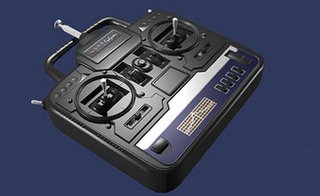 The title was quite the grabber. What does happen when I wiggle the sticks? Below I quote:
1. The transmitter broadcasts a radio signal via the antenna containing the positional information set by the controls.
2. The receiver picks up the radio signal via its antenna and decodes the positional information.
3. The receiver distributes the information to the electronic speed control and the rudder servo
4. The electronic speed control switches the main battery power on and off at high speed to regulate the power output of the motor to the level set by the associated transmitter stick.
5. The servo arm will move to the position set by the transmitter stick.
6. Power for the motor comes from the main battery pack.
7. The power for the receiver comes from an independent battery eliminator circuit. The BEC will provides voltage to the receiver from the main battery pack.
8. The power supply for the servo and the control circuitry in the speed controller come from the receiver
All radio control systems generate a radio carrier wave, at a frequency that is determined by the crystal used in the transmitter. These are thankfully not licensed individually. The FCC handles these devices in bulk by allotting a certain set of frequencies and parameters to the devices. The carrier wave is modulated to carry the digital information set by the transmitter controls. There are two methods of modulation used by R/C systems, AM and FM. As a third variable some use a PCM radio to transmit digital data on the FM carrier wave. This is conceptually not that different from IBOC.
In 1898, Nicola Tesla staged the first demonstration of radio control. His invention (patent No. 613,809), took the form of a radio-controlled boat, a heavy, low-lying, steel craft about four feet long. At that time radio itself had not been officially patented yet! Tesla's own radio patent wasn't granted until March 1900! Initially examiners from the US Patent Office were reluctant to recognize improbable claims made in the application "Method of and Apparatus for Controlling Mechanism of Moving Vessels or Vehicles." Confronted with a working model, however, examiners had to issue approval. ...And today we use it to drop missiles on people. Oh, How far we have come.
Subscribe to:
Posts (Atom)

 Posts
Posts


