Wednesday, April 22, 2015
Marconi Rides Again!
The patent is a difficult read even on a scale of 19th century electrical patents. It's a mix of wrong assumptions, archaic terminology and technically pedantic. But this one uniquely contains new and only inadvertently patented technology. Yes. Marconi drew, but did not describe a unique feature within the patent. Fixated on building coil configurations upon his prior patent 586,193 he missed something big.
At Cambridge, Gehan Amaratunga and Dhiraj Sinha led a group of engineers looking into that very detail. The drawing depicts a transmitter linked to an antenna which is connected to a coil. But the coil had one end grounded (marked "E" for Earth) and the RF signal was clearly fed to the middle of the coil. That detail inspired Amaratunga's team to develop a way to reduce the size of a GHz antenna using dielectric material to emit radio waves. More here. Early testing with piezoelectric films at 1575.42 MHz have already proved that the technique can be used to radiate 1 watt at 60% efficiency from a tiny chip.
Bear in mind how amazing this omission was. This patent was at the center of a legal dogfight back in 1900. The patent addressed the endemic problem of RF interference. It resolved the issue by tuning all the primary components: coils, aerials etc. That's why the patent is so specific with the number of turns of wire in each layer on each coil. There was no other way to tune a circuit at the time. However the solution was stolen directly from an 1897 patent held by Professor Oliver Lodge. Furthermore, Tesla patent 645,576, granted in 1900 described a four-circuit system for a transmitter and receiver with all four circuits tuned to the same frequency. In 1892 William Crookes first predicted tunable transmitters would be invented. He didn't predict that Marconi would then steal it. More here. But my main point there is that three highly competent radio engineers looked that that configuration and didn't see what Amaratunga saw.
Previously it was not understood why or how a piece of dielectric material could radiate signals when a RF signals were applied at one end. It's completely counter-intuitive. All of our understanding began with 100 year old equations developed by Maxwell. The IEEE refers to the behavior as "asymmetric coupling between the spark generator and the antenna." It allows the transformation of the RF electric signal into electromagnetic radiation. The concept is borrowed from quantum theory and it's the first explanation of how Marconi’s transmitter emitted electromagnetic waves over a century ago. More here.
Wednesday, June 18, 2014
DIY Singing Tesla Coil!
Monday, January 06, 2014
Leonardo Torres y Quevedo Telekino
I have written before about the history of radio control and strongly invoked the hallowed name of Nikola Tesla. In 1898, Nicola Tesla staged the first demonstration of radio control. His invention (patent No. 613,809), took the form of a radio-controlled boat, a heavy, low-lying, steel craft about four feet long. At that time radio itself had not been officially patented yet! Tesla's own radio patent wasn't granted until March 1900!
But Tesla didn't do much more with the technology. He licensed his patent and moved on to his other projects. The next inventor to take up the cause was Leonardo Torres y Quevedo Torres. Three years after Tesla won is patent, Torres presented the Telekino at the Paris Academy of Science. In 1903 he did an experimental demonstration of his Telekino... a radio controlled robot He went on to patent his robot in France, Spain, Great Britain, and the United States.
Torres Quevedo has been working on the idea since about 1901. The term "Telekino" comes from from two Greek words "tele" meaning 'at a distance' and "kine" meaning movement. So it means "movement at a distance" which is of course the whole idea of radio control. His Telekino turned the wheel of a tricycle forward and back and steered. By 1905 Quevedo was applying his ideas to remote control boats as Tesla had demonstrated 7 years earlier.
In 1905 Torres Quevedo organized a public demonstration of a radio controlled boat at a lake in Madrid. If that reminds you of Tesla, that's because it's what he had in mind. Tesla's boat mostly controlled the rudder. Quevedo had server control of the motor as well. He later did another more organized event at the port city of Bilbao was a success in some regards but tit didn't win him the government contracts he wanted. There would be no radio controlled torpedoes or war ships. He moved on to new projects and our dystopian future of drone warfare was delayed slightly.
Monday, May 20, 2013
Radio Proximity Fuses
Into this technological melee they dropped William Alan Stewart Butement. In 1931 he and P. E. Pollard, invented a shipboard radio device for the detection of ships. Today we call it radar. It operated at 600 MHz and using pulse modulation was able to detect ships100 yards away. The Navy wasn't big on it, but others saw potential. By 1938 Butement had ramped up his invention into large scale devices that could be used from land to protect the coast.
In 1939 Butement attempted to improve anti-aircraft guns. It's hard to hit a moving target. He had a better idea. His plan was a very compact Radio Direction Finder (RDF) unit placed on the projectile. It would then trigger the detonation when near the target. This was not simple. The RDF had to be small and also durabel enough to be fired out of a cannon. This circuit included glass vacuum tubes. Somehow just over a year the United States was manufacturing projectiles with a proximity fuse. This was also called a VT (variable-time) fuse.
This was not an induction trigger. It wasn't sensing a ferrous body. It was detecting the reflection of radio signals. A later improvement was The transmitter which used the shell body as an antenna and sent out a continuous wave at around 200 MHz. As the shell approaches a reflecting object, (a ship, a plane, the ground) the reflected signal created interference. That pattern changes with proximity. As the objects get closers the signal moves in and out of resonance as the reflected signal length changes; half a wave is resonant, so is a quarter, an eighth etc.
This causes a small oscillation of the radiated power and consequently the oscillator supply current of about 200–800 Hz, the Doppler frequency. This signal is sent through a band pass filter, amplified, and triggers the detonation when it exceeds a given amplitude. Later in life, Butement said that he considered the proximity fuse as his most significant accomplishment.
Monday, August 20, 2012
Goddamn Tesla Museum
Wednesday, August 24, 2011
Broadcast Energy Transmitter
I bring this up because in recent years a few companies have made less crazy, and more believable attempts in this arena. In 2007 Powercast actually did come demos at CES (Consumer Electronic Association) with some small scale equipment that actually did work. The idea is that they are broadcasting over a small area, and that RF energy instead of just rectifying the signal, it's "harvested" to charge a battery, for example. Now as an engineer I know that small transmitters output bupkis. The RF field around a 1 or 2 watt transmitter is just a couple mV/m. But Powercast isn't imagining this to be a high amperage product, they're just suggesting that they can use it to continually charge a battery via their special receivers. That's at least in the realm of reality. Allow me to quote directly from their own website:
Their CEO explained further, "Our solution is, if talk time (on a cell phone) is 5 1/2 hours, by trickle-charging at work, now talk time is 10 hours because the battery never gets to dead..." It's that word trickle-charging that tells me how this is working. It's not that kooky. I can imagine a wireless keyboard, a webcam, or just LEDs, running off a system like this, but not a stereo, or a power drill. This is strictly for low amperage devices and batteries."Powercast is a leading innovator of wireless power technology based on RF energy harvesting. Micro-power can be provided over distance using the same common radio waves that are widely used by many devices including mobile phones, cordless phones, etc. Batteries can be recharged remotely and without wires, or devices can be made completely battery-free. Primary use includes wireless sensors for commercial, industrial, and defense applications."
Another mroe recent one is the Rectenna.The word "Rectenna" starts with the wrong kind of prefix for this crowd. Interestingly both rectum and rectify have related word roots. Rectify comes from from the old French rectifier meaning "to make straight." That comes form the Latin rectificare meaning "make right" from the earlier Latin rectus meaning straight. The word rectum is from the Latin intestinum rectum meaning "straight intestine, which again comes from the Latin regere "to straighten." The word Rectenna is actually a portmanteau of the two words rectifying and antenna. What it does is convert radio waves into electricity (ostensibly.) More here.
My suspicion is that most of these actually operate via induction. There is no actual radio signal, just an electromagnetic field. Induction is the production of voltage in a conductor which is moving through a magnetic field. But the conductor doesn't have to move, Faraday's Law states that a varying electromagnetic field will induce an electric current. In other words, you can vary the field to the same effect and leave the conductor stationary. The theory dates to 1831, and for the record induction is DEFINITELY public domain. The problem is that to induce a strong (i.e. large) em field you consume much mroe energy than you receive. It's very lossy. But it's all still sci-fi fun. You can watch their dog-and-pony show here:
Friday, January 15, 2010
Charles Steinmetz was a dwarf
It was Charles P. Steinmetz who inspired, then hired Ernst Alexanderson in 1902. Steinmetz is the man who literally wrote the book on Alternating current, the basis for power. The book was "Theory and Calculation of Alternating Current Phenomena." It was published in 1900 by Electrical World & Engineer. The book was so revolutionary that it was republished in 1908 by Mcgraw Hill and then again in 1916. By the way, he was a dwarf, and a hunch back. (and a socialist)That's him on the right, you might recognize the fellow on the left. His ideas and his research in alternating current are the basis for electrical lightning, our power grid, and power transmission. He worked for General Electric in the early 1900s. However, this was not his idea alone. His life's work was mostly comprised of expounding upon the work of Nikola Tesla. Tesla held the actual patent from 1889 on A.C. #413353.
Charles Proteus Steinmetz was born Carl August Rudolph in what we now call Poland. At the time it was still in a kingdom called Prussia. It became part of Germany in 1971. In 1888 his Socialist ideas suddenly got ledss popular and he fled to America. [Notice there how our tolerance of others was to our benefit.]
His first job was for Rudolf Eickemeyer in New York. Eickemeyer wasn't much of a scientist, but he was very driven. Eickemeyer was erratic, he built hat-making machines, worked on dynamos. In 1893 with Stephen D. Field, and Steinmetz he invented a system of electric street cars which he sold to GE. GE got some other odds and ends, prototypes, patents and even Mr. Steinmetz in the deal.
It was at General Electric where Steinmetz went from theory to application. He worked on arc lamps, and power transmission lines. He also worked on artificial lightning. Not lighting, lightning. Ultimately a lot of what he did was defining the mathematical foundation for A.C. Steinmetz created the term phasor for his simplified mathematical representation of an electricity waveform. Somehow after writing 13 books, it's this term for which he is most remembered. He died on October 26, 1923.
Friday, July 10, 2009
Tesla Day!
Thursday, April 23, 2009
Oliver Lodge in the ether

Lodge performed his demonstration one year after Tesla transmitted a radio wave, but still before Marconi managed the feat. It makes him an early pioneer, and one that's often overlooked. He was the physicist that used the term "coherer" to describe the early radio detecting device. Branly called it a "radio-conductor"a term that didn't catch on.
Lodge was a believer in the aether (ether). He believed that radio waves occupied a somewhat fantastical medium called ether which only radio waves could pass through. He demonstrated this at a meeting of the British Association for the Advancement of Science at Oxford University. he was a professor of physics and mathematics at University College in Liverpool and one of the few people alive at that time who could assemble such a device.
Lodge used a Coherer based on Edouard Branly's coherer design. But he made one small improvement. That early coherer was a glass tube of metal filings. When a current was applied they clung together lowering the resistance. Lodge created what he called a "trembler" which shook them apart to return the resistance to it's initial value, restoring sensitivity. This "trembler" was literally a tiny mallet. I don't mean to deprecate the improvement; that separate concept was important. Later revisions led to what was called a decoherer, a "trembler" powered by the cohering current. Tesla's improvement to the trembler simply rotated.
Lodge was a little crazy. He was a firm believer in life after death, and was known to consult psychic mediums who helped him consult with death friends and relatives. This is probably where that ether crap originates from. Nonetheless in 1898, Lodge applied for a patent [ 609,154] for an adjustable induction coil that made it possible to tune the transmitter and receiver. Within the decade the coherer was sidelined in favor of crystal tuners, but tuning, that improvement was fundamental. As late as 1943 American courts were affirming Lodge's patent over Marconi's tuned circuits.
Radio wasn't everything. He invented the spark plug, the loud speaker and was knighted in 1902. He retired in 1919 from teaching and ether in general to the family trade; a clay merchant.
Monday, March 26, 2007
The Clicker uses radio
Eugene F. McDonald Jr., the founder of Zenith believed TV viewers would not tolerate commercials indefinitely and was convinced that sooner or later commercial television would collapse. He was full bore behind the development of the remote so that people could avoid watching ads.
The Zenith Radio Corporation was the early leader in this arena. Before they unveiled any actual remote controls they released this weird hand held control. It didn't change channels though. It was for a 1948 Garod TV set and what it did was enlarge the picture. they called it a Telezoom. It was wired to the TV set, with a 20 foot long cable. No radio was involved.Zenith quickly decided that people wanted to change the channel way more than they wanted to zoom in. They released the first real remote in 1950 nicknamed the "lazy bones." It too was tethered to the TV via a 20 foot cable. No radio here either.
In 1955 Zenith figured out that the tether was not popular, it was a tripwire, garrote and jump rope for children and the family pet and it had to go. They then put together the first real wireless remote. It was called the Flashmatic. It worked by shining a beam of light onto a photoelectric cell. It's major shortcoming was that the photoelectric cells couldn't distinguish between light from the remote and light from any other source. it also was very directional and required that the clicker be precisely pointed. and still no radio...
The next year Robert Adler developed the archetypal clicker, the Zenith Space Command. It too was wireless but it worked mechanically to produce ultrasonic sounds. Literally pushing a button struck a bar, each bar emitted a different frequency. The sensor in the TV received these with a microphone. The downside was that the tones were not inaudible. Both young women and dogs often would hear the shrill tones. The channel also could be changed inadvertently by naturally occurring noises. Jingling keys, xylophones and dog whistles among other things. and worse yet.. there was no radio involved at all. More here.
Here's the radio part. All remotes for your TV use either a "near" infrared diode to emit a beam of light to the device, or a radio signal. This beam/wave is a carrier wave with signals that trigger functions being it's modulated frequency. You can actually hear this work with some remotes even on the infrared carrier by playing with the clicker next to an AM radio.
Wednesday, June 28, 2006
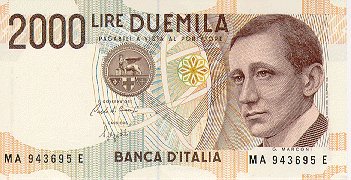
Everybody loves Guglielmo!
Many scientists and inventors contributed to the invention of radio, Oliver Lodge, Hans Christian Ørsted, Michael Faraday, Heinrich Rudolf Hertz, Jagadis Chandra Bose, Alexander Popov, Nikola Tesla, Thomas Alva Edison, Nathan Stubblefield, to name a few...
But it was Marconi's practical system that first achieved widespread use, so gets the championship belt that reads "father of radio." Marconi made his first wireless transmission across water May 13th 1897, from Lavernock Point, South Wales to Flat Holm Island. His famous trans-Atlantic broadcast at Signal Hill in Canada was in 1901. But Marconi's system was based primarily on Nikola Tesla's system. His first test were based entirely on notes from lectures that Tesla had been giving in that era. Later revisions drew on the work of a contemporary radio geek David E. Hughes.
FACT: At the time his contemporaries thought that a radio wave could only be transmitted in the line of sight. No signal could travel between points beyond the curve of the earth. Marconi didn't buy into this. To silence critics he built a spark-gap transmitter to produce a signal with a frequency of approximately 500kHz and a power a peak pulse power of several tens of megawatts. To reach Newfoundland the signal would have to bounce off the ionosphere twice. The supposed success of the transatlantic attempt was recently contested by Dr Jack Belrose. Belrose is no crank, he actually went as far as to reenact the experiment. He believes that Marconi heard only random atmospheric noise and mistook it for the signal. This is pretty believable when you realize that the letter "S" was the message and that in more code that's just three dots. ". . ."
FACT: Marconi joined the Italian fascist party in 1923. Benito Mussolini made Marconi President of the Accademia d'Italia, which also made him a member of the Fascist Grand Council. This was no technicality. He insisted that his correspondence was addressed to "His Excellency the Senator Marchese Guglielmo Marconi, president of the Royal Academy of Italy, Member of the Fascist Grand Council". He attended pro-fascist rallys, wrote pro-fascist articles, made fascist speeches on the radio in a number of countries. Then in 1935 a greatly ironic turn of events, when Mussolini invaded Ethiopia, Marconi found himself [as a national of a country subject to sanctions imposed by the League of Nations] prevented from delivering a talk about the invasion on the BBC.. the broadcasting corporation he had helped to found. ...They don't teach that part in history class.
FACT : Marconi didn't know Tesla, but he did know David E. Hughes through a man named William Henry Preece. Sometime after 1896, Marconi befriended Preece, both of them were experimenting with transmissions across the Conwy estuary. This is the same site he would later transmit Morse code signals to Australia. Preeca had discovered radio induction while developing a telephone system in 1895. While Hughes did not intend to aid Marconi, Preece certainly did. Preece solicited financial assistance from the Post Office to help expand Marconi's work. He was one of Marconi's most ardent early supporters. More here.Thursday, May 18, 2006
The Elusive John Stone
Stone is yet another obscure but important man in early radio engineering. He made many contributions to the fields of telephony and radio telegraphy while working at the original Ma'Bell. Originally trained as a physicist, he found employment as a telephone engineer after graduation from Johns Hopkins University. Like many others of that time the arena of wireless was the next obvious step. More here.He holds several critical patents, (120 in all) one relatively simple one in 1902 for a system of loosely coupled, tuned circuits for radio transmission and reception. Quite critically it was established by the U.S. Supreme court that his held priority over Marconi's similar system. This prevented millions of dollars of royalty money inside US corporations and away from WWI fascist Italy. Politically motivated? ...perhaps.
Stone's arrangement featured a four circuit wireless telegraph apparatus very similar to Marconi's. Marconi,had acquired a patent in the UK (#7777) but had not yet acquired one in America opening the political window on this possibility. More here.
Though the patent was was one after his death, Stone would have definitely approved. he was a member of the American Defense Society; a decidedly pro-war, pro-military intervention group. They advocated war on Germany, the expulsion of American socialists, war on the Bolsheviks and was even pretty critical of the President Wilson. This quiet genius was kind of a political extremist behind closed doors.
He was the author both pro-war propaganda and more relevantly several important technical papers, including "The Practical Aspects of the Propagation of High Frequency Waves Along Wires," for which he was awarded the Franklin Institute Edward Longstreth Medal in 1913. Stone's methods had revolutionized spark telegraphy and he was one of the lucky ones that received credit in his own lifetime.He also is a possible contender for first radio broadcaster. John Stone claimed that, using a a modified arc-lamp generator, he transmitted speech by electro-magnetic waves as early as 1900. Quite impressive if it was true.
...and though he does not hold the patent on it, in 1912 Stone assisted De Forest in the final development of his Audion tube. the single device that made speech over radio even remotely practical. Three years later he wrote one of his better circulated papers, a treatise on Nikola Tesla's priority in radio.
Wednesday, April 12, 2006
Nikola Tesla: brilliant but looney
When Tesla was 41 years old, he filed the first basic radio patent (No. US645576). You can see it HERE. It effectively patented the radio wave.
He was born July 9, 1856, in the village of Smiljan, in the province of Lika, then part of the Austro-Hungarian Empire. Now a part of Croatia, (or part of Bosnia, depending on your political allegiances.) He attended the University of Prague and worked as an electrical engineer in Germany, Hungary and France before emigrating to the United States in 1884. He got off the boat with 4 cents in his pocket and was working for Thomas Edison within a few months.
He did not get along with Edison. Their colossal egos collided like plants. So he quit or was fired with Edison still owing him about $50,000 (depending on your political allegiances.) Just to piss off Edison he chose this time to debut his invention of alternating current. (which was vastly superior to Edison's Direct Current.) His writing suggest he had envisioned it a decade earlier. In 1885, George Westinghouse, bought patent rights to Tesla's system of alternating-current. Edison was peeved.
He developed in rapid succession the induction motor, new types of generators and transformers, a system of alternating-current power transmission, fluorescent lights, and a new type of steam turbine... (whew, busy dude) then about 1898 he suddenly became interested in radio.
On Long Island he began construction of a wireless broadcasting tower. The project was funded with $150,000 capital from financier J. P. Morgan. The project was abandoned when Morgan withdrew his financial support. He relocated to Colorado Springs, Colorado. Upon his arrival he told reporters that he was conducting experiments transmitting signals from Pikes Peak to Paris. He was developing a system for wireless telegraphy, telephony, and the transmission of power. He got his American citizen ship and I guess he started to relax, because this is when the real weirdness began to flow.
In the Colorado Springs lab, he "recorded" signals of what he concluded were extraterrestrial radio signals. His announcements and data were rejected by the scientific community without any investigation of the validity of his data. He noted measurements of repetitive signals from his receiver which are substantially different from the signals he had noted from storms and earth noise. Specifically, he later recalled, that the signals appeared in groups of clicks 1, 2, 3, and 4 clicks together. Tesla spent the latter part of his life trying to signal Mars.
And why not, he'd been totally dicked over by the patent office. He'd patented several fundamental nuts& bolts in radio and the US Government wanted to avoid having to the pay royalties that were he claimed for their use. Edison's and his backers applies pressure on the state department to award many of these patents to Marconi. For the backers, it was about money. They'd been funding Marconi and Edison for years. For Edison was personal. He just hated the Tesla.
Later in life, Tesla announced to the media that he had developed a "Death-Ray" it was
supposedly capable of destroying 2000 airplanes at a 250 mile distance. Although Tesla did allow photographs to be taken of a small-scale prototype in action, he withheld much of the information that would allow others to understand his design. Might have been real, might not (depending on your political allegiances.) but you can read about it HERE. Tesla tried to sell his death ray to Great Britain for $3,000,000 and promised to make the British Isles invulnerable within three months. They didnt bite. Russia did, but he didnt deliver. Possibly because he was becoming psychotically paranoid and was convinced that the US government was making unsuccessful attempts to break into his hotel room.
His death ray was not all sci-fi. His idea was to use a gigantic electrostatic generator run by one of his turbines to accelerate tiny particles of mercury until they became a stream of super high-powered bullets of several million volts. Since they were accelerated in a vacuum, Tesla needed a way to spit them out of the accelerator sphere without letting air in.
In the end, Marconi hit up the government for too much royalty cash during WWI. The patent office vindictively reinstated most of the patents to Tesla. Tesla was an American citizen. Marconi was not. So they waited until he died, so that it would be free. So in 1943, months after his death, Tesla patent number US645576 was reinstated by the US Supreme Court.
Thursday, January 05, 2006
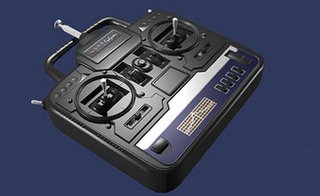
The Radio Controller
The title was quite the grabber. What does happen when I wiggle the sticks? Below I quote:
1. The transmitter broadcasts a radio signal via the antenna containing the positional information set by the controls.
2. The receiver picks up the radio signal via its antenna and decodes the positional information.
3. The receiver distributes the information to the electronic speed control and the rudder servo
4. The electronic speed control switches the main battery power on and off at high speed to regulate the power output of the motor to the level set by the associated transmitter stick.
5. The servo arm will move to the position set by the transmitter stick.
6. Power for the motor comes from the main battery pack.
7. The power for the receiver comes from an independent battery eliminator circuit. The BEC will provides voltage to the receiver from the main battery pack.
8. The power supply for the servo and the control circuitry in the speed controller come from the receiver
All radio control systems generate a radio carrier wave, at a frequency that is determined by the crystal used in the transmitter. These are thankfully not licensed individually. The FCC handles these devices in bulk by allotting a certain set of frequencies and parameters to the devices. The carrier wave is modulated to carry the digital information set by the transmitter controls. There are two methods of modulation used by R/C systems, AM and FM. As a third variable some use a PCM radio to transmit digital data on the FM carrier wave. This is conceptually not that different from IBOC.
In 1898, Nicola Tesla staged the first demonstration of radio control. His invention (patent No. 613,809), took the form of a radio-controlled boat, a heavy, low-lying, steel craft about four feet long. At that time radio itself had not been officially patented yet! Tesla's own radio patent wasn't granted until March 1900! Initially examiners from the US Patent Office were reluctant to recognize improbable claims made in the application "Method of and Apparatus for Controlling Mechanism of Moving Vessels or Vehicles." Confronted with a working model, however, examiners had to issue approval. ...And today we use it to drop missiles on people. Oh, How far we have come.