Showing posts with label PCM radio. Show all posts

Monday, September 24, 2012

The Philosophy of PCM

In short, PCM (pulse code modulation) is a digital schema for transmitting analog data. It and it's derivations are how most electrical communications work today. According to the National Inventors Hall of Fame three different men invented PCM (pulse code modulation.) A similar patent was filed by John R. Pierce in 1945 under U.S. Patent # 2,437,707. The three of them had worked at Bell Labs, and jointly published a unifying document "The Philosophy of PCM" in 1948, a victory for geek inventors everywhere. So how did we get here?

It starts with the telegraph. TDM (time-division multiplexing) was patented in 1853 by Moses G. Farmer, [pictured] a telegraph operator who was employed as a technician to maintain a network of telegraph lines north of Massachusetts. Farmer was trying to interlace samples from multiple telegraphy sources, and convey them over a single telegraph cable. He at least proved the viability of future duplex and quadruplex systems. This was borne out by the work of W. M. Miner in 1903. He successfully multiplexed multiple telegraph signals. He managed to achieve a sample rate of 3500–4300 Hz.

But this was not PCM. It was PAM (pulse-amplitude modulation) In PAM the data is encoded in the amplitude of a series of signal pulses. PCM reuires an A-to-D conversion (analog to digital) First the analog signal amplitude is sampled at a known time interval. The amplitude of the signal at each sample is rounded off to a power of 2 (2,4,8,16 etc) a process is called quantization. This is represented by binary digits three, four, five, or six binary digits (aka bits) respectively. So the output is now just a string of binary numbers. See the chart below:

Decimal Binary number
0 0000
1 0001
2 0010
3 0011
4 0100
5 0101
6 0110

In 1926 Paul M. Rainey at Western Electric patented a facsimile machine which transmitted its signal via PCM. It was using a 5-bit encoded PCM. It was never sold commercially but the idea was taking hold. This was it's first use transmitting an image. Though telegraph and fax are both both used to transmit text, the fax sends an image with text on it. The telegraph sends dots and dashes directly correlating to alphanumeric characters. A fax can send non text data. You can fax a xerox image of your middle finger which I have done on occasion. Alec Reeves invented PCM on his own in 1937 unaware of any prior work. He was a British expat working at the International Telephone and Telegraph in France. He patented the concept in 1938 but no working model. His U.S. patent # 2,272,070 was granted in 1943. More here. He lived long enough to see it used in WWII by the allies, though it was so top secret he probably didn't know until after the war. SIGSALY went into service in 1943 and was in military-only use until 1946.

Thursday, January 05, 2006

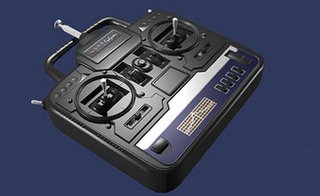
The Radio Controller

I just read this very detailed piece on Radio Control. It's kind of an overview of radio control theory, entitled "What Happens When I Wiggle the Sticks." The author, Neil McGrath, is a British radio-frequency electrical engineer whose hobby is radio controlled power boats.

The title was quite the grabber. What does happen when I wiggle the sticks? Below I quote:

1. The transmitter broadcasts a radio signal via the antenna containing the positional information set by the controls.
2. The receiver picks up the radio signal via its antenna and decodes the positional information.
3. The receiver distributes the information to the electronic speed control and the rudder servo
4. The electronic speed control switches the main battery power on and off at high speed to regulate the power output of the motor to the level set by the associated transmitter stick.
5. The servo arm will move to the position set by the transmitter stick.
6. Power for the motor comes from the main battery pack.
7. The power for the receiver comes from an independent battery eliminator circuit. The BEC will provides voltage to the receiver from the main battery pack.
8. The power supply for the servo and the control circuitry in the speed controller come from the receiver

All radio control systems generate a radio carrier wave, at a frequency that is determined by the crystal used in the transmitter. These are thankfully not licensed individually. The FCC handles these devices in bulk by allotting a certain set of frequencies and parameters to the devices. The carrier wave is modulated to carry the digital information set by the transmitter controls. There are two methods of modulation used by R/C systems, AM and FM. As a third variable some use a PCM radio to transmit digital data on the FM carrier wave. This is conceptually not that different from IBOC.

In 1898, Nicola Tesla staged the first demonstration of radio control. His invention (patent No. 613,809), took the form of a radio-controlled boat, a heavy, low-lying, steel craft about four feet long. At that time radio itself had not been officially patented yet! Tesla's own radio patent wasn't granted until March 1900! Initially examiners from the US Patent Office were reluctant to recognize improbable claims made in the application "Method of and Apparatus for Controlling Mechanism of Moving Vessels or Vehicles." Confronted with a working model, however, examiners had to issue approval. ...And today we use it to drop missiles on people. Oh, How far we have come.