Showing posts with label crystal radio. Show all posts

Monday, January 11, 2016

Interview with K.E. Edwards


After publishing that write up of the classic crystal radio book Radios That Work For Free, [LINK] I reached out to Hope and Allen publishing. Martin Allen himself wrote back and the enigmatic K.E. Edwards granted me his first interview in 35 years. To preserve his anonymity I avoided questions specific to his identity.  How classic?  It was written up by Wired Magazine in 2007 [LINK]. Currently Edwards is engaged in writing the sequel to his now classic book. So this interview comes at a fine time to revisit his original work.

1. Can you tell me about the first crystal radio you built and when? 

I was 8 years old, in 1952. This crystal set was a square piece of wood about 1.5” x 1.5”, about 4” long. It had a slider bar and a fixed capacitor. I had one half of a headphone, one ear piece. I would listen to it with the headphone under my pillow. It worked poorly, and I only got one or two stations. But it was magic. The slider would get moved off the top of the wire, the galena and cats whisker would get bumped and I would work to find the right spot.

2. Did any person, friend or neighbor start you on the radio path? 

I did not know anyone who could help me. I asked radio and TV repair men how to build one and they offered what they remembered from the early days. I did not know it then but the conditions of the early days of radio where so much different that the crystal sets they used allowed for poor sets to do OK. Not like the 1950’s or today.

3. Did you further your radio knowledge at a radio training school, military or technical school? 

No. I finished the 12th grade. I was married and raised a family. All of my crystal set knowledge came from self study and experimenting.

4. Are you now, or have you in the past been a licensed ham? 

Yes. I operate QRP CW, mostly.

5. Have you ever worked in commercial radio? 

No

6. Your book Radios that Work for Free was published in 1977. Books and article on crystal radio building have already been around since at least the 1920s. What inspired you to write your own?


It is true that those works were around from the 20’s. But they had been removed from the library systems for lack of use. Also much of it was no longer relevant. I wanted to show my children how to build a crystal set. I knew how to make one but wanted the latest knowledge on how to do it and went looking for info. I could find none, or just bad info. It was not like today with the internet, where a search will gives you copious amounts of info. So I took my notes from years of experimenting, and decided to share what I had gleaned.

7. My edition has no bibliography. Were there any particular crystal radio books that informed or inspired your work?

No.

8. Are there any particular crystals or whisker combinations that you prefer to use? 

I love to play with crystals, but that is for amusement and research. A diode is the answer.

9. What are your thoughts on the sub-type of crystal radio... the foxhole radio? 

The boys of the second world war wanted to be informed or to be entertained, they used what they had to get the job done. Dissimilar material or imperfect contact detection is what is happening with the foxhole radio. It works, its fun.

10. What has led you to begin work on a second edition of your now classic text? 

I have never stopped experimenting, and building crystal sets. The interest in these sets is ongoing. As you can do the math I am 71 now and none of us know how long we have here. I wanted to share some of the things I could not cover in my first book. Let me say hear, we could write volumes on every single aspect of this fun hobby. I have had to leave so much out of the first book and this second, I feel bad. They are but simple little things but it all adds up to making a better radio. If you read my first book and this new one, I tried to keep my words to a minimum. So some of the smaller sentences; contain the most important info.

Jose, Thank you for your interest in radio. I love this hobby, it has changed my life. I think everyone, 
especially young people can benefit from the experience of building a crystal set. It offers so many rewards that go beyond radio.

Monday, March 16, 2015

Crystal Radios Are Still For Sale

It's hard to argue that radio as a hobby and as an industry aren't in decline. But I do my best. My latest canary in the coal mine is the toy crystal radio set. You remember the kit: 1 diode, 1 tuning rod, 2 connecting wires, 1 copper wire coil, 1 earphone and maybe a cardboard tube.. maybe some rubber bands and a tuner so some kind; or maybe not. They still make that kit... many different companies do actually. See below.

Makes and models range from hardwood mounted toys clearly intended for adults to flimsy designs made mostly of paper. The difficult level clearly varies, but not one of these costs more than $25, so they fall into the toy category.

Science Store - Crystal Radio Kit
 https://store.sciencebuddies.org/Elec_p014/COM-0001-KIT/Crystal-Radio-Kit.aspx

Poof-Slinky - Crystal Radio Mini Lab
http://poof-slinky.com/product/crystal-radio-mini-lab/

Maxitronix - Crystal Radio Kit
http://www.elenco.com/search/searchdetails/crystal_radio_kit=Mjc5

Modern Radio Labs - No 2 Crystal Radio Kit
http://www.modernradiolabs.com/MRL%20No%202%20Crystal%20Radio%20Kit.htm

Peebles - PO-002 Crystal Radio Kit, With a Cylinder Coil
http://www.peeblesoriginals.com/catalog/45.php

Go Labs - Build Your Own Working Crystal Radio Lab Kit
http://www.amazon.com/Build-Your-Working-Crystal-Radio/dp/B000EMB8AA

Xtal Set Society - XS-OB1 Oat Box Radio - Pack 1
http://www.midnightscience.com/kits.html

Flights of Fancy - Crystal Radio Receiver
http://www.crafts4kids.co.uk/flights-of-fancy-radio-receiver/p1310

Artec Build Your Own Crystal Radio Science Craft
https://www.virtuabotix.com/product/artec-build-crystal-radio-science-craft/


Wednesday, October 03, 2012

3 Penny Radio


In science the Penny takes more abuse than any other denomination of American currency. A century ago Herbert Willis famously bombarded pennies with radiation just for giggles... and testing alpha rays. They were the currency of tchotchkes: penny candy, penny post cards, penny arcades and so on. We crush them into oblate shapes in hand cranked machines at truck stops to imprint them with hearts and images of tourist attractions.

The ultimate indignity was in radio, we soldered them. In his autobiography, Steve Wozniak mentions the archetypal use of the penny as the "crystal" in the crystal radio. In that application it's more accurate to say that the cuprous oxide on it's surface is the detector but it's still a penny. It's a use that dates back to at least WWII in early foxhole radios that used American Pennies, German Pfennigs, and old copper French centimes. The 2003 book Sneaky Uses for Everyday Things by Cy Tymony revisits that old design.

But getting back to the foxhole radios, the most common crystal in use by consumers around WWI was probably galena. Metallic detectors were known to exist. Soldiers innovated one that used razor blades which we call the foxhole radio. Iron(III) oxide, aka rust, is a semi conductor. This was discovered by Greenleaf Pickard in 1906. He also patented the  silicon crystal detector that year. It's likely that few, if any men in the trenches were aware of his discovery, more likely that they discovered it independently through trial and error. They already knew that galena could be used... someone probably had the sense to experiment with other metals. It wasn't until 1927 that Lars Olai Grondahl and Paul H. Geiger invented the copper oxide rectifier. More here. they both worked at the Union Switch & Signal Co.  While investigating the corrosion of copper switches they discovered that current flowed more easily one way than the other and made the crucial deduction.


That radio discovery has a modern descendant in the 3-Penny Radio. In this application the Penny is not the detector. The Pennies don't do anything electrically significant in this design. But that's OK. Projects like this are for kids, and half of the adventure is really just soldering practice. It's based on older designs, lacking even an oscillator. But it concedes to kid friendliness with an integrated circuit to handle AGC (automatic gain control) so that when junior hooks up the earphone the results will be more listenable. AM is so much noisier now than it was a century ago AGC is necessary to make the radio experience at all compelling. 

Friday, June 04, 2010

Hugo Gernsback is full of Hugonium

We begin this tale with an obscure reference from an advertisement that is almost a century old. It s a product I'm still not sure what it, and In  in advertisement, in a 1918  issue of  the "Electrical Experimenter" described the installation of Radiocite thus:
"Radiocite can be mounted like any other crystal; it may be clamped between springs, but it is best to set it in Hugonium soft metal.
The "Electrical Experimenter" was published by Experimenter Publishing. It was an 11 x 8.5 inches Magazine that competed with Modern Electronics in the 1920s. It was launched in 1913, and had no advertisements. It was subsidized almost wholly by the Electro-Importing Company. It's editors were Harry Winfield Secor and Hugo Gernsback. Hugo Gernsback had emigrated from Luxembourg in 1905 at the age of 21. As early as 1910 Secor had been publishing electrical essays in  Gernsback's magazines. Hugo's younger brother, Sidney emigrated around 1920 and became the secretary of the Electro-Importing Company, the company that sold Hugonium (among other electrical supplies and products both real and imagined.)

Whether it worked or not, Hugonium addressed a real problem. Admittedly, it was difficult to find a good spot on the crystal to rectify.  But, it was even harder to keep your cats-whisker on that exact spot. There were 101 different ways to mount the whisker and maybe 3 to mount the crystal. None were fool-proof. Most were bogus, crude, haphazard or unreliable. It was the weak link in a hobby that was slowly becoming a commercial enterprise.  My earliest confirmed ad for Hugonium is again from the Electro-Importing company recommended Hugonium in a 1912 Wireless Lesson booklet. That one is published by Electro-Importing but copyrighted to K. I. Co.  More here.
"For the utilizing of this universal detector for other crystals which do not require pointed contacts, a flat metal disc which can be screwed on the pointed contact, is supplied. Thus the detector can be used for any type of crystal which requires either form of contact. This detector, which is supplied by the Electro-Importing Company, uses the Hugonium compound for holding the crystal, as described above."
I thought that Hugonium might be a long lost snake-oil product but I found a more recent reference to it in a Book titled "Electric Relays" by Vladmir Gurevich.  It was published as recently as 2006.  He described it as a solder or low heat alloy for mounting a silicon detector. But that reference is an outlier, most references date to 1920 or earlier. Such as "The How and Why of Radio Apparatus" by Harry Winfield Secor, published in 1920 by Experimenter Publishing.  It makes s single reference:
"The copper pyrite crystal is mounted in a cup mounted on a spring-actuated rod provided with a suitable knob, by which it can be swung in any direction. Zincite crystals are mounted in a large cup containing several pockets, the mounting of both of the minerals being effected with a low fusing solder, Wood's metal or Hugonium alloy"
My theory is that Hugonium is just Wood's metal, a bismuth alloy But that in a fit of ego Hugo Gernsback renamed it for himself as slipped it into the catalog. Nothing else in the history of Electro-importing leads me to believe that they invented their own low temperature alloy. There is no copyright on Hugonium, at least not under that name.  All the references to Hugonium come from their own catalog, or their own periodicals which existed only to sell products through their mail order business. It makes sense then that Hugo Gernsback would eventually segue into science fiction in 1926 with the publication of the magazine "Amazing Stories." It's interesting to note that he also founded the radio station WRNY.  I'll tell that story another time.

Monday, December 28, 2009

Perikon detector

Strange as it may seem, the crystal in crystal radios wore out. The rectifier was a contact metal–semiconductor point-contact junction, aka a Schottky diode. I mentioned this once before so I wont get too much into the diode. But suffice it to say that not every part of the crystal would rectify the circuit. Rectification in this case means "act like a diode." More here.
Because the whisker was made of wire or a needle, and the crystal was softer, the surface was worn by use. OK hypothetically not every "crystal" was softer, but they were almost inherently of different harnesses. The very soft Graphite was used as a whisker sometimes. and at the other end, carborundum was considered durable. So either the whisker or the crystal was experiencing wear and usually it was the crystal. So hobbyist chose a crystal and whisker based both on it's sensitivity as a detector but also it's longevity. The hunt was on from the start for a "permanent detector."

Lets look at the hardness of some known whiskers and crystals:
WHISKERS
Graphite: 1-2 Mohs
Bornite: 3 Mohs
Iron: 4 Mohs
Steel: 7-8 Mohs
Bronze: 3 Mohs

CRYSTALS
Galena: 2.5 Mohs
Zincyte: 4 - 4.5 Mohs
Molybdenite: 1 - 1.5 Mohs
Iron Pyrite: 6-7 Mohs
Carborundum: 9 Mohs
Silicium: 7-8 Mohs
Chalcopyrite: 2.5 Mohs

As narrow as that variation is, remember that the Mohs scale is only a 10 point same topping out with diamond. not every whisker and crystal worked well together and even when they did, their mismatched harnesses could be problematic. Some combinations were proprietary and many of those were discovered by Mr. Greenleaf Whittier Pickard. He found both the Zincite /Bornite rectifier and the Zincite / rectifier. He called it the Perikon Detector.

He also tested versions with iron pyrite and silicon crystals. Silicon was novel enough he patented it's use in 1906. His Zinc Oxide detector was patented in 1909. He developed one with Molybdenite the same year. More here.

Tuesday, February 03, 2009

Sir Jagadis Chunder Bose

In Calcutta, there stands the Bose Institute, a university named for Sir Jagadis Chunder Bose. His original equipment and some of his lab are on display there. His ashes literally sit in a shrine. But in the west his name is unknown. He was born in India, but studied medicine at the University of London and Natural Science at Christ's College Cambridge. Then he returned to India. That's why we ignore an accomplished polymath. While his education happened in the west, his discoveries did not. We even refuse to spell his name right. Above is his signature. Despite that, we write it Jagadish Chandra Bose...

He developed the first point contact diode. (image below) Yes, that is the first "cats whisker" use of galena crystals for making receivers. He tested it with a galvanometer on both radio waves and with light. He was awarded a patent in 1904. but it wasn't his first work. It was just his first substantial patent. In general, he seemed to avoid patenting his work. More here.
In in Kolkata, in November of 1894 Bose demonstrated the ringing of a bell at a distance of a mile with 6mm microwaves. He also ignited gunpowder at a distance. Interestingly his microwave vies with the work of Augusto Righi for first generated microwave. He wrote "“The invisible light can easily pass through brick walls, buildings etc. Therefore, messages can be transmitted by means of it without the mediation of wires.” More here.

He developed wave guides, horn antenna, cut off grating, the mercury coherer, the dialectic lens, microwave reflectors, the double prism directional coupler, semiconductors, the polarimeter, interferometer, dielectrometer... Essentially the only item in his demonstration was the galvanometer which was invented by J.S. Schweigger. He authored a biography a science fiction novel and a series of quack Buddhist text books on plant response. Despite the weird plant thing he was knighted in 1917 and in 1920 he was elected a Fellow of the Royal Society. He died in 1937, a week before his 80th birthday.

Wednesday, January 28, 2009

Karl Braun rectifies

Yesterday I covered an improvement in crystal rectification. While it may seem crude, it was an advancement. And like any "break-through" it begat others, and was based in those that preceded it. I specifically noted Karl Braun. He is best known for invented the first cathode-ray oscilloscope in 1897. It's a big flashy invention with a fluorescent screen. But he also defined the basic principles of rectification, which while not as ostentatious was more important.

Rectification simply put is converting AC to DC. In radio this is a crystal detector, or a diode. Braun had been studying the conductivity of metal salts in solution, what we call electrolytes. he found that they conducted electricity even when not dissolved. He then made an examination of metallic sulfides. He discovered that in many metal sulfides the electrical resistance varies with the magnitude and polarity of the applied voltage. Viola! rectification. More specifically this was the "point-contact rectifier effect."

He went on to write a paper in 1874 on current flow through metallic sulfides. This was before radio, so it's implications were not immediately obvious to him. It was Sir Jagadis Chandra Bose, who made that leap and applied to patent the idea in 1901. In the U.S. we teach that Marconi invented radio. In Germany I understand, they're a little better at mentioning that Dr. Braun shared that 1909 Nobel Prize for physics with Guglielmo Marconi for developing the "Wireless."

Unlike Losev, Braun was an academic. He'd even published scholarly articles while in high school. He attended the University of Marburg and earned his Phd at the University of Berlin in 1872. He taught physics at the University of Strasbourg. His career is well documented. But I find two different stories of his death. One tale tells of him defending his patents on his discoveries. In 1915 he traveled to New York City to go to court. the intimation is that he is defending a closed circuit design that improved upon Marconi's open circuit design. The other tale has him headed to New York to defend the German Telefunken wireless station at Sayville, N.Y. Defending it from none other than Marconi. I lean toward this second version as I can confirm that in 1915 said trial was at least extant.

Both stories end with him being detained because of his German citizenship. Unable to return home, he bought a house in Brooklyn, and died in April of 1918 without having ever returned to his homeland.

Tuesday, January 27, 2009

Crystadyne Radio

We no longer use commercially use crystals in radio tuning. We've fully converted to solid state tuners. When we did use crystals a few different kids were used. We used galena, molybdenite, iron pyrite, Carborundum , silicium ...and "Cristadyne." (sometimes spelled Crystadyne or Crystaldyne) Simply put it was the fairly rare crystal zincite aka ZnO4.

It was Karl Braun who in 1874 discovered that crystals had rectifying properties. But even after radio stations were popping up across America, the mechanism behind rectification was totally unknown. In the U.S. we were moving on to vacuum tubes, without every having fully understood the physics behind the crystal sets we'd been using for decades. the prevailing theory was that it was an unknown thermal effect. The real progress on this front happened in Russia. Vacuum tubes were very expensive, and in Russia the push was on to jump to a solid state tuner. Oleg Losev was self-taught and began by investigating fluorescence in the carborundum-based LEDs invented by Henry Round.

Fluorescence is the emission of light, not normally of much interest in radio. But Oleg in his obsession wrote dozens of papers and realized in his scrutiny that the fluorescence was a quantum effect. Therein he found a correlation between short wavelength cutoff energy and applied voltage. Eureka. He went on to find that with zincite diodes he could achieve negative resistance. His experiments with voltage biases refined reception. He gained amplification, he designed regenerative and superheterodyne receivers, and eventually transmitters. (before Armstrong) These were all fully solid state units. No tubes. He published his findings in an article an article, for the Russian trade mag Telegrafiya i Telefoniya bez provodov (Wireless Telegraphy and Telephony) in 1927. But at the time the revolutionary communist government of the USSR was disinterested. he toiled alone and in vain. The USSR also didn't support the free flow of information as we do. So the notion of small rural hamlets making their own radios, and worse-yet TRANSMITTERS, was unwelcome. The information was even less likely to travel to the U.S. due to poor post WWII relations. We had to rediscover it all on our own. Oleg Losev starved to death in 1942 during the siege of Leningrad.

Thursday, November 06, 2008

The power behind crystal radio sets

In the 1920s the U.S. Government actually distributed literature on making crystal radios. Soon crystal radio sets will no longer work. In February of next year analog TV will cease in favor of HD TV. It is expected by most parties that despite severe problems, radio will go the same way, both AM and FM if you side with Clearchannel's Jeff Littlejohn. Whenever that happens, if it happens, these simplest of tuners will die.

A crystal radio requires no direct power source. It is entirely powered by the radio waves it receives. This is the simplest kind of radio receiver. It's very difficult to name a single or most important inventor. But that didn't stop me from writing about many of them in the past. [Before you nit-pick I'll state for the record that this is the simplest of all radios.] I'll list the parts below but only one of them really needs additional explaining, the diode. I'll get into that in steps, but first lets' cover the radios components:

1. Antenna
*I've covered this here.

2. Coil
Loops of wire, usually copper. Tuning different frequencies is manages with fewer or additional turns of wire in the coil. Iit needs to be grounded. Coil + capacitor = resonant circuit.

3. Diode
This is where the crystal comes in. It's not a lump of quartz. The octahedral crystal is a lump of galena a.k.a. lead sulfide, an ionic compound of lead and sulfur. A wire contact is used to form a junction with the crystal until it forms a diode. The wire is called a "cat's whisker." I hate the name but that's the nomenclature. The wire is usually phosphor bronze. To tune, one literally had to probe the surface of the crystal until it generated sound confirming the complete circuit.

Note: There are also iron pyrite and silicon diodes but they are less sensitive. Modern crystal fans use germanium. The Schottky diode is a silicon diode. Walter Schottky's design was sound, and compensated for it's lack of sensitivity with greater efficiency. But suffered from thermal instability. In other words, it gets hot enough to break shit. See below.

More complicated was connecting the diode to both the coil and the earpiece. The normal heat of a soldering iron could damage the already irascible wad of galena. This was often instead soldered with wood's metal. Wood's metal is an alloy of bismuth, lead, tin, and cadmium. It has a melting point of under 160 °F. Still, it releases toxic fumes at that temp. This was really truly such a pain in the ass many people just improvised clamps.

4. Ground
You need to ground the circuit, this is usually between the antenna and coil.

5. Headphone
For a crystal set, these need to have high impedance.

The basic way it functions is that the antenna receives the signal. The coil stores the energy in it's magnetic field. Through it the wave energy moves to the diode. The diode rejects half of the alternating current converting it to pulsating DC current. This allows the headphone to work. If you fed AC current into an earpiece the alternating sides of the wave cancel each other out and you get an amplitude of zero. More here and here.

Wednesday, November 02, 2005

FOXHOLE RADIO


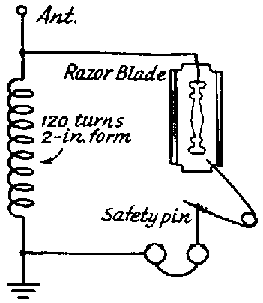
Note the simplicity of the above design. The parts are assembled on a piece of scrap wood, and tacked down. The safety pin is anchored at one end and placed so the point may be moved around on the surface of the razor blade. The blued steel surface of the blade gives the rectifying action replacing a crystal. later versions used a pencil lead point on the razor blade. The only part of a foxhole radio you don't build from scratch is the headphone. Some GIs used their bayonets buried to the hilt in moist earth for a ground connection!

In 1944, during WWI American and British troops in between millitary incursions, found themselves with a little extra time to fill. They missed radio. Thsi of courtse was well before the popularization of TV. Before CDs and 100 years before the Ipod. They wanted to hear music or news on the radio, but personal portable radios were strictly verboten [pun intentional] as the German millitary had radio detecting equipment that could detect certain radio receivers. Superheterodyne radios were just plan dangerous to a man in a foxhole.

At some point a resourceful American GI (probably a drafted engineering student) figured out that a simple radio receiver could be cobbled together from wires and other scrap. The first soldier that made the discovery is unknown. But at the time he was able to hear big band swing music and of course dangerous hypnotizing Axis propaganda! This soldier taught other soldier and it didnt take long to reach every beach head.

These small wireless sets were called "foxhole radios" by the press. It has been over sixty years since these first appeared. http://bizarrelabs.com/foxhole.htm

*diagram borrowed from the article "Foxhole Radios" by the ingenious Don Adamson
http://members.aol.com/djadamson7/articles/foxhole.html