Showing posts with label FOXHOLE RADIO. Show all posts

Wednesday, October 03, 2012

3 Penny Radio


In science the Penny takes more abuse than any other denomination of American currency. A century ago Herbert Willis famously bombarded pennies with radiation just for giggles... and testing alpha rays. They were the currency of tchotchkes: penny candy, penny post cards, penny arcades and so on. We crush them into oblate shapes in hand cranked machines at truck stops to imprint them with hearts and images of tourist attractions.

The ultimate indignity was in radio, we soldered them. In his autobiography, Steve Wozniak mentions the archetypal use of the penny as the "crystal" in the crystal radio. In that application it's more accurate to say that the cuprous oxide on it's surface is the detector but it's still a penny. It's a use that dates back to at least WWII in early foxhole radios that used American Pennies, German Pfennigs, and old copper French centimes. The 2003 book Sneaky Uses for Everyday Things by Cy Tymony revisits that old design.

But getting back to the foxhole radios, the most common crystal in use by consumers around WWI was probably galena. Metallic detectors were known to exist. Soldiers innovated one that used razor blades which we call the foxhole radio. Iron(III) oxide, aka rust, is a semi conductor. This was discovered by Greenleaf Pickard in 1906. He also patented the  silicon crystal detector that year. It's likely that few, if any men in the trenches were aware of his discovery, more likely that they discovered it independently through trial and error. They already knew that galena could be used... someone probably had the sense to experiment with other metals. It wasn't until 1927 that Lars Olai Grondahl and Paul H. Geiger invented the copper oxide rectifier. More here. they both worked at the Union Switch & Signal Co.  While investigating the corrosion of copper switches they discovered that current flowed more easily one way than the other and made the crucial deduction.


That radio discovery has a modern descendant in the 3-Penny Radio. In this application the Penny is not the detector. The Pennies don't do anything electrically significant in this design. But that's OK. Projects like this are for kids, and half of the adventure is really just soldering practice. It's based on older designs, lacking even an oscillator. But it concedes to kid friendliness with an integrated circuit to handle AGC (automatic gain control) so that when junior hooks up the earphone the results will be more listenable. AM is so much noisier now than it was a century ago AGC is necessary to make the radio experience at all compelling. 

Friday, July 23, 2010

Fox Hole Radio Pt. 2

I've written about foxhole radio before. But back them MAKE hadn't made a nifty video on how to make one yet. The instructions are simple, and even cover some basic problems that may come up in the process. The Tools and materials are very simple. If you are even reading this post, you will be able to do this.

You'll note he had a little trouble with the razor blade. The rectifier is a little unclear for me still though. The pencil lead is a mix of clay and graphite. Knowing that the clay isn't a part of it we're making a connection between graphite and steel. So in that model the razor blade is the whisker and the pencil is the crystal. It's sort of backwards to the traditional idea of a crystal detector.

Graphite electrodes were used in Tungar rectifiers, and mercury arc rectifiers in early car batteries. This was a diode of sorts, used to convert AC to DC. This was around the early 1920s. More recently graphite has been used in Schottky Diodes. More here.But I'm not sure why the razor has to be blue. You can steel blue by heating it (to 530 - 600 F) as in the video but what does that do to the steel? I have also read that you can blue steel with a solution of sodium thiosulphate and lead acetate. There is no way to know what method was used on that specific razor blade.  But any non-conductive coating could act as a dielectric. My thinking is that the heating here actually just burns off a lubricant (or other coating) that interferes with the connection.

Wednesday, November 02, 2005

FOXHOLE RADIO


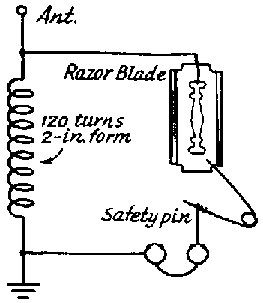
Note the simplicity of the above design. The parts are assembled on a piece of scrap wood, and tacked down. The safety pin is anchored at one end and placed so the point may be moved around on the surface of the razor blade. The blued steel surface of the blade gives the rectifying action replacing a crystal. later versions used a pencil lead point on the razor blade. The only part of a foxhole radio you don't build from scratch is the headphone. Some GIs used their bayonets buried to the hilt in moist earth for a ground connection!

In 1944, during WWI American and British troops in between millitary incursions, found themselves with a little extra time to fill. They missed radio. Thsi of courtse was well before the popularization of TV. Before CDs and 100 years before the Ipod. They wanted to hear music or news on the radio, but personal portable radios were strictly verboten [pun intentional] as the German millitary had radio detecting equipment that could detect certain radio receivers. Superheterodyne radios were just plan dangerous to a man in a foxhole.

At some point a resourceful American GI (probably a drafted engineering student) figured out that a simple radio receiver could be cobbled together from wires and other scrap. The first soldier that made the discovery is unknown. But at the time he was able to hear big band swing music and of course dangerous hypnotizing Axis propaganda! This soldier taught other soldier and it didnt take long to reach every beach head.

These small wireless sets were called "foxhole radios" by the press. It has been over sixty years since these first appeared. http://bizarrelabs.com/foxhole.htm

*diagram borrowed from the article "Foxhole Radios" by the ingenious Don Adamson
http://members.aol.com/djadamson7/articles/foxhole.html