Showing posts with label WRNY. Show all posts

Monday, July 08, 2013

Gernsback Strike Again!

Hugo Gernsback is one of those names that pops up repeatedly in radio history. His late career success in science fiction overshadowed his snake oil interests in radio and his more bonafide accomplishments like WRNY and Radio News. He is for whom the Hugo awards are named. He foresaw video conferencing, social networking, electrical cars, radar, solar power, and microfilm. He didn't invent science fiction, he was science fiction. But let us discuss his more mortal accomplishments. He built one of the first New York radio stations.. then destroyed it with his own endless tinkering.

In 1925, Hugo founded radio station WRNY which broadcast from the 18th floor of The Roosevelt Hotel in New York City and was later involved in the first television broadcasts. Gernsback savvily used WRNY and his magazine Radio News to cross promote each other. Radio programs on WRNY often were used to discuss articles he had written or published, and some of the articles in Radio News covered the activities at WRNY.  The model was later emulated across the nation by daily newspapers that also owned local radio outlets.

At the time there were only about 500 radio stations in the whole of the USA. WRNY's license was so early, they were pre-FCC, and even pre-FRC.  His company, Experimenter Publishing applied for a license from the US Dept of Commerce to broadcast on 1160 kHz in New York City. But they didn't stay there. Before the station closed in 1934 they'd also have broadcast on 800 kHz, 920 kHz, 970 kHz, 1010 kHz, and 1070 kHz. But not all of those moves went so smoothly. In November of 1926, WRNY then operating on 800 kHz  moved from the Roosevelt Hotel to Coytesville, New Jersey. WHN, then operating on 830 kHz claimed that WRNY was causing them interference.There wasn't much they could do until the FRC was formed in 1927, whereupon WRNY was reallocated to share time on 920 kHz with WPCH.

By then Gernsback was getting bored with regular old radio. Just for giggles in 1927, Gernsback started the shortwave station 2XAL (later W2XAL) operating on 9700 kHz. Then he got the TV bug. In April 1928,he started a venture with Pilot Electric Manufacturing and began broadcasting television experiments on the AM band. His transmission on 1010 kHz yielded a silent black and white image on a screen 1.5 inches square. It had only 48 scan lines.  Impressively that tiny low resolution images could be transmitted in as little as 5 kHz of bandwidth. (For comparison remember that commercial television of the 1940s used 6 MHz of bandwidth.)

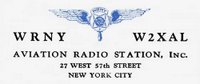
The FRC stepped in and stomped on his television dreams. Under the auspices of preventing interference the FRC limited television broadcast to shortwave stations above 1500 kHz. The experimental broadcasts would be limited to one hour per day and their bandwidth limited to  10 kHz. Oh and they couldn't air them during prime time 6:00 PM to 11:00 PM. The bandwidth limitation was critical. TV experiments were no longer possible on the AM band. In the Spring of 1929 a bankruptcy petition was filed against the Experimenter Publishing Company for debts of over half a million dollars. A trust was established and Hugo was kicked out.  His shortwave station W2XAL became property of a flight school and WRNY went to the Curtiss Aircraft Corp. WHN later bought it out and shut it down to end a pesky dayshare arrangement.

Friday, June 04, 2010

Hugo Gernsback is full of Hugonium

We begin this tale with an obscure reference from an advertisement that is almost a century old. It s a product I'm still not sure what it, and In  in advertisement, in a 1918  issue of  the "Electrical Experimenter" described the installation of Radiocite thus:
"Radiocite can be mounted like any other crystal; it may be clamped between springs, but it is best to set it in Hugonium soft metal.
The "Electrical Experimenter" was published by Experimenter Publishing. It was an 11 x 8.5 inches Magazine that competed with Modern Electronics in the 1920s. It was launched in 1913, and had no advertisements. It was subsidized almost wholly by the Electro-Importing Company. It's editors were Harry Winfield Secor and Hugo Gernsback. Hugo Gernsback had emigrated from Luxembourg in 1905 at the age of 21. As early as 1910 Secor had been publishing electrical essays in  Gernsback's magazines. Hugo's younger brother, Sidney emigrated around 1920 and became the secretary of the Electro-Importing Company, the company that sold Hugonium (among other electrical supplies and products both real and imagined.)

Whether it worked or not, Hugonium addressed a real problem. Admittedly, it was difficult to find a good spot on the crystal to rectify.  But, it was even harder to keep your cats-whisker on that exact spot. There were 101 different ways to mount the whisker and maybe 3 to mount the crystal. None were fool-proof. Most were bogus, crude, haphazard or unreliable. It was the weak link in a hobby that was slowly becoming a commercial enterprise.  My earliest confirmed ad for Hugonium is again from the Electro-Importing company recommended Hugonium in a 1912 Wireless Lesson booklet. That one is published by Electro-Importing but copyrighted to K. I. Co.  More here.
"For the utilizing of this universal detector for other crystals which do not require pointed contacts, a flat metal disc which can be screwed on the pointed contact, is supplied. Thus the detector can be used for any type of crystal which requires either form of contact. This detector, which is supplied by the Electro-Importing Company, uses the Hugonium compound for holding the crystal, as described above."
I thought that Hugonium might be a long lost snake-oil product but I found a more recent reference to it in a Book titled "Electric Relays" by Vladmir Gurevich.  It was published as recently as 2006.  He described it as a solder or low heat alloy for mounting a silicon detector. But that reference is an outlier, most references date to 1920 or earlier. Such as "The How and Why of Radio Apparatus" by Harry Winfield Secor, published in 1920 by Experimenter Publishing.  It makes s single reference:
"The copper pyrite crystal is mounted in a cup mounted on a spring-actuated rod provided with a suitable knob, by which it can be swung in any direction. Zincite crystals are mounted in a large cup containing several pockets, the mounting of both of the minerals being effected with a low fusing solder, Wood's metal or Hugonium alloy"
My theory is that Hugonium is just Wood's metal, a bismuth alloy But that in a fit of ego Hugo Gernsback renamed it for himself as slipped it into the catalog. Nothing else in the history of Electro-importing leads me to believe that they invented their own low temperature alloy. There is no copyright on Hugonium, at least not under that name.  All the references to Hugonium come from their own catalog, or their own periodicals which existed only to sell products through their mail order business. It makes sense then that Hugo Gernsback would eventually segue into science fiction in 1926 with the publication of the magazine "Amazing Stories." It's interesting to note that he also founded the radio station WRNY.  I'll tell that story another time.

Wednesday, May 31, 2006

TV on The Radio, Part Two

It was many moons ago that I posted on the obscure topic of FM radio stations operating on the TV band. But it was an AM station that first broadcast a visual image.

It was August 13th in the year 1928. 1010 WRNY-AM in Coytesville NJ becomes the commercial licensed radio station to transmit a television image. It was a 1.5 square inch image of Mrs. John Geloso enlarged by a magnifying glass to about three inches so it could be viewed by 500 persons at Philosophy Hall at NYU.

At the time technological limitations forced WRNY broadcast the sight and sound alternately rather than simultaneously. Viewers would first see an image and then a few seconds later they would hear the voice. The performances took place for 5 minutes every hour and were designed to lure the radio audience into buying "televisor" sets from the Pilot Electric Co. The Pilot Electric Co. was owned by Mr. John Geloso, his wife's image was the first picture seen over radio. Hugo Gernsback's Experimenter Publishing Co presented daily 5 minute programs including cooking lessons, physical fitness instruction, concerts and calendars of events.

By 1929 sold WRNY for $100,000 to the Aviation Radio Station Inc., a company associated with the Curtiss Aircraft Corp. they used it to promote aviation (duh) and interestingly enough Emelia Earhart delivered a few on air speeches from their studios. The depression cut the legs out from under them and to continue they began a dayshare operation with WHN. The original WRNY was shut down when changed when Aviation Radio Station sold it to WHN-AM who scuttled it to end their day/share agreement in 1934.The WRNY calls now reside on 1350 in Rome NY on a sport talker. Charles Francis Jenkins was the first American to demonstrate television technology. His first successful transmission was 19 May 1922. The first public demonstration was on October 3rd in 1922 using the Naval station NOF in Washington, D.C. but, let me remind you These were still pictures not moving pictures, a cousin to what we think of as "television."

Other early test TV stations include 3XN Whippany NJ, W2XBS New York NY, W9XAA Chicago IL, W3XK Washington DC, W2XBU Beacon NY, W2XBV New York NY, W2XBW Bound Brook NJ, W2XAV East Pittsburgh PA, W4XA White Haven TN, W6XC Los Angeles CA and others Of course some of these test stations later became commercially licensed W9XAA became WCFL and one of those became WGN-AM I think.