Showing posts with label WINS. Show all posts

Monday, October 13, 2025

Matinee with Bob and Ray


Somehow I missed the memo on Bob and Ray. They were on the air for 50 years and I completely missed the boat, discovering them only post-mortem, in the form of a beat up paperback with an introduction by Andy Rooney. Bob and Ray were Bob Elliott (1923–2016) and Ray Goulding (1922–1990). My own mother often said "Write if you get work!" as people left the house. It took me decades to realize she was quoting Bob & Ray.

Elliott and Goulding began as radio announcers. Elliott and Goulding were both on 850 WHDH-AM in Boston. Elliot was an announcer and Goulding a DJ with a morning show. (Some biographies switch the roles and describe Elliot as a DJ and Goulding as a newscaster.) The book Bob and Ray: Keener Than Most Persons by David Pollack gives another version where Elliot presented a demo for Back Bay Matinee he based on an AFRS program. The Music Director Ken Wilson put him on air every afternoon from 2:00 to 4:00. Then Wilson paired him with Goulding to improvise banter as a fill-in when Red Sox baseball broadcasts rained out. Elliott and Goulding (not yet known as Bob and Ray) would improvise and joke around with the studio musicians. It was a comedy recipe you see to this day on late night programs; from Johnny Carson through Jimmy Kimmel. The duo started writing skits to make it work.

Their shtick was a slight twist on the old vaudeville routine. It wasn't a matter of which one was the Straight man. They were both the straight man; something Elliott conceded to Mike Sacks, for the book Poking a Dead Frog: Conversations With Today’s Top Comedy Writers.  “We were both sort of straight men reacting against the other.” Every punchline is silly but completely deadpan, prefiguring Stephen Wright but without the irony. Their trademark sign-off was "This is Ray Goulding reminding you to write if you get work"; "Bob Elliott reminding you to hang by your thumbs." 

After a few months WHDH gave them a morning show simply called Bob & Ray in 1946.  The program started as a 15-minute slot and then expanded to half an hour. The show continued to expand. In the fall of 1947, the pair were given a daily half hour at 1:00 PM called Matinee with Bob and Ray. In 1949 WHDH increased power from 5,000 watts to 50,000 watts and wildly expanded it's coverage and the audience for the duo. After 5 years in Boston, they got a 13-week contract with NBC and started a one hour Saturday Night program in 1951. By 1952 they also had an early morning show on WNBC as well. More here.

In 1955 they signed a new contract with WBZ: Matinee with Bob and Ray but by April of  1956 they terminated their taped WBZ program because they were so busy with their network schedule. Alan Dary got the spot. Bob & ray continued to do daily shows for the Mutual network from 1955 to 1957, then CBS from 1959 to 1960, and on New York station WINS. In 1962 they moved to WHN to start an afternoon show and in 1973 WOR doing a 4-hour afternoon drive program.  In their final incarnation they started a program on NPR: The Bob & Ray Public Radio Show. That ran until 1987. They won three Peabody Awards for their radio work and were inducted into the National Association of Broadcasters Hall of Fame in 1984 and the National Radio Hall of Fame in 1995.


Goulding died in 1990. Born in 1922 he was 68. Many assumed the 67 year old Elliot might retire but instead he became a cast member of Garrison Keillor’s American Radio Company of the Air,  which briefly replaced A Prairie Home Companion on NPR.  Then he started making appearances in movies, and commercials something deeply ironic for a man who had made so many fake advertisements. Ellior once said "By the time we discovered we were introverts, it was too late to do anything about it.”

Wednesday, December 31, 2014

The Spy Who Loved Radio


This is one of those stories in radio that seems a bit too strange. But on the face of it, numerous other public figures, and even politicians have owned media outlets. So maybe it's not that improbable that once, in the 70-year history of the CIA, a known spook happened to also buy WINS-AM in New York City in 1953.

Let's start before he was in the CIA. Lt. Col. John Elroy McCaw was from from Aberdeen, WA.  He founded the first radio station in Centralia, WA: 1440 KELA-AM, in 1937 and owned the Lewis and Clark Hotel where it was originally housed. Years later McCaw also bought station 1260 KYA-AM (with John D. Keating) in San Francisco, 630 KPOA-AM in Hawaii [SOURCE] and 1010 WINS in New York.
 In 1953 In FCC docket 9041 in an Aladdin radio and Television application the bureau listed off a long series of McCaw's facility ownerships and their relative percentages over the prior 20 years:

Call Letters Frequency City State Percentage
KRSC-AM 1150 Seattle WA 100%
KORC-AM 1140 Mineral Wells YX 100%
KELA-AM 1440 Centralia WA 50%
KYA-AM 1260 San Francisco CA 50%
KYAK-AM 930 Yakima WA 33⅓%
KALE-AM 960 Richland WA 33⅓%
KALE-FM 106.1 Richland WA 33⅓%
KPOA-AM 630 Honolulu HI 50%


It appears that most of his large acquisitions involved Keating and/or Charles Skouras. His company in that acquisition was Gotham Broadcasting Corporation. In the book Big Deal: Mergers and Acquisitions in the Digital Age author Bruce Wasserstein praises McCaw's work but not his paperwork, calling him a "freewheeling entrepreneur." One of his wife's obituaries refers to his "his handshake deals."  But he was very successful despite that undercurrent of chaos. I'll quote Wasserstein:
"He converted New York station WINS to the country's first rock station in the middle 1950s, and within 9 years flipped the station for twenty times more than he had paid. At his height, Elroy McCaw owned interests in dozens of radio, television and cable television companies."
His wife Marion was no slouch either. After the end of WWII she started her own radio station KAPA-AM in Raymond, WA. None of this mentions that he had another job. It's not the kind of job you put on your resume, and not the kind of job where you can always tell people what you did at work today. Information is scant. But we know that the Office of Strategic Services (OSS) was formed at least officially in 1942 by President Roosevelt. Lacking cooperation from existing U.S. agencies, early agents were trained by the British. President Truman dissolved the department in 1945, but it's functions were divided between the War Department and the State Department. By the end of the year the term "Central Intelligence Agency" was appearing on documents to describe the collection of intelligence groups, and by 1947 it was official. He has no entry in Wikipedia except in the biographies of his now wealthy heirs. But one of his wife's obituaries get's into the details. [SOURCE].
Throughout the war, she [Marion] commuted from Washington D.C. when necessary while Elroy served at Army Air Forces Headquarters in the Pentagon as Executive Officer and Special Assistant to General McClelland, head of USAAF communications. He was also McClelland’s liaison to OSS.
His exact involvement as you expect, is unknown. I've never filed a FOIA request and I don't intend to. But I have to admit I'm curious. Many businessmen served in the military during wartime— notably Robert S. McNamara who left Harvard to serve in WWI, then left Ford to serve as Secretary of Defense under Kennedy. Very few figures would be so high profile. An issue of the The O.S.S. Society seems to bear a note from son Bruce McCaw looking for more information from retired OSS members about his fathers life. (The operations referred to involve radio controlled ships.)
"My father, Lt. Col. John Elroy McCaw, worked on OSS Special Projects known as operations Aphrodite, Simmons, and Javaman. He worked with OSSers John Shaheen and Jim Rand and is particularly interested in Javaman, which called for blowing up the tunnel connecting Kyushu and Honshu prior to the invasion of Japan.”
Another obituary notes that the family moved to Seattle in 1953. Several sources note that he died in 1969 suddenly, after a brief illness. [Nothing suspicious here, moving along] The cause is never listed but it's clear that his finances were in disarray due to his informal business practices. When his estate was cleaned up, all that remained was a single cable company with fewer than 30,00 subscribers. His sons built that up and bought heavily into cell networks as Cellular One, then sold out to AT&T. It was renamed renamed AT&T Wireless. Today most of them are listed by Forbes. More here.

Monday, October 22, 2012

The Night Club of the Air

You know Morey Amsterdam as the actor that played Buddy Sorrell on The Dick Van Dyke Show back in the 1960s.  But that wasn't his first spin in broadcasting. In the 1930s he was a regular guest on  The Al Pearce Show , and was a substitute host on the CBS radio show Broadway and Vine. But he did relatively little notable radio. He'd also done guest spots on the Komedy Kingdom, The Laugh 'N' Swing Club, Gloom Dodgers, The Chesterfield Supper Club, Hollywood's Open House, and a number of bit parts.  Then on TV, he had an eponymous program back in 1948 and 1949 airing on both RV and radio with the same cast but different scripts.

Somebody must have liked him because despite the 10 year string of bit comedy appearances singing "Yucca puck" he ended up hosting an obscure series called "The Night Club of the Air" on the NBC Blue Network. It's a truly obscure show, with just a single paragraph listing in the Encyclopedia of Old-Time Radio. That gig preceded all the appearances listed above. How did that ever happen? Born in 1908, Amsterdam  would have been 29 years old and hosting his own radio show. It was said he briefly worked in a speakeasy operated by Al Capone... maybe he did know somebody.

Well first of all it might not be true. I found a program of that name listed on a 1949 WINS schedule running at 7:15 PM on a weeknight. But it appears that the show name was recycled several times. In 1930 "Bobby Mac's Radio Night Club of The Air" debuted on KXL, airing midnight to 3:00 AM. It was scaled back a couple times but continued to run until at least 1931.  The "WPEN Night Club of the Air" ran in Philadelphia hosted by Don Frank, Frank Kent, and Fred Darwin, in that order between 1943 and 1944. In Canada there was  Crosse and Blackwell's “Morning Night Club of the Air” on CFRBThere was also the NBC Night Club (1938),  the Bob Wills Night Club of the Air," Radio night Club on WEBQ,  "the Night Club Parade" on WFBL, the Night Club Extravaganza on KMBC, the "Silvertown Nite Club" on WBRC, The Friday Night Club of the Air on WBBM,  The WHB Night Club of the Air, the "KTUL Night Club of the Air", the "Night Club of the Air" on WROK, and others. 

Out of all of these, there are two programs that may be the one connected to Amsterdam. There was a "Night Club of the Air" listed jointly on WHB, WCAE, WSGN and WPEN, possibly the same one DJ'd by Don Frank and maybe even the one on WHB.  Then there was also the NBC Night Club of The Air. Both of these are listed separately in 1937 directories. I thought they might be the same program, but those stations were not all NBC affiliates in that era. I suspect it's the NBC program, not for any documented connection to Amsterdam, but for the documented history of DJs attached to the program on WPEN.

Monday, April 23, 2012

Moondog Vs. Moondog

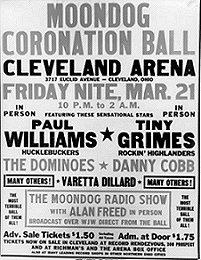
You all know the name Allan Freed. You know his rise and his fall and about the payola scandal and the whole sordid story.  You might even know that he sometimes referred to himself as "moondog" or "the moondog" and to his listeners as "moondoggers."  His show was "The Moondog House" the "Moondog Houseparty" or even "the Moondog Rock and Roll Party." The Moondog thing began around July of 1951 while he was still in Cleveland on 850 WJW-AM.

The problem began in 1954 when he got hired by 1010 WINS-AM. Actually he did a concert in Newark, NJ in advance of his move win WINS, "The Moondog Coronation Ball." But in New York City the name Moondog was already in use by Louis T. Hardin, a blind eccentric street musician who dressed like a viking. Hardin was no crazy hobo. He attended the Memphis Conservatory of Music. Hardin was a professional musician who'd already done work with film scores. He picketed WINS, Freed sued to scare him off. It didn't work. Hardin filed his own claim to defend his brand name. It was ugly.  Even Igor Stravinsky came to his defense. (You can read the documentation here.)  In his complaint he stated that Freed was inspired by an instrumental recording named the "Moondog Symphony" that he had written. This may seem apocryphal but Freed all but cops to it in the court transcript. I had initially assumed this to be untrue sine Hardin had only recorded four sides on 78 rpm by the suit in 1954. [more here] How WJW got copies I can't venture to guess.
Freed contended that his on-air name was "Moondog House" and that WJW actually had the rights to the term. He further claimed that his show was the Alan Freed show. Even more interesting is that WJW in getting the rights to the name "Moondog" used them to enjoin Freed from using the name when he left. But that was all in Cleveland. Hardin had been using the name Moondog since 1947 in New York. Despite the archaic definition of moondog (a synonym for moonbow) Hardin actually just took the name from a howling dog.

Freed lost. He was enjoined from using the name Moondog and had to pay damages to Hardin. He re-named his show during the trial to"The Alan Freed Rock and Roll Party." Moodog continued to dress like a viking, and to write and record eccentric music of no popular consequence. Freed's answers to some money questions in deposition would come back to haunt him later. Moondog ended up out living Freed by 34 years, but Freeds's fame appears to be outliving them both.

Thursday, April 22, 2010

Chez Show and the Copacabana

The Copacabana Lounge first opened November 10th, 1940. The club was located at 10 East 60th Street in NYC. The owner officially was Monte Proser but the club was in bed with mob boss Frank Costello. Costello installed Jules Podell as his man inside the business. Eventually Podell was the name on the lease.

Jack's broadcasting career began a decade earlier at WMCA-AM where he delivered a radio version of a Broadway gossip column he wrote for a New York theatrical publication. Variety claims a plug in an Ed Sullivan column landed him this gig.

But the Copa gig began in 1947. Eigen had a program on WHN cut a deal with Copa boss Jules Podell to do a radio program. It was to be broadcast live from The Copacabana Lounge, one of New York's busiest nightclubs. Podell made arrangements with 1010 WINS-AM to carry it. The whole program was done with 2 turntables, 2 microphones and 2 phone lines. The program ran midnight to four AM, seven days a week. It debuted April 22nd, 1947. Eigen's theme song was "Jack, Jack, Jack" performed by the five DeMarco Sisters. (Interesting to note that in 1944 the club had a no blacks policy, banning African-Americans from the venue and thus the radio show). More here. Fred Allen regularly mentioned Eigen on his broadcasts, adding to his reputation beyond Manhattan. More here.

The program ended in 1950. The Copa started a new show that diminished the role of the disc jockey. New Host Johnny McKnight started in October of 1950 and the new show "Meet me at the Copa" via WVNJ-AM in New Jersey. By Then WINS had backed out and Eigns program was on WMGM. n Chicago Eigen's did a program called "Chez Show" on 670 WMAQ-AM. It was love from the Chez Paree restaurant was was 30 minutes long and ran 6 nights a week. It was similar to his Copa program and began sometime in 1951. More here.

He worked a year in St. Louis radio. Then returned to Chicago in 1960 to resume The Jack Eigen Show on WMAQ. He stayed there until at least 1966. he relocated to Florida in 1971 where he continued to broadcast on local stations. I wish I could say witch ones. He died in Fort Lauderdale in1983. Not bad for a kid from Brooklyn who started out as a pin setter in a bowling alley.

Thursday, July 27, 2006

Bogarting the beatles

It was not immediately obvious that The Beatles were going to be such a success. it seems ridiculous now, but in radio that's how things are.


When the WABC disc jockeys first heard Fab Four records in 1963, they were hardly impressed. They were not alone in that assessment. There were many in both the music and the radio industry who felt the same way. ...But as beatlemania set in, their opinions changed quickly.

WABC set upon a way to own beatlemania.
1. they would get new Beatles music before anyone else
2. they would debut it on Fridays to keep it out of the hands of other stations for as long as possible

Of course, WABC was not the only New York radio station trying to jump on The Beatles bandwagon. So were WINS and WMCA. Competition was intense for everything The Beatles did from releasing new records to their visits to New York. At WINS, Murray "the K" Kaufman dubbed himself the "Fifth Beatle" and WMCA battled WABC for every exclusive. This created one of the great radio station battles of all time. The prize for the station that could ultimately outdo the others and attract that huge "Beatlemania" audience was going to be the ratings winner. And, they all knew it.

For its part in the rivalry, WABC was up to the challenge. Specific Beatles jingles were commissioned from PAMS centered around the theme "W A Beatle C". These jingles were attached to every Beatles record played. There were Beatles look a like contests, poster contests, and name your favorite Beatle contests. WABC even gave away a giant photo of The Beatles that was used as a backdrop for the ABC TV show "Shindig".

But it was long John Wade at WDRC that was the real winner. He was the only American Dj allowed to tour with the band. In 1964 he was one of two Americans allowed to actually fly with them, an unprecedented level of access. Even Murray "the K" Kaufman, the so-called 5th Beatle wasn't allowed that close.

Wednesday, September 07, 2005

A tale of two DJS

In the mid fifties there were two very mighty DJs. Thsi was a world long before MTV or VJs and as entertainers went... without being a rockstar they were as big as big got.

I'm talking about Dick Clark and Alan Freed.
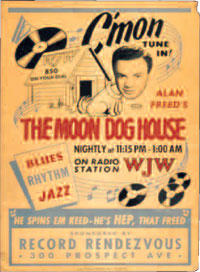
I mentioned Mr. Moondong himself in my poston the Sony Paola scandal and later thought I was unfair. I threw his name out ther ewithout any backstory at all. Most of us are vaguely aware of the story, vaguely aware that hew was bribed. Nobody sems to know by whom, for what record or for how much.... So let me put it in prespective.

This was an era where there were no Federal payola laws. NONE. So these were violations only of state law. A lot of equity trading law, and related contract law has changed since then too so please, really listen to this one.

In 1957 Alan Freed got a show on WABC-AM new york. He'd come over from WINS-AM and had to for legal reasons related to a vagrant musician had to change his DJ name and his show name. Never mind that his PIA would forbid this today but just know that he was at WABC at this point, his new show was "Big Beat" and that Dick Clark by all reports hated his guts.

So Alan takes a bribe, and then a couple more. Later on he would he would put the tally in court documents at about $30,650 from seven record labels. Just previousto this WABC asked all staff to sign contracts stating that they had never taken bribes and never would. Alan refused. It made him a target and it was a poor choice. But it might have been unavoidable. The State of New York fined him $300.
Regardless. He was out at WABC after the arrest came down. He moved to KDAY in Los Angeles. Three years later he was busted again for taking $2,700 in payola from Sun records among others. The bust sent him to WQAM in Miami... and onward.

Dick Clark was running American Bandstand at this point. He signed the contract. Dick claimed to have never taken payola. Tuth told, he probably hadn't. Instead he held stock in 33 music companies. In court he admitted that these "investments" were making him $500,000 a year. On his show he frequenty played songs by bands wherein he held label intrest or publishing monies.

For example. He owned a peice of Duane Eddy. So Duane got played more than say... The Beatles. This went on until WABC pressured him to divest the "questionable conflicts." Dick didnt exactly take payola since he would only have to bribe himself.

TOTALS:
Alan Freed: under $35,000
Dick Clark: over $10,000,000 (probably more)

But Dick played the game and American rascist politics was pretty mad at Alan for refusing to play the lame-ass WHITE VERSIONS of black R&B hits. Dick Played Pat Boone versions. Alan played the original singles when they orignially came out. He was spinning cuts by by Joe Turner, Little Richard and Fats Domino. Thats why there were congressional hearings. It was not about the damn 30 grand.