Showing posts with label KHJ. Show all posts

Monday, November 24, 2025

DJ Foster Brooks


Foster Brooks died in 2001 at the age of 89. His talent has largely been forgotten as he spend the peak of his career type-cast into a role as a lush. Cultural attitudes toward alcoholism had changed by the 1980s such that it wasn't funny anymore. The same thing happened to Dean Martin.  Brooks was was almost 70 at the time and it was late in life to re-make his image. But he still landed a reoccurring role on Mork & Mindy as Miles Sternhagen. The role was a manager at a TV station. With his background, it may have been an impersonation of someone from his own career. Brooks made do with these cameo appearances until finally retiring. Anyone born after the movie Dances with Wolves came out would likely have no idea who he was.  More here.

Brooks was born in Louisville in 1912 and was one of seven brothers. His career started in radio, at WHAS-AM right there in Louisville at the age of 13 singing with his mother Edna. He remained primarily a singer at WHAS for years. The station was barely three years old at the time, having only been founded in 1922.  The earliest record I have found of him at the station is from April of 1932. He would have been only 20 years old. "Foster Brooks and Jim Henry staff singers doing a prolog for Hayden Reads Organlog this week at Loew's State, Louisville."  Then in September of that year another issue of Variety reports "Foster Brooks, WHAS baritone will m.c. at Seville Tavern, Louisville."

He later sang harmony with staff pianist Joe Pierson and by January 1937, he was announcing the Bulova watch time during station breaks. But this was not his first radio program. I found a 1934 issue of Variety which puts him on KSO in Des Moines, IA in 1934. It's just one sentence "Foster Brooks and Joe Plerson a new duo for KSO, Des Moines." Plerson was announcing at WQAM in Miami by March of 1935, so clearly the duo split. Plerson later landed at WFBM in 1946 and stayed at least until 1952. Brooks went back to Louisville by 1936.  More here.

Breaking out of singing, Brooks did everything behind the mic he could. He announced softball games and had an oddball afternoon show called "Yellow Blank Salute" with Herbie Koch organ, Charles Hurta on violin and Brooks own recitations. Radio Daily describes it as the staff organist and a staff violinist and makes no mention of Brooks. It was sponsored by Western Union. Radio Dial confirms it was on the air from May 1937 through April of 1938. He was at WHAS for 7 years (total) and was even captain of their baseball team. 

The WHAS studios were in the Courier-Journal newspaper building in downtown Louisville. Brooks became a staff announcer.  In 1937 he raised his profile for his emergency reporting during a severe flood. This was broadcast on both WHAS and WSM-AM. [SOURCE] In one of the pictures he poses with equipment borrowed from WFIL-AM. Yes, that's Brooks up the pole. It looks like they were clowning, which they were, but Monroe died of an infection from an injury that occurred in that dirty water, he was a year younger than Brooks. He and Pete Monroe sent flood bulletins from Lock 41 on the Portland canal and ended up in Variety and Broadcasting magazine multiple quotes and pictures: 

"At that time WHAS bulletins were spaced five minutes apart... the critical stages of the rescue work had passed. An announcer (Pete Monroe) or (Foster Brooks) said "WSM, this is WHAS calling... we will keep our transmitter open to take whatever stray bulletins come in... perhaps five minutes apart. Our transmitters now working with reduced power— go home WSM and get some sleep..."
That coverage is probably why a year later in 1938 Brooks moved to KWK-AM in St, Louis as an announcer. Trade magazines already knew who he was and reported the move.  He followed WHAS alumni Allan Anthony to KWK. Even Rural Radio magazine called out the hire. (The 1978 book Golden Throats & Silver Tongues by Ray Poindexter incorrectly places this in 1931.) A 1939 issue of variety confusingly describes Brooks leaving again in 1939. [SOURCE]

In 1942 he replaced Jack Berry on WHEC-AM in Rochester, NY taking over the Musical Clock. (Those call letters come up again later.) [SOURCE] In 1946 Brooks made his first commercial record, a 78 on Continental "The Face On The Bar Room Floor" Parts 1 [LINK]  and 2 [LINK]. It's oddly rare. The recording is not music or singing or comedy. It's a recitation with multiple character voices, all of which are probably Brooks. The text is old, I found a copy of the poem in the Stone Cutters Journal in 1922. It's attributed to Hugh Antoine d'Arcy who wrote it in 1887 under the original title "The Face Upon the Floor".  I can't speak for the 78, but the poem was very popular for decades. He wasn't even alone in recording it. Harold Selman did a version in 1928 for Okeh, Art Leonard for Regal in 1930, Buddy Williams in 1942 for Zonophone, and that continued right into the vinyl era. Hank Snow did a version in 1968. 


In 1943 550 WGR-AMWKBW in Buffalo, where he hosted "The Musical Clock" and "Million Dollar Ballroom". In Buffalo, Brooks also performed with a country and western vocal group known as the Hi-Hatters.  Foster continued to play up the zaniness and organized stunts. He co-hosted a quiz show called "Stump Bob Smith." In 1949 he coordinated a canoeing event with WKBW and WEBR. There is one picture from this even of four very soggy DJs: Clare "Butch" Allen, Al Healy, George Walker, and Foster Brooks. It's not clear who won but if that meant staying dry, everyone lost. 

In 1950 went back to Louisville and got a really weird gig on WKLO. The WKLO DJ page describes his time at the station as short and says little else but there are other sources. [SOURCE]  His show was on 15 minutes five nights a week, then Saturdays from 9:30 PM to 1:00 AM. The description (below) in Variety magazine sounds truly bizarre. It sounds vaguely like his old WHAS show, "Yellow Blank Salute." I wish there was a tape of this show somewhere. 

"Brooks has a telephone in the studio and invites listeners to phone in their requests. One of the few air comics in this town, and by far the most versatile, Brooks intersperses vocals with the disks. Accompanied by the electric organ by Jerry Bottorff WKLO program director, Brooks vocals ballads in an excellent baritone voice. He has a gift for ad lib, and his throw-away remarks are entirely unpredictable. His timing and razor sharp zanyisms [sic] are making him a standout ad lib jock." 

By 1950 Brooks was on 970 WAVE-AM. The advertised him in Broadcasting magazine with the note "A top notch MC and wit —has appeared appeared with Arthur Godfrey, Vaughn Monroe, Spade Cooley and others! ... Louisville's most colorful television personality!"  In 1950 He had a "Foster Brooks Show" in 1950" which again sounds oddly like that Yellow Blank Salute again, ad-libs, card trucks and telephone gimmicks and musical accompaniment by the Mart-John Duo playing piano and bass-fiddle. He had a morning show "wake up with WAVE."  H Then he had a kids show at WAVE-TV where he played mickey mouse cartoons and portrayed The Old Sheriff in a western jail set.  Disambiguation Brooks father was a real sheriff in Louisville and Bhis brother was "Cactus" Tom Brooks who portrayed a cowboy clown on WHAS-TV in the 1950s 

Brooks stayed at WAVE for about 5 years. In 1957 Broadcasting also reported when he jumped to WHAM-AM in Rochester, NY. Brooks moved from WHAM-AM/WHFM-FM to WHEC-AM-TV in 1959. [SOURCE] It was the same year he won a Ray-O-Vac radio announcer Top 10 contest. I wish that tape still existed. 


Most short biographies report that he moved to Los Angeles in the 60s and began acting in television and doing stand up comedy. But this is glosses over the details. A Buffalo Bills press book still puts Foster Brooks on WROC-TV, Rochester in 1960, but so does the 1963 issue which seems erroneous. In 1962 KHJ schedules put him on that station in L.A. from January through at least June of that year. This seems to be his last regular radio gig and it's terminus marks the end of his radio career and the transition into character acting and television. 

According to Brooks he quit drinking in 1964 on a $10 bet. "I never drew a sober breath from Friday night to Monday. Eight years ago I quit. Fellow made me a $10 bet I couldn't quit, and I haven't had a drink since. At the time I needed the $10." His first TV appearance was on Gunsmoke in 1962, and his did dozens more; clearly playing a drunk was better for his career than being one. [SOURCE] He had a 30 year career in radio and then had another 20 year career in television. In 1997 Brooks was inducted into the Buffalo Broadcasters Association Hall of Fame. He died in 2001.

Monday, November 08, 2021

Whistling J. Donald Wilson

Our story starts with two radio announcers born only a few years apart with similar names, both working as radio announcers on national networks. Donald Harlow "Don" Wilson and John Donald Wilson. With John and Don being relative homonyms, some confusion was inevitable. Multiple sources claims that in 1938, he had adopted the name "Norman Wilson, but later changed it back to J. Donald Wilson. This is correct and is  documented in the January 1, 1938 issue of Broadcasting Magazine [LINK] which states (on pg 50) in their Behind the Mike column the following:

"J. Donald Wilson, Hollywood announcer on the 'Charlie Chan' and 'Strange as It Seems' transcription serials produced by Raymond R. Morgan Co... has changed his name for professional purposes to Norman Wilson. To avoid confusion with Don Wilson, announcer of the NBC Jack Benny program, J. Donald Wilson, a year ago inverted his name, but it didn't sound right. He has now taken the new name."

The timing of this text is apropos, because on page 19 of the same issue it reports that the other Don Wilson repeated his 1936 victory and was chosen as the best announcer of 1937. (This happened almost annually thru about 1952) John clearly felt like his career was in the shadow of the other Don Wilson. But the newsy, present-tense delivery of the text makes a mess of the chronology. Is his real name Donald John Wilson or John Donald Wilson, which is the inverted form?  His headstone reads "John Donald Wilson" so I take that to be his real name. But that means that his resume may be divided over three pseudonyms.  

The choice of  the name "Norman Wilson" has no clear origin. It was the name of the short-lived bandleader of the Norman Wilson Orchestra on KRKD in Los Angeles. A decade later but there was also a Norman Wilson Co. record distribution company located at 2562 Holmes St. in Kansas City, MO. They operated from at least 1952 - 1960 moving London, Mercury and Hollywood records. They appear in both issues of Billboard and Cashbox in that era. Norman Wilson Distribution had moved to 1914 Washington Avenue in St. Louis. 

Our John Donald Wilson was born on June 5th, 1904 and was a radio and film writer, producer, and voice actor, born in Kansas City, MO. There lies the only connection to that record distribution company. But based on that I'm guessing there is at least a family connection there. It's too much of a coincidence.  But his fame centers mostly around his writing on The Whistler. The Whistler began as a radio mystery drama which debut on May 16th 1942 and ran until September 22nd 1955 on CBS. That's a 13-year run.  There were 692 episodes. This was followed by a series of 8 Columbia films, (below) and a short-lived syndicated TV version in 1954. That's a home run by any measure.

  • The Whistler – 1944
  • The Mark of the Whistler – 1944
  • The Power of the Whistler – 1945
  • Voice of the Whistler – 1945
  • Mysterious Intruder – 1946
  • The Secret of the Whistler – 1946
  • The Thirteenth Hour – 1947
  • The Return of the Whistler

As both a writer and producer on the radio series, you would hope J. Donald Wilson would have earned some decent royalties and licensing fees. Not that Wilson was the only writer on the series; George Allen was the main writer on most of the later episodes, taking over duties in 1944. Allen donated over 100 of those scripts to UC Santa Barbara [LINK] making for a nice research library. Allen actually made some pretty significant changes to the structure of the series, even changing The Whistler from a participant to an observer. Nonetheless, when the first film was in development, it's producer Rudolph Flothow hired J. Donald Wilson to draft that story. More here and here.

Despite writing and producing The Whistler, Wilson wasn't the announcer for The Whistler.  That duty went to Joe Kearns and Gale Gordon in the early episodes and later Bill Forman. Forman was an odd pick. His prior resume included no acting credits at all, and his big gigs were the Fitch Bandwagon and Kay Kyser’s Kollege of Musical Knowledge. But Forman was a natural, and later even co-wrote scripts. More here.

But there was a fourth narrator, Everett Clarke. At the same time Signal Oil was sponsoring it's broadcasts on the West Coast (KNX, KQW etc.) from Feb. 1946 to Feb. 1947, a completely separate and local broadcast of The Whistler was airing Sunday nights at on WBBM in Chicago sponsored by Meisterbrau beer.  They used the same scripts and music as the Los Angeles-based production but broadcast it as a live performance, with an audience and of course, a completely different cast.  It even aired with the same opening narration:

"I am the Whistler, and I know many things, for I walk by night. I know many strange tales, many secrets hidden in the hearts of men and women who have stepped into the shadows. I know the nameless terrors of which they dare not speak. And so I tell you the amazing story of..."

In addition to the radio series "The Whistler", J. Donald Wilson also wrote, produced, and/or directed The Adventures of Bill Lance, The New Adventures of Nero Wolfe, and Dark Venture. Wilson also did his own voice work in radio in the 1930s.  He voiced Mickey Mouse in select 1938 broadcasts of The Mickey Mouse Theater of the Air as well as other characters in Disney productions such as The Reluctant Dragon. He was the announcer on Strange As It Seems and Charlie Chan. After more than a decade of acting on radio, in march of 1945, he became production head of NBC Blue (aka ABC) and later was promoted to vice president. More here.

The Adventures of Bill Lance, private eye, aired in two non-consecutive runs. This detective series first aired on CBS was from April 1944 into September 1945. Wilson rebooted the series at ABC and it ran from June 1947 into January 1948, sponsored by planters peanuts. John McIntire portrayed Bill Lance in the first run, and Gerald Mohr took on the role in the second run.  Mohr  had been in the Mercury Theatre and was quite good. Wilson didn't write the scripts in that second run. A short news piece in The Winona Republican-Herald claimed that ABC hired writers specializing in criminology for the series.  Dick Joy announced both runs, with some fill in by Owen James. Adam Graham will tell you anything you want to know about it More here.

Nero Wolfe was different. That detective already existed, and Wilson just re-worked it for radio. By the time the Nero Wolfe series aired in 1950, author Rex Stout had already published 17 detective novels in the series. The radio series only ran into 1951 but the books kept coming for another 25 years.

The more famous, Donald "Don" Wilson was born on September 1st, 1900, was an American announcer and actor in radio and television. He was sometimes described as having a "Falstaffian" voice. This term is usually used to describe a fat jolly fellow who's a bit mad kind of like John Belushi. The reference is very old, it alludes to Shakespeare's character Sir John Falstaff in the play Henry IV from 1597. You can't be too debauched on the radio, so Wilson was just a bit cheeky. The reputation comes from his time as the rotund announcer and comic foil to the star of The Jack Benny Program. That reputation came from Jack Benny himself, who made Wilson the butt of numerous fat jokes. When they made the jump to television, Jack toned down the fat jokes a little.

His career has been written about much more extensively so I'll just hit the pre-Jack Benny highlights.Wilson began his radio career as a singer over Denver radio station KFEL-AM in 1923. By 1929, he was working at KFI-AM, and shortly afterwards for Don Lee at KHJ-AM, in Los Angeles. Though best known for his comedy work with Jack Benny, Wilson had a background as a sportscaster,  right before working with Benny he was actually the announcer on the George Gershwin series. Wilson first worked with Benny on his April 6, 1934 broadcast. The program ran for 30 years.

Don Wilson died April 25th, 1982 and J. Donald Wilson outlived him by 1 year and 9 months, dying on January 26th, 1984. 

Wednesday, November 28, 2012

The Real Proximate Causation

Not every DJ is remembered, and even fewer in the cannon of legal precedent. The Real Don Steele played a role in a tragic case which led to a notable decision on the issue of proximate causation in tort law.He was also a pretty popular California DJ for about 4 decades. He started DJing at 930 KHJ-AM in 1965 which is all you need to know before reading on...

The California Supreme Court's decision in Weirum v. RKO General, Inc. in 1970 regarded Don Steele's radio show on KHJ-AM. They ran this promotion called "The Super Summer Spectacular." The schtick was that Don himself would drive "a conspicuous red automobile" to a particular area and an announcer would state over the air that Steele was headed to that area. The first person who found Steele (with some conditions) won receive a cash prize. Conditions were pretty simple wearing certain articles of clothing or answering simple questions. Yeah... no way that might go awry...


Subsequently on July 16th  1970, two different teenagers, in two separate cars were tailing Don Steele waiting for the announcement on the air. In their irrational exuberance one imbecile forced another motorist's car off the road, killing him. The victim's family sued everyone, the car manufacturer, the teens and RKO Genera, the owners of KHJ, because this whole stunt was dangerous and amazingly stupid. One teenager settled, but the other teen and RKO were found liable for the accident. The award was 300k, that's over 1.7 million in 2012 dollars. RKO General appealed.

That appeal forced the California Supreme Court to get very specific about liability. They affirmed the jury's verdict that RKO General was legally liable by the reasoning that the contest generated foreseeable risk of harm to the public. they did not say that it was very stupid, but it certainly was. The imbroglio, the court case the the verdict lived on in the cannon of law and Don Steele remained unharmed. Mr. Steele stayed at KHJ until 1973, then moved on to KIQQ, KTNQ, KRLA, KODJ, KCBS and then KRTH in July 1992. He died in 1997 after a truly epic career. 

Wednesday, September 12, 2012

Hollywood Walk of Fame: H - L

This is part three of what will be a 5 part series wrapping this Friday. The Los Angeles Times has a series of biographies of every star on the walk and notes the categories, but even they have been unable to link some of these names to radioland itself. I've examined over 100 "stars" now: some obscure, some still ubiquitous. Very few were actually deejays. The list is mostly comics and singers than anything else. I think that says more about Hollywood than radio.

Jack Haley - This former  host of the Jack Haley Wonder Show later played the Tin Man in the The Wizard of Oz. the Wonder Show was famous for featuring the then not-so-famous Lucille Ball. Jack also hosted the Log Cabin Jamboree on the NBC Red Network.

Carl Stewart Hamblen - He was one of radios early singing cowboys. His first stretch on air started in 1936 on KFYO-AM in Abilene, TX. He later sang as Cowboy Joe on KFI-AM, and with the Beverly Hillbillies, on KMPC in 1930. He performed with several groups under different shows on KFWB into the late 1930s. He found god in 1949, quit drinking and started "The Cowboy Church of the Air" which ran until 1952.

Bill Handel - He won his star only in 2009. He hosts a morning show on KFI-AM  and a legal advice program on Premier Networks presently. He has been notable lately only for making racist remarks on air.

Arlene Harris - She made her name as a comic actress on the radio program "The Chatterbox."  But she also put in some time on CBS as Mummy Higgins, playing the mother of Baby Snooks with Fanny Brice.

Phil Harris - In 1946 he started doing wholesome family skits with his wife Alice Faye on The Fitch Bandwagon show. In 1949 the show was became The Phil Harris-Alice Faye Show. Afterward he moved onto bit parts in TV and cartoon voice over gigs.

Bill Hay - Starting in 1926 he announced for the  Amos 'n' Andy show, moving with them from WGN to WMAQ. He actually got his start on KFKX in 1922.

George Hayes - He is known for his work in westerns acting alongside William Boyd,  Roy Rogers, Gene Autry or Wild Bill Elliott. He also hosted "Melody Ranch" a WWII-era country music program on AFRS. He also guested on the Andrews Sisters show in 1944 and in the supporting cast of the Roy Rogers Show 1946-1947 on Mutual in the role he was typecast for.

Helen Hayes - After a good showing on Lux Radio Theater she got her program the "Helen Hayes Theatre" which ran 1935 - 1936. After which she did a year on the O'Neill Cycle on NBC Blue. She was on the Electric Theater on CBS in 1948 and in 1949 she turned up again on "This Is Broadway" a radio talent show on CBS.

Johnny Hayes - A real deal DJ from KRTH-FM. He started at WAKE in 1961,and after a few stops,  KRLA in 1965 where he stayed for 25 years. (Some sources say 27.) Today he is alive, well and retired.

Dick Haymes - His recording career takes front and center but he was also a performer on Club Fifteen with the Andrews Sisters. His show "Here's To Romance"ran on the NBC Blue network in 1943. He followed that with The Dick Haymes Show running 1944 to 1948. Then "The Carnation Show" in 1950, NBC Bandstand 1956-1957... you get the drift.

Jim Healy - A sports announcer who was on KLAC from 1961 to 1965, then KFWB in 1969. He spent some time on TV but came back and was on KLAC from 1973 to 1982 and KMPC from 1984 to 1994. He also hosted Here's Healy on KBIG-FM back in the 1950s. .

Chick Hearn - He was  the play-by-play announcer for the Los Angeles Lakers  which have been carried on network radio via KLAC-AM since the beginning of time. Still, a sort of dubious inclusion.
*Corrections from  KoHoSo

Horace Heidt - He was a popular radio bandleader on both NBC and CBS. He did dozens of programs: Horace Heidt's Alemite Brigadeers, Pot O' Gold, Tums Treasure Chest, The American Way, Captain Dobbsie's Ship of Joy, The Horace Heidt Youth Opportunity Program the list goes on.

Jean Hersholt - He of the unpronounceable surname had two big roles in his career. He spent 7 years starring on "Dr. Christian" and playing the character Dr. John Luke. The rest of his career appears to have been in TV.

George Hicks - A war journalist who was first on NBC then NBC Blue. He actually recorded the D-Day Normandy Invasion. It was broadcast on NBC and the BBC. That's pretty damn amazing.

Hildegarde - Also known as Hildegarde Loretta Sell a slightly risque cabaret singer. She had two radio shows.  Her NBC radio program "Raleigh Room" ran in the 1940s and AFRS carried Hildegarde's Radio Room for at least a couple episodes in 1945.

John Hodiak - most of his career was on stage and screen but he also played the role of the comic strip character Li'l Abner on radio. It ran in 1939 and 1940 on NBC.

Portland Hoffa - Married to Fred Allen it's no surprise she performed as both comedian and vocalist on his programs.  her character was so unpopular that sales execs begged Allen to drop her but he stood firm. In 1949 he left the program. The performed together on The Big Show 1950–52, and she finally started working without Fred in 1954 usually as a mystery guest on TV quiz shows.

Bob Hope - Bob Hope was inducted into the Radio Hall of Fame in 1990 while he was still alive. He  first appeared on the show "The Intimate Revue" in 1935, followed by the Woodbury Soap Hour in 1937, and the Pepsodent Show in 1938. His film career took off and then those USO shows... etc. Guinness Book rates him as the most awarded entertainer in history.

Warren Hull - He started out on Soap Operas like "The Gibson Family" which ran on NBC in 1934. Following a short film career he became a radio announcer on The Hit Parade and Vox Pop in the 1940s. He then hosted the game show "Strike It Rich" on NBC radio 1949 - 1957.

Frazier Hunt - This respected newscaster and war correspondent was on WLS-AM on every Monday, Wednesday and Saturday  at 6:45 PM. Frazier Hunt and the News was on NBC in the early 1940s. Probably best known for smuggling out a copy of  the Versailles Peace Treaty in order to scoop the story.

Marlin Hurt - He did the Hometown Incorporated show in 1940, Fred Brady Show in  1943 and subbed on the The Bob Burns Show on NBC. But the big fame came from his role on the Fibber McGee and Molly program in 1944. He played the role of Beulah, a black woman. In 1945, Beulah was spun off into it's own radio show "The Marlin Hurt and Beulah Show" which ran 1945 to 1954. Thankfully on TV ABC finally cast a black woman to play the part of  Beulah.

Ted Husing - Primarily known as a sportscaster in the 1930s, he was also a CBS announcer on "March of Time" and an for "George Burns and Gracie Allen.  In 1946, he moved from CBS to WHN-AM to try his hand at DJ-ing.   It was a hit and the Ted Husing Bandstand ran from 1946 to 1954. He moved on to TV after that.

Michael Jackson - Born in England he became a DJ in South Africa. He came to the US in 1958 and did a program on KYA. At KEWB he phased out the record flipping and phased in a talk format. He made stops at KNX,and KHJ, then put in 32 years at KABC starting in 1966.  He came back to KABC in 2009 and is still there.

Jaime Jarrin - The Dogers moved to LA in 1958 and KWKW-AM picked up the Spanish language broadcasting rights for the games. Jarrin was the news and sports director, and he became the  announcer from 1962 to 1984.

Al Jolson - A radio star from it's earliest days he was on NBC's The Dodge Victory Hour and his own shows included Presenting Al Jolson,  Kraft Music Hall, Jolson Sings Again, Shell Chateau and a litany of others.

Spike Jones - After a good performance on The Bob Burns Show, he got his own radio show,  The Chase and Sanborn program on NBC. Then he moved over to CBS 1947 to 1949 for his show The Spotlight Revue, which was renamed later The Spike Jones Show. But really, his recording career is where it's at.

Ellen K- Inexplicably Ryan Seacrest's sidekick has a star on the Hollywood walk of fame. She used to be a co-host with Rick Dees on KIIS at least as early as 1995. She also had a Top 30 Countdown show on Premier networks that was cancelled in 2002.

Casey Kasem - See previous post here.

Danny Kaye -  Most of his fame is from film and music but he also starred in a radio program "The Danny Kaye Show" which was carried on the CBS network from1945–1946. He also did a set of shows for AFRS in WWII and in 1963 he repeated the recipe with a TV version of the show.

Sammy Kaye - He started out on the Mutual network in 1937 doing short sets. Then starting in 1940 had a show called "Sensation and Swing" on NBC. He also was on the Old Gold program for two seasons starting in 1943 . Starting in 1944 he launched the Sunday Serenade, a program title he'd recycle often. He continued to do short run programs and short form music programs into the mid 1950s.

John B. Kennedy -  An American radio correspondent whose radio debut was in 1924 on WJZ-AM on the Collier Hour which ran until 1931. Afterward NBC had him host "The Magic Key" from 1934 to 1939 and "The People’s Rally" which ran 1938 - 1939.

John Reed King - Famous as a game show host on radio and television he ended up doing morning news at KDKA in the 1960s and KGO-TV in the 1970s. The peak of his popularity was probably the radio show "Missus Goes A-Shopping" on CBS.  He also announced on the soap opera "Our Gal Sunday" and the infamous Duffy's Tavern among others.

Wayne King - Nick named the "Waltz king" his longest stretch was 1931 to 1940 on NBC doing random gigs usually as the "Wayne King Program" sponsored by Lady Esther cosmetics. He later subbed for Jack Benny and Jimmy Durante.

Raymond Knight - Originally an ad writer for NBC, he was asked to write a comedy program in 1929 and came up with  "The Cuckoo Hour". He later did the children's program "Wheatenaville Sketches." He later wrote for Broadway productions.

Kay Kyser - You can't forget "Kay Kyser's Kollege of Musical Knowledge". It started in 1937 on WGN-AM in Chicago and then moved to NBC. It continued to air until 1949. He retired from broadcasting in the 1950s and was inducted into the Radio Hall of Fame in 1990.

Art Laboe - See previous post here.

Jim Ladd - Possibly the last surviving DJ of note from the Freeform era, he started at KNAC in 1969, but earned his stripes doing a weeknight show on KLOS-FM starting in 1971. In 1974 he began 13 year stretch at KLOS that ended with in 1984. He was on KMET until 1987 when it flipped to KTWV, smooth jazz. In 1988 he moved to KMPC (later KEDG) staying until it flipped in 1989 to Español. He DJ'd at KLOS again in the 90s getting booted with  format flip staff purge in 2011.  He now does a shift on the Deep Tracks XM/Sirius channel. (Long Live Ladd)
*Corrections from  KoHoSo 

Arthur Lake - Mr. Lake played the part of Dagwood Bumstead in 28 different "Blondie" films, 1 TV show and the radio series on NBC Blue. It ran 1944 to 1950. He also portrayed the character in a couple guest appearances.

Dorothy Lamour - While most of her career was in film she also had her own fifteen-minute weekly musical program on NBC Radio in 1935. She also guested on the Rudy Vallee radio show, The Chase and Sanborn Hour and The Sealtest Variety Hour

Frances Langford - She got onto the Rudy Vallee by auditioning and became a regular starting in 1931.
From 1946 to 1951, she performed on The Bickersons and the Chase & Sandborn Show. She later replaced Judy Garland in Bob Hope's show.

Fulton Lewis II - See previous post here.

Art Linkletter - See previous post here.

Little Jack Little - He was a song plugger in Chicago who got lucky. He was a short man which a big orchestra on WABC-AM in the early 1930s. He did a lot of USO shows in WWII, and was a DJ on WEAM-AM starting in 1947.

Mary Livingston - She was a comedian in her own right, but also the wife and radio partner of comedy great Jack Benny.  In 1932 she turned a bit part into a full-time rule. her stage fright kept her from beginning a major character, and she was large absent from the last season 1954-1955.

Al Lohman & Roger Barkley - They share a star because they shared a show, a highly rated morning drive program "The Lohman and Barkley Show" on KFI. It ran through most of the 1970s into the 1980s. Barkley quit the duo in 1986. They both have notable radio careers before and after they were a team.

Guy Lombardo - He was Dick Clark before Dick Clark. From 1929 to 1959 he and his band hosted a New Years Eve show at the Roosevelt Hotel in New York City live on NBC. From 1959 to 1976 the program continued with Lombardo at the Waldorf Astoria.Starting in the 1960s it was also aired on TV competing with that young upstart Mr. Clark.

Vincent Lopez - His first documented radio performance was in 1921 on WJZ-AM. He and his band continued to perform on air including a series called "Luncheon with Lopez"  but it was in 1952 that he and Gloria Parker hosted a radio program on ABC broadcast from the Taft Hotel called "Shake the Maracas."

Phillips Lord -  He started with a small singing show on WTIC-AM. Then became a successful as a radio script writer for NBC with "Sunday Evening at Seth Parker's" which actually ran 6 days a week from 1929-1939. He later created the show  Gang Busters a huge hit that lasted from 1935 to 1957.

Friday, June 01, 2012

Harold Kayes Mailorder Network

It's almost unthinkable now. In 1950 WGN-AM just handed over night programming to Harold Kaye Mailorder service. The company was very real,  Kay was a former exec from the Olian Ad Agency. the company even appears in the 1950 and 1951 Broadcasting yearbooks simply as "Mail Order Network." According to a 1949 Billboard article they had 50 stations on board. They provided up to 35 hours of programming per week, and were on stations as big as WOR-AM in New York. The "network" was linked by transcription, but provided programming, advertising copy and sponsors. They were headquartered at 1440 Broadway, in New York. The book The Deejays by Arnold Passman described it somewhat grandly:
"So in the fall of 1949, WGN, Chicago, shocked the industry by turning over its midnight-5 A.M. hours to Harold Kaye's Mail Order Network. With Erv Victor spinning pop and hillbilly records between the "per inquiry" spots, plastic Jesus radio, with six pitches per hour, was spewed from WGN's superengineered, wide-ranging, 50-kilowatt mountaintop, where big bands had been beamed to the nation just a few years earlier."
 Their first produced program was "Big Joe," hosted by Joe Rosenfield which was carried by 710 WOR-AM. His program ran from 2:00 AM to 5:00 AM from 1949 to 1954. Joe went on to host Big Joe's Happiness Exchange on 770 WABC-AM in 1959. How long his WOR program was involved with Kaye is unclear. More here. The aforementioned Uncle Erv Victor was a country music DJ formerly of KMOX, where he had been since at least 1946. He left for WGN in September that year. The program ran overnights, 1:00 AM to 6:00 AM, syndicated on 56 stations.  One of them was KHJ-AM. The mail order network had previously claimed to have 50 affiliates with stations in New York, Chicago, Philadelphia, Boston, Baltimore, Washington, Miami, Jacksonville, Tampa, Atlanta, Birmingham, New Orleans, Buffalo, Rochster and New Orleans. I count 15 cities in that list. With 50 affiliates that is either a lot of double coverage or a lot of omitted stations, or a gross over-estimation. The article went to some pains not to name the stations, describing wattage and market but not the call sign... almost as if there were some shame attached...

It was said that NAB didn't like the precedent, but WGN wasn't a member so there wasn't much they could do. For Harold Kaye results were great. the huge coverage area of WGN parlayed into more orders from more customers in more markets. It was the QVC of it's day and as programming it bordered on repugnant, but the sales numbers didn't lie. But in 1951 Kaye told Billboard that his similar programming on TV was "headed for the junk pile."  Kaye credited the two-month drop to "the current economic squeeze, public resentment of phony claims and inferior merchandise, and the fact that mail-order pitches are no longer a novelty to TV audiences." Unsurprisingly Kaye shows up as the new TV department head at the Dorland Ad Agency in June of 1951. I can't be certain that it's the same Harold Kaye... but it fits the story.

Monday, September 26, 2011

DJ Wink Martindale

Today Winston "Wink" Martindale is remembered as the host of a number of cheesy TV game shows. He hosted a total of 12 different game shows including Las Vegas Gambit, You Don't Say, Can You Top This, Headline Chasers, High Rollers, Debt, Tic-Tac-Dough and Trivial Pursuit. To modern sensibilities his accomplishments are cheesy, and trite. But in many ways he was a leader in this arena. Without Tic-Tac-Dough there wouldn't be Deal or No Deal, or Who Wants to Be a Millionaire. Today there's an all Gameshow network, GSN. Wink is a part of that somewhat grotesque legacy, and before all this... he was a radioman.

Martindale was born in Jackson, Tennessee in 1934 and got his first DJ gig at the age of 17 at 1490 WPLI-AM.he is listed incorrectly in the 1953 issue of the Broadcasting Yearbook as "Winkie" Martindale. At least I hope it's incorrect. That'd be an awful nickname. The station's license was cancelled 2 years later. He crossed the street to WTJS-AM then WDXI, but his last stop was definitely 1460 WJAK-AM. The 1957 Broadcasting Yearbook lists Winston Martindale as it's PD. He didn't stay in town long after that. He graduated from Memphis State College, with a Bachelor of Science degree that year.

He tried Television for the first time in 1958 at WHBQ-TV in Memphis. the program was a kids sci-fi show called  Mars Patrol. While at WHBQ-TV  Martindale became the host of the Saturday night "Dance Party" show. I dont' have the sequence cemented yet btu that same year Martindale recorded the song, "Deck Of Cards" and it went to number seven on the Billboard Hot 100 chart. The disc sold over a million copies. He even performed it on the Ed Sullivan Show. He was two steps away from becoming Dick Clark. Instead, he retreated back to radio. maybe the offer from  KHJ-AM in Los Angeles looked better than his prospects in TV. Fellow WDXI-AM alum Ron Meroney was happy to take over for him at WHBQ-TV.

In 1959, he became the host of the morning show at KHJ-AM. It was a Top-40 station at the time. About a year later he moved to KRLA where he stayed a bit longer. Then he moved to KFWB in 1962 where he stayed 5 years replacing Gary Owens in morning drive slot. Simultaneously he was hosting the game show What's This Song? on NBC.  (Two episodes are known to exist.)  But TV wasn't hsi mainstay yet. He had some more miles to put into radio.

He started at KGIL in 1968, and put in three years there. Then on to 710 KMPC-AM doing oldies under Golden West Broadcasting then owned by Gene Autry.  He worked briefly at KJQI and KOJY in 1993 staying less than a year then went back for another short tour stop at KGIL. But that was it.. he did another year of KGIL maybe then off to TV land for good. In 1966, Billboard had voted Wink the #1 mid-day personality. He was a hot item and he seized the day so to speak. He began hosting the game shows Everybody's Talking, and You Don't Say in 1967.  In the 1970s he went onto the big name shows like Las Vegas Gambit, and Tic-Tac-Dough. He's still at it today, he's slowed down a bit, but he's 77 cut the guy a break.


Wednesday, February 24, 2010

The Drake-Chenault formula

Drake in Drake-Chenault is Bill Drake, the Chenault is Gene Chenault. The irony of my hatred for their version of radio is that it's alive and well today. they brought the gift of repetition and automation to Top-40. There was probably as much automation in FM radio in the 1970s as there are today. Sure the hardware was rudimentary, but it worked.

At the time the FCC had passed a new regulation prohibiting owners of AM and FM stations from simulcasting programming. This was intended to force media owners into running original content on their shiny new FM stations. The result was somewhat the opposite. With FM still fresh out of the shrink wrap it's ad revenues were still quite low. So station owners turned to automation and syndication to keep costs down. This played right into Drake-Chenault.

Drake was the VP of programming at RKO. Gene Chenault owned KYNO in Fresno. In the beginning they started to market production music on tape under the company name barton Industries. In 1967 they began pitching a Top-40 countdown style program called Hitparade which launched on KHJ. They began consulting shortly thereafter. But RKO was watching their own ratings slide. They put the heat on Drake-Chenault with the general impression that their new hobby automating FMs was hurting their business arrangement for RKOs network of AMs. Drake could no longer multitask.

Drake and Chenault left and formed American Independent Radio to market pre-recorded programs.For them consulting was to apply the Drake-Chenault formula. Their Top-40 formula was made of most of the things we take for granted in radio. It was the original more-rock-less-talk arrangement. Programs were broken into hours, hours in to quarter hours, bumpers, liners, jingles, branding, short repetitive playlists... and it worked. It produced ratings. As much as I despise it, it's still the standard for CHR Formats today. More here.
But taking the autonomy away from the DJ was received poorly, at least by DJs. Sometimes their arrival at a station went badly: Staff walkouts, vandalism, and theft. KMPX for example experienced all three. Drake-Chenault was the polar opposite of the free-format mania some stations had been running with. Their GM Bert Kleinman bragged in 1975:
"Current estimates indicate that over 20 percent of all stations in the United States are automated. In 1974 alone, it is estimated that 500 AM and FM stations have switched from manual to automated operation. At thiis rate over half the radio stations in the country could be automated by 1980."
In 1979 Billboard called them "the fastest growing syndicator around." Stations using the Drake-Chenault formula were calling it Top 40 or Hot 100 might have been spinning as few as 30 singles. There's no slow fade out on this story. Their partnership dissolved and they sold the company. It dissolved in the mid 1980s. But aside from that anti-climactic exit they succeeded in every way possible. Their formula has had total industry dominance since the late 1970s.

Thursday, May 28, 2009

KKHJ to KHJ

The FCC no longer grants 3 character call letters, or that's the general rule. It's supposed to be a firm rule, but like all things in radio there always seems to be an exception. Stations make all sorts of cockamamie arguments to acquire them, but KKHJ is the present champion. On March 15th, of 2005 KKHJ became KHJ, again. It was a magical moment but let's rewind to the last time they were KHJ and then follow the ouroboros back to 2005.

In 1922 KHJ took to the airwaves for the first time; it's calls issued from the Department of Commerce as there was yet no FCC or FRC. They operated on 760 kHz, and were owned by the Los Angeles times Newspaper. It was an early CBS affiliate, but CBS dropped them infavor of the bigger stick at KNX-AM in 1931. the station was sold to Don Lee who brought it into the Mutual Broadcasting Network. In 1941 under his ownership they increased their wattage with a move to 930 AM. Don sold out his whole chain to RKO General in 1949

In 1965 KHJ got a complete make-over from ham-fisted top-40 consultant Bill Drake. KHJ became known as Boss Radio. (I'll slander Drake another day) This was the stations golden era. There must be a dozen websites commemorating the DJs and branding of this time in the stations life. PD Ron Jacobs brought in good talent and the ratings killed.

But no good thing can go untarnished in radio. KHJ owner RKO General was in deep doo-doo with the FCC for "unethical conduct" at some of it's stations notably KHJ-TV. At the same time FM was on the rise and KHJ was losing it's grip on the ratings book. In 1980 they tried at country music which floundered. they tried being the "Boss" again in 1984 with an oldies format but the magic was gone. In 1986 they gathered up some classic DJs and bid the station bon voyage as the call letters were changed to KRTH, but still playing oldies. RKO was still in the hot seat though. After the FCC took away a TV outlet in Boston in 1989, RKO bailed out and sold KHJ (then KRTH) to Beasley Broadcasting. Beasley flipped it like cheap realestate and sold it to Liberman Broadcasting.

Liberman changed it to a spanish formatted station and changed the calls to KKHJ reusing some of the classic brand. But KKHJ isn't the same as KHJ. A 3-letter call is a rare thing, Somthign the FCC hadn't issued since the 1930s. PD Alfredo Rodriguez and chief engineer Jerry Lewine really wanted to get back to those classic calls from 1922. So they hatched a plan.

For the record, I want to point out that they didnt' lie. They just got creative. They told the FCC that they spanish pronunciation of K-K-H-J was an expletive. English and Spanish share an alphabet, but our names for the letters are slightly different. In Spanish it's pronounced as follows "chey chey hache jota." Alfredo told them that it's "cah cah hache jota" He told them that caca is an expletive in spanish.. which is also a bit dubious. "Caca" is akin to the word "poop". "Mierda" is more akin to the expletive "shit." [FYI: the more formal "excrementos" means "feces" or "excrament".] None-the-less the FCC bought it. On March 15, 2000 they dropped that first "K" and became KHJ for the first time in 14 years. Today that station is known not as the Boss but as "La Ranchera."

Tuesday, October 28, 2008

Charlie Tuna

Not the Starkist mackerel on the can of Tunafish. I mean Charlie Tuna L.A. radio personality at KRTH. Art Ferguson first became Charlie Tuna at KOMA in Oklahoma City. The nickname was a hand-me-down from DJ Chuck Riley who moved on to other pseudonyms.

I only first heard of the big Tune last fall. KBIG added a slightly deeper playlist to their Hot AC format. They didn't want to go all the way to adult hits, but they wanted to tweak thigns a bit. They tweaked Charlie righ tout the back door. They cut all their DJs and went all automated. Somhow "MY fm” didn't involve any me in my. But Clear Channel didnt' can Charlie, immediately. Thus ended a 7 year reign at K-BIG.

What I didn't know was that Charlie was also on 930 KHJ-AM back when it was "The Boss." That original team at The Boss still hads a lock on Los Angeles, they are the kings of the airwaves.

The Hollywood Chamber of Commerce honored Charlie with a Star on the Hollywood Walk of Fame in 1990. he was the first of the KHJ staff to get one. In 2008 he was inducted into the National Radio Hall of Fame.

It was in 1967 that Charlie scored a slot at KHJ. He debuted on Thanksgiving Day. He never really left LA after that. He had a non-compete that sent him to san Diego KCBQ for 6 months. But, in 1972, he moved over to 1500 KROQ-AM back in LA. It was attempting a wild top-40 format we'd think of as Classic Rock now. But the station had a rocky start, had trouble paying the DJS, the station even went off air at one point. In 1976, the FCC told it's owner Gary Bookasta KROQ would lose its license if they didn't resume broadcasting. KROQ went back on-air. It was much too unstable for Tuna. He bolted and got a gig at KKDJ in 1974. He eventually became management.

In addition to the above he's worked at KGFW, KLEO, KBZT, WMEX, KTNQ, KCBS, KHTZ KRLA, KODJ, KMPC, KIKF, KKDJ, KIIS-AM & FM, KCBQ, and KLAC. I don't think that's every stick in the city.. but it might be a record.

Friday, May 12, 2006

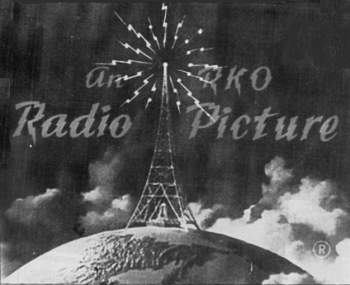
The RKO Radio Picture

The peak RKO radio station lineup consisted of WOR-AM in New York, KHJ-AM in Los Angeles, KFRC-AM in San Francisco, WHBQ-AM in Memphis, CKLW-AM in Windsor Canada, and the Yankee Network and its flagships WNAC-AM in Boston... (The Canadian government later tightened rules on foreign ownership of radio and television stations, forcing RKO to sell its CKLW-AM to a Canadian-based company in 1970.)

A radio picture? Radio doesn't have pictures, that's the point of radio...
RKO was formed in 1928 as a massive merging of four parties:

1. Keith-Albee-Orpheum (KAO) theater chain
2. Film Booking Office of America (FBO) studio
3. American Pathé film studios
4. Radio Corporation of America (RCA) Photophone division.

The prominence of the word "radio" in the corporate name reflected RCA's 66% holding. It is claimed that the broadcasting-tower logo of the production arm, "Radio Pictures," was suggested by David Sarnoff himself, but the reference is arcane and unproven.

In 1933 the U.S. Justice Department forced a re-org of RCA, requiring that RCA sell off a portion of it's RKO holdings. This change shifted power to investor Floyd Odlum and the Rockefeller brothers. In 1932 during the height of the great depression it went into debt. A corporate re-organization in 1936 made for a leaner more profitable company.

ten years later Howard Hughes gained control by buying 25% of the outstanding stock. Within weeks of taking control, he dismissed 66% of the staff and as a result production was shut down for six months! Hughs spent the time investigating possibly communists in the filing cabinets and under the carpets. As a reward, In the fifties Hughes got whacked with an anti-trust lawsuit and had to sell off RKO theaters.

With the loss of his theater division, Hughs focused on TWA and his aviation division. It was the Korean war after all. Hughes found the steady stream of lawsuits from RKO's small shareholders pesky. So since he was the worlds richest man, and a nutjob, he bought them all out in 1954. it cost $24 million. then, seemingly on impulse six months later he resold RKO to General Tire for $25 million. We all know what happened to him after that....

General Tire restored RKO's links to broadcasting. They already owned the Yankee network and in 1951 bought General Teleradio. But licensing problems with WNAK and KHJ hampered growth for the next 20 years! 1965-1987. Tt began with a simple license renewal. Fidelity Television claimed RKO General forced it's vendors purchase advertising time on RKO stations. Then the dirt came out from under the carpet: General Tire had bribed foreign officials, they had misappropriated foreign corporate funds, they bribed elected officials, RKO misled advertisers about its ratings, engaged in fraudulent billing, lied to the FCC about a destroyed audit reports and filed false financial statements etc. The FCC considered this gross misconduct. In 1980 the FCC stripped RKO of the two licenses.

In 1987, judge Kuhlmann found RKO unfit to be a broadcast licensee and recommended that the FCC strip RKO of its licenses. Kuhlmann based his ruling on numerous instances of dishonesty by RKO. RKO sold off it's remaining licenses shortly thereafter. Remember back when large corporations used to get punished by the government? Because the governments job was to serve it's citizens? Today I am reminded regularly by headlines that those days are long gone.