Showing posts with label CKLW. Show all posts

Monday, May 14, 2018

DeHaan's Radio Bible Class

I have a soft spot for the old medicine-show quack radio preachers and Dr. Martin Ralph DeHaan was one old fashioned, hard-drinking, radio preacher. After graduating from seminary in 1925, DeHaan took his first pastorate at Calvary Reformed Church in Grand Rapids, where he attracted large audiences both at the church and on radio. He broadcast live for the first time on 1310 WEXL-AM on September 4th 1938. Even at 50 watts, it reached from the suburb of Royal Oak into the city proper of Detroit.

Dr. DeHaan was not a healthy specimen. Born in 1891, he became a doctor after graduating from the University of Illinois in Chicago. In 1921 he had a severe allergic reaction to some medication (probably morphine) which set off his religious conversion and he became an evangelical. He then attended Western Theological Seminary. He earned his doctorate, but the stress set off two heart attacks. Yes, two, and there were more to follow.
He suffered his first heart attack at the age of 45 in 1936 and another in 1938. It was only after his recovery that he began teaching bible classes. He also began broadcasting a half-hour program on the radio. This is where his biographies get hazy. Some lazily describe it as a Detroit radio station. This is clearly WEXL in Royal Oak. But many claim he moved to another "Radio Bible College" by 1941, in Grand Rapids. This appears to have been the physical location of his "school", and not a radio station. Though it may have had a recording studio.

DeHaan's "Detroit Bible Class" broadcasts originated at WEXL, which in 1938 was on 1310 (Today on 1340 as WCHB). At the time it shared the frequency with WBEO in Marquette, and WFDF in Flint. WEXL was founded either in 1924 or 1926 depending on sources as WAGM. It operated out of the A.G. Miller Furniture and Radio Shop.  In 1929 they sold the station to Rev. Jacob B. Spark who changed the callsign to WEXL in 1931. (It later became a country music station of note in the 1960s.)  But more important to DeHaan, Mutual Broadcasting picked up and renamed it as the "Radio Bible Class" program in 1941, and ABC networks followed. The program later originated at CKLW in Windsor. His half hour program was carried on 500 stations at it's peak.

DeHaan's sermons were out there. As a premillennialist, he believed that Jesus was coming back imminently (i.e. before the year 2000) and kicking off the end of days. He also spent a fair time ranting about the Russians and nuclear weapons visa-vi the book of revelations. Perhaps that fixation was also stressful for him. In 1946 he had a heart attack on air. It was around that time that his son Dr. Richard DeHaan took on more responsibilities running the program. M.R died in 1965. Nonetheless the elder DeHaan wrote some 25 books in his lifetime. His grandson Mart DeHaan took over in 1985, and runs the organization today.

Thursday, December 16, 2010

The First Black Radio Announcer (Part 4)

It always seems to be worthwhile to research an early black DJ. According to Ebony magazine in 1948 there were only 16 black DJs on air. (Their count was low but the point is valid) Van Douglas was one of them. My first encounter with his name in print was in Billboard magazine October 1948. There was a single line in the VOX JOX column: "Van Douglas, 1500 WJBK-AM, Detroit, subject of the new Alben Disk. Stampede with Van by Andy Johnson and his Peppermint Stocks."  I have found that record in a few catalogs. It was a 78,  with the A and B sides as Stampede With Van / Mood By Midnight. It was Alben records #101.  It was almost certainly their first release.  The record is more collectible for the the sax player Floyd "Candy" Johnson on deck.
His real name was Howard D. Morison.  he was born in Virginia and moved to Detroit in the 1930s to attend Wayne State University. His radio career mainly concerns three Michigan area radio stations: WJBK-AM, WJLB-AM, and 800 CKLW-AM. Between the three of them he was in broadcasting for 59 years. For the most part in the 1940s he was the only black DJ on any of these stations, with the exception of  WJLB who hired Ed Baker after he left. Nelson George called this era "The Dawn of Urban radio." His first radio gig was at 1400 WMBC-AM in 1935. It was a gospel station and it's how he learned his chops.1400 is now WDTK-AM. Here's the tricky part that confuses people. In 1939, WMBC's calls were changed to WJLB-AM by the new station owner John Lord Booth. So yes he was at WMBC-AM and WJLB-AM. but only because they were the same station. Van Douglas' brokered program was allowed to continue on the cash-strapped independent station.

I have some trouble figuring out the 59 years. If he began in 1935 and worked for 59 years then he was still on air in 1994?   at the very least those years were not continuous. A September 1948 issue of Billboard notes that after a month-long absence Van Douglas was back on air at WJBK with a one hour nightly slot at 11:00 PM. In November of that same year it also noted that was hosting a religious program on alternate weekends at WJBK. It also said he was formerly with WJBK.But that should not be construed as to undermine his importance. He was as big as could be for a black man on the radio he even made appearances at the Duke Theater a black movie house and sometimes appeared at dances alongside white DJs. One contemporary reference claimed that it made the event notable as it was now "integrated."

For the life of me I cant find when he was on CKLW, I assume it's later in his career and do note that for a time under Music Director Rosalie Trombley in the 1960s it was playing a lot of Motown. I have no attribution but everyone says it was called "the blackest white station in America."  I'd like to think he had a home there in that era having already been the cities racial trailblazer. After his death his wife Conchita Morison donated his papers and record collection to Michigan State University. It includes a huge pile of collection of gospel, jazz, blues and swing but more importantly radio advertisements, scripts, program announcements, program schedules... One can only hope it'll one day be in their online collection as well.

Tuesday, February 13, 2007

Tom Clay was a wack job.

I cite three prime events that prove my thesis :
1. He was busted for payola and lost his job
2. Despite this he went on to defraud the residents of Detroit of about half a million dollars.
3. He accidentally cut a top 10 single.

These were not three random events. These were well thought out goals. Tom just wasn't working off the same life-planning sheet as the rest of us.

Mr. Clay was born in 1929, an indigenous New Yorker (real last name Clague) He rose to popularity in the1950s as a Detroit area DJ on 1490 WJBK-AM. It was a good job that parlayed into side gigs hosting dances and events. He screwed it up in 1959 by accepting over $6,000 in payola bribes thereby falling in to scandal and disrepute. In 2005 dollars that bribe would be over $40,000. By comparison, Alan Freed accepted about $34,000 in payola bribes at the same time. Bigger fish = bigger bribes. More on that here and here.

He gets lucky and crosses over to work at a Canadian station in the same market 800 CKLW-AM in neighboring Windsor, Ontario. At the time, the station was a taste-making Top 40 station, back when AM stations could do that. He did a Beatles interview there. More here.

So after burning his ass mishandling the till, he gets fired from CKLW-AM for something equally as bad. He hatched this scheme. He started a non-existent Beatles Fan club. And members paid $1 to join. The club had no benefits so the $1 just got a sticker or something. But with 80,000 not-so-bright members that means 80,000 one dollar bills appeared in his personal PO box. That's $506,940 in today's dollars. So yeah, they really had to fire him.

He tried to stay in the Motor City, but after some short gigs at 1310 WWWW-AM, 560 WQTE-AM, and WTAK-AM he had to leave town. He did manage to get some part-time work at 1020 KGBS in Los Angeles. It would never parlay into a full-time gig... but it did get him production studio access which turned out to be really very important for his future. 

It was there that he put together a medley of sorts. It was based around the song "What the World Needs Now Is Love" performed by the Blackberries. It was originally written by Burt Bacharach with lyrics by Hal David and originally performed by Jackie DeShannon. Over this Clay interspersed a narrative made of sound clips from speeches by John Kennedy, Robert Kennedy, and Martin Luther King Jr. It was a little schlocky but so was that 7 o'clock News/Silent Night song that Simon and Garfunkel did in 1966 and it's considered a classic protest song.


The single "What the World Needs Now Is Love" went to #8 on the Billboard chart. A follow-up album had respectable sales, but his second single single, "Whatever Happened To Love" tanked and he ended up collecting unemployment checks. Tom did a show on 1490 KBLA-AM. But his time in radio came to and end and Tom finished his career doing voice over. Cancer got him in 1995. If his discography interests you, his hit single was originally part of an LP. It's track listing is as follows:

     (Side 1)
     
1. What the World Needs Now (Abraham, Martin & John) - 6:19
      2. Whatever Happened To Love (Butler, Tom Clay) - 3:13
      3. What's Going On (Cleveland, Gaye, Benson) - 3:07
      4. For Years? (Tom Clay) - 1:58
      5. The Victors (Tom Clay) - 4:35

      (Side 2)
      1. MacArthur Park (Webb) - 1:32
      2. This Guy's In Love with You - 4:13
      3. Baby I Need Your Loving (Holland, Dozier& Holland) - 2:30
      4. Both Sides Now (Mitchell) - 3:50
      5. Bridge Over Troubled Water (Simon) - 2:30

Friday, May 12, 2006

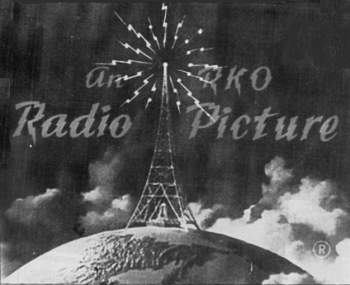
The RKO Radio Picture

The peak RKO radio station lineup consisted of WOR-AM in New York, KHJ-AM in Los Angeles, KFRC-AM in San Francisco, WHBQ-AM in Memphis, CKLW-AM in Windsor Canada, and the Yankee Network and its flagships WNAC-AM in Boston... (The Canadian government later tightened rules on foreign ownership of radio and television stations, forcing RKO to sell its CKLW-AM to a Canadian-based company in 1970.)

A radio picture? Radio doesn't have pictures, that's the point of radio...
RKO was formed in 1928 as a massive merging of four parties:

1. Keith-Albee-Orpheum (KAO) theater chain
2. Film Booking Office of America (FBO) studio
3. American Pathé film studios
4. Radio Corporation of America (RCA) Photophone division.

The prominence of the word "radio" in the corporate name reflected RCA's 66% holding. It is claimed that the broadcasting-tower logo of the production arm, "Radio Pictures," was suggested by David Sarnoff himself, but the reference is arcane and unproven.

In 1933 the U.S. Justice Department forced a re-org of RCA, requiring that RCA sell off a portion of it's RKO holdings. This change shifted power to investor Floyd Odlum and the Rockefeller brothers. In 1932 during the height of the great depression it went into debt. A corporate re-organization in 1936 made for a leaner more profitable company.

ten years later Howard Hughes gained control by buying 25% of the outstanding stock. Within weeks of taking control, he dismissed 66% of the staff and as a result production was shut down for six months! Hughs spent the time investigating possibly communists in the filing cabinets and under the carpets. As a reward, In the fifties Hughes got whacked with an anti-trust lawsuit and had to sell off RKO theaters.

With the loss of his theater division, Hughs focused on TWA and his aviation division. It was the Korean war after all. Hughes found the steady stream of lawsuits from RKO's small shareholders pesky. So since he was the worlds richest man, and a nutjob, he bought them all out in 1954. it cost $24 million. then, seemingly on impulse six months later he resold RKO to General Tire for $25 million. We all know what happened to him after that....

General Tire restored RKO's links to broadcasting. They already owned the Yankee network and in 1951 bought General Teleradio. But licensing problems with WNAK and KHJ hampered growth for the next 20 years! 1965-1987. Tt began with a simple license renewal. Fidelity Television claimed RKO General forced it's vendors purchase advertising time on RKO stations. Then the dirt came out from under the carpet: General Tire had bribed foreign officials, they had misappropriated foreign corporate funds, they bribed elected officials, RKO misled advertisers about its ratings, engaged in fraudulent billing, lied to the FCC about a destroyed audit reports and filed false financial statements etc. The FCC considered this gross misconduct. In 1980 the FCC stripped RKO of the two licenses.

In 1987, judge Kuhlmann found RKO unfit to be a broadcast licensee and recommended that the FCC strip RKO of its licenses. Kuhlmann based his ruling on numerous instances of dishonesty by RKO. RKO sold off it's remaining licenses shortly thereafter. Remember back when large corporations used to get punished by the government? Because the governments job was to serve it's citizens? Today I am reminded regularly by headlines that those days are long gone.