Showing posts with label WABC. Show all posts

Monday, April 05, 2021

The Great Black Out of 1965

When New York has black outs they can make history. Readers may remember the 2019 New York black out that left 73,000 New Yorkers in the dark if only for 5 hours. I can attest that it was hard to sleep that hot sweaty night in July of 1999 without power for the Air Conditioner for 18 hours... There was a similar black out back in 2003, affecting more of the North East, and back in 1977 they had one that stretched into the next day. But back in 1965 was the big daddy of them all: The North east black out affected 30 million people stretching from New Jersey deep into Ontario, Canada. The worst spots were without power for 13 hours. In New York City, six deaths were reported. More here.

History dives deep into the human story: people dying of carbon monoxide poisoning, and falling into elevator shafts; the apartments without heat slowly getting colder, the sardine tin panic inside stalled commuter trains and the parallel disaster control story at Con Edison. The story played out live on television on back up generators. But on an aircheck of 77 WABC from November 9th, 1965we also can hear evidence of a a subplot playing out on the radio band.

That evening between 5:15 PM and 5:27, just before the city was "sucked into the maw of darkness" as the New York Times wrote, there was a brown out.  The frequency of electrical power in America is standardized on 60 Hz. That means the voltage changes from positive to negative, and from negative to positive voltage 60 times per second. This process is literally driven by the rotation speed of  the rotor of the generator which is 60 cycles per second. At some point after 5:00 PM that day that speed began to drift. To quote Eric Alper [SOURCE]

"The station’s music playback equipment used motors that got their speed timing from the frequency of the powerline, normally 60 Hz. Comparisons of segments of the hit songs played at the time of the broadcast, minutes before the blackout happened, in this aircheck, as compared to the same song recordings played at normal speed reveal that approximately six minutes before blackout the line frequency was 56 Hz, and just two minutes before the blackout that frequency dropped to 51 Hz. "

 For reference, the drop from 60 Hz to 56 Hz is a 6.7% frequency shift and 51 Hz is a 15% shift and the rotational speed of the LP is directly affected by the speed change in the motor. This changes the playback speed, and therefore the pitch of the music in that recording. In western music an octave has a frequency ratio of 2:1 and is divided in to 12 parts (semitones). Pitch changes works on a logarithmic scale, so that 15 percent change does not change the pitch 15%. In fact the first 2% had already lowered the pitch by a full half-tone. This is eerily similar to the way that Varispeed was used in recording studios in the same era. There is a fun calculator here.

WABC disc jockey Dan Ingram was hosting his afternoon drive time show and playing the song Jonathan King's "Everyone's Gone to the Moon." It sounds noticeably slow, as did the ads that followed it. Ingram even remarked that the King record "sounds particularly slow" and "was in the key of R." 


After the ad break for hotel bar butter and the station jingle he again notes that "it's slow" and during the ad for Adams Sour Orange gum you can hear the pitch continue to drift.  "It sounds like it's running in slow motion." Then the song "(Up a) Lazy River"by Si Zentner starts to play (very slowly) and Ingram notes that the lights in the studio are dimming. The power continues to dip as they segue into news and the power is lost  about the time newscaster Bill Rice starts into the second story about the gubernatorial election... If you're interested, David Nye wrote a good book on the subject, When the Lights Went Out : A History of Blackouts in America.

Friday, July 31, 2015

WTC Antenna

I was not aware of this exhibit until today. The Newseum continues to impress. Starting in the Summer of 2011, they began exhibiting the upper section of the 360-foot antenna mast from the World Trade Center North Tower.


The backstory is the story every American knows. Terrorists conducted suicide attacks using commandeered aircraft to target U.S. landmarks including the World Trade Towers in New York City. Aircraft collided with two WTC buildings, which collapsed and resulted in the deaths of 2,606 people at WTC including all 19 terrorists, 246 passengers, 72 law enforcement officers, 343 firefighters, and 55 military personnel.

The Radio and TV dial in New York city had a lot of dark spaces that day as many area stations broadcast from WTC. Nine TV and four FM radio stations were knocked off the air including WPIX-TV, WCBS-TV, WABC-TV, WNBC-TV, WNEW, WFAN and WPAT.  [SOURCE] On the new WTC structure, a mast was built that could support the whole of the NYC radio band. More here.

Wednesday, September 12, 2012

Hollywood Walk of Fame: H - L

This is part three of what will be a 5 part series wrapping this Friday. The Los Angeles Times has a series of biographies of every star on the walk and notes the categories, but even they have been unable to link some of these names to radioland itself. I've examined over 100 "stars" now: some obscure, some still ubiquitous. Very few were actually deejays. The list is mostly comics and singers than anything else. I think that says more about Hollywood than radio.

Jack Haley - This former  host of the Jack Haley Wonder Show later played the Tin Man in the The Wizard of Oz. the Wonder Show was famous for featuring the then not-so-famous Lucille Ball. Jack also hosted the Log Cabin Jamboree on the NBC Red Network.

Carl Stewart Hamblen - He was one of radios early singing cowboys. His first stretch on air started in 1936 on KFYO-AM in Abilene, TX. He later sang as Cowboy Joe on KFI-AM, and with the Beverly Hillbillies, on KMPC in 1930. He performed with several groups under different shows on KFWB into the late 1930s. He found god in 1949, quit drinking and started "The Cowboy Church of the Air" which ran until 1952.

Bill Handel - He won his star only in 2009. He hosts a morning show on KFI-AM  and a legal advice program on Premier Networks presently. He has been notable lately only for making racist remarks on air.

Arlene Harris - She made her name as a comic actress on the radio program "The Chatterbox."  But she also put in some time on CBS as Mummy Higgins, playing the mother of Baby Snooks with Fanny Brice.

Phil Harris - In 1946 he started doing wholesome family skits with his wife Alice Faye on The Fitch Bandwagon show. In 1949 the show was became The Phil Harris-Alice Faye Show. Afterward he moved onto bit parts in TV and cartoon voice over gigs.

Bill Hay - Starting in 1926 he announced for the  Amos 'n' Andy show, moving with them from WGN to WMAQ. He actually got his start on KFKX in 1922.

George Hayes - He is known for his work in westerns acting alongside William Boyd,  Roy Rogers, Gene Autry or Wild Bill Elliott. He also hosted "Melody Ranch" a WWII-era country music program on AFRS. He also guested on the Andrews Sisters show in 1944 and in the supporting cast of the Roy Rogers Show 1946-1947 on Mutual in the role he was typecast for.

Helen Hayes - After a good showing on Lux Radio Theater she got her program the "Helen Hayes Theatre" which ran 1935 - 1936. After which she did a year on the O'Neill Cycle on NBC Blue. She was on the Electric Theater on CBS in 1948 and in 1949 she turned up again on "This Is Broadway" a radio talent show on CBS.

Johnny Hayes - A real deal DJ from KRTH-FM. He started at WAKE in 1961,and after a few stops,  KRLA in 1965 where he stayed for 25 years. (Some sources say 27.) Today he is alive, well and retired.

Dick Haymes - His recording career takes front and center but he was also a performer on Club Fifteen with the Andrews Sisters. His show "Here's To Romance"ran on the NBC Blue network in 1943. He followed that with The Dick Haymes Show running 1944 to 1948. Then "The Carnation Show" in 1950, NBC Bandstand 1956-1957... you get the drift.

Jim Healy - A sports announcer who was on KLAC from 1961 to 1965, then KFWB in 1969. He spent some time on TV but came back and was on KLAC from 1973 to 1982 and KMPC from 1984 to 1994. He also hosted Here's Healy on KBIG-FM back in the 1950s. .

Chick Hearn - He was  the play-by-play announcer for the Los Angeles Lakers  which have been carried on network radio via KLAC-AM since the beginning of time. Still, a sort of dubious inclusion.
*Corrections from  KoHoSo

Horace Heidt - He was a popular radio bandleader on both NBC and CBS. He did dozens of programs: Horace Heidt's Alemite Brigadeers, Pot O' Gold, Tums Treasure Chest, The American Way, Captain Dobbsie's Ship of Joy, The Horace Heidt Youth Opportunity Program the list goes on.

Jean Hersholt - He of the unpronounceable surname had two big roles in his career. He spent 7 years starring on "Dr. Christian" and playing the character Dr. John Luke. The rest of his career appears to have been in TV.

George Hicks - A war journalist who was first on NBC then NBC Blue. He actually recorded the D-Day Normandy Invasion. It was broadcast on NBC and the BBC. That's pretty damn amazing.

Hildegarde - Also known as Hildegarde Loretta Sell a slightly risque cabaret singer. She had two radio shows.  Her NBC radio program "Raleigh Room" ran in the 1940s and AFRS carried Hildegarde's Radio Room for at least a couple episodes in 1945.

John Hodiak - most of his career was on stage and screen but he also played the role of the comic strip character Li'l Abner on radio. It ran in 1939 and 1940 on NBC.

Portland Hoffa - Married to Fred Allen it's no surprise she performed as both comedian and vocalist on his programs.  her character was so unpopular that sales execs begged Allen to drop her but he stood firm. In 1949 he left the program. The performed together on The Big Show 1950–52, and she finally started working without Fred in 1954 usually as a mystery guest on TV quiz shows.

Bob Hope - Bob Hope was inducted into the Radio Hall of Fame in 1990 while he was still alive. He  first appeared on the show "The Intimate Revue" in 1935, followed by the Woodbury Soap Hour in 1937, and the Pepsodent Show in 1938. His film career took off and then those USO shows... etc. Guinness Book rates him as the most awarded entertainer in history.

Warren Hull - He started out on Soap Operas like "The Gibson Family" which ran on NBC in 1934. Following a short film career he became a radio announcer on The Hit Parade and Vox Pop in the 1940s. He then hosted the game show "Strike It Rich" on NBC radio 1949 - 1957.

Frazier Hunt - This respected newscaster and war correspondent was on WLS-AM on every Monday, Wednesday and Saturday  at 6:45 PM. Frazier Hunt and the News was on NBC in the early 1940s. Probably best known for smuggling out a copy of  the Versailles Peace Treaty in order to scoop the story.

Marlin Hurt - He did the Hometown Incorporated show in 1940, Fred Brady Show in  1943 and subbed on the The Bob Burns Show on NBC. But the big fame came from his role on the Fibber McGee and Molly program in 1944. He played the role of Beulah, a black woman. In 1945, Beulah was spun off into it's own radio show "The Marlin Hurt and Beulah Show" which ran 1945 to 1954. Thankfully on TV ABC finally cast a black woman to play the part of  Beulah.

Ted Husing - Primarily known as a sportscaster in the 1930s, he was also a CBS announcer on "March of Time" and an for "George Burns and Gracie Allen.  In 1946, he moved from CBS to WHN-AM to try his hand at DJ-ing.   It was a hit and the Ted Husing Bandstand ran from 1946 to 1954. He moved on to TV after that.

Michael Jackson - Born in England he became a DJ in South Africa. He came to the US in 1958 and did a program on KYA. At KEWB he phased out the record flipping and phased in a talk format. He made stops at KNX,and KHJ, then put in 32 years at KABC starting in 1966.  He came back to KABC in 2009 and is still there.

Jaime Jarrin - The Dogers moved to LA in 1958 and KWKW-AM picked up the Spanish language broadcasting rights for the games. Jarrin was the news and sports director, and he became the  announcer from 1962 to 1984.

Al Jolson - A radio star from it's earliest days he was on NBC's The Dodge Victory Hour and his own shows included Presenting Al Jolson,  Kraft Music Hall, Jolson Sings Again, Shell Chateau and a litany of others.

Spike Jones - After a good performance on The Bob Burns Show, he got his own radio show,  The Chase and Sanborn program on NBC. Then he moved over to CBS 1947 to 1949 for his show The Spotlight Revue, which was renamed later The Spike Jones Show. But really, his recording career is where it's at.

Ellen K- Inexplicably Ryan Seacrest's sidekick has a star on the Hollywood walk of fame. She used to be a co-host with Rick Dees on KIIS at least as early as 1995. She also had a Top 30 Countdown show on Premier networks that was cancelled in 2002.

Casey Kasem - See previous post here.

Danny Kaye -  Most of his fame is from film and music but he also starred in a radio program "The Danny Kaye Show" which was carried on the CBS network from1945–1946. He also did a set of shows for AFRS in WWII and in 1963 he repeated the recipe with a TV version of the show.

Sammy Kaye - He started out on the Mutual network in 1937 doing short sets. Then starting in 1940 had a show called "Sensation and Swing" on NBC. He also was on the Old Gold program for two seasons starting in 1943 . Starting in 1944 he launched the Sunday Serenade, a program title he'd recycle often. He continued to do short run programs and short form music programs into the mid 1950s.

John B. Kennedy -  An American radio correspondent whose radio debut was in 1924 on WJZ-AM on the Collier Hour which ran until 1931. Afterward NBC had him host "The Magic Key" from 1934 to 1939 and "The People’s Rally" which ran 1938 - 1939.

John Reed King - Famous as a game show host on radio and television he ended up doing morning news at KDKA in the 1960s and KGO-TV in the 1970s. The peak of his popularity was probably the radio show "Missus Goes A-Shopping" on CBS.  He also announced on the soap opera "Our Gal Sunday" and the infamous Duffy's Tavern among others.

Wayne King - Nick named the "Waltz king" his longest stretch was 1931 to 1940 on NBC doing random gigs usually as the "Wayne King Program" sponsored by Lady Esther cosmetics. He later subbed for Jack Benny and Jimmy Durante.

Raymond Knight - Originally an ad writer for NBC, he was asked to write a comedy program in 1929 and came up with  "The Cuckoo Hour". He later did the children's program "Wheatenaville Sketches." He later wrote for Broadway productions.

Kay Kyser - You can't forget "Kay Kyser's Kollege of Musical Knowledge". It started in 1937 on WGN-AM in Chicago and then moved to NBC. It continued to air until 1949. He retired from broadcasting in the 1950s and was inducted into the Radio Hall of Fame in 1990.

Art Laboe - See previous post here.

Jim Ladd - Possibly the last surviving DJ of note from the Freeform era, he started at KNAC in 1969, but earned his stripes doing a weeknight show on KLOS-FM starting in 1971. In 1974 he began 13 year stretch at KLOS that ended with in 1984. He was on KMET until 1987 when it flipped to KTWV, smooth jazz. In 1988 he moved to KMPC (later KEDG) staying until it flipped in 1989 to Español. He DJ'd at KLOS again in the 90s getting booted with  format flip staff purge in 2011.  He now does a shift on the Deep Tracks XM/Sirius channel. (Long Live Ladd)
*Corrections from  KoHoSo 

Arthur Lake - Mr. Lake played the part of Dagwood Bumstead in 28 different "Blondie" films, 1 TV show and the radio series on NBC Blue. It ran 1944 to 1950. He also portrayed the character in a couple guest appearances.

Dorothy Lamour - While most of her career was in film she also had her own fifteen-minute weekly musical program on NBC Radio in 1935. She also guested on the Rudy Vallee radio show, The Chase and Sanborn Hour and The Sealtest Variety Hour

Frances Langford - She got onto the Rudy Vallee by auditioning and became a regular starting in 1931.
From 1946 to 1951, she performed on The Bickersons and the Chase & Sandborn Show. She later replaced Judy Garland in Bob Hope's show.

Fulton Lewis II - See previous post here.

Art Linkletter - See previous post here.

Little Jack Little - He was a song plugger in Chicago who got lucky. He was a short man which a big orchestra on WABC-AM in the early 1930s. He did a lot of USO shows in WWII, and was a DJ on WEAM-AM starting in 1947.

Mary Livingston - She was a comedian in her own right, but also the wife and radio partner of comedy great Jack Benny.  In 1932 she turned a bit part into a full-time rule. her stage fright kept her from beginning a major character, and she was large absent from the last season 1954-1955.

Al Lohman & Roger Barkley - They share a star because they shared a show, a highly rated morning drive program "The Lohman and Barkley Show" on KFI. It ran through most of the 1970s into the 1980s. Barkley quit the duo in 1986. They both have notable radio careers before and after they were a team.

Guy Lombardo - He was Dick Clark before Dick Clark. From 1929 to 1959 he and his band hosted a New Years Eve show at the Roosevelt Hotel in New York City live on NBC. From 1959 to 1976 the program continued with Lombardo at the Waldorf Astoria.Starting in the 1960s it was also aired on TV competing with that young upstart Mr. Clark.

Vincent Lopez - His first documented radio performance was in 1921 on WJZ-AM. He and his band continued to perform on air including a series called "Luncheon with Lopez"  but it was in 1952 that he and Gloria Parker hosted a radio program on ABC broadcast from the Taft Hotel called "Shake the Maracas."

Phillips Lord -  He started with a small singing show on WTIC-AM. Then became a successful as a radio script writer for NBC with "Sunday Evening at Seth Parker's" which actually ran 6 days a week from 1929-1939. He later created the show  Gang Busters a huge hit that lasted from 1935 to 1957.

Monday, September 10, 2012

Hollywood Walk of Fame: A - C

As of this writing there are 2,476 stars in the Hollywood walk of fame. I recently read that only 10% of those are so-called radio stars.  By that math there should be about 248 radio stars on the walk. There are in fact only 238, which is 9.61%... close enough.

Because many stars cross media formats from music, to film to print and broadcasting the Hollywood Chamber of Commerce breaks this down into categories for us. Each category has an identifying emblem for it's brass radio star.  Inside the coral-pink terrazzo five-point star rimmed with brass is a circular 4-inch brass plaque showing an antique studio-style microphone Radio microphone. I'll warn you now that some category inclusions are dubious.

Since there are hundreds of these lets go at it alphabetically. This will take all week. In cases where there are two names or a state name absent a surname I have alphabetized by the first name of the listed first party. If I have already written a post about them I have inserted a link, if not then just a very abbreviated bio.

Bud Abbott - The straight man of the comedy team of Abbott and Costello, with Lou Costello which his listed under "C."  Many comedy duos share a star. They do not.  Costello appears below.

Dear Abby - Dear Abby of the advice column by the same name. It was founded in 1956 by Pauline Phillips under the pseudonym Abigail Van Buren. Her daughter Jeanne Phillips. There was in fact a Dear Abby radio show.

Fred Allen - He was a vaudeville performer, who became a guest on a couple radio shows then began hosting The Linit Bath Club Revue starting in 1934. The eponymous Fred Allen Show debuted on NBC in 1945. His radio career is long and storied.

Steve Allen - You already know his voice. The Steve Allen Show began airing in 1956,  but his first radio gig was on KOY-AM way back in 1945. You'd know him best as the first host of the tonight show.

Don Ameche - He was a film actor in the 1930s and '40s but he started in radio. He had numerous bit parts over the years, but his big radio role was as John Bickerson... of the Bickersons. It ran 1946 to 1951 but it lives on as a model for sitcoms today.

Morey Amsterdam - He had an eponymous TV program starting in 1948. He did relatively little notable radio. He was was a regular guest on The Al Pearce Show show, and himself hosted an obscure series called the Night Club of the Air which only ran for 2 months in 1937. His inclusion is dubious.

Eddie Anderson - Anderson rose to fame playing the character of Rochester, Jack Benny's personal valet.  He began playing bit parts on the program starting in 1937.  Anderson made it to the Radio Hall of Fame in 2001. He was the man. His gravelly voice tops even Tom Waits.

Eve Arden - She was a a regular on Danny Kaye's variety program in 1946. But her career was playing the character Connie Brooks in the sitcom "Our Miss Brooks." Arden portrayed the character on radio from 1948 to 1957 then for TV from 1952 - 1956, and then a film in 1956.

Eddy Arnold - He was a country artist with over a hundred singles to his name. He made his career the hard way playing live on air. He was on WTJS-AM in Jackson, WMPS-AM in Memphis, KWK-AM in St. Louis, WHAS-AM in Louisville eventually making it to the Grand Ol' Opry on WSM-AM.

Cliff Arquette - It has been said that at one point he was performing on 13 different daily radio shows in the Chicago metro. The big one was called "Dave and Charley" which Arquette hosted with Dave Willock,it even made it on TV briefly. He later revisited his characters for the Tonight Show while Jack Paar was host.

Gene Autry - See previous post here.

Dan Avey - Avey won over 30 major journalism awards in his career including 15 Golden Mikes, which might be a record. He was a sportscaster and newscaster on stations like KXLY-AM, KWIZ-AM, KFI-AM, KFWB-AM, and KABC-AM. He retired in 2007.

Lew Ayres - He was in more than 50 films in his career but he did a tour of radioland. He acted the part of Kildare on the program "The Story of Doctor Kildare" airing 1950 through 1951. He also played the part in film. His inclusion is dubious.

Jack Bailey - He was the host of a daytime game show called "Queen for a Day."  It debuted on the Mutual Radio Network in 1945 continuing through 1948 when it jumped to television.

Art Baker - His real name was Arthur Shank. The program "Art Baker's Notebook" debuted on KFI-AM in Los Angeles in 1938. It ran for 20 years. If that wasn't enough, he went on to host the TV show "You Asked for It."

Kenny Baker - This is different fellow than the Kenny Baker that was in R2D2. This Baker was a singer on  The Jack Benny Program in the 1930s. He had his own program which didn't do so well. He went on to sang on the Texaco Star Theater radio program and do film.

Phil Baker - He hosted a number of big radio programs in his career. Starting in 1933 Baker starred in his own NBC series "The Armour Jester." He was also the host of the popular quiz show "Take It or Leave It," which later became "The $64 Question." He also appeared on Duffy's Tavern in 1944.

Lionel Barrymore - He portrayed the character Doctor Gillespie on the program Doctor Kildare in the 1940s. He also performed in the radio series, Mayor of the Town, and got a bit typecast playing Ebenezer Scrooge on the radio every Xmas from 1934 to1953. He also hosted the AFRS "Concert Hall" Radio Show in he late 1940s.

Brian Beirne -  He actually trade-marked the nick name "Mr. Rock N' Roll."  Beirne was a DJ for KRTH-FM known as K-EARTH 101. After 29 years on air years he retired in 2004.

William Bendix -  His program "The Life of Riley" aired from 1944 through 1951. When it was revised for television "The Life of Riley" ran from 1953 to 1958. His character's tag line "What a revoltin' development" lives on.

Jack Benny - The Jack Benny show ran from 1932 to 1955. It became a television program from 1960 through 1964 on CBS, then NBC for another year. His career requires no further explanation.

Edgar Bergen - A ventriloquist who guested on Rudy Vallée's program in 1936, then a regular bit on the Chase and Sanborn Hour in 1937. That was followed by the Charlie McCarthy Show which lasted 2 years. He jumped to Film and TV from there.

Milton Berle - He made his reputation as a regular on on The Rudy Vallee Hour, and the Gillette Original Community Sing in 1936. The Milton Berle Show only ran a year from 1947 - 1948. Berle became the host of NBC's Texaco Star Theater taking over for Jack Carter.. His reign ran from 1948 to 1955 when it jumped to TV.

Ben Bernie - He was called  The Old Maestro. He broadcast on NBC Blue WJZ-AM starting in 1923. His program ran on CBS through most of the 1930s.  He slowly started to segue into film around 1937 and left radio. His last starring radio role was the "Ben Bernie War Workers" program" which ran from 1941 to 1943.

Rodney Bingenheimer - Rodney has been hosting his own program "Rodney on the ROQ" on KROQ since August of 1976. They'll probably have to tear it from his cold dead hands.

Mel Blanc - Now just famous for his voice work on Warner Bros cartoons, he actually began in radio. In 1927 he began doing voice over the KGW-AM program The Hoot Owls. He jumped to KEX-AM in 1933 to produce his Cobweb And Nuts show which lasted 2 years. He followed that with a spin on the Johnny Murray Show, then The Joe Penner Show, then a big win on the Jack Benny Show. He got his own program "The Mel Blanc Show", which ran from 1946  into 1947. It didn't matter.. he'd already discovered cartoon work. The die was cast.

Ford Bond - Bond was a radio announcer peaking in the mid 1940s. He did Manhattan Merry-Go-Round, Fun At Breakfast, Kraft Music Hall, Easy Aces, and many others. He began on WHAS-AM in Louisville in 1922. He died in 1962 after retiring to the Virgin islands. Can't knock that.

Edward Bowes - He was host of  Major Bowes' Amateur Hour on WHN-AM in 1934. The show ran until 1946 when he retired. He died two months later.

Bill Boyd - A western Swing man he played on air at many stations including WRR-AMKTER-AM and KSKY-AM in Dallas and alter WKNE and WPWA. His band The Cowboys Ramblers, had their own popular radio show, "The Bill Boyd Ranch House" around 1947 on WRR.

Eddie Bracken - Another vaudeville man who moved to radio. It was his success in film that landed him his very own "Eddie Bracken Show." It ran for 2 years on CBS 1946 and 1947.

Tom Breneman - Breneman was the host of "Breakfast in Hollywood." It debuted on the Blue Network in 1941, but moved to ABC, NBC and Mutual at various times. It initially launched as "Breakfast on the Boulevard" on KFWB-AM in Los Angeles.  It was so big it had a magazine, he had a restaurant and they made a movie about the program in 1946. It was finally cancelled in 1948 only because he died.

Fanny Brice - She spent most of her career trapped in the role of Baby Snooks. The character first appeared in a skit on The Ziegfeld Follies of the Air. At the age of 60 she was still typecast as a child.

Ray Briem - Ray retired from radio in 2008 after a long career at KABC-AM. As a conservative talk show host. He'd been a long time radio man having even hosted programs for AFRS.

Cecil Brown - Brown was famous as a WWII news commentator. He was hired by CBS in 1940. His career gained ground criticizing Mussolini but lost it criticizing the British. After the war he became a commentator for the Mutual Network.

Bob Burns - He was a regular on the Kraft Music Hall program, and Rudy Vallee's show The Fleischmann Hour starting in 1935. Prior to that he'd only done random appearances on programs like "The Fun Factory." He hosted the Academy Awards in 1938 which improved is cache. His own radio show, The Arkansas Traveler ran from 1941 to 1943 and was followed by  The Bob Burns Show  which ran 1943 to 1947.

Judy Canova - Her career exploded after a 1931 guest spot on the Fleischmann Yeast Hour. She did a series of films, then got her own radio show 1in 1943, The Judy Canova Show. It ran for 12 years. She moved on to TV and had a long career there as well.

Eddie Cantor - See previous post here.

Ken Carpenter - Ken was an NBC Radio Announcer. He was probably best known for announcing Bing Crosby on the Kraft Music Hall radio variety program for 27 years. He started his career in KFI-AM in 1929 as a sports announcer. He stayed with NBC doing sports color until 1942.

Jack Carson - He appeared in 1938 on the Kraft Music Hall while Bing Crosby's was host. He guested several more times and got own CBS radio show, the Jack Carson Show,  in 1943.  The show lasted 4 years. he left to host The Sealtest Village Store program where he stayed until 1948.

Bud Collyer - Bud was Superman on The Adventures of Superman on the Mutual Network in 1940. That iconic work would probably be enough but he also acted on all 3 major networks. He went on to host TV game shows like Beat the Clock and to Tell the Truth.

Jerry Colonna - He had the greatest mustache ever made. He was famous on radio as Bob Hope's zany sidekick. He actually started as a serious trombonist in the CBS house orchestra. He even recorded as a part Raymond Scott's famous Quintette and of course played on the Kraft Music Hall.

Perry Como - Como is most famous for his recording career and his early work hosting television programs. His work on the radio program "Beat the Band" was notable, lasting on NBC radio from 1940 to 1944. Btu it represents the bulk of his radio career.

Spade Cooley - He had his own TV show starting in 1947 but before that he was on radio a bit. He guested in 1946 on Gene Autry's Program "Melody Ranch." Then with his own show "Spade Cooley Time" on KFVD-AM. He went straight from there to KTLA-TV.

Charles Correll - He played the character Andy Brown of Amos & Andy alongside Freeman Gosden. The bit began on WMAQ-AM in 1926 as Sam 'n' Henry and continued on to WGN-AM, where it became Amos and Andy. It became syndicated and continued on in different forms until 1962.

Lou Costello - He was the shorter stouter half of the comedy team of Abbott and Costello, with Bud Abbott. They began in vaudeville individually, then as a team and signed up with the William Morris Agency in 1938. They became a regular feature on The Kate Smith Hour and rapidly moved into film.

Bing Crosby - Bing appears at least 5 other times on this page for launching other careers during his tenure on the Kraft Music Hall from 1935 to 1946. But he'd already been host of the Woodbury Soap Program, the Chesterfield's Music Program, The Cremo Singers and The Radio Singers on CBS back in 1931. his first appearance was probably in 1929 on Old Gold presents the Paul Whiteman Orchestra.

Bob Crosby - Despite am 18-month interruption for WWII the "Bob Crosby Show" ran on NBC and CBS separately from  1943 to 1950. He moved from there to a show called "Club Fifteen" on CBS from 1947 to 1953. From 1952 to 1955 he was a band leader on the Jack Benny Show. That was followed by a half hour Bob Crosby Show that ran on CBS from 1953–1957. He tried a little TV show in Australia in the 1960s but it fizzled.

Milton Cross - See previous post here.

Frank Crumit - Crumit was a vaudeville man. He and his wife Julia Sanderson were a comedy and singing duo in 1928 on CBS as the "Singing Sweethearts" even though they were already divorced. In 1030 they started co-hosting a quiz show called "The Battle of the Sexes", which ran 13 years. they started a new program on WABC-AM, but it was abruptly cut short when Crumit died of  a heart attack in 1943.

Bill Cunningham - This is not the same radio man as right-winger Bill Cunningham in Cincinnati. This is the man who hosted "Meet the Boss" from 1944-1952 carried by Mutual Broadcasting.

Monday, August 08, 2011

DJ Ernie Kovacs

Ernie Kovacs is remembered today as a ground-breaking television comedian. He got credit later in his career in videography as some of his work there was highly influential as well. His career was cut short by a car wreck at the age of 43, which though tragic only cemented his career in that way that an early death seems to in America. He was born and raised in Trenton New Jersey, and that is where his time in radio began.

In 1942 after some jibbing from fiends he auditioned for 920 WTTM-AM. He adlibbed jokes while reading the news off the teletype. They hired him. He had graduated from class clown to professional clown. The station had only been on air since that April. He became an announcer, DJ and non-stop prankster. In 1945 he picked up a gig writing a humor column for The Trentonian Newspaper.

He left WTTM-AM for a job at WPTZ-TV in Philadelphia in January of 1950. He started there as co-host a cooking show of all things. It was called "Deadline for Dinner."  He later hosted a morning show "Three to Get Ready" at 7:00 AM. It was a bit of news, a bit of comedy, a bit of weather. He dumped water on the weatherman, he ran through restaurants in a gorilla suit...it was a very odd format, very Kovacs actually. That started in November of 1950. By 1951 he was hosting his own shows "It's Time for Ernie," "Ernie in Kovacsland," and later "Kovacs on the Corner." His winning streak came to an end when NBC insisted their morning program "The Today Show" be aired on the station, bumping Kovacs. It was unfair, but it drove Kovacs from Philly to New York. He landed on on WCBS-TV in New York City with a new program "Kovacs Unlimited."

It was in New York that he took some time to return to radio. He was a morning-drive radio personality on WABC-AM. The "Ernie Kovacs Show" debuted May 30th 1955 at 6:00 am and ran to 9:00 pm. It ran Monday through Saturday.  The program was sponsored by Horn and Hardart, makers of the Automat.

Thursday, December 30, 2010

Booze, Broads and Bribes

It's sort of a chicken and the egg scenario. Did payola exist before it was illegal? Well, wasn't always illegal, but even after it was, most people didn't care or at least they acted like they didn't. It is still quite common as you might guess. I actually can put a date to the appearance of payola on the American consciousness: November of 1959. It was a hard year: Buddy Holly and the Big Bopper died, Castro took Havana, and the perception of radio changed forever.
It's a simple cause and effect sequence of events. Lets' do this in chronological order. On Memorial day weekend May 28th - 31st was the second Annual Todd Storz' Disc Jockey Convention. It was held at the Americana Hotel in Miami. This was located at the oceanfront on 97th Street, Bal Harbour, Miami Beach.  Their promotional literature of the day described itself thus
"...the magnificent Americana features the award-winning cuisine of the Gaucho Steak House, Dominion Coffee House, Bal Masque Supper Club and Carioca Lounge. An outdoor pool and all-weather enclosed pool are part of the delightful cabana and garden area..."
It was designed by the flamboyant Morris Lapidus, a neo-baroque Miami architect who defined a number of other modern hotels that defined the 1950s 'Miami Beach' resort hotel style.  The Americana was to Miami what the Sands was to Las Vegas. (It was demolished in 2007.) Needless to say... this conference was really a big blow out. About fifty record labels contributed funding  lascivious four-day party in Miami.  I don't have dollar amounts, but they were probably unspeakable.  The book Something In the Air by Marc Fisher described it in gory detail:
"...Todd Storz hosted the biggest, most raucous convention of deejays staged to date.  the Americana Hotel in Miami Beach was the setting for a bacchanalia for twenty-five hundred deejays, with free bottles of liquor and prostitutes on call all week long.  In one eight-hour party at the Americana featuring the Count Basie Orchestra, two thousand bottles of bourbon were consumed. Hired women were instructed to make themselves available to any deejay..."
The description sounds colored perhaps, or exaggerated. It's not. Fisher cites his source: the testimony of Edward Eicher, convention manager at the Americana Hotel before the U.S. House of Representatives. Almost every informed source describes it as an orgy of drugs, whores and booze. In Voice Over. The Making of Black Radio William Barlow described it similarly:
"...besides the around-the-clock receptions, parties, concerts and gambling junkets to nearby Havana, the convention featured one of the largest contingents of hookers ever assembled in a Miami Beach hotel. (The prostitutes were recruited from as far away as New York City.) Although the record companies spent an estimated $250,000 on this spectacle, and their top executives were in attendance, it was the DJs who were pilloried in the press."
Eight months passed between the investigation and the hearings. For radio it was eight brutal months in which every other media platform beat the tar out of them. It was a full-on media flogging. Payola was the vocab word of the day every damn day.When WABC fired Freed on November 20th the flood gates opened:
June 08 - Time Magazine: P is For Payola
Nov. 16 - Billboard: Clearing The Air 
Nov. 23 - Life Magazine: Gimmie, Gimmie, Gimmie,On the Old Payola
Nov. 25 - Miami Herald: Booze, Broads, Bribes 
Dec. 04 - Billboard ...Payola Scandal
Dec. 05 - The Nation: Payola, Sing A Song For Sixpence
Dec. 07 - Life Magazine: Payola Axes 'King' Freed
Dec. 14 - Billboard: Thorn In Industry Side
Dec. 17 -  Jet: Music Experts Predict Death of Rock 'N' Roll
Jan. 01 -U.S. News & World Report: Payola- An Inside Story
Jan. 18 - Billboard: Slugfest at FCC Hearings
Jan. 21 - Jet: Disc Firms Pay me $855 Monthly  
Jan. 25 - Billboard: Payola Crackdown

On February 8th 1960 the House Special Subcommittee on Legislative Oversight began it's investigation.  it was chaired by Oren Harris [D] of Arkansas. But while the crimes were real, the investigation was a sham. The big star witness was Norman Prescott of WBZ-AM. The feds confronted him with canceled checks from record distributors and blackmailed him into testifying.From there it was a slaughter eventually leading to the inevitable recriminations, criminalization and frequent investigations of today.

It went on for a year.By June of 1959 Billboard was publicly questioning whether there should be a 3rd Annual Todd Storz' Disc Jockey Convention. The first convention had been in Kansas City in 1958. Mitch Miller used it as a forum to harangue rock programmers and to blame rock n' roll music for the vagaries of youth. He got a standing ovation.  In some deranged way the 2nd convention was used to "prove" his point. some stations dropped their tainted DJs and flipped formats. In the end Todd Storz walked. He got off scot-free. His stations being Top-40 were purported to be immune from the influence of payola as they did not debut records. He used the corrupt commerce at his own convention as a marketing gimmick for his own Top-40 Format. It was bunk of course.

Many stations held on to rock n' roll.  Some even fired back at TV and print media. WSAI-AM in Cincinnati took their local paper to task with a series of "Newspaper Critiques." Print had been soft balling and/or quietly promoting their advertisers products. the CBS Network got in on it and they not-so-gently reminded their friends in print that hypocrisy is even less appealing than bribery. In the end they had already taken down Freed, and dozens of other DJs.. for some reason they didn't want Storz or Dick Clark or anyone else. Justice was ultimately as indiscriminate as it was symbolic.

Wednesday, December 01, 2010

Pick and Pat

Black face "comedy " really offends me. But I won't ignore that it existed because that would conceal the problem... sort of like civil war revisionism. The first step is that you have to admit you have a problem. So I try to write about these programs in the normal course of events, even as those elements of the programs may be by modern standards be totally offensive. So on we go.

Pick and Pat was a minstrel style variety program that first aired in 1934 on NBC. Pick Malone and Pat Padgett were vaudeville comics, a quintessential example of the stage to radio transition. Like many other programs, it was short lived, and it last aired in May of 1935. They were sponsored by Dill's Best via U.S Tobacco Company, and the program was produced by Frank McMahon. " Rands Esoteric OTR has an Episode Here.  The 30 minute program first aired 8:30 Saturday nights then moved to Fridays at 10:30. Music was by Josef Bonime and His Orchestra, Benny Kreuger and His Orchestra and The Ray Bloch Orchestra. The intro theme was a harmonica version of the standard "Humoresque. As you might expect, there is little information available about there on them. Here and here.The program was also known as, "Pipe Smoking Time."

Their big break out vaudeville routine before that sweet radio gig was called  Molasses and January. It was a black-face routine. They later performed that routine on the Maxwell House Show Boat, another syndicated NBC program. It ran on Thursday nights, 9 pm. That program ran from 1931 to 1935 so while you might expect the bit to predated their solo run, it was actually concurrent.  Pick Padgett and Pat Malone did other radio programs too.
In 1938  they went back to radio on "Model's Minstrels" sponsored by Models Tobacco. It was carried by CBS for 5 years. In 1942 they lost that slot and began a doing a daily 5 minute spot on the NBC Blue Network at 9:55 PM. In 1949 they performed on a short TV series "American Minstrels of 1949". More here. Esentially it was an old-time vaudeville show performed on television. After 20 years, Pick and Pat were back to their old black-face routine.

OTR Digest ran a story about them in Winter of 2000 that both mocked their stale routine but also some of the myths of their background. They are described as "Irish" in most biographies. Which at first I took as a random error but perhaps not. Calling them Irish implies they are immigrants, or otherwise unassimilated  Americans.  In truth they were both native Georgians. They had both moved to New York seeking work and met at an auto-mat. The black-face veterans were not naive immigrants but in fact cynical, bigoted southerners. Pick died in 1962.  I can't find anything else on Pat. Culture changed, and left them both behind.

Wednesday, September 09, 2009

First Broadcast from a Train

WABC-AM conducted the world's first broadcast from a moving train in 1932. It aired at 9:00 PM, March 24th and was hosted by none other than Belle Baker. The program originated form a moving train, and was rebroadcast from WABC-AM.

I have seen sources that cite the broadcast as occurring in Maryland... considering the technology of the day it seemed at first reasonable to assume that most of the broadcast occurred in the New York area. This is not so. The train was the Baltimore & Ohio Railroad. I know for a fact the "pick up points" were Beltsville, M.D. and Laurel, MD. I found a single reference referring to "pick up points." I think these are not regular stop on the train nor are they the locations of repeaters, etc. I think the complete run of the train was from Beltsville to Laurel. This would allow a single site to receive and transmit the program to WABC-AM. The Kane Book of First Facts and Records explains
"The transmitter was operated on a frequency of 1542 kilocycles employing high percentage modulation and running on fifty watts power."
So with only fifty watts ERP at no more than 20 feet HAAT an 8 mile stretch of rail is actually doable. It's journey began in Baltimore and headed north through Maryland, New Jersey and into New York state. Those two towns are only 8 miles apart. There is still a rail line between them, you can see it off to the eastern side of Route 1. These towns are halfway between Baltimore and Washington D.C. about 200 miles South West of New York City. You can actually see the Laurel stop on the map below.If there were two sites to receive and rebroadcast it's possible the program began somewhat before Beltsville and somewhere after Laurel. But I think it is safe to assume that the program in it's entirely was complete before they reached Philadelphia. Belle Baker and Jack Denny's Orchestra were featured on the variety program. The Jack Denny's Orchestra was one of the earliest orchestras on the radio at all. they played on WRC, WJZ, WABC and WEAF. They were in 1932 the house band for the Waldorf Astoria Hotel.

Friday, November 28, 2008

Stephen Vincent Benet

I inherited a box of old books, mostly book-of-the-month club hardbacks, nothing particularly special jumped out but on the inside flap of the Book "Western Star" was a bio of it's author and as it often does the word "radio" jumped out. Who the hell is this guy?
"The words Mr. Benet used to describe Americans apply equally well to him. He ws always moving on... Millions of Americans have heard his great radio programs, They Burned the Books and Listen to the People, among others... There have been unprecedented tributes to his memory in newspapers, magazines and on the air..."
He was an American poet, novelist, and writer of short stories. He did a number of epic poems which I find dull dated and dry but were clearly popular in their day. He was born in Bethlehem, PA, into a military family and was relocated several times. He grew up in Benicia, California and rural georgia to name a few. He attended military school in the end, but was too myopic for actual service. He remained a staunch militarist, and supporter of the allies in WWII.

Benét made a number of radio broadcasts and worked in Hollywood as a screenwriter. He wrote a series of radio scripts, including "We Stand United" which was read over the CBS network by Raymond Massey in November of 1940. That same year he published "The Undefended Border" which was broadcast on the Cavalcade of America Program in December of that year. Massey also narrated that work. That same program also aired his work "A Child is Born" in December of 1942 on NBC but actually re-performed it in December of 1943 by popular request. That same year, on Flag day, President Roosevelt read at the end of his speeche a peice by Benet, witten just for the occasion titled "Toward the Century of Modern man, Prayer"

He published "Listen to the people in 1941 it was broadcast over the NBC Blue Network on the 4th of July 1941. He wrote They Burned the Books in 1942, which was read over the NBC network in May of 1942 a spart of a big Lester O'Keefe production. That year WABC and the CBS network all carried his play "A time to Reap" on Thanksgiving He had done a similar, but much smaller production the previous year on the NBC red network.

In 1944 his script "Your Army" was performed on all 4 big networks across 600 radio stations and on shortwave. He died in 1943 just missing his own big radio finale.

His works in the cannon of WWI propaganda were almost as ubiquitous as war bonds. He was a rabid patriot and nationalist. It makes sense then that these programs were produced not by Nabisco and Kraft but by big propaganda machines like The Council for Democracy, the America United Rally, The office of War information.. etc. It is what Mark Twain called "Art for the wrong reasons."

In 1945 a post-humus collection of his radio scripts was published under the title "We Stand United." many of these begin as letters from variosupeoples to Adolf Hitler and begin with the words "Dear Adolf." This last text is not only in the public domain but also readily availabel online so I've posted it for download here. Most of it reads like WWI radio propaganda.. which was conceeded by Norman Rosten in the forward:
"His weapon was the word, and Stephen vincent benet rolled up his sleeves and began turning out weapons. Here in this book of radio plays, are some of them. they are modern, built to specification, made for the need and cause of our time. Propaganda? That word used to be the big boogeyman of the thirties."
His and many of the Benet family papers are at the Cornell University Library in Ithaca, NY. It reveals that his sister Laura also wrote radio scripts.

Tuesday, August 05, 2008

DJ Curtis Sliwa

Curtis Sliwa isn't really a DJ. He did eventually became a radio show host. He is a somewhat conservative populist and in New York City, that can be unpopular as these are totally conflicting belief systems.You probably know Silwa as the founder of the Guardian Angels. Those meat-head Brooklynites with the red berets actaully have over a hundred chapters across America. It was founded back in 1979 to protect a neighborhood. It is no longer a dozen friends of Silwa. It is an international civic organization. It was through this new position as a public figure that he became a radio talk show host in 1993.

Sliwa was co-host with his then-wife Lisa Evers on WABC-AM in New York City. In 1992, none other than John Gotti tried to have him wacked. Why Sliwa was worth wacking I don't know. I can only guess he said something in the course of his program the don found offensive. He may have cast aspersions on the musical talent of Frank Sinatra. That will get you the death penalty in New Jersey. After his attempted murder, his WABC-AM radio program was canceled. But his longtime supporter, Mayor Rudy Giuliani, Sliwa landed him a radio program on the then city-owned and operated WNYC. It's a good turn of luck for Silwa, former mayor Koch was totally opposed to the Angels.

In 1996 Sliwa returned to WABC, and later he became the co-host, with Ron Kuby, of the "Curtis and Kuby in the Morning" program aired weekdays during morning drive time on WABC-AM. The "Curtis and Kuby" radio show,which ran in the mornings.. until Imus came back. That must have stung a little, but he had to see it coming. his ratings in that slot were terrible. He got bumped and landed at 11am. It could have been worse. As of this spring, Curtis had also picked up a regular guest-hosting gig for The Bill O’Reilly Show.

Not bad for a guy that was managing a McDonalds when this all began.

Friday, December 28, 2007

A Milton Cross Christmas

I discovered Milton Cross via RCA 45-5106-B. It's a 78 with two tracks. The B side is an orchestral rendition of "Jingle Bells Fantasy" by the Victor Salon Orchestra. The A side is a reading of "The Night Before Christmas" by Milton Cross. It's read over a smooth string piece similar to the B side. Lee posted the B side last year. It's expired but it's such a worthy Blog.
I Found a single reference to it in the book 45 RPM: The History, Heroes & villains of a Pop Music Revolution. The book refers to the release as a 45 and to Milton Cross as a source of the music. These may be both incorrect. My copy is clearly a shellac 78, but still sports all the packaging described. It may have been later released as a yellow vinyl 45. But the reference is still informative.
"One of the first 45 records with a full color, four picture sleeve was a recitation of "The Night Before Christmas" (47-0141) by Clement C. Moore, with Music by Milton Cross and the Victor Salon Orchestra. The record had not only a sleeve with an aerial shot of Santa Claus and his flying reindeer but also a fold over flap with another full-color illustration of angelic, caroling children. It was issued as part of RCA Victor's Youth series in 1949."
So the real question was "Who is Milton Cross?" It turns out that he was the announcer for the Metropolitan Opera broadcasts on WABC-AM for 43 years. That's from their first program in 1931 until his death in 1975. He was also host of a classical program called "The Chamber Music Society of Lower Basin Street."

He was first hired by Tommy Cowan at WJZ-AM in 1921 while it was still based in Newark. It relocated to Manhattan as part of the NBC Blue Network. He did several children's programs including "coast to Coast on a bus", "Presenting A&G Pipsies" and "Children's Hour." With all that in context it begins to make sense that he be tapped to narrate that old Christmas recitation. RCA also had him read Little red Riding Hood and others. he also did some lesser known narrations of "the Great Foodini" for Caravan records. More here.


Late in his career he did a sunday night swing show and even hosted the Quiz program "Information please." George Ansbro wrote an autobiography in 1986 that tells as much about Milton as himself. It was reprinted with an introduction by Leonard Maltin in 1999. More here.

Saturday, December 08, 2007

Divorced radio hosts

It couldn't get worse than that... the husband and wife airing grievances during drive time on different channels. That could be high Drama, better than reality TV. It happened, and it happened in New York City, and you know the players even if you didn't know they were married: Rudy Giuliani and Donna Hanover. I cant find a picture of them together so I'll just use one of Guliani cross-dressing.
Mayor Mr. Giuliani’s radio program, “Live From City Hall" was on 770 WABC-AM a heritage 50,000-watt powerhouse. It ran in New York City for eight years, from 1994 to 2001. This was no light-touch fluffy program, Rudy was an arrogant bastard who had no problem abusing his listeners. By comparison his persona as a presidential-hopeful is bowdlerized. I am curious if his bizarre psychotic hatred of ferrets will at all effect his presidential run.

His ex-wife Donna Hanover is the who is a morning show co-host on 710 WOR-AM an equally powerful station. She shares the mic with Joe Bartlett. It airs weekdays from 5:00am to 9:00am. She hates Rudy so much she even roots for the opposing sports teams, but never will mention Rudy's name. She's that savvy. Just this year they received the New York State Broadcasters Association’s "Outstanding On-Air Broadcast Team" award for excellence in broadcasting.

Giuliani and Hanover filed for divorce in October 2000. So what should a mayor do? The fight was nasty, and dirty and took over the front pages for a few months. Giuliani was accused of adultery, taking bribes from sports franchises, and other general naughtiness. The divorce was finalized in July 2002 after he left office as Mayor; Hanover was awarded $6.8 million and custody of their two children.

Thursday, May 24, 2007

Radio begets crooning

Yeah, no kidding. The singer Vaughn De Leath supposedly is the inventor of "crooning." A style of singing not beget by amorous cooing but instead a method of singing adapted to match the limited range of early radio equipment.

At the time the high notes hit by soprano singers often broken delicate transmitter tubes. Try to recall that at the time most radio listeners were using crude cat whisker crystal radio sets. She was compelled to sing in a soft voice, now called crooning so that no loud and or high notes would over-modulate and destroy the expensive and delicate transmitter power output tubes.

"According to Ben Gross of the New York Daily News, after her first broadcast, Vaughn received one of the first radio fan letters ever written; it read "You have inaugurated a new form of song which, no doubt, will become very popular." I understand her comp on Document Records is quality.

She was an early famous female radio jazz singer who gained popularity in the 1920s and became known as "The Original Radio Girl" and "First Lady of Radio". She was born as Leonore Vonderleith in the Midwestern town of Mt. Pulaski, IL in 1894. While at Mills College, she began writing her own songs, but later dropped out to pursue a singing career. Later she changed her name to Vaughn De Leath. Some Real Audio here: http://vintage-recordings.com/vocalshow2.html

She sang at 770 WJZ-AM (WABC today) In 1923, she became the first female executive to run a radio station, WDT-AM, along with a small network of power stations. She routinely appeared on the Wrigley Show during the mid twenties. In 1931, she appeared on an experimental television broadcast. That same year, she sued Kate Smith and won an injunction preventing Smith from using the "First Lady of the Radio" name. Smith laid off until Vaughn to croaked, then started right back up.


In 1922 she began recording on different labels, including Edison Records. But at the time Edison was transitioning from vertical cut discs to lateral cut recordings. Edison didn't' issue any lateral cut recordings until 1929. So much if thsi material was shelved, even as test pressings. In the mid 1970s these were rescued and finally released; 30 years after her death from complications sue to cirrhosis.

Thursday, July 27, 2006

Bogarting the beatles

It was not immediately obvious that The Beatles were going to be such a success. it seems ridiculous now, but in radio that's how things are.


When the WABC disc jockeys first heard Fab Four records in 1963, they were hardly impressed. They were not alone in that assessment. There were many in both the music and the radio industry who felt the same way. ...But as beatlemania set in, their opinions changed quickly.

WABC set upon a way to own beatlemania.
1. they would get new Beatles music before anyone else
2. they would debut it on Fridays to keep it out of the hands of other stations for as long as possible

Of course, WABC was not the only New York radio station trying to jump on The Beatles bandwagon. So were WINS and WMCA. Competition was intense for everything The Beatles did from releasing new records to their visits to New York. At WINS, Murray "the K" Kaufman dubbed himself the "Fifth Beatle" and WMCA battled WABC for every exclusive. This created one of the great radio station battles of all time. The prize for the station that could ultimately outdo the others and attract that huge "Beatlemania" audience was going to be the ratings winner. And, they all knew it.

For its part in the rivalry, WABC was up to the challenge. Specific Beatles jingles were commissioned from PAMS centered around the theme "W A Beatle C". These jingles were attached to every Beatles record played. There were Beatles look a like contests, poster contests, and name your favorite Beatle contests. WABC even gave away a giant photo of The Beatles that was used as a backdrop for the ABC TV show "Shindig".

But it was long John Wade at WDRC that was the real winner. He was the only American Dj allowed to tour with the band. In 1964 he was one of two Americans allowed to actually fly with them, an unprecedented level of access. Even Murray "the K" Kaufman, the so-called 5th Beatle wasn't allowed that close.

Tuesday, June 27, 2006

Singin' Sam the Barbasol Man

Singin’ Sam was the stage name of Harry Frankel, who lived in Richmond for much of his life. He began his career as a vaudeville performer and was quite the famous personality in the early days of commercial radio. He was best known for his radio character Singin’ Sam, the Barbasol Man. He was the blue print for semi-celebrity product spokespeople. Not sure what i mean?Ex. that kind of annoying cell phone guy who says "can you hear me now?"

Frankel was born on January 27, 1888, to Sol and Lizzie Frankel, Harry in rural Danville, Kentucky. The family relocated to Richmond, Indiana nine years later. Harry was a musically inclined child eventually singing with local barbershop quartets of singing in local quartets. Eventually he realized his dream and began performing in black face in 1908 with the professional minstrel group; Coburn’s minstrels.

When the great depression started to take a bite out of the vaudeville buisness, he got lucky and got an invite from the Great States Lawn Mower Company to promote their products on air. He accepted and began broadcasting from WLW-AM in Cincinnati. His real name didn’t seem catchy enough for a radio personality, so he adopted the stage name “Singin’ Sam” and billed himself as “The Lawnmower Man.” He was so successful that Great States had trouble filling all the new orders, and his show was voted the most popular on WLW-AM. When an executive of the Barbasol Company heard him, he brought Sam to New York to begin broadcasting for his company. “Singin’ Sam the Barbasol Man” made his debut on WABC-AM in 1931.

From 1937 to 1942, Harry recorded ads for Coca-Cola on 16-inch transcription discs. This was done as a 15 minute program, Refreshment Time with Singin’ Samthat suited him very well. Every other week Harry flew to New York, and in two days he recorded 10 of these shows. The rest of the time he spent in rural life in Richmond.

His career flourished throughout the forties but took a turn in the 50s, perhaps deliberately where he retooled his act for nostalgia stations with a new recorded program reminiscin' with singing Sam. He died of natural causes in 1981.

Wednesday, September 07, 2005

A tale of two DJS

In the mid fifties there were two very mighty DJs. Thsi was a world long before MTV or VJs and as entertainers went... without being a rockstar they were as big as big got.

I'm talking about Dick Clark and Alan Freed.
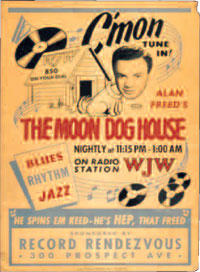
I mentioned Mr. Moondong himself in my poston the Sony Paola scandal and later thought I was unfair. I threw his name out ther ewithout any backstory at all. Most of us are vaguely aware of the story, vaguely aware that hew was bribed. Nobody sems to know by whom, for what record or for how much.... So let me put it in prespective.

This was an era where there were no Federal payola laws. NONE. So these were violations only of state law. A lot of equity trading law, and related contract law has changed since then too so please, really listen to this one.

In 1957 Alan Freed got a show on WABC-AM new york. He'd come over from WINS-AM and had to for legal reasons related to a vagrant musician had to change his DJ name and his show name. Never mind that his PIA would forbid this today but just know that he was at WABC at this point, his new show was "Big Beat" and that Dick Clark by all reports hated his guts.

So Alan takes a bribe, and then a couple more. Later on he would he would put the tally in court documents at about $30,650 from seven record labels. Just previousto this WABC asked all staff to sign contracts stating that they had never taken bribes and never would. Alan refused. It made him a target and it was a poor choice. But it might have been unavoidable. The State of New York fined him $300.
Regardless. He was out at WABC after the arrest came down. He moved to KDAY in Los Angeles. Three years later he was busted again for taking $2,700 in payola from Sun records among others. The bust sent him to WQAM in Miami... and onward.

Dick Clark was running American Bandstand at this point. He signed the contract. Dick claimed to have never taken payola. Tuth told, he probably hadn't. Instead he held stock in 33 music companies. In court he admitted that these "investments" were making him $500,000 a year. On his show he frequenty played songs by bands wherein he held label intrest or publishing monies.

For example. He owned a peice of Duane Eddy. So Duane got played more than say... The Beatles. This went on until WABC pressured him to divest the "questionable conflicts." Dick didnt exactly take payola since he would only have to bribe himself.

TOTALS:
Alan Freed: under $35,000
Dick Clark: over $10,000,000 (probably more)

But Dick played the game and American rascist politics was pretty mad at Alan for refusing to play the lame-ass WHITE VERSIONS of black R&B hits. Dick Played Pat Boone versions. Alan played the original singles when they orignially came out. He was spinning cuts by by Joe Turner, Little Richard and Fats Domino. Thats why there were congressional hearings. It was not about the damn 30 grand.

Thursday, July 28, 2005

BUSTED FOR PAYOLA

I try to avoid current events, but this really got me going (since I am an ex-promo man myself). The way the gears have turned in the record industry hasn't changed in half a century. This most recent Sony scandal isnt going to change a thing. There will be a few new sacrifical lambs.Alan Freed was driven out of the buisness. Sony will probably make a charitable contribution. The Radio staitons will probably get a tersely worded warning.

If you hadn't heard... Sony got busted for Payola.
Below are quotes from emails naming radio stations they bribed for airplay.
I quote some great lines below. but the full text from Spitzer is here:
http://www.oag.state.ny.us/press/2005/jul/payola2.pdf

In discussing a bribe given to a radio programmer in Buffalo, one promotion executive at Sony BMG's Epic Records wrote to a colleague at Epic: "Two weeks ago, it cost us over 4000.00 to get Franz [Ferdinand] on WKSE. That is what the four trips to Miami and hotel cost . . . At the end of the day, [David] Universal added GC [Good Charlotte] and Gretchen Wilson and hit Alex up for another grand and they settled for $750.00. So almost $5000.00 in two weeks for overnight airplay. He told me that Tommy really wanted him to do it so he cut the deal."

Another Epic employee who was trying to promote the group Audioslave to a Clear Channel programmer asked in an email: "WHAT DO I HAVE TO DO TO GET AUDIOSLAVE ON WKSS THIS WEEK?!!? Whatever you can dream up, I can make it happen."

A promotion employee unhappy with the times assigned for spins of the song "I Drove All Night" by Celine Dion wrote this internal email: "OK, HERE IT IS IN BLACK AND WHITE AND IT'S SERIOUS: IF A RADIO STATION GOT A FLYAWAY TO A CELINE [DION] SHOW IN LAS VEGAS FOR THE ADD, AND THEY'RE PLAYING THE SONG ALL IN OVERNIGHTS, THEY ARE NOT GETTING THE FLYAWAY. PLEASE FIX THE OVERNIGHT ROTATIONS IMMEDIATELY."