Showing posts with label WHBQ. Show all posts

Monday, September 26, 2011

DJ Wink Martindale

Today Winston "Wink" Martindale is remembered as the host of a number of cheesy TV game shows. He hosted a total of 12 different game shows including Las Vegas Gambit, You Don't Say, Can You Top This, Headline Chasers, High Rollers, Debt, Tic-Tac-Dough and Trivial Pursuit. To modern sensibilities his accomplishments are cheesy, and trite. But in many ways he was a leader in this arena. Without Tic-Tac-Dough there wouldn't be Deal or No Deal, or Who Wants to Be a Millionaire. Today there's an all Gameshow network, GSN. Wink is a part of that somewhat grotesque legacy, and before all this... he was a radioman.

Martindale was born in Jackson, Tennessee in 1934 and got his first DJ gig at the age of 17 at 1490 WPLI-AM.he is listed incorrectly in the 1953 issue of the Broadcasting Yearbook as "Winkie" Martindale. At least I hope it's incorrect. That'd be an awful nickname. The station's license was cancelled 2 years later. He crossed the street to WTJS-AM then WDXI, but his last stop was definitely 1460 WJAK-AM. The 1957 Broadcasting Yearbook lists Winston Martindale as it's PD. He didn't stay in town long after that. He graduated from Memphis State College, with a Bachelor of Science degree that year.

He tried Television for the first time in 1958 at WHBQ-TV in Memphis. the program was a kids sci-fi show called  Mars Patrol. While at WHBQ-TV  Martindale became the host of the Saturday night "Dance Party" show. I dont' have the sequence cemented yet btu that same year Martindale recorded the song, "Deck Of Cards" and it went to number seven on the Billboard Hot 100 chart. The disc sold over a million copies. He even performed it on the Ed Sullivan Show. He was two steps away from becoming Dick Clark. Instead, he retreated back to radio. maybe the offer from  KHJ-AM in Los Angeles looked better than his prospects in TV. Fellow WDXI-AM alum Ron Meroney was happy to take over for him at WHBQ-TV.

In 1959, he became the host of the morning show at KHJ-AM. It was a Top-40 station at the time. About a year later he moved to KRLA where he stayed a bit longer. Then he moved to KFWB in 1962 where he stayed 5 years replacing Gary Owens in morning drive slot. Simultaneously he was hosting the game show What's This Song? on NBC.  (Two episodes are known to exist.)  But TV wasn't hsi mainstay yet. He had some more miles to put into radio.

He started at KGIL in 1968, and put in three years there. Then on to 710 KMPC-AM doing oldies under Golden West Broadcasting then owned by Gene Autry.  He worked briefly at KJQI and KOJY in 1993 staying less than a year then went back for another short tour stop at KGIL. But that was it.. he did another year of KGIL maybe then off to TV land for good. In 1966, Billboard had voted Wink the #1 mid-day personality. He was a hot item and he seized the day so to speak. He began hosting the game shows Everybody's Talking, and You Don't Say in 1967.  In the 1970s he went onto the big name shows like Las Vegas Gambit, and Tic-Tac-Dough. He's still at it today, he's slowed down a bit, but he's 77 cut the guy a break.


Wednesday, December 29, 2010

DJ George Klein

When people interview George Klein, it's usually about Elvis, and not about George Klein. When he's mentioned in print it's usually in the middle of a reference to Elvis too. It's really a damn shame. Writer Bill E. Burke called him "America's Oldest Teenager."  Burke meant that DJ GK, (as he also called him) was the real rock n' roll deal compared to Dick Clark. There's also a George Klein at WEMU, a fine jazz man but that's a Klein of a different color. Writer Mitch McCracken also noted Klein's position squarely in Elvis's shadow. More Here. In the Memphis Examiner he wrote:
"George Klein ... was one of the first DJ’s in Memphis to play rock and roll on the radio, before Elvis. That was just the beginning of what George would do for Memphis music wise He became one of the most famous disc jockeys in Memphis history. He had the RKO “Boss” jock sound down when he was at WHBQ. You can’t mention those call letters without thinking of George Klein or GK as Elvis called him."
Yes, Klein  happened to be friends with Elvis since they were 14 years old. But Klein was big in Memphis radio, and Memphis was the epicenter of rock n roll at the time.  In short, Elvis Presley isn't the only big name in his career. Yes, in 1954 Klein was the second DJ in the country to play Elvis’s Sun Records debut “That’s All Right.” (Dewey Phillips, was the first)  When Klein was on KWEM he was the first DJ to host Johnny Cash live. At the time they were still just Johnny Cash and the Tennessee Two.  They as yet had no drummer, and no record deal. A few months later Cash got signed to Sun Records and Klein obligingly played that record too.

He began at WHHM-AM doing high school football broadcasts. then he worked for Harvey Stegman at WHBQ-AM working on their baseball broadcasts for the Memphis Chicks. Klein became the WHBQ-AM gopher.  Dewey Phillips sent him out to pick up barbecue, and coffee, wrangle fans and answer the phone. Klein even came in early to clean up the studio after Dewey. Dewey was renowned for trashing the joint as he tossed records around the room. He frequently yanked 45s off the turntable and threw them toward the trash can.In his own words "I...made sure he didn't burn the station down." In the book Dewey and Elvis writer Louis Cantor called him a "baby sitter" and a "radio groupie."  
He finished college and he went over to KOSE-AM in Osceola, AR and came back to host a rock n roll show at KWAM-AM.   His afternoon show was so hot that he was soon poached by WMC-AM. Some sources say he quit, others say he was fired, but they all say he left to tour with Elvis in 1957.  But Elvis was drafted in 1958 stopping the tour bus indefinitely. Klein went back to radio and got a gig offered by Sam Phillips at 1220 WHEY-AM radio station. He was doign afternoons in the slot next to his old pal Dewey Phillips. He left Sam for a gig at WHBQ-AM in 1960.  He started pulling double duty on the TV side with show on WHBQ-TV Channel 13 called ".Talent Party.." It ran for 12 years and 500 episodes. It was like American Bandstand but better, it was more rock and more local. He later hosted the TV show Memphis Sounds which was produced at WYPL.

L
ate in life he did an easy listening show on the Sam Phillips-owned WLVS.  I thought at first this was the present WLVS 106.5 but that station only launched in 1999. It's actually what was once called 94-LVS.  Sam changed the call letters in 1979 to honor the then recently deceased Elvis himself. It was originally licensed in 1976 as 94.3 WGTG.  It flipped to Beautiful music as WEZI in 1983. In 1992 they shifted frequencies to 94.1. In 2008 they went classic hits changing calls to WKQK. the first song they played was Bob Seger's "Old Time Rock and Roll."  It's owned by Entercom, but so is WMC.

Klein wasn't immune to the fame and money available in the shadow of Elvis. Almost exactly a year ago he published his own personal account of life with Elvis “Elvis: My Best Man” ISBN-10: 0307452743.  I've gone out of my way not to read any of it out of solidarity for the fame George should have had.

Thursday, May 06, 2010

Red Hot and Blue

There have been a few Deejays to use the on air name "Daddy-O." Dewey Phillips may well have been the greatest. Dewey Phillips was the host of Red, Hot & Blue on 560 WHBQ-AM in Memphis. And in connection to that program he is reputed to have been the first DJ to play Elvis Presley. In July 1954, he spun Presley's first single: "That's All Right/Blue Moon Of Kentucky." Sam Phillips hand-delivered him an acetate to spin. But Dewey wasn't all about Elvis. Sun records didn't even exist until 1952. Dewey made Elvis, not the other way around. Red, Hot & Blue debuted October 10th 1949.

1070 WDIA-AM was already playing Rhythm & Blues in 1947 but it was black owned. Dewey was white and he was playing Rhythm & Blues singles ostensibly for a largely black audience. While WHBQ was only playing R&B at night, Dewey's show managed to create a biracial following even in 1949. He was born May 13,1926 which made him only 22 when his show debuted. He was playing rock n' roll 2 years before Alan Freed. And Dewey's style was high-speed, almost frantic, his humor a little wacky and even kind of crazy. He mispronounced words on purpose as a sort of rhyming slang. What later we might have called jive-talk. He didn't just sing along, he screamed over the broadcast sometimes like a madman. More.
His Radio show was so big, it also became a TV show which was simulcast live on AM. And on TV he got even crazier. His co-host was as mute as Harpo Marx but wore a gorilla mask. In 1950 he started a record label with Sam Phillips. The first record was "Boogie in the Park" by Joe Hill Louis. But the growing problem was that Dewey actually was kind of crazy. The constant drinking didn't help. Then it turned out that the high-speed came from actual speed. He was popping amphetamines. He was hospitalized twice for drunkenly crashing his car. He got strung out, behaving erratically even for him. In his defense.. so was Johnny Cash at the time. He was fired in 1959 supposedly for shooting up morphine and talking about it on air. He was still the #1 DJ in Memphis at the time.

Phillips died of heart failure at age 42 in 1968.

Friday, May 12, 2006

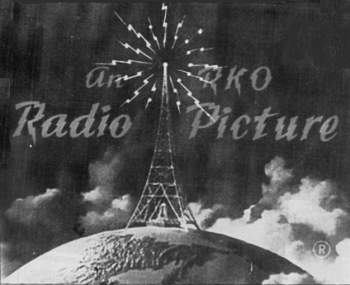
The RKO Radio Picture

The peak RKO radio station lineup consisted of WOR-AM in New York, KHJ-AM in Los Angeles, KFRC-AM in San Francisco, WHBQ-AM in Memphis, CKLW-AM in Windsor Canada, and the Yankee Network and its flagships WNAC-AM in Boston... (The Canadian government later tightened rules on foreign ownership of radio and television stations, forcing RKO to sell its CKLW-AM to a Canadian-based company in 1970.)

A radio picture? Radio doesn't have pictures, that's the point of radio...
RKO was formed in 1928 as a massive merging of four parties:

1. Keith-Albee-Orpheum (KAO) theater chain
2. Film Booking Office of America (FBO) studio
3. American Pathé film studios
4. Radio Corporation of America (RCA) Photophone division.

The prominence of the word "radio" in the corporate name reflected RCA's 66% holding. It is claimed that the broadcasting-tower logo of the production arm, "Radio Pictures," was suggested by David Sarnoff himself, but the reference is arcane and unproven.

In 1933 the U.S. Justice Department forced a re-org of RCA, requiring that RCA sell off a portion of it's RKO holdings. This change shifted power to investor Floyd Odlum and the Rockefeller brothers. In 1932 during the height of the great depression it went into debt. A corporate re-organization in 1936 made for a leaner more profitable company.

ten years later Howard Hughes gained control by buying 25% of the outstanding stock. Within weeks of taking control, he dismissed 66% of the staff and as a result production was shut down for six months! Hughs spent the time investigating possibly communists in the filing cabinets and under the carpets. As a reward, In the fifties Hughes got whacked with an anti-trust lawsuit and had to sell off RKO theaters.

With the loss of his theater division, Hughs focused on TWA and his aviation division. It was the Korean war after all. Hughes found the steady stream of lawsuits from RKO's small shareholders pesky. So since he was the worlds richest man, and a nutjob, he bought them all out in 1954. it cost $24 million. then, seemingly on impulse six months later he resold RKO to General Tire for $25 million. We all know what happened to him after that....

General Tire restored RKO's links to broadcasting. They already owned the Yankee network and in 1951 bought General Teleradio. But licensing problems with WNAK and KHJ hampered growth for the next 20 years! 1965-1987. Tt began with a simple license renewal. Fidelity Television claimed RKO General forced it's vendors purchase advertising time on RKO stations. Then the dirt came out from under the carpet: General Tire had bribed foreign officials, they had misappropriated foreign corporate funds, they bribed elected officials, RKO misled advertisers about its ratings, engaged in fraudulent billing, lied to the FCC about a destroyed audit reports and filed false financial statements etc. The FCC considered this gross misconduct. In 1980 the FCC stripped RKO of the two licenses.

In 1987, judge Kuhlmann found RKO unfit to be a broadcast licensee and recommended that the FCC strip RKO of its licenses. Kuhlmann based his ruling on numerous instances of dishonesty by RKO. RKO sold off it's remaining licenses shortly thereafter. Remember back when large corporations used to get punished by the government? Because the governments job was to serve it's citizens? Today I am reminded regularly by headlines that those days are long gone.