Showing posts with label WNAC. Show all posts

Monday, September 21, 2026

Find That Radio Dial (Part 5)


This is an interesting Superhet table radio made by Silvertone. They were a Sears & Roebuck company, and are still based in Chicago today. It's a Silvertone model 4769 made in 1937. This particular model could tune both AM and two shortwave bands. The preset buttons are laid out in a ring, like an old phone with the tuner dial in the center. They called it a "Teledial."  [SOURCE]  I did fine a thread where someone tried to restore one. That quirky mechanism appears to be a challenge to disassemble and reassemble, with different pulleys turning clockwise and counterclockwise. [SOURCE] 

This dial has WEEI, WHDH, WORL, WCOP , WNAC, and WAAB; all metro-area Boston stations, so there's little mystery about location. This is set also closely matches an ad in the 1937 Radio Yearbook for the most popular Boston radio stations. (below) It lists WNAC, WEEI, WBZ, WAAB, WHDH, WMEX, WCOP, and WORL in that order. (Of course, that's a list of only local stations. )  But the omission of WMEX and WBZ from the pre-sets is at the least, interesting. Perhaps a reception issue, or just personal taste. These sets usually came from the dealer with some buttons already set for demonstration purposes. Then there were perforated tags the owner might add. This owner may not have bothered. This radio has 4 unlabeled.

Broadcasting Yearbook 1937

 WEEI is a well known Boston station, operating today on 850, but were on 830 kHz from 1929 to 1941, when this radio was new. However, the station today that broadcasts as WEEI broadcast as WHDH from 1929 until 1994; so this is a actually different button on that same dial. That WEEI, a Hubbard station and CBS affiliate, broadcast at 5,000 watts daytime, and 1,000 at night from 590 kHz.  590 in Boston today is WEZE; a religious talker. More here.

 WHDH broadcast from 850 kHz, and was owned by Matheson Radio Co. I know I wrote 830 above but 850 is what's in the Radio yearbook. It broadcast out of the Hotel Touraine from 1933 to at least 1939. The building was on the corner of Boylston St. and Tremont near the Boston Common. Built in 1897, the Jacobethan building even contained a library and in the 1950s, was the HQ of the local Communist party. It is still standing today but was converted to apartments in 1966. 


WORL broadcast from the Myles Standish Hotel. That building is also called Myles Standish Hall, and is located at 610 Beacon St. In 1949, Boston University bought the building and converted it into a dorms. They renovated again in 2018 and re-named it Wituwamat Memorial Hall. 

WCOP broadcast on 1120 from the Copley Plaza Hotel. The station changed calls from WMFH in 1935. Owned by the Massachusetts Broadcasting Corp on paper it was operated by it's founder, Joseph Kirby. He died in 11937 and it was sold by his estate to Arde Bulova. Under NARBA it moved to 1150 kHz in 1941. I think they began broadcasting the Hayloft Jamboree in 1948. Today this is WWDJ still on that frequency but broadcasting religious blather.

WNAC was a member of both NBC-Red and the Yankee network. Their studios were at 21 Brookline ave. But it shared a transmitter site with WAAB in Quincy, MA. A year later Congress began an investigation of "duopoly" stations and John Shepard had to divest. Seems quaint with the crazy monopolies allowed to run wild today. 


 WAAB was both a member of both the Mutual and Colonial networks. It broadcast on 1410 at 500 watts; another occupant of 21 Brookline Ave. It was the home of the Colonial network, which itself carried some Mutual programming. Owner John Shepard operated the Yankee network out of WNAC. Shepard had bought the station in 1931 and changed it's calls from WLEX. Mayflower Broadcasting made an attempt in 1938 to take WAAB from Shepard, but in 1941 he won in a re-hearing with the FCC.

But back to the Silvertone model 4769. It appears to have been popular in the 1930s, or maybe that's survivorship bias. Maybe they're just popular with collectors. A quick web search finds dozens of mostly non-working dust collectors.  


This one (above) has WJR, WLW, WKJR, KDKA, WWJ, WJAS, WWSW?, and WKBN? This is a mix of Cincinnati, Pittsburgh, and Detroit stations. This has to be someone in a rural area of Ohio, but that's hard to narrow down without a local station. 

WABC, WCAP, WBRB, WMCA, WIP, WEAB, WOR, WJZ, and KYW. This one is certainly in New Jersey, receiveing both New York and Philadelphia metro stations. WBRB, being the only local one of the bunch. 


Wednesday, March 28, 2012

Gretchen McMullen's Radio Cooking School

Gretchen McMullen's Radio Cooking School on 590 WEEI-AM from Boston and was designed to supplement lessons broadcasted from January to July, 1928.  The book was compiled to promotes the "Housekeeper's Chat" radio show on WEEI.

It was one of the earliest cooking/housekeeping programs , but it turned out to be long-lived. The show was not only still running 14 years later, just not on WEEI.  By then also syndicated on all 12 Yankee Network stations: WNAC-AM, WICC-AM, WEAN-AM, WLLH-AM, WRDO-AM, WTAG-AM, WSAR-AM, WCSH-AM, WLBZ-AM, WTIC-AM, WNBH-AM, and WFEA-AM. That's  according to the December 10th 1938 issue of Radio Guide.  But it's congruous with WNAC being a part in the Yankee Network after 1930. More here.

Alexander Russo refers to her in his book Points on the Dial: Golden Age Radio Beyond the Networks. Apparently John Shepard III had a hand in co-branding “The Gretchen McMullen Household Hour.” More here. The book is worth reading on it's own merits.

In 1941 she appears in the Radio yearbook on the staff of WBZA, and in 1942 she's noted in a 1942 issue of Broadcasting as taking a job at WBZ as a part of the new England Regional Network. The article also describes her as a food expert with 15 years broadcasting experience.  That matches nicely with a start date +/- 1 year from the publication of the that cook book. But where she went after 1943, I have no idea...

Wednesday, July 20, 2011

Rise and Shine with Salty Brine

Salty Brine aka Walter L. Brine died back in 2004. Outside of Rhode Island he is a total unknown, but in that small state, he was a celebrity. He was a veteran broadcaster, and a host of a popular children's television program: Salty Brine's Shack. He's best known for that time spent on TV with his collie Jeff, but he was in radio both before and after his tour on the tube. More here.

He was born in 1918 in Boston, and  in 1941 he graduated from the Staley College for Radio in Brookline, MA. After spending time at a few Boston are stations, notably WNAC-AM, WESX-AM and WCOP-AM he became an announcer on 630 WPRO-AM in 1942.  Some sources say as early as 1938. This is erroneous. Over time, his program just became a part of Rhode Island culture. A 1976 issue of Billboard quoted station manager Jay Clark about Mr. Brine:
"...Salty Brine, a 35-year veteran of WPRO is a much a part of Rhode Island life as fishing and johnny cakes. Brine may play as few as 2 records an hour, but he provides news [traffic,] sports, ski reports, and is totally service oriented."
His morning show ran from 5:30 AM to 9:00 AM Monday through Friday. he maintained the show through many format changes. He began the children's program on WPRO-TV Channel 12 in 1955 and it continued into 1968. When the TV program ended and Salty stuck with WPRO-AM. He retired in 1993 but  remained on air part tie here and there at least into 1999. His legacy was immortalized in an unusual way in 1990. The state legislature named a stretch of beach in Narragansett as Salty Brine State Beach.. There is a nice obit here. He is survived by his son Walter Brine Jr. who goes by the name Wally Brine. Wally went into radio as well, spending time on both WVBF and WROR.

Friday, March 13, 2009

The First Simulcast

On January 4th 1923 the first simulcast occurred. A concert live on 660 WEAF-AM in New York City was carried on 1230 WNAC-AM in Boston. the connection between the two stations was not by STL, it was by telephone line, leased from Bell telephone.

The word "simulcast" did not yet exist. They called it a "chain broadcast." If you're wondering how WEAF explained this all to the phone company dont. AT&T owned WEAF making the experiment much more feasible. At 8:03 PM Davera Nadwernay sang the song "Habanera" from the opera Carmen by Bizet. That broadcast only lasted 5 minutes, emanating directly from Carnagie Hall. (While this is the ersion I beleive, other sources refer to this as a solo saxophone performance)

For KDKA thsi was less than a year after they received the first commercial license from the FRC. This was also of course the very beginning of network broadcasting. Only a few months later they attempted a bigger simulcast involving 810 WGY-AM in Schnectady, KDKA-AM in Pittsburgh, and 1500 KYW-AM in Chicago. This too was successful. AT&T enthused by the success of the two projects built a station in D.C. 980 WCAP-AM to advance their ability to syndicate programming. The facilitiy they built at WCAP for the purpose of linking staitons by phone was called the "Red" layout. This became the NBC Red Network, which formally launched Sept. 9th, 1926.

Wednesday, January 16, 2008

Radio Ratings Part 3: Nielsen

The AC Nielsen Company was founded in 1923 by Arthur Charles Nielsen, Sr. You'll note yesterday I said that Crossleys work in 1929 was the first radio ratings. There' a 6 year gap there to account for. Well, I'll get to that in a minute.

Arthur Nielsen was born the child of two accountants in Chicago back in 1897. He attended the University of Wisconsin at Madison and graduated with an engineering degree in 1919. he worked for Iskop breifly on refridgeration equipment, but it didn't stick. He needed to get back to his roots, raw math and measurement. So in 1923 he borrowed 45 grand from his frat brothers and founded the AC Nielsen Company.

He shopped around the idea of product evaluation and other consumer surveys. It was very early in the game and it was a struggle to convince advertisers that this data was both useful and accurate. 140 trained field investigators made phone calls to a sample of drug and grocery stores. It wasn't until the mid 1930s that he entered the radio arena.
His inner accountant was continually irritated that radio ratings were based on bad data. People were prone to lie and forget interviewers to lead and obfuscate. He wanted better data. He found the audimeter. Claude Robinson a student at Columbia University developed a rough experimental device to record what radio stations had been listened to. It's uncertain if he even built a model or demonstrated it, but his Professor Frank Stanton did. RCA bought the patent just in case. Two professors at M.I.T. Prof. Robert welder and Louis F. Woodruff had developed the device anopther device and encountered the Robinson patent seeking their own patent. they proceeded with funding from John Shepard, of 680 WNAC-AM. In the end they had to buy the old patent from RCA. Field tests began in 1938. It was years before the device was truly ready for field use. But by 1950 they'd also adapted it for use with television.

But in 1939 ACNielsen was expanding internationally. Hooper had killed C.A.B. and in turn Nielsen would swallow him. The audimeter was far superior to any interview system. It still had faults though. It could record what channel was on and for how long... but not if anyone was actually watching.

The earliest version of the audiometer attached to the radio and tracking channel, time and duration of tuning. The early Audimeters contained tapes or cartridges which were mailed back to Nielsen weekly from each sample home. Later versions of the meter fed the information directly to Nielsen Media Research in real time by a dedicated phone line. In 1973 Nielsen introduced the "Storage Instantaneous Audimeter" that actually stored the data locally and was retrieved in a nightly data dump. It made possible the first set of daily national ratings.
More here.

In 1996, ACNielsen split off the field work portion of it's company forming Nielsen Media Research. NMR was acquired by Dutch conglomerate VNU in 1999. Neilsen now operates in more than 100 countries. Arthur died in 1980.

Friday, May 12, 2006

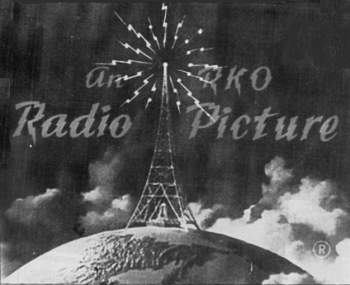
The RKO Radio Picture

The peak RKO radio station lineup consisted of WOR-AM in New York, KHJ-AM in Los Angeles, KFRC-AM in San Francisco, WHBQ-AM in Memphis, CKLW-AM in Windsor Canada, and the Yankee Network and its flagships WNAC-AM in Boston... (The Canadian government later tightened rules on foreign ownership of radio and television stations, forcing RKO to sell its CKLW-AM to a Canadian-based company in 1970.)

A radio picture? Radio doesn't have pictures, that's the point of radio...
RKO was formed in 1928 as a massive merging of four parties:

1. Keith-Albee-Orpheum (KAO) theater chain
2. Film Booking Office of America (FBO) studio
3. American Pathé film studios
4. Radio Corporation of America (RCA) Photophone division.

The prominence of the word "radio" in the corporate name reflected RCA's 66% holding. It is claimed that the broadcasting-tower logo of the production arm, "Radio Pictures," was suggested by David Sarnoff himself, but the reference is arcane and unproven.

In 1933 the U.S. Justice Department forced a re-org of RCA, requiring that RCA sell off a portion of it's RKO holdings. This change shifted power to investor Floyd Odlum and the Rockefeller brothers. In 1932 during the height of the great depression it went into debt. A corporate re-organization in 1936 made for a leaner more profitable company.

ten years later Howard Hughes gained control by buying 25% of the outstanding stock. Within weeks of taking control, he dismissed 66% of the staff and as a result production was shut down for six months! Hughs spent the time investigating possibly communists in the filing cabinets and under the carpets. As a reward, In the fifties Hughes got whacked with an anti-trust lawsuit and had to sell off RKO theaters.

With the loss of his theater division, Hughs focused on TWA and his aviation division. It was the Korean war after all. Hughes found the steady stream of lawsuits from RKO's small shareholders pesky. So since he was the worlds richest man, and a nutjob, he bought them all out in 1954. it cost $24 million. then, seemingly on impulse six months later he resold RKO to General Tire for $25 million. We all know what happened to him after that....

General Tire restored RKO's links to broadcasting. They already owned the Yankee network and in 1951 bought General Teleradio. But licensing problems with WNAK and KHJ hampered growth for the next 20 years! 1965-1987. Tt began with a simple license renewal. Fidelity Television claimed RKO General forced it's vendors purchase advertising time on RKO stations. Then the dirt came out from under the carpet: General Tire had bribed foreign officials, they had misappropriated foreign corporate funds, they bribed elected officials, RKO misled advertisers about its ratings, engaged in fraudulent billing, lied to the FCC about a destroyed audit reports and filed false financial statements etc. The FCC considered this gross misconduct. In 1980 the FCC stripped RKO of the two licenses.

In 1987, judge Kuhlmann found RKO unfit to be a broadcast licensee and recommended that the FCC strip RKO of its licenses. Kuhlmann based his ruling on numerous instances of dishonesty by RKO. RKO sold off it's remaining licenses shortly thereafter. Remember back when large corporations used to get punished by the government? Because the governments job was to serve it's citizens? Today I am reminded regularly by headlines that those days are long gone.