
Showing posts with label AM radio. Show all posts
Showing posts with label AM radio. Show all posts
Tuesday, February 02, 2016


Thursday, December 02, 2010
The End of Daytimers

As of December 1st, 1987 new daytime-only stations are no longer being authorized by the FCC. MM Docket 87-131 reads as follows:"Numerous daytime-only AM stations on the U.S. clear and regional channels, many of which are typically small entities, will benefit from the proposed rule change by being enabled to enhance their broadcast service during nighttime hours."
- I. Reason for Action: The need to improve the capacity of daytime-only AM radio broadcast stations to provide improved service to the public during nighttime hours.
- II. Objective: To increase the opportunities for daytime-only AM stations to operate during nighttime hours, thereby enhancing the usefulness to the public of their broadcast programming; and to discontinue the authorization of new daytime-only stations in order to ensure the efficient use of remaining spectrum for new and improved nighttime service.

Wednesday, October 20, 2010
AM Radio Bandwidth (Part 2)
We left off Monday with the NRSC having to referee where the FCC had failed to tread. Fifty years of indecision had ruined an industry. The NRSC made a compromise decision that might rescue survivability from certain destruction. It was the 10 kHz roll off.
 Technologically the bandwidth reduction is accomplished with a low-pass audio filter. It just chops off everything above 10 kHz. But there is a price to be paid for that steep roll off: group delay distortion aka envelope delay distortion. This is so hard to explain I am going to quote Dana Puopolo, who did a very good job in radio World article in 2005.
Radio wouldn't be interested in data above 20 kHz or below 20 Hz as those are the limits of human hearing. More subtly human hearing sensitivity isn't uniform, not between people, and not between frequencies. That is part of the reasons that the NRSC put the roll off at 10 kHz. That cut off means that only the frequencies above 7 kHz experience group delay distortion. But it does mean that people with sensitive hearing can hear upper harmonics above that frequency arrive after the fundamental.
 That was 1986.Now Clear Channel and Crawford both are advocating a steep roll off at 5 kHz. It cuts the bandwidth in half. If you understood that last paragraph the problem becomes quite clear. Group delay distortion now occurs at 3.5 kHz in the center of human hearing sensitivity. (Humans typically have a sensitivity plateau around 3kHz.) Some of this can be diminished with modern digital filters. But this had no effect on the tuner. Those cheap radios that were problematic in the 1970s are still what we use. They have very poor high-frequency response perhaps down 6 or more dB at 4 kHz, some even roll off at 2kHz. this compounds the problem with a result of severe audio artifacts. In other words.. It sounds kind of crappy. It's the same spacing as they use in shortwave radio.
 Their goal in reducing it to 5kHz is dubious. It allows the station to maintain a higher average loudness. It further reduces interference in a frequency band that's loaded with it. It may even open up some markets for some power increases. It also allots space to shoehorn in HDAM. That's why Jeff Littlejohn at Clear Channel and Cris Alexander at Crawford Broadcasting have already shopped their AM talk stations to 5 kHz and music stations to 6 kHz. Notice their talk and music have been rolled off at different frequencies. This means that on a Clear Channel owned station, a Talk radio station sounds only 1kHz better than a land line phone call. 6kHz for music is unspeakable, sub-MP3 audio quality. For reference, remember that FM radio has up to 15kHz.

In the book The Age Of Electronic Messages author By John G. Truxal rhetorically asks the question "Why did the United States adopt these regulations that doomed AM Radio to music of poor quality?" He then spent a few paragraphs describing what it would really take for an AM station to have high audio quality. I'll summarize. To reproduce the full range of a CD quality recording you would need a 36 kHz allocation. That would reproduce frequencies all the way up to 18,00 Hz. The problem is that then AM stations would need to be 36 kHz apart. It would require reducing the number of AM radio stations by about 66%. That really underlines the source of the problem.
The problem is human, not engineering. We have tried to find solutions in compromise. Physics isn't interested in placation. Reality is not negotiable. Listenership is already sliding. Trading around different painful compromises is no solution. The refusal to commit fully to one solution is the problem and always has been the problem. FM achieved ratings parity with AM in 1979. It's all been downhill for AM since then. My assessment is that it will continue to be the problem until no one is listening anymore. ...Or more cynically, until the remaining audience is old enough that they can't hear the problem anymore.

"To recreate any sound accurately, the reproduction equipment must have flat frequency response, low distortion and noise and a flat time response. In other words, the entire audio waveform must arrive at your ear clearly, at the right level and in the proper time. Group delay is exactly what it says: delay. As you approach the cut off frequency of a filter, the frequencies begin literally to slow down as they go through the filter. This means that they arrive after the fundamental and other harmonics. Problem is, humans can hear time delay distortions and filter group delay quite easily. We usually perceive group delay as a "phasiness" to the audio"Not all frequencies have this problem. Let me explain why. When you pluck the first guitar string it is tuned to "E" also known as 83 Hz. But it has harmonics. You hear natural harmonics at even intervals 165 Hz, 247Hz, 330 Hz, 659 Hz, 989 Hz, 1.3 kHz etc..(there are a mess of other harmonics at uneven intervals) This continues outward from the fundamental frequency beyond the limits of human hearing.
Radio wouldn't be interested in data above 20 kHz or below 20 Hz as those are the limits of human hearing. More subtly human hearing sensitivity isn't uniform, not between people, and not between frequencies. That is part of the reasons that the NRSC put the roll off at 10 kHz. That cut off means that only the frequencies above 7 kHz experience group delay distortion. But it does mean that people with sensitive hearing can hear upper harmonics above that frequency arrive after the fundamental.

 Their goal in reducing it to 5kHz is dubious. It allows the station to maintain a higher average loudness. It further reduces interference in a frequency band that's loaded with it. It may even open up some markets for some power increases. It also allots space to shoehorn in HDAM. That's why Jeff Littlejohn at Clear Channel and Cris Alexander at Crawford Broadcasting have already shopped their AM talk stations to 5 kHz and music stations to 6 kHz. Notice their talk and music have been rolled off at different frequencies. This means that on a Clear Channel owned station, a Talk radio station sounds only 1kHz better than a land line phone call. 6kHz for music is unspeakable, sub-MP3 audio quality. For reference, remember that FM radio has up to 15kHz.
In the book The Age Of Electronic Messages author By John G. Truxal rhetorically asks the question "Why did the United States adopt these regulations that doomed AM Radio to music of poor quality?" He then spent a few paragraphs describing what it would really take for an AM station to have high audio quality. I'll summarize. To reproduce the full range of a CD quality recording you would need a 36 kHz allocation. That would reproduce frequencies all the way up to 18,00 Hz. The problem is that then AM stations would need to be 36 kHz apart. It would require reducing the number of AM radio stations by about 66%. That really underlines the source of the problem.
The problem is human, not engineering. We have tried to find solutions in compromise. Physics isn't interested in placation. Reality is not negotiable. Listenership is already sliding. Trading around different painful compromises is no solution. The refusal to commit fully to one solution is the problem and always has been the problem. FM achieved ratings parity with AM in 1979. It's all been downhill for AM since then. My assessment is that it will continue to be the problem until no one is listening anymore. ...Or more cynically, until the remaining audience is old enough that they can't hear the problem anymore.
Tuesday, March 24, 2009
FM overtakes AM
Today FM enjoys a huge dominance over AM radio. In every market the number of FM stations both outnumbers the AM stations and overall carry superior ratings. It is a rare market that an AM station of any format remains dominant over a comparable FM. At one point in recent history FM radio overtook AM in popularity. FM overtook AM in terms in total number of stations, and in ratings. let's consider the progression... The first commercial radio license ever issued went to KDKA October 27th 1920. Only about a year later the FRC had licensed 62 licenses... all AM obviously, by 1929 they had licensed 143. Growth continued steadily. FM didn't begin licensing until 1937. That year W1XOJ was the first FM radio station, to be granted a CP from the FCC. In 1937 there were 704 AM radio stations, a growth of over 400%.
In 1946 we were up to 62 FM radio stations. This fulfilled what was then a plan to allocate only 70 licenses for commercial FM and 20 for non-commercial. Almost all of the 600 FM applications were filed based on the original FM rules, which they had promptly changed. They denied most of them. The Annual report of 1946 clearly notes that 250 FM applications are pending. The start was shaky.
In 1963 docket 14185 adopted most technical FM rules and really established a nation wide tabel of FM assignments. At this time the FCC was openly considering a ban between FM /FM simulcasts as an "a waste of valuable spectrum space." By 1965 at least 7,570,000 homes had FM radios. This leaned heavily toward urban areas. New York City had a penetration of over 50%. There were 4,097 Am stations at that time and 1628 FM stations. You can see the gap closing at least in terms of raw numbers.
The magic year was 1978. That year AM became a ratings minority. Of Arbitron's 500 top 10 stations in the top 50 markets, AM only had 240 stations. To quote from the Broadcasting cable article written that year:
 The first commercial radio license ever issued went to KDKA October 27th 1920. Only about a year later the FRC had licensed 62 licenses... all AM obviously, by 1929 they had licensed 143. Growth continued steadily. FM didn't begin licensing until 1937. That year W1XOJ was the first FM radio station, to be granted a CP from the FCC. In 1937 there were 704 AM radio stations, a growth of over 400%.
In 1946 we were up to 62 FM radio stations. This fulfilled what was then a plan to allocate only 70 licenses for commercial FM and 20 for non-commercial. Almost all of the 600 FM applications were filed based on the original FM rules, which they had promptly changed. They denied most of them. The Annual report of 1946 clearly notes that 250 FM applications are pending. The start was shaky.
In 1963 docket 14185 adopted most technical FM rules and really established a nation wide tabel of FM assignments. At this time the FCC was openly considering a ban between FM /FM simulcasts as an "a waste of valuable spectrum space." By 1965 at least 7,570,000 homes had FM radios. This leaned heavily toward urban areas. New York City had a penetration of over 50%. There were 4,097 Am stations at that time and 1628 FM stations. You can see the gap closing at least in terms of raw numbers.
The magic year was 1978. That year AM became a ratings minority. Of Arbitron's 500 top 10 stations in the top 50 markets, AM only had 240 stations. To quote from the Broadcasting cable article written that year:
"Take the number-one market, New York, where WBLS, WRFM, WPLJ, and WXLO, all show up in the top 10. Tehre are also four in Chicago (WLOO, WLAK, WBMX, and WCLR) and three in Los Angeles (KJOI, KMET, and KLOS). Rounding out the top-10 markets-Detroit has six, Philadelphia has five Sanfrancisco four, Boston Five Dallas-Ft. Worth six, Pittsburgh six including one AM-FM simulcast combination and Washington eight (including one combo)."That same year there were only 3,896 FM stations to compete with 4,495 AM stations.
Friday, June 29, 2007
AM Cross Talk example
The human ear is very tolerant to noise. It can detect sounds from  20Hz to about 20,000 Hz. It's highest sensitivity is between 500 Hz and 5000 Hz. It has mechanisms for coping with sounds that are too loud, too soft, and even for noise filtration. Your brain, in it's infinite wison tries to hear signal instead of noise, and its far more effective than any software.
 20Hz to about 20,000 Hz. It's highest sensitivity is between 500 Hz and 5000 Hz. It has mechanisms for coping with sounds that are too loud, too soft, and even for noise filtration. Your brain, in it's infinite wison tries to hear signal instead of noise, and its far more effective than any software.
Here's a nice example: DivShare File - AM_Clip.wav
...and again with the volume adjusted: DivShare File - AM_clip2.wav
I cranked the volume at the end of clip 2 as the music fades out so you can hear the other station bleeding in. It's almost inaudible otherwise. I only heard it with headphones on initially. Our ears filter out the noise otherwise. I glean two things from this lesson:
1. I have very mixed feelings in the debate about 10Khz AM bandwidth Vs. 6 Khz... knowing how much noise is there already I think reducing the quality is probably a bad idea.
2. I also have very mixed feelings about the future of AM radio in terms of the audio quality I've come to expect from other media.
Monday, February 27, 2006
All stations on one frequency
This was a brief but painful stage in radio. At first, radio broadcasting stations operated with an experimental amateur license, and with call signs such as 6XAJ. They could operate over a wide range of frequencies. Then in 1918 almost all licenses were yanked as a part of WWII. That wasn't repealed until 1922. (more some other time on the ones that were not yanked)
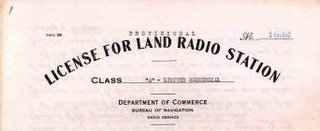
In the middle of all this time period the (DOC) The Department of Commerce made some regulations that went into effect on December 1, 1921. It was one of the earliest broadcast rules. It required all non-government broadcasting stations to obtain a limited commercial license. These new licenses came with new three letter call signs. So 6XAJ became KZM.
 This new license also required all stations to broadcast on the single authorized frequency of 833 kHz. Most government and weather broadcasts were allocated on 619 kHz. Now the immediate problem with this dumbass idea is that radio stations can't operate simultaneously on this channel without causing interference. Try to imagine radio as the newest hottest fad at the time. Over 100,000 radios had already been sold. And now, they barely worked because of all the damn crosss-talk. So the owners of the stations met and had to agreed on a time-share schedule. in San francisco the above mentioned KZM not only shared time with KLX but also their transmitter!
It got a little better in January of 1922. The Secretary of commerce sponsored the first National Radio Conference. It was decided that high- power stations (above 500 watts) were assigned to 750 kHz, and low-power stations (below 500 watts) remained on 833 kHz. Each station got exclusive use of the frequency for several hours each day. It was an improvement but the rudimentary radios of the time could babrely discren between the two frequencies. Despite this, about 1.5 million radios had been sold by the end of that year.
 This cluttering was absolutely crippling in some cities. In Washington D.C. there were at least 11 stations sharing that frequency. This includes WQAW, WJH, WDW, WHAQ, WPM, WIL, WEAS, WIAY, WDM, and WMU. When the regulation was first issued in 1921, there were only 28 radio stations on the air. But in the year 1922 the DOC issued 480 more licenses! This was becoming a problem. By 1925 there were more than seven hundred stations and Herbert Hoover, then Secretary of the Department of Commerce, had to block the further issue of licences.
By 1924, the AM band stretched from 550kHz to 1500 Khz. Three levels of power, 5000, 500 and 100 watts were established. These became the designations of "clear", "regional" and "local". Finally, the Radio Act of 1927 enabled the government (thru the FRC) the power to regulate the technical side of stations. Thus we traded set of headaches was traded for another.
early FRC map: http://www.eliillinois.org/00001_00/main/map1932/map1932.jpg
In the middle of all this time period the (DOC) The Department of Commerce made some regulations that went into effect on December 1, 1921. It was one of the earliest broadcast rules. It required all non-government broadcasting stations to obtain a limited commercial license. These new licenses came with new three letter call signs. So 6XAJ became KZM.
 This new license also required all stations to broadcast on the single authorized frequency of 833 kHz. Most government and weather broadcasts were allocated on 619 kHz. Now the immediate problem with this dumbass idea is that radio stations can't operate simultaneously on this channel without causing interference. Try to imagine radio as the newest hottest fad at the time. Over 100,000 radios had already been sold. And now, they barely worked because of all the damn crosss-talk. So the owners of the stations met and had to agreed on a time-share schedule. in San francisco the above mentioned KZM not only shared time with KLX but also their transmitter!
It got a little better in January of 1922. The Secretary of commerce sponsored the first National Radio Conference. It was decided that high- power stations (above 500 watts) were assigned to 750 kHz, and low-power stations (below 500 watts) remained on 833 kHz. Each station got exclusive use of the frequency for several hours each day. It was an improvement but the rudimentary radios of the time could babrely discren between the two frequencies. Despite this, about 1.5 million radios had been sold by the end of that year.
 This cluttering was absolutely crippling in some cities. In Washington D.C. there were at least 11 stations sharing that frequency. This includes WQAW, WJH, WDW, WHAQ, WPM, WIL, WEAS, WIAY, WDM, and WMU. When the regulation was first issued in 1921, there were only 28 radio stations on the air. But in the year 1922 the DOC issued 480 more licenses! This was becoming a problem. By 1925 there were more than seven hundred stations and Herbert Hoover, then Secretary of the Department of Commerce, had to block the further issue of licences.
By 1924, the AM band stretched from 550kHz to 1500 Khz. Three levels of power, 5000, 500 and 100 watts were established. These became the designations of "clear", "regional" and "local". Finally, the Radio Act of 1927 enabled the government (thru the FRC) the power to regulate the technical side of stations. Thus we traded set of headaches was traded for another.
early FRC map: http://www.eliillinois.org/00001_00/main/map1932/map1932.jpg
Subscribe to:
Posts (Atom)

 Posts
Posts


