Showing posts with label single sideband. Show all posts

Wednesday, October 20, 2010

AM Radio Bandwidth (Part 2)

We left off Monday with the NRSC having to referee where the FCC had failed to tread. Fifty years of indecision had ruined an industry. The NRSC made a compromise decision that might rescue survivability from certain destruction.  It was the 10 kHz roll off.
Technologically the bandwidth reduction is accomplished with a low-pass audio filter.  It just chops off everything above 10 kHz. But there is a price to be paid for that steep roll off: group delay distortion aka envelope delay distortion. This is so hard to explain I am going to quote Dana Puopolo, who did a very good job in  radio World article in 2005.
"To recreate any sound accurately, the reproduction equipment must have flat frequency response, low distortion and noise and a flat time response. In other words, the entire audio waveform must arrive at your ear clearly, at the right level and in the proper time. Group delay is exactly what it says: delay. As you approach the cut off frequency of a filter, the frequencies begin literally to slow down as they go through the filter. This means that they arrive after the fundamental and other harmonics. Problem is, humans can hear time delay distortions and filter group delay quite easily. We usually perceive group delay as a "phasiness" to the audio"
Not all frequencies have this problem. Let me explain why. When you pluck the first guitar string it is tuned to "E" also known as 83 Hz. But it has harmonics. You hear natural harmonics at even intervals 165 Hz, 247Hz, 330 Hz, 659 Hz, 989 Hz, 1.3 kHz etc..(there are a mess of other harmonics at uneven intervals) This continues outward from the fundamental frequency beyond the limits of human hearing.

Radio wouldn't be interested in data above 20 kHz or below 20 Hz as those are the limits of human hearing. More subtly human hearing sensitivity isn't uniform, not between people, and not between frequencies. That is part of the reasons that the NRSC put the roll off at 10 kHz. That cut off  means that only the frequencies above 7 kHz experience group delay distortion. But it does mean that people with sensitive hearing can hear upper harmonics above that frequency arrive after the fundamental.
That was 1986.Now Clear Channel and Crawford both are advocating a steep roll off at 5 kHz. It cuts the bandwidth in half.  If you understood that last paragraph the problem becomes quite clear. Group delay distortion now occurs at 3.5 kHz in the center of human hearing sensitivity. (Humans typically have a sensitivity plateau around 3kHz.) Some of this can be diminished with modern digital filters. But this had no effect on the tuner. Those cheap radios that were problematic in the 1970s are still what we use. They have very poor high-frequency response perhaps down 6 or more dB at 4 kHz, some even roll off at 2kHz.  this compounds the problem with a result of severe audio artifacts. In other words.. It sounds kind of crappy.  It's the same spacing as they use in shortwave radio.

 Their goal in reducing it to 5kHz is dubious. It allows the station to maintain a higher average loudness. It further reduces interference in a frequency band that's loaded with it. It may even open up some markets for some power increases. It also allots space to shoehorn in HDAM.  That's why Jeff Littlejohn at Clear Channel and Cris Alexander at Crawford Broadcasting have already shopped their AM talk stations to 5 kHz and music stations to 6 kHz. Notice their talk and music have been rolled off at different frequencies. This means that on a Clear Channel owned station, a Talk radio station sounds only 1kHz better than a land line phone call. 6kHz for music is unspeakable, sub-MP3 audio quality. For reference, remember that FM radio has up to 15kHz.


In the book The Age Of Electronic Messages author By John G. Truxal rhetorically asks the question "Why did the United States adopt these regulations that doomed AM Radio to music of poor quality?"  He then spent a few paragraphs describing what it would really take for an AM station to have high audio quality. I'll summarize.  To reproduce the full range of a CD quality recording you would need a 36 kHz allocation. That would reproduce frequencies all the way up to 18,00 Hz. The problem is that then AM stations would need to be 36 kHz apart. It would require reducing the number of AM radio stations by about 66%. That really underlines the source of the problem.

The problem is human, not engineering. We have tried to find solutions in compromise. Physics isn't interested in placation. Reality is not negotiable. Listenership is already sliding. Trading around different painful compromises is no solution. The refusal to commit fully to one solution is the problem and always has been the problem. FM achieved ratings parity with AM in 1979.  It's all been downhill for AM since then. My assessment is that it will continue to be the problem until no one is listening anymore. ...Or more cynically, until the remaining audience is old enough that they can't hear the problem anymore.

Monday, October 18, 2010

AM Radio Bandwidth (Part 1)

It is a simple engineering argument over AM audio frequency response. But the topic is so conceptually above the laypersons head, that very questionable decisions are being made in an arena where regulation should be making the final decision. I've kept the specifics out of the preamble and I'll begin in the arcana of AM history.

The problem is nearly as old as radio itself.  It's called "splatter" which is short for Spectral Splatter. This is when the broadcast includes noise at frequencies other than the frequency of the carrier wave. If there was only one radio station this wouldn't need to exist, but we have 14,000. So much like the suburbs, where your lawn ends, another neighbors lawn begins.  Because the goal is to have as many choices as possible, we want to use the existing bandwidth efficiently.  But you cant put your ficus bush on your neighbors property.  Radio is much like this where stations are squeezed in together such that splatter will occur on adjacent channels and not vacant space. Essentially, there is no vacant space. This situation requires a referee (the FCC) and a lot of regulations. In radio, FCC regulations require radio signals be contained in a particular frequency band. This is defined by a "spectral mask". OK, new word. It's also called a channel mask or transmission mask.
"...a mathematically-defined set of lines applied to the levels of radio transmissions. The spectral mask is generally intended to reduce adjacent-channel interference by limiting excessive radiation at frequencies beyond the necessary bandwidth. Attenuation of these spurious emissions is usually done with a band-pass filter, tuned to allow through the correct center frequency of the carrier wave, as well as all necessary sidebands."
The key phrase there is "all necessary sidebands."  This is the topic over which engineers have been arguing. the carrier wave is what you tune the radio to.  If you're listening to 100.1 FM, on a graph 100.1 FM is just a line, or a point. Data takes up space.  In the most rudimentary sense this is referred to as bandwidth. Here is a picture of an FM HD signal to help visualize the relationship. The sidebands are mirror images and the carrier wave a dividing line. How far away from this center point the side bands can be is the point of contention. Enter the NRSC.
Right now AM bandwidth is fixed at 10 kHz as per the NRSC standards that were set November 20th 1986 read it here. The ruling was sort of late to the AM radio game. FM radio had already overtaken AM radio by the early 1980s at least in sheer numbers. FM had them on fidelity, and bandwidth  was partially why. I'll quote the December 1976 issue of Popular Mechanics to summarize the situation:
"Most of the inexpensive portable or table radios... are too insensitive to pick up any but the strongest signals clearly, are plagued by interference, and are limited by tiny speakers that produce only tinny sound. Even the AM sections of component high-fidelity tuners and receivers are frequently cheap, poorly designed circuits... the fewer listeners who can hear the difference at home between  good and bad AM broadcasts, the less motivation AM stations have to clean up and improve their signal."
AM stations are spaced 10 kHz apart. that sounds fine except that the FCC allowed AM stations to broadcast sidebands on some stations up to 30 kHz wide!  That's 15khz to each side  of course. the math is obvious, broadcasting more than 20kHz increased the odds of interference significantly. But there was a second problem. Most AM radios tuned much more narrowly than 30 kHz.  they did so for 2 reasons. First is was cheaper, second it reduced interference by avoiding second adjacent stations. But that also meant not receiving the stations high frequencies. It made everything sound muddy.

Stations fought back. They used an audio process called "pre-emphasis" to boost high frequencies.  It's wasn't a radical new technology.  The RIAA equalization curve on 33 rpm and 45 rpm vinyl records used pre-emphasis. it can also be used in digital processing to reduce bit errors. the downside was that in the already narrow world of AM bandwidth, it caused even more interference. Makers of consumer radio tuners narrowed bandwidth even further to reduce that interference. By the 1980s the end result of this downward spiral is that most AM radio tuners reproduced 4 kHz of bandwidth. That's only a slim margin better than the audio quality of a land line telephone (3.4 kHz.) Consumers were driven away from AM toward FM. It was about then that the FCC OK'd AM stereo. It was the perfect storm.

The NRSC tried to salvage a radio service from this nightmare.  The NRSC studied the problem and came out with a simple compromise: the 10 kHz steep audio roll-off.  ...more in part 2

Thursday, December 03, 2009

Single Sideband Transmission

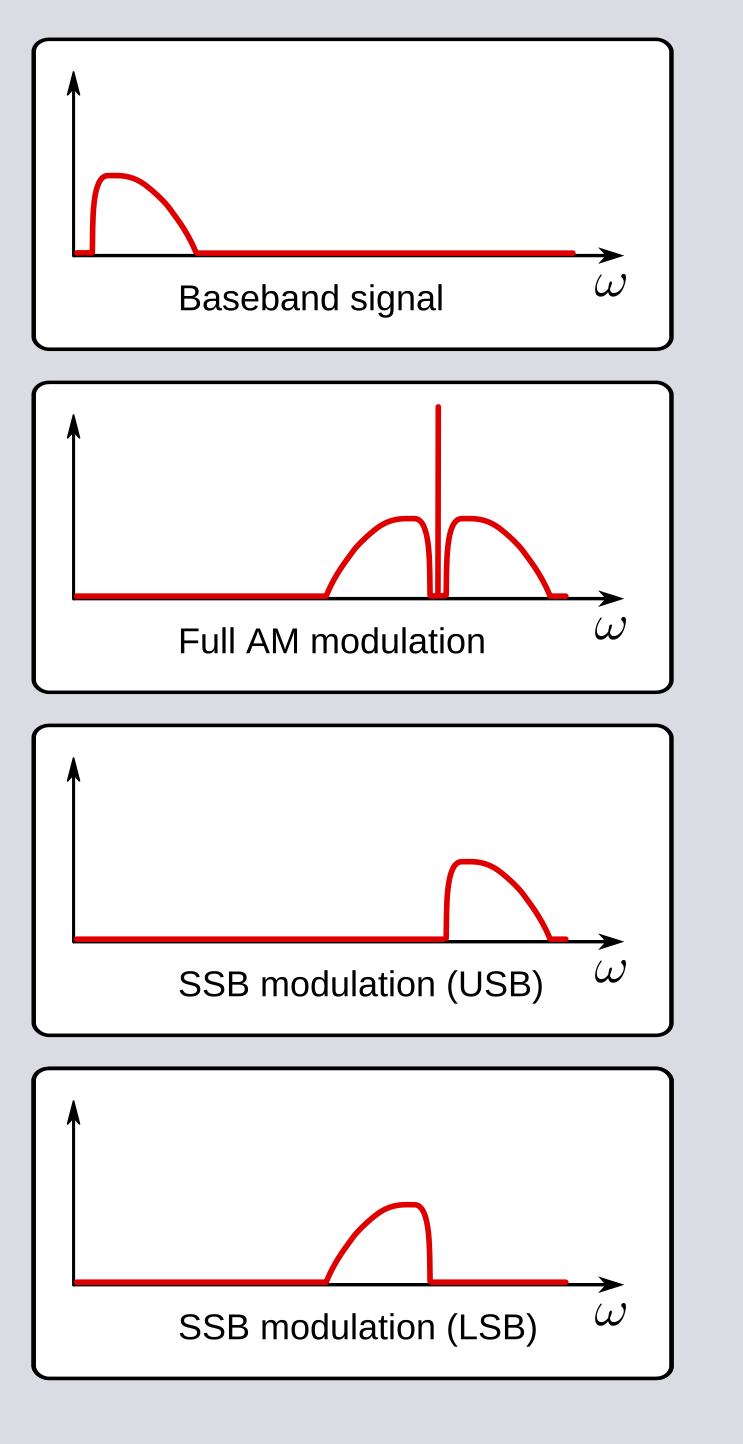
We call this SSB for short, Single Sideband Modulation. Before SSB we used straight Amplitude modulation. It was noisy and it used a lot of bandwidth. More specifically Amplitude modulation produced an output signal that used twice the bandwidth of the original baseband signal. This is where I should start defining my terms I expect. More here.
What's a sideband?
Every kind of modulation produces sidebands. A sideband is just the frequencies adjacent to the carrier wave that contain power as a result of signal modulation. Every transmission signal contains more than a single frequency, these are linked together or superimposed upon each other. Everything that isn't the carrier wave is in the side bands.

What's a baseband?
A baseband is a band of frequencies starting at zero reaching up to the to the highest frequency component of the transmission. RF Modulation results in shifting the signal up to a much higher frequency than it originally spanned. In a nutshell, this everything you had before you modulated the signal, or everything you have after demodulating a modulated signal. The reason we shift all these signals away from zero is that lower frequency signals tend to distort. More here.

How's that different from Bandwidth?
Easy. Bandwidth is the same thing but measured from the lowest frequency, if that's zero, higher than zero or even below zero. The RF bandwidth of a signal is usually about twice its baseband bandwidth.

Almost by default Amplitude modulation of a carrier wave results in two mirror-image sidebands, one on each side of the carrier wave. This is called double sideband modulation. The one below the carrier is the lower sideband, the one above it is called the upper sideband. It all seems intuitive now, but 5 minutes ago you had no idea what any of this was. More here.

In 1914 John R. Carson of AT&T invented single sideband transmission. Single Sideband could be either the upper or lower sideband. Before the FRC ever licensed a single AM radio station, John proved that either sideband could carry as much information as the two sides together. this was a revelation.

In 1915 he filed for the patent "Method and Means for Signaling with High Frequency Waves." After much litigation, Patent number 1449382 was granted in 1923 to Mr. Carson. Wait litigation? Yes, at the same time experiments were conducted at the US Naval Radio Station in Arlington an antenna was tuned to pass one sideband and attenuate the other. regardless.. Carson got the patent for AT&T. More here.

What makes this so interesting is that even though it produced a bandwidth savings of 50% it wasn't embraced. This was largely before broadcast applications, so it was used in telegraphy. But at that time message traffic didn't yet require spectrum-conservation. It had to wait until WWII and government intervention to standardize the power and bandwidth saving innovation.