

KLX-AM shared a frequency, staff and equipment with KZM-AM in the 1920s. KZM had come up as experimental station 6XAJ getting the calls in 1921. The Tribune Newspaper was deeply involved with the station and through inexplicabel logic, was convinved to get it's own license for the share-time by KLX founder Preston Decker Allen in 1922.
In 1928 Allen wanted to sell his license and rather than sell to the Tribune, he sold out to a lcal buisnessman Leon P. Tenney. Tenney moved the station to 1300 as a share time with KRE-AM then 1370. By 1930 Tenneywas bored and sold out to Julius Brunton who already owned KJBS-AM. That last transfer was not authorized by the FRC (this is pre-FCC) and bang the FRC deleted the license. The void of KZM is what allowed KLX to flourish.
So in 1932 when Dude martin does his first mic break on KLX they have the new frequency of 880 to themselves and are running at 1000 watts from the 20th story of the Tribune building. For the era, this was a big stick.
The Nevada Nightherders were Martin's highschool band. The Nightherder name went away as the shows popularity grew. The band ballooned to 10 members and the band was known as 'Dude Martin's Roundup Gang.' Around then they At this point they moved over to 1260 KYA-AM in San Francisco where they stayed for a decade. On KYA his sponsor was Gene Compton's Restaurant. By 1939 he changed the name again to the Wild West Show Revue Gang.
In 1949 Martin took at stabe at television and hosted The Dude Martin Show on KGO-TV. It was popular enough that he eventually moved to Los Angeles to host the Hoffman Hayride taking over for the erratic and possibly manic Spade Cooley on KTTV-TV in that much larger market. That show ran into the 1950s. He died in 1991.


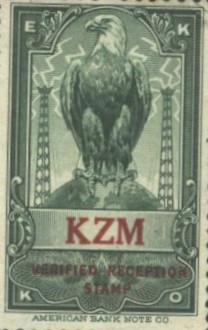

 This new license also required all stations to broadcast on the single authorized frequency of 833 kHz. Most government and weather broadcasts were allocated on 619 kHz. Now the immediate problem with this dumbass idea is that radio stations can't operate simultaneously on this channel without causing interference. Try to imagine radio as the newest hottest fad at the time. Over 100,000 radios had already been sold. And now, they barely worked because of all the damn crosss-talk. So the owners of the stations met and had to agreed on a time-share schedule. in San francisco the above mentioned KZM not only shared time with KLX but also their transmitter!
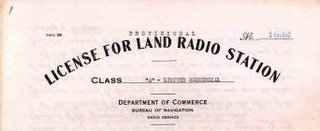 This cluttering was absolutely crippling in some cities. In Washington D.C. there were at least 11 stations sharing that frequency. This includes WQAW, WJH, WDW, WHAQ, WPM, WIL, WEAS, WIAY, WDM, and WMU. When the regulation was first issued in 1921, there were only 28 radio stations on the air. But in the year 1922 the DOC issued 480 more licenses! This was becoming a problem. By 1925 there were more than seven hundred stations and Herbert Hoover, then Secretary of the Department of Commerce, had to block the further issue of licences.
 Posts
Posts


