Monday, December 31, 2007

Mystery Acetate Label: Air-Tone

On the label it says Air-Tone Sound & Recording Co. The 78 rpm box is checked and typed on the label are the three words "Junior League Follies." The disc itself is missing. I found the label at the bottom of a bin of junk vinyl. So I have no matching disc to give it any context. 

I found a listing for a similar label on a 78 rpm, aluminum-based 12 inch acetate. This type of disc was mostly phased out in the 1950s. I suspect it was a radio program because of the name, and the numbering. A "1" is probably one in a series, as opposed to the standard Side A/ Side B terminology. The 1527 Chestnut St, Philadelphia address on the label is now a burger joint. Old documents indicate it has been home to both private residences and business: Trademan's Trust Co., Bonschur & Holmes, Chas H. Elliott Coal, Newton Coal, and A. Pomeranz & Co. Anybody know anything else?

UPDATE!!!
I posted the above way back in 2007. Just this last January Richie Piggott posted a disc to match. [LINK] His is dated 1949, and is attached to a 16" disc. As far as I recall there were no 16" discs in the bin where I found my label. Richie seems to have confirmed my suspicion that it was a radio program as his disc can be connected to Philadelphia DJ Wilfred Michael (‘Will’) Regan. He also posted the audio!  I'll quote Mr. Piggot's post:

"After WW2, he joined the station WDAS in Philadelphia as a radio announcer. It was at WDAS that Regan hosted the Irish Dances at the Crystal Ballroom, in Upper Darby, which were often broadcast live with Regan as the emcee. He was with WDAS announcing Will Regan’s Irish Hours program until 1967, when he joined WVCH in Philadelphia. He retired in the early 1990s. "

Will died in 1995 and his long running Irish Hours radio program was taken over by Michael Concannon. That station is WJFP-AM today and airs mostly ultra-conservative talk radio. He was still there in 2009. [SOURCE] He's still posting the program on his website today. [LINK]

With the expansion of the internet in the last decade I did find more information on Air-tone. In an issue of House and Garden I found ad for Carol Grey costume jewelry in 1946 puts a bracket on the start date.  The earliest print reference to Air-Tone is in 1948 in Radio Electronics Magazine. It's a list of retailers selling "Fen-Tone Audiophile components."  


In multiple 1950 - 1952 issues of Audio Engineering Air-Tone ran advertisements selling Magnecord Recorder & Amplifier, Electrovoice Speakers and Newcomb Amplifiers. A 1952 issue of Audio Magazine lists Air-Tone making their own branded Applause Meter. In 1955 in CQ magazine they ran ads for Motekl tape decks.  One of the latest dated entries was an ad for Air-tone dated to 1954 in Bucks County Traveler Magazine. A single issue of Audio Magazine, (Nov 1950)  names just one person at Air-Tone: Gene Hessel. 
 
Gene Hessel also appears in a 1952 issue of Broadcasting described as the President of Air-Tone. In 1954 Gene wrote an article on PA systems for the Radio-Television Service Dealer magazine. [SOURCE] But this is all I can find about Gene, so a bit of Mystery remains.

Friday, December 28, 2007

Jesuits give up on radio

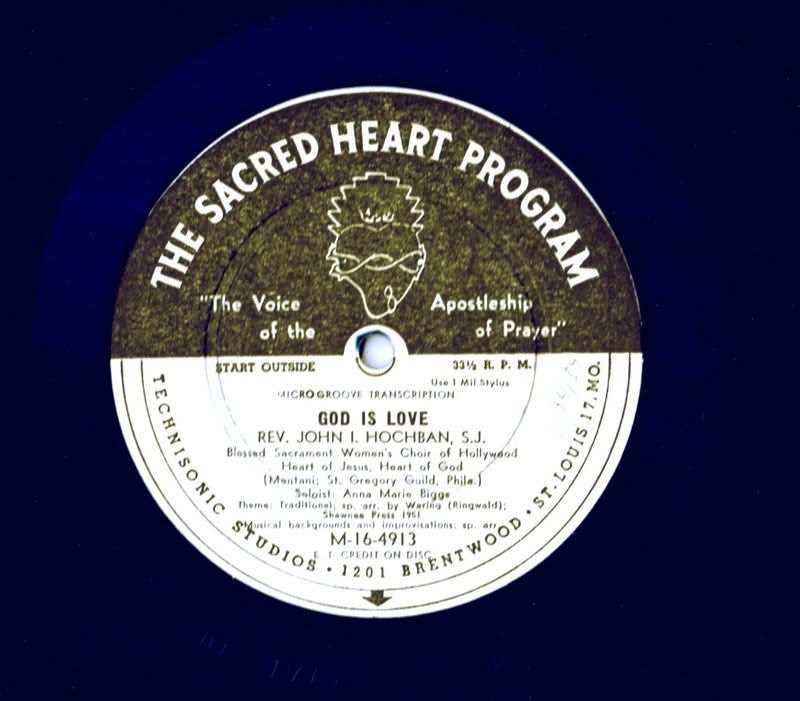
Here's another one that begins with a transcription disc I found in a thrift store. It was a translucent blue, slightly mottled transcriptions disc. It's Sacred Heart Program M-16-4913. Witten in pen on the label is a date "11/14/57 WISK." The choral is provided by Blessed Sacrament Womens Choir of Hollywood. I though that first the WISK notation referred to WISK-AM in Georgia, that seems unlikely.
Not surprising, the Jesuits also gave up on operating the seismographs of the world. It's an interesting clickish religious sect hell-bent on educating the ignorant heathens. Overall they've done much good. It turns out we infidels could use some learnin'.


They also ran a radio program. Notice that's in the past tense. The Jesuits of the Missouri Province voted to terminate their Sacred Heart program in November of 2005. It had been running without interruption for 66 years. It began way back on Nov. 18. Since 1939. It was a 15 minute radio program consisting of gospel music, and a short sermon. Many of these were done by the program's founder Reverend Eugene Murphy.

He was a Saint Louis University Jesuit originally stationed at Rockhurst University. Before he was sent to SLU, he lost his voice due to a severe illness. While hospitalized he was inspired to create a radio program for Sacred Heart. At SLU, he found 770 WEW-AM.
WEW-AM in St. Louis went on air in April of 1921 just weeks after KDKA-AM. It was founded by Saint Louis University meteorologist George Rueppel. He worked at several Jesuit colleges before SLU. He showed up at SLU in 1908. More here.

On Jan. 15 of 1939 Murphy began broadcasting Sacred Heart Programs. They broadcast hymns and Murphy sermonized. The program was distributed on phonodisc through 1988. I'll end with an interesting piece of radio arcana. Chucky Berry's first electric guitar was sold to him by a DJ on WEW-AM according to an interview by Don Menn in the book 'Secrets from the Masters."

A Milton Cross Christmas

I discovered Milton Cross via RCA 45-5106-B. It's a 78 with two tracks. The B side is an orchestral rendition of "Jingle Bells Fantasy" by the Victor Salon Orchestra. The A side is a reading of "The Night Before Christmas" by Milton Cross. It's read over a smooth string piece similar to the B side. Lee posted the B side last year. It's expired but it's such a worthy Blog.
I Found a single reference to it in the book 45 RPM: The History, Heroes & villains of a Pop Music Revolution. The book refers to the release as a 45 and to Milton Cross as a source of the music. These may be both incorrect. My copy is clearly a shellac 78, but still sports all the packaging described. It may have been later released as a yellow vinyl 45. But the reference is still informative.
"One of the first 45 records with a full color, four picture sleeve was a recitation of "The Night Before Christmas" (47-0141) by Clement C. Moore, with Music by Milton Cross and the Victor Salon Orchestra. The record had not only a sleeve with an aerial shot of Santa Claus and his flying reindeer but also a fold over flap with another full-color illustration of angelic, caroling children. It was issued as part of RCA Victor's Youth series in 1949."
So the real question was "Who is Milton Cross?" It turns out that he was the announcer for the Metropolitan Opera broadcasts on WABC-AM for 43 years. That's from their first program in 1931 until his death in 1975. He was also host of a classical program called "The Chamber Music Society of Lower Basin Street."

He was first hired by Tommy Cowan at WJZ-AM in 1921 while it was still based in Newark. It relocated to Manhattan as part of the NBC Blue Network. He did several children's programs including "coast to Coast on a bus", "Presenting A&G Pipsies" and "Children's Hour." With all that in context it begins to make sense that he be tapped to narrate that old Christmas recitation. RCA also had him read Little red Riding Hood and others. he also did some lesser known narrations of "the Great Foodini" for Caravan records. More here.


Late in his career he did a sunday night swing show and even hosted the Quiz program "Information please." George Ansbro wrote an autobiography in 1986 that tells as much about Milton as himself. It was reprinted with an introduction by Leonard Maltin in 1999. More here.

Wednesday, December 26, 2007

DJ Krys Kryngle


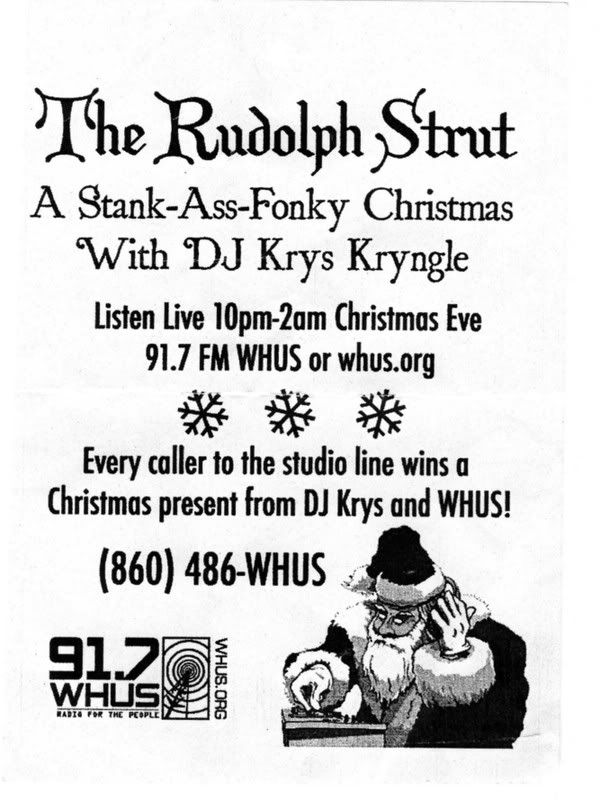
This was a great idea. It's the alter ego of Benny Shaik. There's a lot of bad xmas music in the world. He's a DJ willing to brave the crates of crap to find the rare gem.

Tuesday, December 25, 2007

Elvis Banned on xmas!

Elvis got a rough shake at radio. He was banned a few times for his hip-shaking in a time that was so uptight you'd think Jedediah Bush was president too. Thankfully Elvis overcame adversity got fat and has a successful career complete with the comeback tour. What you didn't know was that among all his trouble was that even one of his Christmas songs got banned. It was that famous year that Ed Sullivan cut off Elvis at the hips...

The hubub went down even later than you might expect. In 1957 Elvis was recording his first of several Christmas-themed releases. But it was released at the peak of Elvis's renegade status. Some stations in a fit of wholesomeness banned the album. WCFL-AM in Chicago banned all records by Elvis entirely. KMPC-AM and KEX-AM in Portland followed suit. But at KEX, DJ Al Priddy played his version of "White Christmas." anyway and was fired. In response DJ Allen Brooks of CKWS in Kingston, Ontario, played the entire LP.

The problem was that a secular and sex-crazed rock n' roller was playing sacred music. Fanning the flames was none other than Irving Berliner. Irving ran amok writing letters to radio stations. Elvis had recorded a version of his "White Christmas" a song that Berliner had written. Royalties be damned, it was too much for him to bear. I'm sure his estate has no problem depositing the checks today.

Monday, December 24, 2007

Burl Ives is the Antichrist

100000watts.com informs me that there are 427 radio staitons playing all-xmas today. Inside radio tells me that thsi is slightly less than last year which came in at a total of 431. Music tracking companies like BDS and Mediaguide tell me that Burl Ives classic song "Holly Jolly Christmas" is the most played Christmas song in radio... again.

I do not like Christmas music. Most of it ranges from cheesy to schmaltzy. There are a few punk rock songs that manage to enter the arena mockingly and exit cleanly, but they are few. But worse than laying off your DJs for 6 weeks is trying to do the 50/50 split. Modern pop and rock music does not blend with Christmas classics. I actually heard a CHR/Pop station play the Dean martin version of "Silent Night" immediately after Fergie's original version of "My Humps." I actually heard the Irving Berlin version of "what Christmas" followed by "Freaky Gurl" by some dude named Gucci Mane. It's atrocious. Please stop.

The only upside of Burl is that he's an ex-radio man. He dropped out of school to travel across America in the 1930s like Woody Guthrie; unemployed and unwashed. He did whatever day labor came his way but also played banjo wherever possible. He was actually jailed in Utah for playing a slightly naughty song named Foggy Dew. He took it as a sign and went back to school.

It was 1931 and he enrolled at Indiana State Teachers College (now Indiana State University) in Terre Haute. He worked at a drug store and played a few gigs. Later that year he landed a show on 640 WBOW-AM. It was an affiliate of the ABS Network owned by Samuel Insull. Jay Stewart of American bandstand also spent some time on WBOW. The radio gig didn't last for Burl and he blew town to attend Juliard.

Ten years later after a little fame and growing fortune he returned to radio. Ives began his own radio show on the CBS network called The Wayfaring Stranger. It was named for a popular folk song. he also used the title for his first book, published in 1948. More here.
But, Burl did not write "Holly Jolly Christmas." That "honor" goes to Johnny Marks who also cursed us with "Silver and Gold", "Jingle, Jingle, Jingle," "The Most Wonderful Day of the Year", and "We are Santa’s Elves". Burl was not even the first Troglodyte to record it. That class act was the Quinto sisters. More here.

Friday, December 21, 2007

Last reviews of the Year


I'm trying to sneak a few more under the wire before Kwanzaa gets too busy and I lose track of time. KMFDM – Tohuvabohu

Thursday, December 20, 2007

Audio Lesson

I've taught this lesson before, but to the uninitiate the terminology is meaningless. The popularity of low fidelity audio formats like MP3 virtually proves that either the general public cannot discern audio quality or does not care. But still, for those of you who are podcasting for the first time, or merely wondering why the mic sounds terrible when you pot up all the way.. allow me to explain. Dont' worry I'll use audio visual aids. Todays lesson is all about distortion.


In this example above I take a tiny clip of the song "Christmas Cha Cha" by the Merry Macs. Note the position of the peaks and valleys in the wave form. If anyone cares, I'm using an open source audio editor named Audacity. I recommend it.


Here (above) I've amplified the audio. It's louder than the original clip but no data was lost. I've not compressed or limited the audio nor process it. in fact when you play the sample you'll find the difference to be barely discernible.


But here (above) I've over-amplified the audio. The peak data has been lost. As one technician I know once described it "I've colored outside the lines." In reality it's much like that. I've increased the amplitude beyond the capacity the bit rate and bandwidth will allow. It's called Amplitude distortion. The technical definition is "the output amplitude is not a linear function of the input amplitude. " Some operators use the terminology "hot," as in "the levels are too hot."


Here I've corrected the volume. It's less loud, but the audio still sounds terrible. That's because the peak data is lost forever. The waveform is full of "flat tops." Lowering the amplitude after you've had clipping is useless. that distortion has already happened. The audio cannot be "undistorted." No amount of post processing can fix it. My personal recommendation is to create the highest quality source audio BEFORE editing or broadcasting your recorded content.

Now don't be downloading my audio and checking one me. Your own audio editor will try to "rebuild" the peak data in it's own GUI. New peaks will appear, with fewer and lesser flat tops, but the distortion will remain.

Wednesday, December 19, 2007

Kevin Martin is a Terrorist

If you hadn't heard, we just got screwed. Kevin Martin succeeded in pushing through a rule change that effectively neuters ownership caps. Sam Zell can buy up any media outlet he wants; other papers, radio stations, TV stations.. he can have whatever he wants.

Congress asked the FCC not to vote on it. The FCC's own congressional oversight committee asked them to delay the vote until next year. Most Americans when polled actually prefer less consolidation in media, not more. The rationalization that newspapers are struggling is a lie. Circulation is down yes, but profit margins average 17% according to the FCC's own data. Kevin Martin lied to justify it. He will have to lie further to rationalize it. The man is unfit to serve.

Media diversity is critical to the function of our republic. Kevin Martin attacked that freedom and democracy as blatantly as if he'd bombed an embassy. Watching it on C-Span today was like watching Mongol hoards run over our borders, rabid like dogs gnashing their teeth and defiling everything that mattered.

Please call your congress person.
http://www.house.gov
http://www.senate.gov/general/contact_information/senators_cfm.cfm
...or tell Kevin what you think: KJMWEB@fcc.gov

Tuesday, December 18, 2007

Career Academy School of Famous Broadcasters

I found these two LPs at a flea market. They both had identical sleeves, only the labels differ. Pictured on the jackets are Howard Miller, John Cameron Swayze, Robert St. John, Ulmer Turner, Fran Allison, Westbrook Van Voorhis, and Earl Gillespie.

I had no idea who any of these people were, but according to the jacket they were all famous. I have two of the LPs and The Transmitter, the newsletter of Library of American Broadcasting here tells me there are a total of 36 LPs in the series.

"St. John’s work as the Dean of the Directing Faculty of the Career Academy Division of Famous Broadcasters is represented by thirty-six LP records containing home study lessons and a copy of his textbook Encyclopedia of Radio and Television Broadcasting (The Man Behind the Microphone)."

Side A disc one was the program introduction. which told me that Robert St. John was the dean. He was born in 1902,and grew up in Chicago, Illinois. At the age of 16 he lied about his age and enlisted in


World War I. Upon returning home he enrolled at Trinity College where eventually he was expelled over an article he wrote for the Hartford Courant. He later became a writer for the Chicago Daily News and co-founded the Cicero Tribune. Al Capone bought out his partner and mobsters beat and hospitalized him over an anti-gangster article.

He survived the ordeal and he started working for the AP as a war correspondent in the Balkans. But AP writers were not allowed to publish books, so he secured a job at NBC Radio. We heard his voice on NBC on D-day, he stayed in the studio for 117 hours. He was fired from NBC for merely being mentioned in "Red Channels" an anti-communist mag. He had been using them as a source for one of his books. It didn't' stop him, he wrote another twenty books and used whatever sources he damn well pleased. He died in 2003 at the age of 101. It seems impossible he'd have had the time to be the dean of anything. But then I found a single collaborating reference.

Gary Knapp wrote the book "Building the American Dream".

"The mock broadcast studio at the school even had it's own call letters and was referred to as WCAB radio, named after Career Academy of Broadcasting, and used to identify our school station. the academy had both morning and afternoon classes; I was in the morning session. ...We were informed our school had a prestigious board of directors made of such dignitaries as Robert St. John, a world famous news correspondent for NBC news, an advertising expert John Cameron, Swayze from the famous TV watch commercial, (it takes a licking and keeps on ticking), and children's host Fran Allison from Kulka Fran and Ollie, to name a few. our Class got to meet Robert St. John one day as he stopped by the class on new journalism and he signed our broadcast textbooks. "

That's an affirmative. Knapp goes on to describe other visits by St. John and other staffers, field trips to the FCC and his later employment at KGPC. Other students that I've found include authors Robert Lewanski and Robert Zuraw. Jimmy Jet from KYA-AM, Rick Thomas of Kissin' Country and Elijah Mondy of KJIW-FM all were also graduates.

For a broadcasting school that apparently had branches in half a dozen cities that seems like a small crop. There's a lot more to this mystery. If any reader knows more, feel free to enlighten me.

***UPDATE***

This short post is one of the most popular ones I've ever posted. In the years since a few Facebook groups have popped up and the comments section here has become a genuine class reunion. I do recommend you read the comments, you might find people you know.

Monday, December 17, 2007

News and Reviews for 2007

This year as every year I, like many, take stock and evaluate. I have seen many great things in disparate places and in my old age found yet more foods I am not allowed to eat. As is often the case, what I like is not what you like so herein is only my recommendations, it's what I've taken from the year and you're welcome to ignore me as a viceregent and evaluate it on your own and to be your own arbiter of things. My thinking is far from sacrosanct, we engineers get hung up on measuring things.

Best Pastrami Ruben: Reins Deli in Manchester CT
I stopped here after a long drive down from New Hampshire. Their ruben sandwich is the gold standard. To be truly great you have to be better than them. Honorable Mention to Moe's Diner in Osseo, WI for the best Dagwood.

Best Music Blog:Locust Street
It's reading is better than Moistworks, and better music than even the Probe. Each time I visit I actually read the whole essay. Honorable Mention to Office Naps for educating me every week.

Best Radio Show Playlist: The Drive in Speaker Box on KXUA.
Monday Nights at 8:00 pm With host "Boom Operator" plays film scores and movie soundtracks from all over the map. the concept is original, and the deep library cuts span decades seamlessly.

Best Record Store: Stereo Jack’s in Cambridge, MA.
If I wasn't forcibly removed, I'd have a bought real estate. They had it all LPs, CDs, 45s, and even a nice selection of music books in the back.

Best Local Paper: The City Pages, Minneapolis, MN.
I actually read about local politics as a total outside and they wrote so compellingly that I actually gave a damn.

Best Disk Jockey: Rex of Fool's Paradise on WFMU
The retro-rock playlist, and the spazzy 60's presentation complete with movie clips is just unbelievable in combination. He's a throwback, a dinosaur and a classic.

Best Concert: Neptune at the Middle East Cafe Boston, MA I bought one of every album at the merch booth. That was an amazing show.

Top 10 records of 2007*
(In no particular order)
1. Jared Micah and Hats - T.C.H.T.O.B.
2. Panthers - The Trick
3. The Braille Tapes - F-Bomb
4. Alina Simone - Placelessness
5. Qui - Love's Miracle
6. El Paso Hot Button - When I needed Sympathy
7. Dalek - Abandoned Language
8. Saul Williams - Niggy Tardust
9. Health - Self-titled
10. Pleasureboaters - Gross
*Note: This is different than my top 10 for Stranded in stereo. This is only because I found a few I missed after submitting. Isn't that always the way?

Friday, December 14, 2007

Submarine Telegraphs

I saw a book cover, ornate and gilt that read "Submarine Telegraphs." I was struck immediately with the wrongness of that configuration. You can't have a telegraph on a submarine, wireless yes, but telegraph no. After a bit of research I found three things.
1. Cable terminology has changed
2. Google books scans peoples hands by accident

Today we more often refer to these as sea cables, or marine cable, maybe even submarine cables. Our complete abandonment of the telegraph has slowly led us to refer to the cabel and not the device it connects to.

In 1902 The New York times published the article I clip above. Over 100 years ago we were so reliant on the telegraph that it made business sense to run 200,000 miles of submarine telegraph cable cable in 1,750 separate segments. As the tile says the cost of that was over a quarter of a million dollars. In 2006 moolah that equals $6,423,801. Of course the catastrophic devaluation of the dollar this year reduces that somewhat but I'm sure it's still a very big number. More here.

The construction of such an infrastructure commits you to both it's maintainence and compatibility moving forward. Those cables transmitted 4 billion messages a year. Of course that's less than our modern network move in a minute. Running a cable under the ocean is a big undertaking. At the time there were 1,180,000 miles of cable . Each carried dozens of individual wires, almost 4 million miles of copper.

At the time the aforementioned article was written, there were still cables being laid to criss-cross the Pacific to connect Canada with Australia. These cables weren't laid in straight lines. While that would have saved thousands of miles of copper, it's not practical. In order to access the wire, it needed to "land" at multiple islands. Just negotiating the connections with the multiple municipalities and nations was incredible. More here.

At the time all this was still battery powered. It was only in 1860 that terra voltaism became a possibility. A British civil engineer named Septimus Beardmore worked out a way to operate a telegraph system with only a single voltaic element. it consisted of a pair of dissimilar metals buried in the earth at opposite ends of the line. His early experiments worked over a 300 miles cable between the Cromer and Heligoland Islands.General Oceanic was the first company to attempt a production submarine telegraph. They incorporated in 1845. they later changed the name to the “General Oceanic & Subterranean Electric Printing Telegraph Company.” Mostly they talked a big game. They never built anything. Today we call it vaporware. the real hero of undersea cabling was Nathaniel J Holmes. In 1848 the Electric Company of London had fired Nathaniel J Holmes after the telekouphonon fiasco. He became the principal electrical engineer in domestic and submarine telegraphy. He became manager of the General Telegraph co. A company that lasted until 1951. Within a decade he was overseeing projects for the South-of-Ireland Direct Telegraph Company laying 60+ mile lengths under the sea.

Thursday, December 13, 2007

Wednesday, December 12, 2007

A side of Ham

Amateur radio operators are called "hams." The etymology is convoluted, starting in the early 1900s. The term for the original pork product dates to 1637 the Germanic "hamm" meaning bend of the knee, it's straight from the pre-germanic "kham" and dutch "hamme" both meaning shinbone. Around 1928 pilots who were hard on the controls were called "ham-fisted." It comes from the the derogatory word "hammy." At the time it only meant "over-acting" which is still it's primary meaning. More here.The amateurish, "hammy" comes from theater. Actors weren't "hammy" until around 1880 when the derogatory "hamfatter" was shortened. Hamfatter was a reference to an older minstrel show the "ham fat man." But the actual "amateurish" meaning comes from radio. It was used first in print in this sense around 1919. More here.Amateur radio like any other highly technical microcosm had it's own jargon. The jargon of telegraph operators was called "hog-morse." That probably eased the transition of the word ham across it's various meanings. As today an impish newcomer to HTML might be called a "newbie"less-than-capable radio operators were called hams. An article in earlyradiohistory.us was very informative: "McClure's Magazine, author L. C. Hall noted "It is an every-day thing to hear senders characterized as Miss Nancys, rattle-brains, swell-heads, or cranks, or 'jays,' simply because the sound of their dots and dashes suggests the epithets."

In 1915 the article "Floods and Wireless" by Hanby Carver in Technical World Magazine the author used the word ham in the modern sense. You can actually read the article here, courstesy of earlyradiohistory.us What happened after 1919 is gradually the term lost it's negative connotation. It became just general slang for all amateurs... no insult intended.

STOP IBOC!

My personal take on IBOC is this
IBOC on FM = good
IBOC on AM = bad

But this site is very entertaining in it's fervor.
http://www.stopiboc.com/ibocstory.html

Tuesday, December 11, 2007

RFR limits

First I should say that The United States has not established any Federal guidelines for RFR exposures. ANSI and ACGIH have published voluntary guidelines. These coupled with the individual standards of the DOD and a few State and local standards constitute the whole of the law. More here. See also (U.S. AFOSH Standard 161-9, 1984; ).

It is claimed that radio waves do all sorts of things. They sterilize mice and men, cause memory loss, hypogonadism, tumors, cause leukemia, impair the nervous system, and worse. Most of this is crap. There are a number of studies that claim radio waves do all sorts of things. There are also a number of studies that claim homeopathy has medical value when most sober people with an IQ of over 60 know it's as reliable as Ouija boards and numerology. RFR can harm you. Let's discuss how. More here .

It is a fact that RFR can cause electric shock and burns under very specific circumstances. This deals a lot with radiation dosimetry. This is the calculation of amount of energy deposited in matter and tissue (i.e. you) resulting from the exposure to ionizing radiation. It's called TID for Total Ionizing Dose. This is reported in a unit called gray (Gy) or Sieverts (Sv.) It's the equivalent of 1 joule per kilogram. Lots of vocab words today. I'll try not to use them.

They keep some of this vague on purpose and the use of highly technical language and jargon is not because they're provincial. The theory is that the general public is less knowledgeable and therefore less capable of taking precautions in a scenario of RFR exposure. They're right.Truly, the feds dislike talk on this topic. Here's the basics. Exposure limits are broken into two categories. Handy dandy table Here. 1. Occupational (me)
2. General Public (
you)

That little table above is the ANSI standard. The link here is the ACGIH standards chart. It's generally accepted that those higher frequency standards are not conservative enough. Before these standards in 1982, there was only a single field strength standard. A power density of "10 mW/cm2, time averaged over any 6-min period" was considered acceptable regardless of frequency. Even then it was probably suspected, but now it is certain that frequency matters to RFR. These newer rules (see charts) aim to limits the average whole-body absorption to 0.4 W/kg.

Saturday, December 08, 2007

Divorced radio hosts

It couldn't get worse than that... the husband and wife airing grievances during drive time on different channels. That could be high Drama, better than reality TV. It happened, and it happened in New York City, and you know the players even if you didn't know they were married: Rudy Giuliani and Donna Hanover. I cant find a picture of them together so I'll just use one of Guliani cross-dressing.
Mayor Mr. Giuliani’s radio program, “Live From City Hall" was on 770 WABC-AM a heritage 50,000-watt powerhouse. It ran in New York City for eight years, from 1994 to 2001. This was no light-touch fluffy program, Rudy was an arrogant bastard who had no problem abusing his listeners. By comparison his persona as a presidential-hopeful is bowdlerized. I am curious if his bizarre psychotic hatred of ferrets will at all effect his presidential run.

His ex-wife Donna Hanover is the who is a morning show co-host on 710 WOR-AM an equally powerful station. She shares the mic with Joe Bartlett. It airs weekdays from 5:00am to 9:00am. She hates Rudy so much she even roots for the opposing sports teams, but never will mention Rudy's name. She's that savvy. Just this year they received the New York State Broadcasters Association’s "Outstanding On-Air Broadcast Team" award for excellence in broadcasting.

Giuliani and Hanover filed for divorce in October 2000. So what should a mayor do? The fight was nasty, and dirty and took over the front pages for a few months. Giuliani was accused of adultery, taking bribes from sports franchises, and other general naughtiness. The divorce was finalized in July 2002 after he left office as Mayor; Hanover was awarded $6.8 million and custody of their two children.

Thursday, December 06, 2007

Two on the front page

Two new reviews, and now I've got two on the front page at the same time.
Nine Inch Nails - Y34RZ3R0R3MIX3D
The Vandelles - Park the Van

Wednesday, December 05, 2007

Cue Burn

Cue Burn is a little piece of technical jargon used mostly my DJs from before 1980 and record collectors. It's a common find on 45s that spent time in radio station libraries. In most cases it's made evident by a hiss, crackle or fidelity loss in the first few seconds of a single. He's an example:


Cue Burn happens because of the way DJs cue up a record. The Jock drops the needle on the record and then by hand turns the turntable back until the stylus sits just before the start of the song. In this process the stylus is dragged back and forth repeatedly over the very beginning of the track.

The goal here is that the song start instantly, with no gap. When I did this, back in the Triassic period, we used a felt pad on the turntable. This was so that the platter could be spinning, but light finger pressure holding the LP from spinning. As you fade down the prior track, you can just let off the pressure on the felt and it starts spinning at full speed instead of "revving up."

regardless of my personal skill, we all had to cue the record. So we all generated cue burn. The act of turning the record back and forth under the stylus wears that segment of vinyl faster than the rest of the recording. It happens because the needle is a diamond, the hardest substance known to man, and vinyl is designed to be flexible and durable.. not hard.

F

I use these constantly. It was invented by Eric Winston at Jerrold Electronics. It was in the in the 1950’s while they were developing cable television. The F connector is a type of RF connector. There's one at each end of the cable connecting your cable box to your television. there's probably another split off and connecting to the cable modem that is proving the Internet access that permits you to read this.

Eric was a mechanical engineer, he has a few dozen coax-related patents for feeder lines, bushings, and other paraphernalia. He worked with Len Ecker an RF engineer. Len's role in the invention is downplayed, but it seems impossible that he was not involved. Today it's a standard for several applications, most commonly for TV signals. The most commonly used are RG6 and RG59. It's cheap, and has a decent 75-ohm impedance match up to 1 GHz. Popular F-connectors today have integrated compression technology and dialectic to reduce water entry, lengthening it's functional life. It's also hard to screw up. Even a novice can learn how to crimp a fitting, and most "mistakes" will not fully obstruct function. More Here.

The reason it's so cheap in terms of comparable connectors is that it uses the center wire of the coaxial cable as the pin of the male connector. That does have a downside. Water entry in that case causes oxidation directly to the center wire increasing resistance. They also make screw on F-connectors that actually thread onto the sheath of the coax. These are for plebeians. Don't use them, it only encourages radio shack to dumb down consumers. More here.
Coaxial cable is much older than cable TV so we can at least rest easy that the F-connector is superior to the C52 fitting it largely replaced.In application, a coaxial cable is stripped to expose a length of the copper center wire, a segment of the dielectric, and a length of the grounding mesh. the mesh should be spread out and then pushed back against the sheath to ensure good grounding. This stripped cable is pushed into the fitting. The copper should protrude just beyond the fitting, the dielectric should fill the void up to but not into the threaded portion. Then crimp, or compress.. whichever fitting it it. I also like to smear a smidgen of dielectric paste into the threads to reduce water entry.

Jerrold Electronics did not invent cable TV. That honor goes to John Walson. They were however pioneers in the cable TV industry. Jerrold was founded in 1950 by Milton Jerrold Shapp. The company was sold to General Instrument in 1967, but Jerrold kept the brand name which he continued to use on hardware into the 1990s. General Instrument merged with Motorola in 1999. More on that here. Shapp became incredibly wealthy on the massive growth of CATV which was due in part to the simple home installation of the F-connector. He was so popular in Pennsylvania he actually parlayed the success of Jerrold into a democratic two runs for governor. He won the second time and served 1971 - 1979. More on that here.

Monday, December 03, 2007

Cheerio! on KPO-AM

At first I thought Cheerio was fiction. The tale seemed mythical, and the main character too good-hearted and idealistic to be real. It's turns out he was just a California.I read some of that first book and it's mostly crap. He lionizes and exaggerates like a talking head on Fox News. But some parts ring true:Charles Kellogg Field entered broadcasting in his sixties and was “Cheerio” on KGO-AM in the mid 1930s. He wrote the semi-autobiographical “The Story of Cheerio” in 1936. Four years later he penned a book of quotations “Cheerio’s Book of Days; Comfort, Cheer and Encouragement for Every Day in the Year.” You can read some here.

Mr. Field wrote "The Story of Cheerio: in 1936. From it's cheerful presentation and that of it's follow up you can tell that Field intends Cheerio to be inspiring. Born in 1873 in Vermont he graduated from Stanford in 1895 and began writing plays and short fiction. He became the editor of Sunset Magazine in 1911. It was an artsy mad about naturalism and the bohemians. The magazine had a pro-worker stance that many today might mistake as anti-industry. But pre-union and pre-OSHA and pre-minimum wage there were many more wrongs to be written about.

He began his foray into radio in 1922 at KPO-AM. The goal of the show was to reach the "shut-ins, and convalescent invalids." the show was popular enough it appears to have been syndicated on WEAF-AM at least briefly. I'd say more the the tale is somewhat hard to collaborate.

In 1936, he bought the Johnson-Field house and turned the barn into a theater. Supposedly, he hanged himself from the banister in 1948. But as much as the rest has been exaggerated I wont confirm that.

Saturday, December 01, 2007

An odd Find

I found this being used as a bookmark in a used bookstore in Virginia. The note on the back dates it to 2001.

Adventures in Research

 No, not my Adventures in Research. Most of my research is kind of erratic and highly partisan. I refer to Westinghouse's radio series "Adventures in Research". It was a documentary-style radio series from the 1940s that was focused on science and research. Of course, they too are partisan. In one biographical episode they actually lionize George Westinghouse. In another they claim that radio broadcasting began on KDKA-AM.
Slightly self-aggrandizing, but usually informative it was described both as a celebration of "Yankee Ingenuity", and also as a Public Service Program. It ran from The 1942 to 1954 producing at least 75 different fifteen minute episodes. The episode about KDKA is #49596. though inaccurate to a fault, it's recreation the election returns broadcast was great radio. Of course the Adventures in Research program was being created in the studios of KDKA, so that one is perhaps more partisan than any other. **AUDIO EXPIRED** 

Other topics included rural electrification, Morse code, the telegraph, modernization of agriculture, radio navigation, penicillin and many others. The first programs are more stiff consisting largely of Q&A sessions with Paul Shannon asking the questions, and Dr. Phillips Thomas answering. The later programs included dramatizations that were much more engaging for listeners. It was a wise format change considering the young audience they were aiming for.


Host Paul Shannon was a Pennsylvania native, born near Washington, PA in 1909. He worked at KDKA-AM for years eventually leaving for a gig at WTAE-TV doing children's programming including the locally popular "Adventuretime". Throughout the 1950's and 1960's he continued to do similar shows, hosting reruns of youth-oriented programs. He retired in 1975, and died in 1990. More here.

Dr. Phillips Thomas was a research physicist for Westinghouse. His position historically is somewhat unclear. He's often sighted in magazines of the day demonstrating electronic gizmos like photoelectric marimbas, and a "vortex gun." He was a real member of the research department but seems to have segued into a spokesperson of some kind.

Their Adventuretime programs are available from OTR in a nice CD-R package here or download some from Archive.org. for free.