Friday, July 22, 2005

Aircheck History Part 2

RADIO DEFEATS AXIS IN WWI!


The earliest surviving recordings of a radio signal are segments of Morse code transmissions recorded 1914 by Charles Apgar, a New Jersey radio ham. He fitted the electrical element of a headphone to a home-made recording head he attatched to an Edison cylinder phonograph. This Rube-Goldberg device allowed him to record radio signals picked up by his receiver on wax cylinders. He made at least a dozen such recordings before 1915.

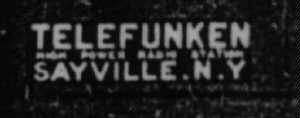
Some of these led to the discovery of high-speed coded messages being transmitted by German spies thru the Telefunken wireless station at Sayville, Long Island!

Other recordings made by Apgar were more pedestrian. He mostly recorded Morse code news bulletins from WHB in Manhattan. Apgar's original wax cylinders are long since lost; but somce samples of his recordings survive. These still exist in yet another aircheck. Apgar made an appearance on station WJZ in New York in 1934. These airchecks of airchecks are owned by the Antique Wireless Association, and a tape copy is in the Library of Congress.
More here: http://telefunken.8k.com/spies.htm

The art of hom-brew aircheks continued Sporadically until 1921 when the Brunswick-Balke-Collender Company and the Victor Talking Machine Company bregan making regular broadcast recordings. Documentation exists for many of these. Sadly nothing survives of these or any of the other experimental recordings thru 1922. Some of their recordings from 1925 are known to exist.

By 1928 a number of big events: presidential speeches, Public safty tests, anniversary broadacasts etc are recorded. Without getting into rediculous details, these include WOR, WJZ, WEAF, WRC, WMAQ CKAC a few NBC network events and some lesser known shortwave stations. Aircheck recording increases in popularity in the late 20s into the early 30's leaving us with recording of figures like Colonel Lindbergh, Grantland Rice, King George V and others.

By 1935 NBC was using acetate discs to record and archive programming for later use. The other big networks jumped on board shortly thereafter.

more here: http://www.midcoast.com/~lizmcl/earlyradio.html

Thursday, July 21, 2005

Aircheck history Part I


We couldnt have airchecks without recording so I am going to give a little extra back story...
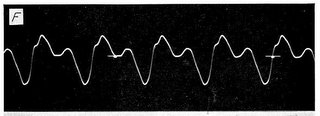
In 1857, Edouard-Leon Scott de Martinville received French patent #17,897/31,470 for the phonautograph. This device made a visual image of sound waves on a cylinder, but did not record reproduceable sound.

1876, Charles Cros deposited a paper on audio recording at the Paris Academy of Sciences titled PROCESS OF RECORDING AND OF REPRODUCING AUDIBLE PHENOMENA. It contained the correct and working process for recording and replaying audio. It is not known if he built a prototype. Later prototypes produced things like this:

1877 - Edison made the first recording of a human voice ona tin cylinder. He may have successfully recorded prior to this on an early paper model derived from his telegraph repeater.

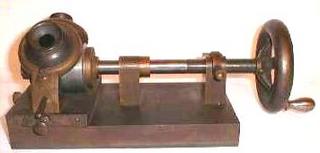
1878 - Frank Lambert developed a talking clock. I should say tried to develop a talking clock. Soft tinfoil was the recording medium of the day and did not produce a lasting copy. Lambert used a lead cylinder in his prototype. Because of this, we can play back this early recording attempt today. Pic of device below...


His device is in the Guinness Book of World Records as the world's oldest playable recording. The recording. It seems to have been recorded at about 85 revs per minute. If you are patient you will hear lambert reading out the hours. The Lambert talking Clock is on display at the National Clock and Watch Museum in Columbia, PA. Audio orginates at tinfoil.com. They are absolutely amazing, please visit their site.
Listen: http://tinfoil.com/lam-clock~.mp3
Visit: http://www.nawcc.org/

Ok, Airchecks tomorrow, I promise.

Wednesday, July 20, 2005

The Drive In Movie Theatre & Radio

The drive-in movie theater was invented in 1933. The sound sucked pretty bad then, and it pretty much continued to suck for about 40 more years. (I'm not making this up. I went to drive-ins as a little kid.) But FM radio didn't exist yet either so the expectations were set pretty low.

When the first drive-in opened in Camden NJ, a company by the name of RCA Victor designed the sound system. They called it "Directional Sound". Using 3 main speakers mounted next to the screen, they tried to blast the volume so that even the cars in the back could hear.

There were 2 major problems with this type of sound system. Since light travels slightly faster than sound, the sound arrived at the back rows late, i.e out of sync with the picture. The second problem was that while everyone in the entire drive-in could hear the sound, so could the neighbors, passing cars, and overhead planes. Some complaints stated that farm animals were disturbed miles away. This system was replaced with the individual window-speakers most movie goers are probably familiar with.

It was in the early 70's that radio sound came into practical use at the drive-in. Although the idea had been kicking around since the 1950's, with some systems even calling for a separate box the patron would purchase and reuse, it was made practical by Cinema Radio, a company started by Fred J. Schwartz after experiencing what he felt was poor sound quality at a drive-in.


The big change since 1950 was that the majority of cars now had radios. By 1970 the number was up to an estimated 97%. The timing was perfect. Normally transmitting a radio signal would require a facility license.  But under part 15 they were allowed to operate without any licensing by the FCC. They passed on licensing these Low Power stations as long as they kept it under 50 milliwatts. [Closed cable FM was also exempt for the same reason.] These broadcasts usually could be received via your car radio, or by a transistor radio which you could borrow from the snack bar. Initially these were AM stations but the policy spread to FM licenses as that became adopted as the standard. FM is what remains in use to this day at most drive-ins. Read more here.

The earliest version of Part 15 goes back to 1938. This was meant to govern devices which emitted incidental radio waves as a means of governing that source of interference. That initial set of rules were adopted in November 1938 and remained unchanged until 1957. It was then that the rules needed retooled as the 15 microvolt uV/m exemption had already been leveraged for purposeful, not incidental use. More here

RELATED DRIVE IN RADIO FIRSTS:

In 1986 FM stereo sound was introduced via FM broadcast at broadcasting is introduced at Shankweiler's in Orefield, PA. This is also America's oldest, continually running Drive in. In 1999 The Boulevard Drive in was the first drive in theater in the world to install digital sound. They broadcast at 89.7 FM in Kansas City. I am told that their fixation on high quality audio has made it superior to that of many indoor theaters.

There is now even a company trying to buy time before, between and after the movies run on the radio signals at the drive-ins! They distribute content via CD-R mailed weekly. It's an interesting niche service. More here.

Tuesday, July 19, 2005

YMCA radio

This is hard to explain: http://www.kymcradio.org/

In 1976 WBCE signed on at 89.7 FM. For reasons I dont know they went dark in 1979 then in 1991 moved to 105.3. This paved the way for KYMC to squeeze another FM into the St. Louis FM radio dial.

This is the only YMCA FCC-licensed radio station in the U.S.

The West County Family YMCA in Chesterfield, MO owns operates KYMC independant of the YMCA HQ. It all started with a group of enthusiastic volunteers in 1977 that convinced the YMCA to give this a shot as a local community program. The FCC granted a license and the station was born as a picayune 10 watter. It has since expanded to 120 watts, broadcasting 24 hours a day with an all-digital studio.

KYMC runs a mix of eclectic local shows paired with a mix of obscure syndicated programs. This ranges from a well-known local goth-rock program (Hypnotic Nightmare) to a syndicated program focusing on topics regarding parenting (The parents Journal) Their local focus has led KYMC Radio to start a Summer Radio Camp for kids ages 8 to 15 in which young DJs actually get to run the show with the help of a seasoned professional.

I have heard that in the late 80's they needed more than a little help, as near by Maryville College ran day to day operations for about a year.

Monday, July 18, 2005

The Easternmost Radio Station in the U.S.

It's not in Texas. It's not in Florida, not even on the Keys. It's not in Puerto Rico either.
It is actually in the town of Christiansted on the island of St. Croix in the U.S. Virgin islands.
http://www.stxjames.com/paradise.htm

WYAC also known as "Paradise 93.5 fm" features the Caribbean's best music 24 hours a day plus a morning talk program called Free Speech with Roger W. Morgan every weekday at 9:00 AM. It focuses on topics concerning the Virgin Islands and more.

If you were looking for a easternmost radio station in the contigious 48 states then my answer would have been over 120 miles off. That station would have been 90.9 FM WJIR. Located on Key West WJIR is a member of the SOS network running primarily satellite fed christian programming. http://www.sosradio.net/mainIndex.html
A mere quarter mile north is the infinitely more interesting WIIS: http://www.radiokeywest.com/

So that's the furthest East... can any reader guess which is the furthest west? South or North?