Showing posts with label WHB. Show all posts

Thursday, February 16, 2012

Nocturnal Nighthawks

The story starts with the Coon-Sanders Original Kansas City Nighthawks.  The orchestra began broadcasting in 1922 on WDAF-AM. At the time they were a share time on 730 AM with WHB-AM. They were broadcast live from the Muehlebach Hotel, which still exists today. More here. The group started in 1919, as the Coon-Sanders Novelty Orchestra.  There's nothing racial about the name, Mr. Coon is Carleton Coon and Sanders is pianist Joe Sanders. They took the name Nighthawks because their program aired late at night an approach they took around the country with them on tour in 1924. They first played in Chicago on KYW-AM. More here.

The group left Kansas City for the first time in 1924 for a three-month engagement in a roadhouse in Chicago. WBBM specialized in local, live programming, including a station promotion called the "Nutty Club." With over a million listeners in the US and Canada wiring, phoning or writing in for membership, it was clear that Program Director Charlie Garland, aka "Colonel Nut," and his crew had something good going.Guy Lombardo and the Royal Canadians, who were named as the official "Nutty Club" orchestra. I'll quote teh St. Petersburg times from 1927...
"...the Nutty Club of WBBM, the Stewart-Warner Air theater known from coast-to-coast for its "Cuckoo Signal" and the other is the orchestra that has made insomnia a famous indoor sport Coon-Sanders Original Kansas City Nighthawks. Under an arrangement just completed this orchestra is to broadcast exclusively over WBBM by remote control from the Blackhawk Grill; Chicago. It will be heard during the three weekly sessions of the Nutty Club, which start at midnight Wednesday, Saturday and Sunday Nights."
They actually played quite regularly on WBBM and were syndicated coast to coast on CBS after 1928. A 1926 news article described them as playing nightly there at 8:00 PM and again from 11:00 PM to Midnight Tuesdays and Thursdays. the band recorded a large number of sides for Victor, and at lease a few furtively for Vocalion. In 1928 Henry Sellinger made them an offer to bring their late night shindig over to WGN-AM. For the next twenty years they performed at the the Blackhawk Restaurant live on that Chicago Tribune radio station. More here.

In 1932 Carelton Coon came down with a jaw infection and died. He was only 38 years old. Joe Sanders tried to keep the band together, but failed. He started his own group and stayed in music until his death in 1965. The band is celebrated annually at the The Coon Sanders Nighthawks Fans' Bash in in Huntington, WV. Why it's not held in Kansas City or Chicago... I have no idea.

Thursday, March 31, 2011

Kansas Engineering Experiment Station

The Engineering Experiment Station of Kansas State Agricultural College is just another part of Kansas State University. Back in In 1917 they were not. Actually they published the following self-description in their monthly bulletin that year:
"The Engineering Experiment Station was established for the purpose of carrying on tests and research work of engineering and manufacturing value to the state of Kansas, and of collecting, preparing and presenting technical information in a form readily available for the use of the various industries within the state. It is the intention to have all the work of this experiment station of direct importance to Kansas."
The Experiment Station still exists today and has actually proliferated. Today Kansas State University owns and operates 18,000 acres of Agricultural Experiment Stations in research centers in Hays, Garden City, Colby, and Parsons Kansas. In a practical sense, this is the academic lab for agribusiness. If you want wheat resistant to wheat rust and glows in the dark... this is where that would happen. Why do I bring this up?  Well they did a little something with early radio.More here.

Professor Andrey Abraham Potter was their assistant professor in mechanical engineering from 1910 to 1913 professor of mechanical engineering in the Kansas State Agricultural College. After that he was the acting dean of their Engineering division and acting director of the engineering experiment station.Because this bulletin was kept so early in the history of radio he very avidly had them include articles on the "radiophone."  It includes some very informative QSL reports.  It lists off the regular broadcasting programs in their district for potential listeners particularly on WDAF-AM, WEAF-AM, WBAP-AM, KLZ-AM, KSD-AM and WHB-AM. Among others. In a 1923 bulletin they published the following:
"To those living in Kansas the service rendered by the broadcasting station of the Kansas City Star, which has been designated by its government license as W. D. A. F., is available afternoons and evenings. The Sweeney Automobile School of Kansas City also renders valuable service from its high powered station W. H. B. The stations at Topeka, Wichita, Emporia, Hutchinson, Salina, Denver, Colo., Lincoln, Neb., Jefferson City, Mo., and the Kansas State Agricultural College supply all parts of the state with information and entertainment adapted to the communities served; while the large stations at Davenport, Iowa; Omaha, Neb.; Chicago, 111.; Pittsburgh, Pa.; Atlanta, Ga.; Detroit, Mich.; Minneapolis, Minn.; St. Louis, Mo.; Schenectady, N. Y., and a number of Texas stations may be heard through most receiving sets in Kansas."
The published information on making cheap receiving sets, and making  and charging batteries to power them. They sent out their own weather reports by telegraph from a station WTG. Sadly the bulletins have little information on this service. Barry Mishkind wrote about a 1923 Department of Commerce list that had WTG broadcasting on 485 meters. There is some confusion about the station because documents self-describe it as "telegraphic." It was not a telegraph office. It just broadcast in Morse Code. Their first experimental callsign was 9YV, based in Manhattan, KS. It was first licensed in 1912 and became WTG in 1922. In 1924 the calls changed to KSAC-AM with a new frequency of 880 kHz. In 1925 they moved to 580 to share time with WIBW-AM. In 1984 the calls changed to KEXT-AM, then finally KKSU later that year.

They are generally thought to have broadcast the first regular weather information in the United States. Their daily weather broadcast in Morse code went out at 9:00 AM. In 1921, physics instructor Eric R. Lyon was running the station. Route56.com has great information on these early years. Today that station comes down to us as 580 KKSU-AM which after 78 years of broadcasting went off air in 2002 allowing WIBW to go full-time. The KKSU staff reorganized and now produce agricultural news programming for other Kansas stations, with now more than 50 affiliates. More here.

Friday, July 22, 2005

Aircheck History Part 2

RADIO DEFEATS AXIS IN WWI!


The earliest surviving recordings of a radio signal are segments of Morse code transmissions recorded 1914 by Charles Apgar, a New Jersey radio ham. He fitted the electrical element of a headphone to a home-made recording head he attatched to an Edison cylinder phonograph. This Rube-Goldberg device allowed him to record radio signals picked up by his receiver on wax cylinders. He made at least a dozen such recordings before 1915.

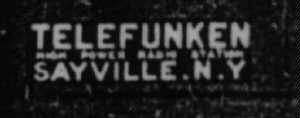
Some of these led to the discovery of high-speed coded messages being transmitted by German spies thru the Telefunken wireless station at Sayville, Long Island!

Other recordings made by Apgar were more pedestrian. He mostly recorded Morse code news bulletins from WHB in Manhattan. Apgar's original wax cylinders are long since lost; but somce samples of his recordings survive. These still exist in yet another aircheck. Apgar made an appearance on station WJZ in New York in 1934. These airchecks of airchecks are owned by the Antique Wireless Association, and a tape copy is in the Library of Congress.
More here: http://telefunken.8k.com/spies.htm

The art of hom-brew aircheks continued Sporadically until 1921 when the Brunswick-Balke-Collender Company and the Victor Talking Machine Company bregan making regular broadcast recordings. Documentation exists for many of these. Sadly nothing survives of these or any of the other experimental recordings thru 1922. Some of their recordings from 1925 are known to exist.

By 1928 a number of big events: presidential speeches, Public safty tests, anniversary broadacasts etc are recorded. Without getting into rediculous details, these include WOR, WJZ, WEAF, WRC, WMAQ CKAC a few NBC network events and some lesser known shortwave stations. Aircheck recording increases in popularity in the late 20s into the early 30's leaving us with recording of figures like Colonel Lindbergh, Grantland Rice, King George V and others.

By 1935 NBC was using acetate discs to record and archive programming for later use. The other big networks jumped on board shortly thereafter.

more here: http://www.midcoast.com/~lizmcl/earlyradio.html