Showing posts with label walkie talkie. Show all posts

Monday, March 28, 2016

Militia Radio

Whether the presence of militias make you feel patriotic or remind you of Isis, you should know there are non-governmental paramilitary groups in all 50-states. Membership is estimated at between 20,000 and 60,000. You may not have seen them, but they are there. More here.

Not only are they there, but they are really into walkie-talkies. As it turns out, there are websites that track this sort of thing. The Militia radio band of choice is MURS Channel 3 ( 151.9400 MHz FM simplex ). The reason is probably because MURS is the longest range VHF radio service that can be used without the need for a radio license. Anything better would require getting a license from the man... and you knwo how they feel about the man.

Below is a more specific list of channels. You might want to try a band scan ans see what you can hear in your own neighborhood. Posse Comitatus could be practicing marching drills in your local park.

  • BAND| CHANNEL |FREQUENCY MHZ| DESCRIPTION
  • === | ======= | ============| ======= ======= =======
  • UHF |HAM U975=| 446.9750 FM | MILITIA HAM SIMPLEX
  • UHF |HAM U025=| 446.0250 FM | PATRIOT HAM SIMPLEX
  • UHF |FRS 3 ===| 462.6125 FM | MILITIA PATRIOT FRS COMMON
  • VHF |MURS 3 ==| 151.9400 FM | MILITIA PATRIOT MURS PRIMARY
  • VHF |HAM 42 ==| 146.4200 FM | PATRIOT HAM SIMPLEX
  • VHF |HAM 485 =| 146.4850 FM | MILITIA HAM SOUTHEASTERN SIMP
  • VHF |HAM 53 ==| 146.5300 FM | PATRIOT MILITIA HAM SIMPLEX
  • VHF |HAM 55 ==| 146.5500 FM | PATRIOT HAM SIMPLEX
  • HF =|HAM 10 M | 028.3000 USB| MILITIA HAM EASTERN
  • HF =|HAM 10 M | 028.3050 USB| PATRIOT HAM NATIONWIDE
  • CB =|CB 3 AM =| 026.9850 AM | MILITIA PATRIOT CB COMMON
  • CB =|CB 3 USB | 026.9850 USB| MILITIA AM USB OR LSB
  • CB =|CB 14 AM | 027.1250 AM | MILITIA CB SOUTHEASTERN LOCAL
  • CB =|CB 32 LSB| 027.3250 LSB| MILITIA CB SSB SOUTHEAST
  • CB =|CB 36 USB| 027.3650 USB| MILITIA PATRIOT CB
  • CB =|CB 37 USB| 027.3750 USB| PATRIOT CB SSB NATIONWIDE

Wednesday, February 11, 2015

The Motorola GMRS network

So this is a thing. If you use high-end walkies-talkies you are probably aware of this top-tier pricing option.Following the relative inaction of the FCCs proposed 2010 rule-making, GMRS (General Mobile Radio Service ) repeaters still require a license as previous.  I've written about walkies-talkies a twice before but this is a unique service worth discussing. It's a walkies-talkie network.

Walkies-talkies can communicate directly, one to one with no intermediary devices or services. If you've ever bought one you know that this is the cheap end of the pool. There are problems with this  typically analog service. Large buildings, hills, and sources of interference can obstruct reception. But most of the walkies-talkies in this group are basically toys.  They operate at low power, literally half a watt. In this application walkies-talkies are often referred to as HTs, for handheld transceiver. While this may work well in an open area, there will be issues indoors. There are a number of solutions to this but many of them require an FCC license. There is a great synopsis of features and spec here.

The typical solution is to increase the power, and use a GMRS repeater. This repeater's antenna can be installed at a high elevation point to mitigate areas of null reception. Some vendors insist at this point that the device is no longer a walkie-talkies but is a "commercial 2 way radio." This is marketing bunkum and should be duly ignored.  However, it's worth noting that many users avoid this scenario because that GMRS repeater requires a license. But there remains another option.

Motorola has carefully patched together what I consider to be the first walkies-talkie radio network. Using "commercial partners" i.e. their distributors, as proxies they have made significant progress building a GMRS subscription model. These resellers/network providers include:  Utah Communications, New York Communications, Triangle Communications, Comtronics, Mohre Electronics, Illinois Communications, Maine Radio, MCE Wireless, Telecom Communications,  and many others.  Instead of buying your own GMRS repeater, and having to maintain your own license you more-or-less just subscribe the theirs. Using TDMA and frequecy allocations they can cram a surprising  number of subscribers onto the same network.

Motola intends to expand the service to become a ubiquitous Nextel-like service. The twist here is that because these all-digital networks are transmitting data over two-way radio, these local monopoly networks may eventually find themselves classified as ISPs. Their own documentation notes a data rate of 9600 bps which is not much, but certainly could be all that's available in some rural areas. Old PSTN dial-up networks offered 300 bps, so it's not unthinkable that this may be inadvertently included in the new ISP-as-a-utility legal concepts.

Monday, July 02, 2012

TETRA and TETRAPOL

Terrestrial Trunked Radio(TETRA) is a type of professional mobile two-way transceiver; aka a walkie-talkie. TETRA is not for little Billy's camping trip. It was specifically designed for use by government agencies and emergency services, ie the military and police. Under TETRA the transmitter uses a block encoder, a convolutional encoder, a re-order interleaver, a scrambler, burst builder, and differential encoder all before the signal is modulated and transmitted. Needless to say it's highly secure, but it can also be configured for group calls. they can communicate via network or like a walkie-talkie. More recently, in the TETRA release 2, it was modified to also provide wide-band high speed data communications.  (Yes that means the internet. )

It is sometimes confused with TETRAPOL. Tetrapol uses Gaussian Minimum Shift Keying (GMSK) modulation instead of the Quadrature Differential Phase Shift Keying (QDPSK) used by TETRA. This is where most people say "huh?" GMSK is a type of digital modulation that uses spectrum efficiently. Efficiently in these case refers to its needed bandwidth.  Other forms of phase shift keying have sidebands that extend outwards from the main carrier and cause interference to other signals. QDPSK is less efficient and uses two encoded BPSK carrier waves. The two carrier waves are out of phase with each other by 180°. So it's highly noise resistant. If that's getting too complicated just remember that TETRAPOL is the one based on an FDMA multiplex using a narrow-band channel.

There are more than a hundred nations using TETRA systems: China, India, Pakistan, Germany, Ireland, Italy, Poland, Sweden, Australia, Mexico, Israel and the UK. (Notice that the USA isn't on that list. The FCC has not officially allocated any frequencies for the use of any TETRA-based standards. TETRA is a European Telecommunications Standards Institute (ETSI) standard. The first version published 1995 and it's fully endorsed by the European Radio Communications Committee (ERC.)  So why don't we have it here?

You might think that maybe the FCC doesn't like open standards, or maybe just not European ones. But that's not the case. Motorola cock-blocked all that technology. Motorola, having invented the walkie-talkie owns a lot of valid US patents.They just refused to license them to the ETSI. More here. They tried to petition the FCC to intervene, but they did nothing since ETSI  has no standing as a broadcaster in the US.

Thursday, October 13, 2005

THE TWO-WAY RADIO

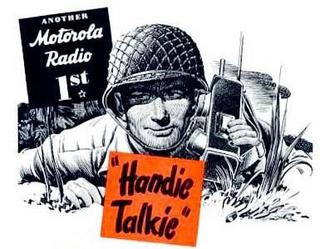
Another Motorola First
(remind me to buy some stock)
Dr. Noble originated the systems planning for the Connecticut State Police radio system and personally supervised every phase of site selection, testing and design detail. Completed in 1940, this was the first two-way state police system to be placed in operation and the first practical two-way FM radio telephone mobile system in the world.
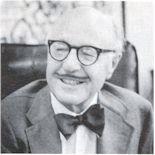
The news of the innovative Connecticut system spread quickly. Paul Galvin, of the Galvin Manufacturing Corp. offered Noble a position as Director of Research in 1940. In 1941 Teh cumbersomely named "Galvin Manufacturing Corp" reincorporated as Motorola.

In 1943, Daniel E. Noble designed the first portable FM two-way radio for the U.S. Army Signal Corps. This radio weighed 35 pounds, had a range of 10 to 20 miles, and became known as a “walkie-talkie.” Initially it was known as the Handie-Talkie radio (sounds oddly like a dirty joke I once heard) The model SCR536 Handie-Talkie AM radio is used during World War II to link soldiers in the field to each other and to a central command. Its immediate millitary value cannot be over exaggerated.

He also had a heavy hand in the beginnings of many great Conecticut stations including WDRC, and WHUS. He also performed a series of experiments with high frequency broadcasting from W1XSL at 40.3 MHz. It was renamed W1XPW in early 1938.

More here: http://www.wdrcobg.com/noble1.html

Daniel E. Noble was born on October 4, 1901, in Naugatuck, Connecticut, received his B.S. degree in engineering from UCONN [go huskies] and attended MIT graduate student.
-There is a great Noble bio on the equally great www.ieee.com

Noble died on 16 February 1980, at the age of 78