Showing posts with label national radio institute. Show all posts

Monday, October 12, 2009

Receiver Principles

This is the last of the NRI booklets It is the largest at 37 pages and it is jam-packed with details on those old obsolete receivers of the 1940s. It is titled "Broadcast all-wave and television super heterodyne receiver principles." It's a little hefty. All the more interesting now in the sunset of analog TV broadcasting to read about what we just lost.

Sections about short-wave, and broadcast are equally interesting.

You can get all 23.6 MB if you
DOWNLOAD HERE

Monday, October 05, 2009

Sound Quality

This is NRI booklet 24FR-1 "Tone Control, Volume Expansion and Noise Limiting Circuits" It is not a sweeping collection of information on various radio circuits. It is actually narrowly focused on sound quality.

Faintness, noise, and tone were the then three available ways to improve the listening experience. This segues nicely into an explanation of human hearing sensitivity. It's a simple fact that human hearing is most sensitive between 500 and 5,000 cycles. This explains the "smiley face" EQ we see preset into stereo amplifiers today. To compensate for the shortcomings of the human ear, response above and below that range proportionately.

It refers to stereo sound as experimental. Instead it breaks down the categories of Brilliance, Bright, and Mellow. These concepts never went away. In the 1980s Sony Walkman's some series offered a button called "Mega-Bass." It was just another circuit that modified the EQ. Here is the same idea presented in 1940.

You can get all 19.6 MB if you
DOWNLOAD HERE

Thursday, September 24, 2009

THE DETECTOR!

This is NRI Booklet 17FR-2, printed in 1939. It's titled "How Detectors Work in Sound and Television Radio receivers." It covers the fundamentals of how radio works, something that almost no laypeople understand at all. It covers concepts like demodulation, rectification, signal separation, diodes, grid-leak condensers, C-Bias Detectors, and some early heterodyne explanation. This is heavy duty and there is a lot of math.

But it's important. You don't have to be an engineer to understand what a crystal detector does. You don't have to be an engineer to understand that no D.C. bias is required to get zero output current when the input voltage is zero... but it helps.

You can get all 17.9 MG if you
DOWNLOAD HERE

Thursday, September 17, 2009

Receiver Circuits

Much like the loudspeaker booklet, 18FR-2 "How Practical Requirements Changed receiver Circuits" has a historical tone. The National radio Institute published this booklet in 1938. This was before all-solid state ADLL circuits replaced analog tuners. But even then a long series of steps had taken place to achieve the relatively high-functioning devices.

I've written about PLL circuits, tuner development and coherers before. In some ways, the development if tuner circuits is the history of radio. This little booklet begins in 1856 with the Maxwell coherer and takes us through to the superheterodyne. It does stop briefly on power supplies a topic most-often ignored.

You can get all 20.6 MB if you
DOWNLOAD HERE

Monday, September 14, 2009

Loudspeakers and How they Operate

This is NRI booklet 26FR-1 "Loudspeakers and How They Work." I have written extensively about speakers in the past. Actually I wrote about them for a straight week back in 2007. This post was almost titled "The Loudspeaker (Pt 6)" Here I can add a nice addendum to that series.

This one is doubly interesting because someone wrote out a question and taped it to the first page:
"What two changes of energy occur in a loud speaker?"
What I found most interesting is that the booklet is old enough that it discusses the action of the horn. We no longer cover this in speaker design because there is essentially no more horn. Yes of course there are acoustic chambers but that old school exponential horn is long gone. This piece is detailed enough to distinguish between straight and curled exponential horns.

You can get all 19.5 MB if you
DOWNLOAD HERE

Thursday, September 10, 2009

Radio Frequency Amplifiers

Radio Frequency Amplifiers for Sound and Television Communication is NRI booklet 16FR-1. It was first printed in 1937. When I first began looking at these booklets I was struck by the term "radiotrician."

It is this booklet where I noticed it was stated inside the cover it actually that the term "radiotrician" is registered to the NRI. No other company can use the term "radiotrician" it's a registered trademark of the no longer extant National Radio Institute. It's a good reason that the term never fell into general use.

This booklet covers resonance curves, amplifer stages, choke coils, tuned transformers, tube capacities, neutodyne circuits, grid supressors, cross-modulation, pentode circuits etc. It's one of the most technically hardcore texts in the series. Best of luck.

You can get all 19.7 MB if you
DOWNLOAD HERE

Friday, September 04, 2009

Volume Controls...

This is 19FR-2 Manual and Automatic Volume Controls in the seemingly endless series of National Radio Institute booklets. Amplification was a novel advance that came with electrification. This manual covers RF voltage controls, AF voltage controls and gain controls.

You Can get all 20.1 MB if you
DOWNLOAD HERE

Thursday, September 03, 2009

Signal Currents...

This is National Radio Institute booklet 20FR-3 "How Signal Currents are Kept in Correct Paths." It's another highly technical 29 page tome. Bizarrely the booklet opens with a plea for healthy eating habits. Then thankfully it segues gently into a long piece on simple condenser filters.

Also covered: shielding, conversion error, grounding, EMI, RFI, magnetic fields, and all manner of hurdles to clear. The technical limbo bar peaks at the superheterodyne receiver as it rightly should.

You can get all 17.7 MG if you
DOWNLOAD HERE

Tuesday, September 01, 2009

R.F. Tuning Circuits

Peak and Band-pass RF Tuning Circuits is Booklet 22FR-2 in that massive National Radio Institute Series of Educational manuals. They are fascinating individually despite the obsolete technology. Collectively they are a history book, more so than any Triassic-period strata.

This one was published in 1938 and concerns exclusively analog tuners. On the last page of the booklet is a Quiz. Would you pass?

1. What does a Sharp peak response curve for an R.F. Amplifier indicate as regards gain and selectivity?

2. Will an R.F. Amplifier which has a sharp peak response curve cause severe attenuation of the higher modulation frequencies?

3. Will amplitude distortion occur when an RF amplifier has a symmetrical double-peak curve?

4. How is a high Q factor obtained for a coil which has a given inductance?

5. Does the Q factor of a practical coil vary with frequency?

...there are more of course.

You can get all 21.69 MB if you
DOWNLOAD HERE

Monday, August 31, 2009

Practical Laboratory Training

This is 5BA-1 "Practical Laboratory Training Course" in the ongoing series of National Radio Institute training booklets. This is a bit older than the other booklets, being the only one that is top bound, and also clearly dated to 1932.

It contains experiments 41 - 50 intimating that there are another nine books in the sub-series out there. This one addresses simple laboratory experiments you can do at home. You can learn how to make a practical low frequency modulated oscillator, a regenerative receiver and

You can get all 15.89 MB if you
DOWNLOAD HERE

Friday, August 28, 2009

NATIONAL RADIO INSTITUTE catalog

The National Radio Institute claimed to have over 8,000 students in 1922. I have no definitive source for their complete catalog over the years, and thus no idea what those first students were studying. But I have concatenated a few lists of available texts from the 1930s and come up with a partial list of over 80. There were certainly more. The list begins below the Download Link.

Today's booklet is PRACTICAL ELECTRONIC CONTROL EQUIPMENT. It's an overview of "modern industrial magic." It covers an array of automated detectors from photoelectric cells to humidity detectors. The latter detector there uses human hair as a sensor...

For all 18.5 obsolete MB

Acoustics of Buildings
Adopting a Service Technique Set Analyzer Method
Aural radio range-beacon.
Antennas, Preselectors, Frequency Converters And Sound Channels For Television Receivers
Automatic Tuning Control Systems
Common radio terms, symbols, abbreviations
Condensers—how they behave in radio circuits.
Direct Stage By Stage Elimination Method of Trouble Shooting Revitalizing Receivers
Essential Circuits in a Television Receiver
Essentials of Indoor and Outdoor Public Address Systems Part 1
Essentials of Indoor and Outdoor Public Address Systems-- Part 2
Essentials of Radio Circuits and the Meters Used To Test Them
Field and Bench Testing of Radio Parts
Geometric and Electronic Optics
How Detectors Work In Sound And Television Radio Receivers
How Electricity Is Generated For Use In Radio Systems
How Resistors Are Used In Radio To Control Current
How Sounds And Scenes Are Converted Into And Reproduced From Electrical Signals
How The A.C. Receiver Gets Its Power
How The Cathode Ray Oscillograph Is Used In Radio Servicing
How To Eliminate Man-Made Interference
How to Install and Service Auto Radios
How To Recognize, Locate and Remedy Internal Receiver Noise and Intermittent Reception
How To Select A Good Radio Receiver
How To Start A Spare Time Radio Business
How to trouble shoot by the point to point voltage and resistance methods
Impedance Matching Networks, Pads and Volume Controls
Impulse Separators, Sweep Circuits and Power Supplies For Television Receivers
Introducing You to Radio
Language of radio-tricians
Light-sensitive cells for control circuits
Low frequency amplifiers for sound and television signals
Meters For Measuring Current The Cathode Ray Oscillograph
Modulating and keying radio transmitters
Photo Audio Amplifiers Power Level
Photoelectric control circuits with relays
Photoelectric Control Circuits With Relays
Pointers on promoting inventions
Power Audio Amplifiers
Practical electronic control equipment
Practical Electronic Control Equipment
Practical R.F. Circuits And Methods Of Controlling Volume
Profits from new inventions.
Radio accounting and records
Radio Accounting and Records
Radio aids to air navigation.
Radio And Electronic Tubes At Work In Typical Circuits
Radio and electronic tubes at work in typical circuits
Radio Formulas And How To Use Them
Radio Frequency Amplifiers For Sound And Television Communication
Radio indicator systems for air navigation
Radio measurements in transmitters
Radio Merchandising
Radio receiver troubles, their cause and remedy
Radio Salesmanship
Radio Transformers and the Principle of Tuning
Recent Developments in Loudspeakers and Tone Controls
Requirements of a Television System
Resistance, Capacity, Inductance And Frequency Measurements
Servicing broadcast and all-wave superheterodynes
Servicing of Television Receivers
Servicing Sound Reproducers and Pickups
Servicing, checking and equalizing audio amplifiers
Special Power Supplies For Radio Equipment
Special power supplies for radio equipment
Superheterodyne receiver principles.
The Language of Radio-Tricians
The Radio Frequency Amplifier And How It Works
The Correct Professional Attitude Installing and Servicing Radios
The Theory of Light
The Use of Arithmetic in Radio
Transmission Lines and Filters
Transmitting antennas and couplers
Tuners and Wave Filters
Tuning Indicators and Automatic Frequency Controls for Radio Receivers
Types of Radio and Electronic Tubes; How They Operate
Use of Arithmetic in radio
Uses For Optics In Electronics And Television
Vacuum tube as an AС. generator in radio-television circuits
Video I.F. Amplifiers, Video Detectors and Automatic Gain Controls
Voltage Measuring Devices and Their Use
Weather and weather dissemination

Thursday, August 27, 2009

Radio Accounting

This is 48RX in the NRI series of unknown size and proportion. It's 29 pages, and laid out similar to the last one. It's an introduction to basic accounting and book-keeping. it's no9t terribly radio-specific. But it's certain that radiotricians as the booklets call them, would need to operate like small businesses.

The full extent of the tailoring is to list expenses as solder, shellac and wire in stead of printer paper, mouse pads, and ergonomic keyboards. On Page 26 it begins a very short dictionary of terms which included the oft-used modern term in radio...

"INSOLVENCY: the inability to pay debts, due frequently to inability to convert assetts into cash. Bankruptcy is an excess of liabilities over assetts making it impossible for the person to meet hsi obligations under any circumstances."

Wednesday, August 26, 2009

Radio Business

Recently I acquired a set of National Radio Institute booklets from the 1930s. I will be scanning them and posting them here one at a time.

I have written about the National Radio Institute before. They were a correspondence school focusing on radio. As with most of this blogs content, it no longer exists. I'll quote myself rather than rehash it all anew.
" In 1968 Mcgraw -Hill purchased it and changed the name to NRI Schools. They ceased operations relatively recently. A Smith bio states they closed up in 1999, a learn-at-home directory gives it as March of 2002."
NRI struggled under Mcgraw Hill. In the 1970s they had the foresight to offer computer courses, but Mcgraw never successfully sold their text books to other schools, their primary business. Their phase-out in the 1990s was inevitable.

This first one "HOW TO START A SPARE TIME RADIO BUSINESS" calls itself a reference book, both terms being fairly dubious at 29 pages long. It's number "22X" in a series of unknown size or duration. It covers sale of radios, advertising and emphasizes repair service contracts. It has been out of print surely since the 1950s and is so obsolete it will never be in print again. No one repairs radios now, many stereos now emphasize their Aux inputs or better yet, USB.

You can download it
HERE

Thursday, January 01, 2009

Be a Radio Technician!

The president of National Radio Institute (NRI) was James E. Smith in 1948. NRI published a huge number of pamphlets and manuals during their existence. This ad was scanned from a western pulp magazine, but they also advertised in Popular Science, and a number of comic books. The scan is very larege, CLICK IMAGE TO SEE FULL IMAGE FOR MORE DETAIL.
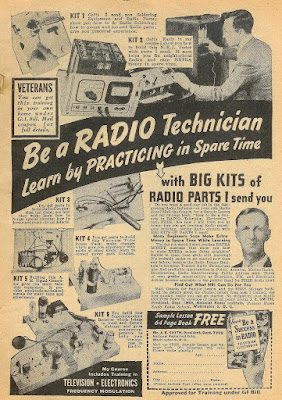
They were located at 16th and N.W. U Street in Washington D.C. NRI was another learn-radio-by-mail schools. Uniquely, they publishing a magazine called the the National Radio News. E.R. Haas was the Editor. Powell Crosley wrote for the mag, Edwin Cohan of CBS, and Joseph Kauffman and members of the FRC (before the FCC). Newsletters confirm the company was operating as early as 1929. The newsleter continued to at least 1951. In 1961 they published a text book "Mathmatics for Electronics and Electricity" then in 1972 another "Servicing Electrical Appliances."

The school was taken more seriously after they formed an alumni association. The Vice President of the United States, Charles Curtis spoke at a 1930 alumni gathering. Their Alumni Association had a formal constitution. It reads like that of most any other, allow me to quote
"The object of the association is to cultivate fraternal relations among the alumni of the National radio Institute, to promote the welfare of each alumnus by interchange of helpful information, to foster the spirit of unity and loyalty to out alma mater, to encourage the institute in it's dissemination of radio knowledge and to promote it's interests..."
The alumni included R.E. Hartzog of KFEC, John Fetzer of WEMC, K.W. Griffith KGJF, Bayard Keough of WJSV, Donnell O'Conner WBT, Polk Perdue of WAPI, Glen Gingles of KGBZ, and an unbelivably long list of others.

General advertisements seem to stop dead in 1973. It was not the end of the school, just an end to direct marketing. In surviving five decades, they did broaden the ciriculum to add more appliance servicing a nd of course television. Their claim of being founded in 1914 seems incredulous, but I easily found ads going back to 1919 so it's possible. In 1968 Mcgraw -Hill purchased it and changed the name to NRI Schools. They ceased operations relatively recently. A Smith bio states they closed up in 1999, a learn-at-home directory gives it as March of 2002.