Showing posts with label cassette. Show all posts

Monday, September 16, 2024

Cassette Magnetic Shield

tapemuzik.de
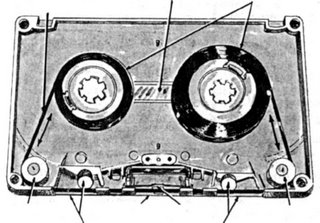
I had to transfer some cassette spools last year into new shells. In the process I noticed that new and old magnetic shields are very different sizes. Most are flat and roughly 25 mm x 12 mm. I've seen a few that had rounded angles on the outside edges but that seemed to just hold it in place inside the shell.

My thesis is that these have maintained roughly the same dimensions, but have decreased in thickness over time. I don't own a gaussmeter (dang) so I can't measure the effectiveness. I'm using a cheap Fowler caliper that uses a 1⁄1000  scale so we are doing this in thousandths like a luthier. I'm also using a mix of blank stock and retail cassettes to see if there's any difference there. This does require in some cases that I destroy the shell to access the magnetic shield. For their sacrifices we give our thanks.
 

artist/title
MFR
Year
size
The James Gang / Passin' thru
AMPEX
1972
 30 thou
J. Geils Band
N/A
1973
28 thou
Rolling stones - Beggars Banquet
N/A 1976
25 thou
Certron HD90
Certron 1977
24 thou
SONY CHF 90
SONY
1978
30 thou
Maxell UD II 100 Maxell 1981 20 thou
Jorma Kaukonen (bootleg)
N/A 1982 28 thou
Memorex Metal IV Maxell 1982 15 thou (cup)
Rich Little - Comedy Edition
 Radioshack 1983 9 thou
Maxell UDS II 90
Maxell 1985
21 thou
JVC dynarec GI-90
JVC 1988
21 thou
FUJI DR-II 90
FUJI 1990
22 thou
Rhino Humpers - Intense
N/A
1994
12 thou
P.U.S.A.
N/A
1996
12 thou
Reach the Sky - s/t
N/A 1997
10 thou
WKDU Live Vol 1
N/A 2013
11 thou
Allston Pudding - localz only
N/A 2014
15 thou
Tankini - dousuk
N/A 2017
12 thou
Heavy Discipline - demo
N/A 2019
10 thou
Strange Mono- bail fund benefit
N/A 2023
21 thou
 Magnetic Responsibility / Naan Cul
N/A 2023
12 thou

I kept commercial tapes to a minimum in the sample because their date of manufacture is harder to narrow down. The few I kept are slot or coffin cases which more definitively date to the 1970s. Hypothetically some may date to the late 60s. Despite the haphazard sample, the trend here is pretty clear. I think the overage thickness has decreased by about 30-40%.  The thinnest shields are either very new or from old novelty recordings. (I'm looking at you Rich Little.)  That Memorex IV from 1982 incorporates the shield into a 5-sided box which is at the very least novel.

While reading up on this I found a Billboard article from 1986. The article quoted Glenn Maenza, the manager of electronic engineering for CBS records and IEEE member. [SOURCE]

"Cassette quality is not affected by elimination of the shields since the shield typically reduced the 60/120 Hz level from -23 to -26 dB, relative to audible threshold levels..."

Maezenza did go on to say that he wasn't advocating removal of the shield. But ever cheaper manufacturing delivered the change anyway. Today new blank tapes (if you can find them) often have no shield at all!  Starting around 2015, I started noticing new blanks from TDK, Sony and Maxell completely lack the shield. Usually you can't tell from the audio alone. But depending on your deck and how close the motor is to your read head, you might pick up more 60 Hz noise with these newer, cheaper tapes. But if you're using cassettes... you're probably not a hard-core audiophile anyway.

**I may expend this article as I find more reliably dated recent blank tape stock.

Monday, July 29, 2024

Mystery Cassette 1973


I bought a few cassettes, mostly for parts. But upon closer inspection this one had clear adhesive tape over the corners. For those of you that don't know, that indicates that something was recorded over the original content. On blank tapes these are tabs which can be snapped off for anti-write protection. I've seen in some cassette designs to use little plastic sliders. There's probably a patent for it. (I note that write-protect is not in the original 1962 patent.)

The first track on Side A matched the expected track sequence which was a disappointment, but then the song ended abruptly mid-verse. The next track was Jimmy Buffet. This was now a mixtape. I spent a little time to ID and log the track listing below. The audio quality was inconsistent tracks to track. Some were dubbed off of LPs or 45s, but others were definitely recorded off the radio. Some sounded like they'd lost a generation of audio to duplication. Then I heard a radio station ID after the Eagles. "Barry Manilow, You're looking hot tonight, This is Stereo 100."  It's not a terribly unique ID but I think we can narrow it down.


Side
Arist
Song Release Year
A
 J. Geils Band  House Party  1973
A
 Jimmy Buffett  Brown Eyed Girl 1983
A
Eagles
Witchy Woman
1972
A
Barry Manilow  You're looking Hot Tonight 1984
A
Sniff & the Tears Drivers Seat
1978
A
Firefall
I Love You
1977
B  J. Geils Band South Side Shuffle
1973
B
 J. Geils Band Hold Your Loving
1973
B
 J. Geils Band Start Over Again 1973
B
 J. Geils Band Give It To Me 1973

That Sniff & the Tears tune is very helpful. They had one single in 1979 in the US and that one flows directly into an Airforce recruiting spot confirming that it too was taped off the radio. But the two songs by Jimmy Buffet and Barry Manilow date this tape to no earlier than late 1983, possibly early 1984.  (Interestingly the B side is all J. Geil's songs but not matching the track listing on the cassette.) 

I found multiple stations who used that "Stereo 100" brand at one time or another but only two which overlap that late 1983 time window. I was able to eliminate some edge cases like Hermosillo XHSD 980 as I would have recognized the pronunciation of "Estéreo 100."  Similarly the accent would give away on TGXA Stereo 100 FM in Mexico.

Top Candidates:

  • WFXD 103.3: An unlikely candidate in their current iteration. But the station began broadcasting in 1974 at 100.1 FM as WUUN broadcasting AC branded as Stereo 100, moving to 103.3 in 1985. So they fit the timeline.

  • WJRZ 100.1 in Manahawkin, NJ. They signed on in 1976 playing top 40 under Jersey Shore Broadcasting. They went thru a series of brands "Stereo 100 WJRZ", "FM 100 WJRZ", and as "HitRadio Power 100 WJRZ" before they flipped to Classic Hits in 1991, then country in 1998.

  • WQXY 100.7 in Baton Rouge, This “Stereo 100" was using the brand as early as 1970 but Airchecks confirm it was still in use in 1973. Today it's WTGE "The Tiger." Airwaves Inc operated the station until it's sale in 1984 to the Oppenheimer Broadcast Group.

  • WVNJ 100.3 in Newark, NJ “Pleasure Radio WVNJ Stereo 100.” They used the format from 1977 through August of 1983, when they changed to WHTZ Z100. The timeline is tight but they hit the window. the ID is s little off but the Easy Listening format is way off for these songs.


Of those four, (and there could be more) I think that WJRZ fits best with the intersection of format, place and time. It's not definitive, but it's a 1,700 watt FM station audible along the Jersey shore from Asbury Park to Atlantic City. Forty years ago some teenager made a mixtape, alternating their favorite singles off WJRZ with the best sides from a 10-year old J. Geil's album they probably stole from their dad.

Monday, May 13, 2024

The Telex Cordless Tape Eraser


Res ipsa loquitur, the thing speaks for itself.  As you'd imagine, a cordless cassette tape eraser is just some permanent magnets, and it is so. In my lab, my tape eraser of choice is an electromagnetic model. The brand name of mine "Magneraser." But this Telex cost me a whole $5 at a thrift store so I thought I could do a little comparison. Thankfully one of the fine folks over at Tapeheads.net already dissected one, saving me some time. [LINK]

The verbiage on the side of the box reads as follows:

"Erases standard & micro/mini cassette. For use in the home-office-on the road. — No outside power or batteries required. Can operate practically forever with built in alnico magnet which produces a strong demagnetizing field. Particularly useful with dictation systems which allow erasure of sensitive recorded material with minimal effort."

So I read up on those powerful "alnico magnets." Alnico is a family of iron alloys which, in addition to iron are composed primarily of aluminum, nickel, and cobalt, hence the acronym al-ni-co. The development of alnico began in 1931. Metallurgist Prof. Tokushichi Mishima in Japan discovered that an alloy of iron, nickel, and aluminum had double the coercivity of steel magnets. Before you ask, he does have the patents to prove it. [LINK] Mishima is on the Japan patent office top 10 inventors webpage. [LINK] He had quite a storied career. Born in 1893 in Empire of Japan, Mishima graduated from Tokyo Imperial University and spent his entire career as a metallurgist, eventually returning to Tokyo Imperial University as a professor. He died in 1975. Magnets are cool.

As you'd expect, the first thing I wanted to know is how old this device actually is. The first and only catalog listing I found was in the ICIA Directory of 1999. But the tech is much older. In 1999 you could buy this bulk eraser individually for $20 or a case of 12 for $216. The catalog number isn't on their website anymore of course. Telex is part of the Bosch Communications these days. Founded in 1936, they got bought by Memorex in 1988, got spun off in 1989 and then merged with Electro-voice in 1998. Bosch only bought them in 2006. Telex was in the audio equipment market from the get-go so very little of that corporate history narrows the window down. This eraser could have been made in the mid 1930s, except that the cassette wasn't invented until 1962. But sure enough, the bottom of the box reads "MFG. FOR TELEX COMMUNICATIONS, INC. MINNEAPOLIS, MN. U.S.A.  Based on the company name, and the catalog, this device was probably made in 1998 or 1999.

How well does it erase?  It does a better job than I expected, the results are not as different as I expected between the Telex and the Magneraser. With the Magneraser I get long audible segments interspersed with areas of total loss. The Telex seems to have less of those exaggerated peaks and valleys, though it didn't erase everything by any stretch. Thinking back, the late 90s were the end of the CD/Tape format war. [SOURCE] CDs were now 90% of the market. The CDs had won so cassette electronics were headed to the budget bin. So this wasn't limited to ancillary devices like this Telex. Almost all the tape player erase functions after the year 2000 seem to use permanent magnets. To make cheaper gadgets we got cheaper components. Res ipsa loquitur, the thing speaks for itself.

Sunday, December 03, 2023

Some Thoughts on Cassettes


Cassettes have always sounded a bit crap.  CDs can flawlessly reproduce the entire range of human hearing, from about 20 hertz all the way up to 20 kHz. Cassettes roll off everything below about 40 Hz and attenuate everything above about 10 kHz.  The tapes themselves were not always manufactured well. They're notorious for hiss, noise, bleed through, warble, whistle, distortion and a few types of oscillating fade that I don't think even have names. More here and here.

Then the tapes break. Despite the frequent references to their durability I found that both heat and cold cause damage to the audio, that the wheels do jam, the leader tape breaks, the felt pads fall off... Nothing lasts forever. Even if you transplant it into a shiny new shell eventually the coating starts leaving crud on the playback head, or it starts de-laminating or sticking to itself. Yeah you can replace the pads too see Tapeheadcity.com or 8trackavenue.com for supplies. But once the tape itself is wrecked there is no going back. It's as destructive as scratches on records and CDs.

Most articles say that there are four kinds of cassette tape. But they are  more like categories and there are actually 5. Some categories are "mixed" and in truth, every manufacturer: BASF, AMPEX, Maxell, TDK, Sony, Memorex all have some uniqueness to their manufacturing process and coating formulas. Back in 1981 Audio magazine published an article All That Data: Tape Deck Frequency Response and Headroom, one of the more readable articles on the topic. You can read it here [LINK]

  • Type 0 - Non-standard
  • Type I - Ferro tape
  • Type II - Chrome tape or a cobalt doped
  • Type III - Dual layer ferro-chrome 
  • Type IV - Metal

What it all boils down to is that every tape formulation was a compromise between dynamic range, noise, frequency response, distortion and the tapes physical ability to retain magnetic data. If your design favors the treble, you probably lost something else in trade. I favor Type III as the 'best" but that's probably due to the decks I've used, the music I typically listen to or some other non-empirical personal bias.

Then to compound that problem most cassette players are also a bit crap. All the late era ones were budget brand plastic trash, they squeak, the belts fell apart after a few years and there's a reason they all ended up at Goodwill. Good cassette players are rare, and new good cassette players are quite pricey. I'm looking at you We Are Rewind.  Despite that I have a few. My main cassette deck is a Panasonic RQ-2104. It was made in 1989, and is still on the original belts somehow. It's got one speaker and old duct tape stock to the door I can't get off. I also have a Marantz PMD 221 that needs lube and new belts very badly, but it's VU meter is super cool.  I also have a project deck I got at a flea market. It's a Rolls RS72CD dual cassette deck and It needs multiple kinds of TLC... but it's rack-mountable and that's irrefutably cool. Anyway, the state of the latter two is the reason the Panasonic is my primary deck today.

So why the hell after all that am I still buying tapes?

1. Demo tapes: Many demo tapes have never been released on any other format. It's something true of many formats: 78s, CDs, 45s, 10-inch records, 7-inch records, 8-tracks. Sometimes there's only one release of that thing.

2. Affordability: I can still buy tapes on the cheap. LPs are back in and prices way up, 78s are over-fetishized, and 8-tracks are mostly disco. But tapes are a cost-effective impulse buy. Is the Lyres "Nobody But the Lyres" tape any good?  Yes it is, and it was totally worth 5 bucks and that's a really specific way to try new things that hasn't been possible since CDs filled up miles of used bins.

3. Shoddyness: This is the flip side of affordability. Yes I might have to open the shell and splice that tape. But it might also be moldy, or shedding so hard that it needs to go in the trash. That's OK since I only spent a fiver.

4. Cultishness: The cassette cult hasn't driven up prices like the LP cult. Some more rare objects cost more as always. I saw a used Minutemen tape for $25 at a flea market. But generally used tapes are under 10 buckeroos USD. New tapes seem to be around $15.  

5. Bootlegs, oddities and Mixtapes: Damn these are fun. I buy home recordings, and bootleg live shows when I bump into them. Mixtapes are frequently half-finished for some reason but I found a break-dance mix, a reggae mix, dozens of bootlegs and more recently two utterly inexplicable compilations of professional wrestling promos. [LINK] Just as in cities with cheap real estate, cheap audio formats also attracts the art students, punks and weirdos.

I had thrown out all but my irreplaceable tapes some 20 years ago. The more you move, the more you debate how much you really want to keep things. So the tapes went. Then this year a compadre at the Slingshot Collective sent me a few Plastic Island comps. The year prior, I had discovered the Panasonic tape player in an old band practice space. It was moldering under a pile of microphone cables and a mouse nest. After a lot of clean up, they all made beautiful noise together.

Sunday, September 10, 2023

K-TEL Archeology

K-Tel is still in business today. But their music footprint is mostly limited to licensing songs for film and television now. Not that they were always in the business of cheap comps. K-Tel was selling Teflon pans back in 1962. Their first compilation album didn't come until 1966. That gem was a collection of 25 country songs entitled "25 Country Hits".  I should point out that at that time, compilation albums were still a brand new thing. Prior to about 1952 all commercial releases were singles, 78s, 45s and even cylinders.  (I am going to collate a post on that topic at come point.) 

But that chintzy comp sold 180,00 copies back in. That proved the market viable and opened up the floodgates to a river of drivel. I like most audio enthusiasts mostly disdain most various artists comps, especially "hits" comps. But Phillip Kives was able to license those singles for pennies, so he was raking in the cash. The record labels were all-in as well, to them it was just a new way to monetize their dusty back catalogs.


Anyway, the compilations let to K-Tel amassing the rights to a whole library of songs they eventually licensed to Apple. They're mostly out of the comp business but if you check discogs, [LINK] you can see that they've mostly left the physical media market, but not entirely. 2023 has been mostly kids compilations released in AAC on iTunes. But even last year there were still single artist, "hits" comps Percy Sledge, Chubby Checker, Sam & Dave, The Surfaris... etc all digital of course. The last CD comps were some 2xCD techno comps in 2017.

That back story makes this K-Tel catalog an interesting artifact. K-Tel sold their comps on bad TV adverts at night, but they also spent a lot of their music marketing at Point-of-sale locations. You probably saw them at truck stops, and car washes back in the 1970s and 1980s. That's very consistent with printing a tiny catalog right on the J-card of the cassette, something I haven't seen in decades.


Friday, August 26, 2011

GEN SBD AUD FM

That last checkbox is about radio and the rest really is not. This is more about audio than radio but it's pertinent because the art of the analog bootleg is being lost. Old tapes are sometimes labeled and sometimes not, the same way that  ID3 tags are sometimes filled in, and sometimes not. But because it does not appear to be consistently explained elsewhere, today I will detail the most crucial abbreviations I commonly see on analog bootleg cassettes.
  • SBD: A (SBD) labeled recording is a tape recorded directly from the outputs of the soundboard at a show.  These are usually the best that can be found as ancillary noise (ex. crowd noise) is as low as possible. These sometimes later find legitimate release.
  • AUD: A tape labeled (AUD)  is recorded from the audience at a venue. These may also be noted as Front of Board (FOB) which is just am observation of improved vantage. the sound could still be good or bad. Modern recording devices do a better job of noise cancelling than the old analog ones. generally I'm not interested in an AUD tape unless it's a band I am obsessed with.
  • FM: Radio Recordings made off of the radio are usually designated FM. With a good tuner, FM recordings can actually sound really clear. These are often even in true stereo, which many AUD recordings are not. But the downside is that some radio stations roll off their high frequencies, and the dynamic range is compressed. It can make the sound unnatural. This varies by format, and over time. The trend has been toward greater and greater compression. In modern FM bootlegs, the dynamic range can be severely compressed to the point of sounding distorted. These are undesirable, but so are those stations. There are AM bootleg recordings out there, but all the ones I have seen are recorded to acetates due to the changes in AM programming over time.
  • GEN:  This designated which generation the recording belongs in . The master recording is #1. You will almost never find these as there is only one of them by definition. A second generation copy is the best that can be found typically. Because if digital recording, now all bootlegs can be identical to the original since dubbing is now lossless. If the master is compressed to MP3 from an original in a lossless format like FLAC, then effectively it is diminished to a 2nd generation copy. Though, analog dubbing was often much worse.

Tuesday, July 19, 2011

The Weight of Media

Having recently moved and had to move my audio library I happened to notice it's really heavy. Books are heavy and records are heavy.  Cassettes are light and CDs seem light until you're stacking boxes of hundreds of them. 78s are heavy, but steel-core acetates are heaviest. So I have been thinking about large-scale digitization, and the cloud since I closed the door behind me. The cloud may have it's downside, but it'll never give you a hernia. (I am taking recommendations.)

So to that point I have begun to work out the weights of various audio media.  I have begun with a list of mostly media I already have, and I've added in a few additional sizes and types which I presently do not. rather than calculate these in some very precise minor unit I'm using a postal scale to provide the weights in units that we would all be more familiar with. (Please excuse the awkward columns)

MEDIA TYPE                                             WEIGHT
10.5 inch open reel tape, 1/4 inch and box =   33 ounces
7 inch reel-to-reel tape (1/4 inch) with box =   11 ounces
5 inch reel-to-reel tape (1/4 inch) with box =   6 ounces
Fidelipac Tape (A size)  =                               4.5 ounces
Cassette and case =                                       2 ounces
DAT with case =                                            1.5 ounces
CD in jewel case =                                         4 ounces
78 with sleeve =                                             8 ounces
Edison Diamond disc =                                  10 ounces
Edison cylinder with tube =                             6 ounces
LP with sleeve =                                             6.5 ounces
LP with gate-fold sleeve =                               7 ounces
45 with sleeve =                                              2 ounces
6.5-inch paper core acetate disc with sleeve = 1.5 ounces
6.5-inch metal core acetate disc with sleeve =  17 ounces
10-inch paper core acetate disc with sleeve =  2.5 ounces
10-inch metal core acetate disc with sleeve =   26 ounces
12-inch metal core acetate disc with sleeve =   31.5 ounces
16-inch metal core acetate disc with sleeve =   42 ounces

*scale image from PSDS images by permission.

Thursday, June 02, 2011

Clean Your Heads

Radio Shack sold head cleaning kits for everything, even things that probably didn't need it like the 5¼ floppy drive head cleaning kit for the TRS-80. They made them for VHS, 8-Tracks, cassettes, mini DV, reel-to-reel and floppy discs of all sizes. These days they still make the cleaner for mini-DV but the rest are discontinued. Head cleaning is a task long practiced in radio-land.

Since the advent of optical devices we seem to have forgotten that media playback used to require maintainence. Kits come in two basic types, both use denatured isopropyl alcohol to clean but one has a little hand hand-scrubber and the other a scrubber built into playback device that will contact the head. There are a number of tape cleaning kits still made today by Epson, Maxell, Chemtronics, Sony, Phillips, Panasonic, Cannon, JVC and others.

Personally I've always preferred a Q-tip. They're cheap, plentiful and you can buy the ones on long wooden sticks so they can reach everything. If you take this as a reminder to clean your heads, do recall that there will be up to three of them, write, erase and playback. Don't skip any, and do remember to blow out the dust with canned air before you begin.

Thursday, April 06, 2006

The Humble Cassette

Radio hated cassettes. If new music arrived on cassette, that was it.s death knell. Cassettes sounded like crap and wore out faster than vinyl. For the most part Radio stuck to vinyl until CDs came around. So why did we have tape decks at all? They were for air-check tapes.
Magnetic tape is basically rust particles (ferrous oxide, FeO) painted/glued onto a polyvinyl composite backing. They have used vinyl, celluloid, nylon and all manner of backing. Nothing lasts forever. There were four primary backing types; each with its own failing:

1. Paper (which becomes acidic),
2. Acetate (which becomes brittle),
3. Polyester (which may become sticky) and
4. PVC & plastics (which becomes brittle and/or sticky)
It was initially introduced by Philips in 1963 under the brand name "Compact Cassette". It was not the first magnetic tape cartridge at that time, but due to their marketing plan it quickly became dominant. Sony pressured the crap out of them to license it for free. It went on to become a popular and most importantly re-recordable, alternative to the LP.
After the debut of the Sony walkman in 1981 , its popularity grew even further with cassette sales finally overtaking those of LPs. Prior to that development Viny had remained in the lead due to the greater sales of singles.
It's a common assumption that early wire recorders "evolved" into tape recorders. On the contrary, tape, wire, and disk magnetic recorders were invented virtually simultaneously. These various formats were developed and promoted by competing companies. After WWII wire recorders died off, and magnetic tape took off. I'll write these up some other time.


Magnetic sound recording tape was first developed by Valdemar Poulsen in the 1890s. He used a solid band of magnetically "hard" steel, and this type of tape continued to be used through the end of the 1930s by some manufacturers.  The approach more familiar to us was to use a non-magnetizable carrier such as plastic, coated with "FeO" The German company I. G. Farben improved such coated tapes and introduced them for use with the AEG Magnetophon in the 1930s. 

Prior to this in 1888, American scientist Oberlin Smith published an article in the magazine Electrical World. In his article Smith discussed the possibility of permanent magnetic impressions for recording sound and suggested, as a medium, cotton or silk thread, in which steel dust was suspended. He did not create a prototype, so the credit goes to the Germans. Which is fine since they lost WWII and we stole all their scientists. Following World War II, the I. G. Farben process was transferred to England and the United States and further refined. Today cassettes are experiencing a minor re-birth as mix-tape nostalgia sets in.