Showing posts with label Valdemar Poulsen. Show all posts

Friday, November 20, 2015

Re-engineering a Wire Recording

I am posting this because it's deeply impressive from an engineering standpoint. The goal of their experiment was to learn about magnetic recording heads by building and testing a wire recorder. This requires understanding the relationship between recording current and playback voltage, the number of turns used in the coil for the recording head, and the speed of the moving wire among other variables.

Unfortunately the experiment recommends starting with vintage recording wire. This will be difficult to find, probably be oxidized, and more than likely already contain a recording. So the experiment will in destroy a 60-year old recording. Please don't do that.

Any steel or iron wire will certainly work. Aluminum, copper and brass wire will not work, it needs to be a ferrous metal. Also avoid Austenitic Stainless steel as that is by definition non-magnetic. Avoid wound wire, which owing to it's irregular surface, will produce inconsistent contact with the recording head and therefore low fidelity. 

The original wire Postwar wire was  was very thin.  Poulsen's early model, the Telegraphone (1898) used .01-inch (0.25 mm) wire, but later models used a diameter of .004 to .006 in (0.10 to 0.15 mm) which was standard into the mid 1940s. You can find it online as a jewelry making supply.

Wednesday, October 02, 2013

The Arlington Radio Towers

As garish as it may seem, there were once wireless towers standing over Arlington National Cemetery.  The part of the cemetery pictures is marked as the "World War Section" which means both that it precedes WWII and that the image is facing South West. The towers were on the outskirts of Ft. Meyer, which was originally established in the Civil war as Fort Whipple. But it became unique. In 1870, The National Weather Service was founded there by General Albert J. Myer. The first flight of a military aircraft took place there. This was a military base where science happened.

It's just outside the fence of a DOD facility. There is a marker commemorating them which is a bit hard to find. It reads as follows:
"Three radio towers similar to the Eiffel tower were erected here in 1913. One stood 600 feet, and the other two 450 feet above the 200-foot elevation of the site. The word "radio" was first used instead of "wireless" in the name of this naval communications facility.  The first trans-Atlantic voice communication  was made between this station and the Eiffel tower in 1915. The nation set its clocks by the Arlington Radio time signal and listened for its broadcast weather reports. The towers were dismantled in 1941, as a menace to aircraft approaching the new Washington National Airport."
Some sources refer to the three towers as "the three sisters." Some even place their construction as early as 1911. It's difficult to trace it back that far.  It its reputed to be the first such time signal broadcast. In 1915, Creighton University in Omaha, NE built a wireless station just to receive it's time signals. That same year Western Electric used the towers to carry out that aforementioned experimental broadcast received in Paris, 3,900 miles away.  Most of that distance was over water so they tired it in the opposite direction and were received at Mare Island in California, 2,400 miles away. More here and here.

The Navy began experimenting with wireless as early as 1904. By 1909 the Navy had a 1,000 watt transmitter,and were itching for a big tower to plug into it. Given construction dates vary anywhere between 1911 and 1914. At least some of the towers were probably viable in 1912, as it was already in use by March of 1913. Using the call letters NAA, it broadcast a time signal on 113 kHz throughout the 1920s. In 1922 I found a listing for it broadcasting weather bulletins on 5950 meters, and marine forecasts on 2650 meters.  All this with a few hundred watts and a Poulsen arc.The anniversary of their construction was celebrated quietly this past February. More here.

The towers may not be entirely destroyed. They were in stead moved to Greenbury Point  at Annapolis Naval Acadamy in Maryland where they remained in use until the 1990s.  In 1999 three remaining towers (which may not be the original three) were ceded to Anne Arundel County for telecommunications. Last year the support buildings including and the transmitter bunker were demolished. There may or may not be anything left. More here.

Wednesday, November 21, 2012

Oberlin Smith

I wanted to get back to Oberlin Smith. In 1888, Oberlin Smith published an article discussing the possibility of magnetically recorded sound and suggested, as a medium, cotton or silk thread, in which steel dust was suspended. This is an eerily accurate description of later German wire recorders, so his tale bears consideration.

His Electrical World magazine article favored silk or cotton thread over steel wire because he didn't think it would be possible "that it would divide itself up properly into a number of short magnets."  What he probably meant by that that in being contiguous and ferrous, it couldn't magnetize it in small enough physical increments to make for practical playback. he thought that the tiny currents would cancel each other out. He was wrong, but his idea of coating metal powder on a flexible base is how audio tapes, video tapes, and floppy discs are all made. (Sort of odd we still make all of them isn't it?)

Smith did have the sense to patent the idea in September, 1878, but he never built a prototype. So his article only discussed a theory.  While he never made a working model, sources claim he did fabricate a bit of his preferred recording media. He produced a cotton thread which he embedded with steel dust or possibly short clippings of fine wire. It is highly likely he at least attempted to record and playback something prior to publishing but it's impossible to be certain. The IEE raises a similar question in their Smith biography here.
noting that most of his records were later accidentally destroyed.

Smith was born in Cincinnati in 1840, and ran a machine shop in Bridgeton New Jersey with his partner J. B. Webb. Some sources list it's start in 1863, others in 1877. Smith and Webb specialized in making large sheet metal presses to be used by factories to stamp out small objects. But he tinkered too. He patented looms, locks, an automatic garage door opener, an automatic record changers, and other doodads. It was only after his 1880 visit to Thomas Edison’s New Jersey laboratory he began thinking about audio. Edison had recently invented both the phonograph and the microphone.When Smith returned to his shop he began his magnetic experiments.

In the 1898 Valdemar Poulsen proved that Oberlin Smith was right about magnetic recording but wrong about steel wire. Poulsen  gave a public demonstration at the Paris Exposition of 1900. Smith became the President of the American Society of Mechanical Engineers in 1899. Fritz Pfleumer followed that up with the first magnetic tape recorder in 1928 fulfilling an Smith's idea, 2 years after his death. More here.

Monday, August 13, 2012

Duddell's singing voice

The first AM transmitters were arc transmitters aka arc converters. The first model to generate a continuous wave (CW) were invented separately by Elihu Thomson and William Du Bois Duddell. These models generate a carrier wave by continuously shocking a tuned circuit. This was the best we had until vacuum tube technology appeared on the scene.

Previous to these models transmitters were all spark gap transmitters. These just emitted a series of short arcs hence the term. These sparks were noisy and emitted broadband noise. Real improvements to these transmitters just timed the sparks so instead of emitted a series of damped waves, they edged closer to transmitting a continuous wave. This is what Marconi was using from about 1895 forward. He was still using them in 1901 for his public transatlantic experiments even when there was superior technology available.

Elihu Thomson had beat the hell out of that spark gap idea by 1892 (patent 500630). He discovered that a carbon arc with a tuned circuit would "sing" i.e. emit audio frequencies as well as radio frequencies. This is only a year after Tesla's invention HF coupled oscillatory circuit (patent 454622) in 1891. Tesla's was for arc lights, but it's actually closely related. Thomson's work also extended into arc lighting. This is the transmitter Reginald Fessenden used in his experiments.

It's worth noting that one of the reasons that it is believed that Fessenden may have broadcast voice and even music is that this arc converter couldn't be stopped and started (make/break) fast enough for practical Morse code. (This is widely debated) But it had other more serious problems. The intensity was variable as was the frequency. Fessenden made numerous improvements of his own mostly between 1900 and 1903. after that he moved onto rotating spark-gap transmitters that were generally inferior concepts.

But before Fessenden and after Thompson is where we squeeze in William D. Duddell. e was a a British physicist and electrical engineer. Like Thompson and Tesla he was working on arc lighting. In 1897 he invented an Oscillograph sensitive enough to see the shape of a wave with a frequency of up to 100 Hz. Tools matter. It was the first time we could see AC waveforms. In 1899 he discovered that arc lamps could emit frequencies of up to 1 MHz. His own oscilloscope couldn't quantify that, nor could any until after 1920. Around 1900 he invented an arc transmitter based around a carbon arc (like Thompson) but with a shunt to a resonant tuned circuit. This cancelled out the resistance of the RLC circuit. RLC stands for  Resistor, Inductor, and a Capacitor. [Engineers use the character "L" for inductance, in honor of the physicist Heinrich Lenz. But also because we are poor typists. ]  More here.

Duddell's Singing Arc Transmitter was only able to emit waves at about up to 15,000 Hz. Most of it's output was still audible sound. He had doubts that it could emit RF at all. He played "God Save The Queen" at a demonstration in 1901. This was the device that Valdemar Poulsen began improving up on in 1903 (patent 789449), and commercially feasible in 1908. The Poulsen arc transmitted continued to be used until about 1920. More here.

Friday, August 10, 2012

Valdemar: Great Dane

Valdemar Poulsen is chronically under-rated by history. He was Danish, which is probably part of the problem. Popular radio history is very anglo-centric. We Americans carve out exceptions for Marconi, Hertz and Tesla, but little more. So this leaves Valdemar Poulsen on an island so to speak. But he was indisputably brilliant and far ahead of his time. In 1902 (30 years before Edwin H. Armstrong) Poulsen invented FM. In September of 1902 he patented an RF arc oscillator that used FM. He wasn't the first, that was Cornelius Ehret, but that's beside the point. Ahead is ahead whether it's 30 years or 30 minutes.

Here's the difference: while Ehret imagined an FM system and patented an FM system, he failed to make a working prototype. Poulsen succeeded where Ehret failed. He imagined and patented a working model. If that's not impressive enough, he also invented magnetic recording. So... why don't you know who this guy is? More here.

He was a poor student, and was particularly bad with mathematics. He family pushed him into medical school and he didn't do so well there either. He found work at the Copenhagen Telephone Company where he had time to experiment. He may or may not have read Oberlin Smiths Electrical World article on theoretical Magnetic recording. But his world was along those lines. Oberlin thought wire recording was impractical and was thinking more aline the line of a threat embedded with ferrous particles. Smith turned out to be right in the long run. But Poulsen managed to get it to work with wire, a battery, a magnet and some telephone parts. On 1st December 1898, he filed a patent in Denmark for the Telegraphone, the first magnetic recording device in history. In a variation of the wire method he also patented a 4.5 inch diameter steel disk with an embossed magnetic recording and playback was achieved by spinning the disc... like a hard drive.

In 1908 he developed an arc converter that we now call the Poulsen Arc Transmitter.  It was capable of transmitting at frequencies up to 100 kHz. This was widely used in early experimental radio before the rise of the vacuum tube. It was a huge improve ment on Duddell's Singing Arc Transmitter which only could achieve 10kHz. By 1920 some Poulsen Arc transmitters were operating as high as 1000kW!

He died on 23 July 1942. He was 73 years old. Germany had fully occupied Denmark by 1940, but they allowed the Danish government to function until 1943. So Poulsen never saw Denmark liberated, but he never saw it dominated either.

Thursday, April 06, 2006

The Humble Cassette

Radio hated cassettes. If new music arrived on cassette, that was it.s death knell. Cassettes sounded like crap and wore out faster than vinyl. For the most part Radio stuck to vinyl until CDs came around. So why did we have tape decks at all? They were for air-check tapes.
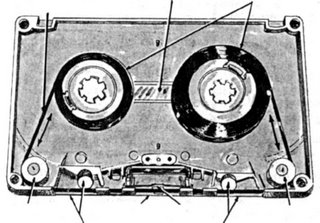
Magnetic tape is basically rust particles (ferrous oxide, FeO) painted/glued onto a polyvinyl composite backing. They have used vinyl, celluloid, nylon and all manner of backing. Nothing lasts forever. There were four primary backing types; each with its own failing:

1. Paper (which becomes acidic),
2. Acetate (which becomes brittle),
3. Polyester (which may become sticky) and
4. PVC & plastics (which becomes brittle and/or sticky)
It was initially introduced by Philips in 1963 under the brand name "Compact Cassette". It was not the first magnetic tape cartridge at that time, but due to their marketing plan it quickly became dominant. Sony pressured the crap out of them to license it for free. It went on to become a popular and most importantly re-recordable, alternative to the LP.

After the debut of the Sony walkman in 1981 , its popularity grew even further with cassette sales finally overtaking those of LPs. Prior to that development Viny had remained in the lead due to the greater sales of singles.
It's a common assumption that early wire recorders "evolved" into tape recorders. On the contrary, tape, wire, and disk magnetic recorders were invented virtually simultaneously. These various formats were developed and promoted by competing companies. After WWII wire recorders died off, and magnetic tape took off. I'll write these up some other time.


Magnetic sound recording tape was first developed by Valdemar Poulsen in the 1890s. He used a solid band of magnetically "hard" steel, and this type of tape continued to be used through the end of the 1930s by some manufacturers.  The approach more familiar to us was to use a non-magnetizable carrier such as plastic, coated with "FeO" The German company I. G. Farben improved such coated tapes and introduced them for use with the AEG Magnetophon in the 1930s. 

Prior to this in 1888, American scientist Oberlin Smith published an article in the magazine Electrical World. In his article Smith discussed the possibility of permanent magnetic impressions for recording sound and suggested, as a medium, cotton or silk thread, in which steel dust was suspended. He did not create a prototype, so the credit goes to the Germans. Which is fine since they lost WWII and we stole all their scientists. Following World War II, the I. G. Farben process was transferred to England and the United States and further refined. Today cassettes are experiencing a minor re-birth as mix-tape nostalgia sets in.