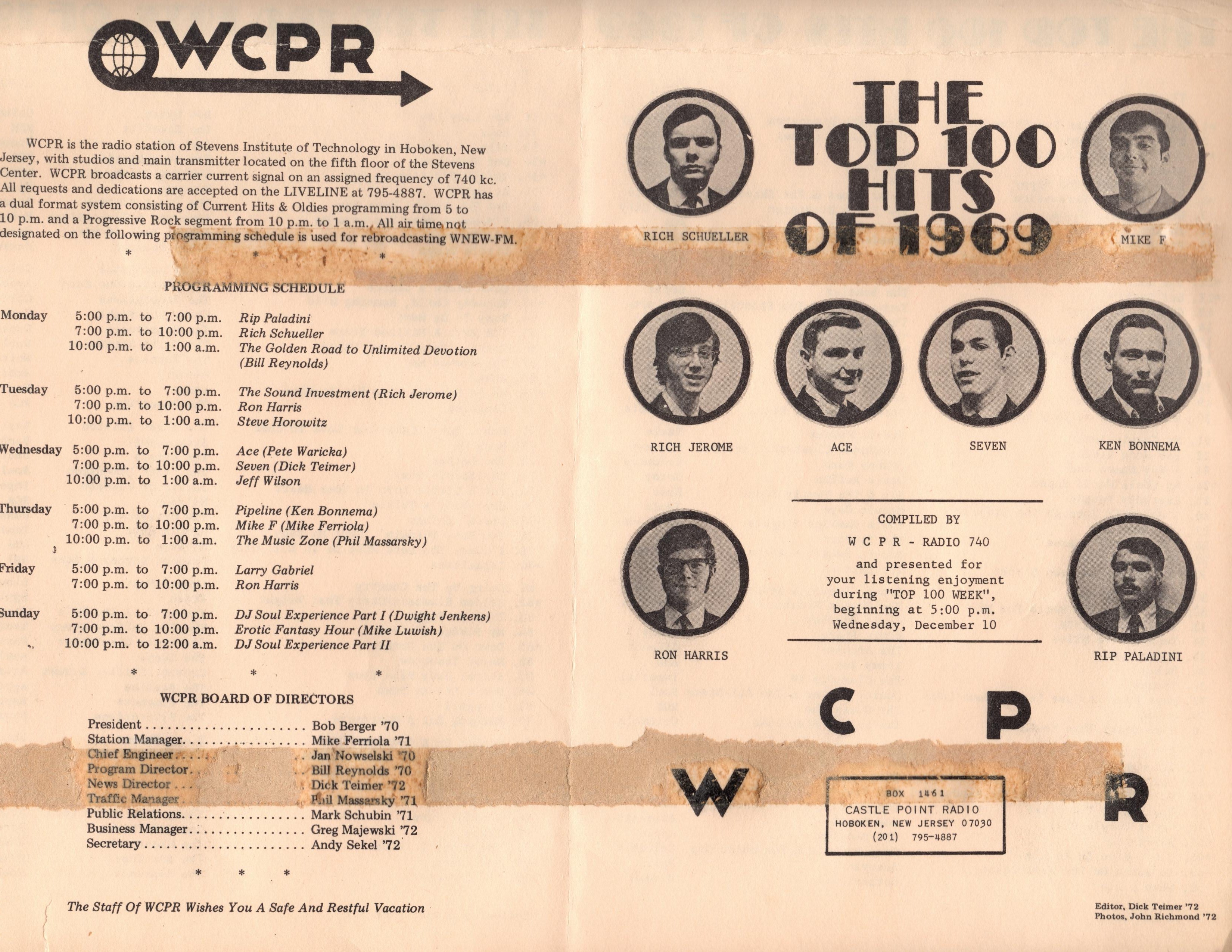
There have been a lot of different WCPRs over the years. Today there are three: 1450 WCPR-AM in Coamo, PR which first signed on in 1967, also 97.9 WCPR-FM in D'Iberville, MS which signed on in 1992 and then my favorite: 740 WCPR the college radio station of Stevens' Institute of Technology. My research indicates that it was founded in 1961. There were also a few historic WCPRs, all to be untangled.

Sometimes listed at 530 AM, the station never actually had an FCC license. There is a legend of an SS Steven's and a related FCC raid of WCPR somehow using that floating dormitory to boost their signal. The boat was real, [SOURCE] but the rest remains an uncorroborated legend, though very colorful. If it helps you imagine it, the SS Steven's did have a radio room which may have been the origin of the tall tale where they "lost" their FCC license.
In 1967, the first year the SS Steven's housed students, WCPR was already broadcasting on 1450 Khz in Coamo, Puerto Rico. That means at the very least, those calls were not available. However at the time WCPR was using the call letters WSRN; confusingly also a carrier current station at Swarthmore College in Philadelphia at the time. References between 1957 and 1966 in multiple publications confirm.It appears their WCPR calls were adopted in 1967
Not that there was any confusion in Hoboken. Generally speaking, Hoboken hasn't been a hotbed of radio broadcasting. RCA operated WJY from Hoboken in 1921, and it's not been home to a licensed transmitter since. Purportedly WCPR was using a retired one from WAAT-AM. However, I did find that Stevens was offering radio broadcasting courses as early as 1941 so amateur and unlicensed broadcasting are certainly on the table.

Tying it to Stevens is the hard part. If I go back all the way to the 1920s I did find one amateur license, 2AIS operated in 1925 by H.A. Thompson at Stevens Institute. The calls go back to at least 1920 with other operators, also in Hoboken: George William Stewart and Fred Britton Llewllyn. The 1922, 1923, and 1926 listings of the Citizens Radio Call Book connect 2AIS to the "Stevens Radio Club" at 521 River Street. Perhaps this is the actual origin of WCPR, not that these things tend to have only one origin, true or not. (Back in 1915 the calls belonged to Fred Dawson of Arlington, NJ)
WCPR was always a carrier current station. The campus radio station at Steven's Institute of Technology in Hoboken, NJ was not even audible in the one square mile area of Hoboken. They were geographically situated such that they might be on the same radio dial as the biggest, most desirable non-commercial playlists in America: WFDU, WNYU, WSOU, WKCR, WHCR, WFUV, WFMU but they were only audible in select locations on that campus.

But because the kids at WCPR were highly organized, they were reporting their top 5 to Billboard magazine in the early 1970s right along side what we'd later call "core" reporters like WWUH, WVKC and WLSU. That's pretty amazing. Back in the 1960s they rebroadcast WNEW off hours. Hey, when you're not broadcasting, there are no rules! [SOURCE] Then in 1976, a Brooklyn pirate radio station re-used their call letters! Was it out of ignorance or was it an homage? we may never know. But that pirate and the college station both appear in various books by the legendary Andrew Yoder. [SOURCE] There are multiple sources but the very best is a column from Popular Communications. I quote all three relevant paragraphs below:
Tom [Macko] also goes on to tell about a station he heard last December. The station, Tom says, broadcasts on 1620 kHz from "some where in New York... Obviously it is a pirate station. I heard it playing rock music and conducting what were announced as transmitter tests. The station gave a phone number, which I called. A young man answered. We talked for a while but he said he couldn't answer some of my questions about the station's location and details. This was very interesting. Probably the FCC will shut down the station by the time this report gets printed."
You betcha! That's,exactly what happened to this rather ambitious pirate ambitious pirate station used the call letters WCPR. Actually it took a number of weeks before complaints of this unlicensed operation reached the Federal Communications Commission. And during that period,the signals of this pirate station, just above the normal medium-wave AM band, were heard as far north as New Brunswick, Canada and as far west as Illinois.
But, when the FCC did learn about WCPR's illegal operation,it took just one night of radio direction finding effort to pinpoint the station's location, in an apartment building in Brooklyn, NY. The transmitting equipment was confiscated and at this writing no decision had been made as to whether to charge the offenders with a criminal violation.
So that's four or more WCPRs detailed above. But I do have just one more which is perhaps just a misnomer: In the 1990s there was another WCPR which reported to CMJ for years. It was ostensibly based in "Peona, IL" later this was corrected to Peoria, IL. (Only one of those towns actually exists of course.) For a long time I was unable to identify that radio station. It could be our WCPR in Hoboken with incorrect metadata, or some other even more obscure carrier current station. A 1986 issue of "The Stute" does claim Stevens was reporting to CMJ at least in the late 1980s adding to the confusion. [SOURCE] In some issues both stations charts appeared side by side.

In a single issue of CMJ in 1999 I found the mystery station reporting under different calls in different parts of the issue: adds, metal chart, top 30 etc. The Peoria station was now using the call sign WRBU, That's was and very real carrier current station at Bradley University, a campus also home to the public station, WCBU. (Oddly today WCBU is operated by WGLT.) There is very little information online about this station. Today Streema lists WRBU as no longer streaming. A 2014 issue of the Scout [SOURCE] lists the station manager as Ethan Hoerr in a short article about campus group ads. Their social media posts peter out around November of 2022. Other shows were posted later directly on YouTube but those also peter out. Below is the description they were using online around that time.
WRBU The Edge is Bradley University's Student owned and operated college radio station. Here at The Edge we strive to provide quality radio programming you won't hear on any other major station. Shows are developed and hosted by students that are unrestricted in format. This results in a wide range of programming that gives WRBU a creative and original edge over all other college radio stations (yes, pun intended).
Their old URL was buedgeradio.com and thankfully there are multiple captures on the wayback machine. But most importantly in addition to streaming, it confirms they were available on Channel 3 on Bradley Campus Cable and also on 97.7 FM on Bradley Campus in Peoria, IL —that's the carrier current signal. The station has at least two separate eras. It first started around 1968 at WBUR and ending in the late 1970s. Then it was rebooted in 1987 driven by faculty advisor Tom Richman. Early station managers include Jeremy Styniner. They are able to trace the station in that form back to the 1960s broadcasting 5 hours a day on carrier current. Bradley University also has it's own Amateur Radio Club with the calls W9JWC and a public television station WTVP which all may have shared staff and/or facilities at different times. Posts on their new website stop in April of 2022. It ends abruptly with two videos on the history of The Edge. The production value is decent, clearly NPR-inspired. It's quite good.
The problem with this 1980s reboot of WRBU is that all print sources already refer to it as WRBU. The video histories also refer to it only as WRBU even thought their CMJ reports list them at WCPR for another decade. The 2nd episode of the history confirms they were a carrier current station even in the early 1990s. On United Artists cable FM at 99.5 they could be heard in Bartonville, Maxwell, Bellevue and Norwood Illinois. This expansion, while driven by cable television increased their coverage wildly beyond their campus. In pictures I do see a CMJ poster in the background. A 1998 article confirms they were moving to a part 15 low power broadcast and that they were re-branding as "the Edge" and abandoning the call sign WRBU. My theory is that they attempted to update their calls with CMJ and realized that it was incorrect, and some limitation kept them at 4 letters. Why they didn't go with EDGE, I'll never know.

Looking at all the overlapping timelines, we can say definitely there were at least four WCPRs in 1998, its a very popular call sign. But being unable to connect the two stations WRBU and WCPR there is the possibility that there was just one more, unless this was always a typo, or yet another very clever pirate. As always... there's a mythos there.


 Posts
Posts