Showing posts with label RCA victor. Show all posts

Wednesday, March 12, 2014

RCA Victor's In The Groove

RCA Victor's "In The Groove" was in circulation beginning in March of 1946 and running into 1949. they operated under editor Frank O'Connell until 1948 then Charles Schafhauser. (Schafhauser had previously been a script writer at WPEN in Philadelphia.) In the Groove was a small 12-page, 9' x 6' magazine featuring their own artists promotional fluff. It also contained RCA-centric radio news for it's radio-centric readers. While this January 1949 issue has the total unknown Jane Pickens on the cover other issues bore the faces of  Wayne King, Perry Como, Louis Prima, Sammy Kaye, Charlie Spivak, Desi Arnaz,  and Erskine Hawkins.

This issue is notable for both containing a Leonard Feather feature on Dizzy Gillespie, a blurbs on  stations WKBW, WAAT, WJZ, and WBBC. But most importantly it announces "RECORD BAN OVER, " the end of the Petrillo recording ban. This was not the 1942 - 1944 strike but the later 1948 strike that was his personal downfall. Petrillo ended it in December of that year making 1949 a banner year for new recordings. Bebop had gone largely unrecorded because of the ban and Gillespie himself would have a banner year.

You Can Download it 

Wednesday, September 10, 2008

317X

I'm going to admit I don't actually know what 317X is. I do know that in the 1960s RCA Victor began marketing their vinyl LPs as having "Miracle Surface" due to a mysterious substance called 317X. The important quality that 317X imbued upon common vinyl to warrant the description "Miracle Surface" is that it repels dust. It is described sometimes as an "anti-static agent" and seen on many of the records branded as "Living Stereo."
"MIRACLE SURFACE" this record contains the new revolutionary anti-static ingredient, 317X, which repels dust, helps prevent surface noise, and helps insure faithful sound reproduction."
Searching for more information based on three numeric characters, and the most common character used to represent a variable is not fruitful. It will find you half a dozen blogs asking what 317X is. This is not helpful. Records do collect dust. They in fact can develop quite a static charge. There is a wide variety of anti-static tools, substances and gri-gri available for the home audiophile. There are even antistatic dust brushes. It's just a brush with a ground wire. I'm not going to pull a Mythbusters and test "ion guns." I just want to know what 317X is.Think about the three most common materials to be stacked on the turntable: Rubber, felt and PVC in that order. Spinning felt against PVC creates an electrophorus; a triboelectric charge is applied to the vinyl. On the Triboelectric series materials are rated from most positively charged to most negatively charged or "in order of the polarity of charge separation when they are touched with another object." PVC has a very strong negative charge. Rubber has a small negative charge, Felt happens to have a positive charge. It's there that electrons start to move around and create static.

Anti-static agents work by making a surface slightly conductive, or absorbing moisture form the air to become slightly conductive. The latter is called a humectant. There are also some conductive polymers out there but I think we can rule that out in 1960. What we're probably looking at is a humectant. So here are what we find:
behentrimonium chloride
cocamidopropyl betaine
aliphatic amines
esters of phosphoric acid
polyethylene glycol
polyols
Indium tin oxide

Polyethylene Glycol is very common, has a low toxicity, and is a flexible water-soluble polymer. It was used in anti-static varnishes, and it's not absorbed into the blood stream if accidentally ingested. (It does have a powerful laxative effect so don't eat it.) This is safe enough to smear on records. Most of the others on that list are not. It's my best guess. DO NOT EAT ANY OF THESE SUBSTANCES.

I've read reports that records treated with 317X in the 1960s still are static-free today. I have some doubts about that. Today there are spray on products available that are undoubtedly similar: Permostat, Zerostat, and Gruv Glide. But none of them work forever. These products do in fact work, and most of them are humectants, or contain a humectant ingredient. DO NOT EAT ANY OF THESE SUBSTANCES EITHER.

Monday, May 05, 2008

The 45rpm Adapter

In 1949 RCA Victor introduced the 45 rpm record. They did not invent the 45 adapter. major oversight. I've covered this previously in the broader context of vinyl. But the adapter has an interesting lineage that really allowed it to carry forward form novelty to standard. More here.
The Adapter didn't take long though. It's patent was filed September 1949; granted February 12th 1952. As you can see by the two above, they were in use long before the patent was granted. They were invented by Paul K. Bridenbaugh and Frank A Jansen for the Webster Chicago Corporation. I don't know another damn thing about them.

The design was simple, even elegant. It converted the 1.5" spindle hole to a 9/32nd spindle hole. It also added a small amount of weight, a tad more than 7 grams. This had the added benefit of increasing frictional contact between records in a stack. This allowed a stack of 45s so sit in an automatic record changer with the 9/32nd spindle. The patent refers to a few other patents, mostly phonograph related. But one single reference indicates a derivation. It's for a flexible bushing that is inserted into a worn spindle hole and bent outward to conform and adhere to the record allowing regular play. That is patent #1755743. Later revisions produced the more similar lightweight plastic adapters.

Friday, February 22, 2008

RECORD WEEK Part 5: Victor

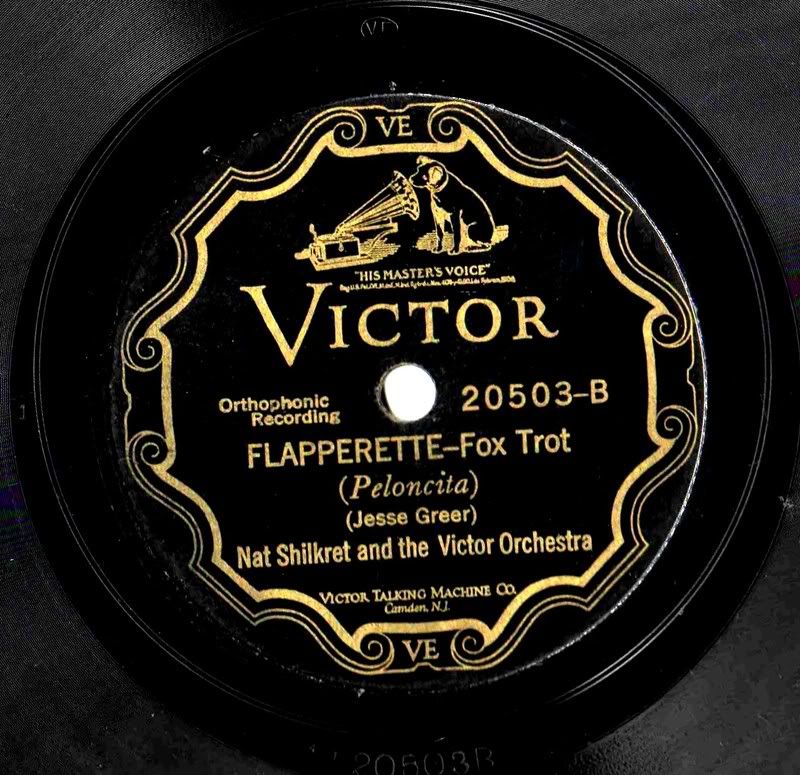
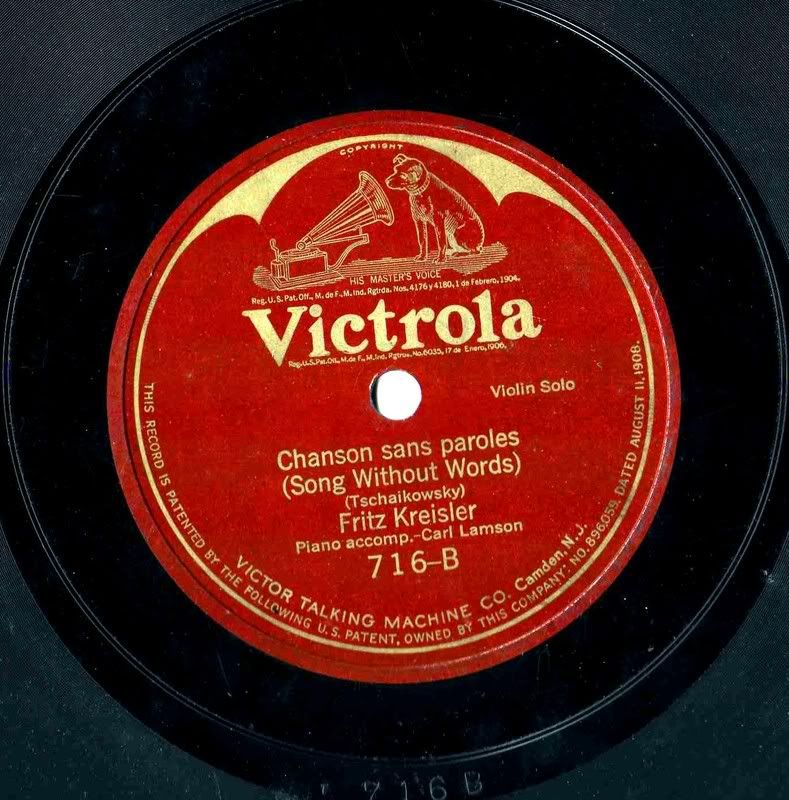
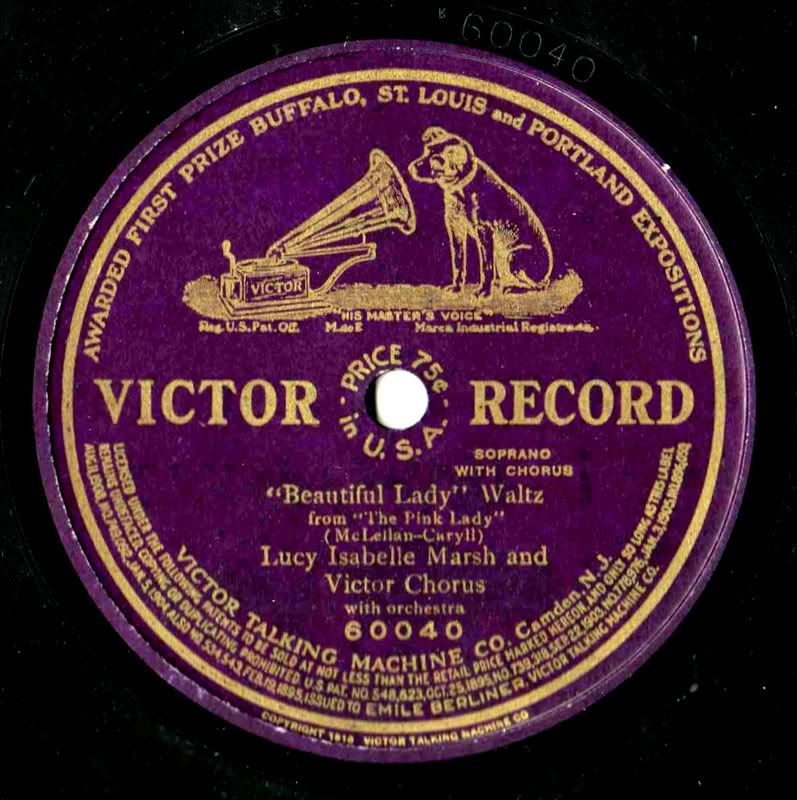
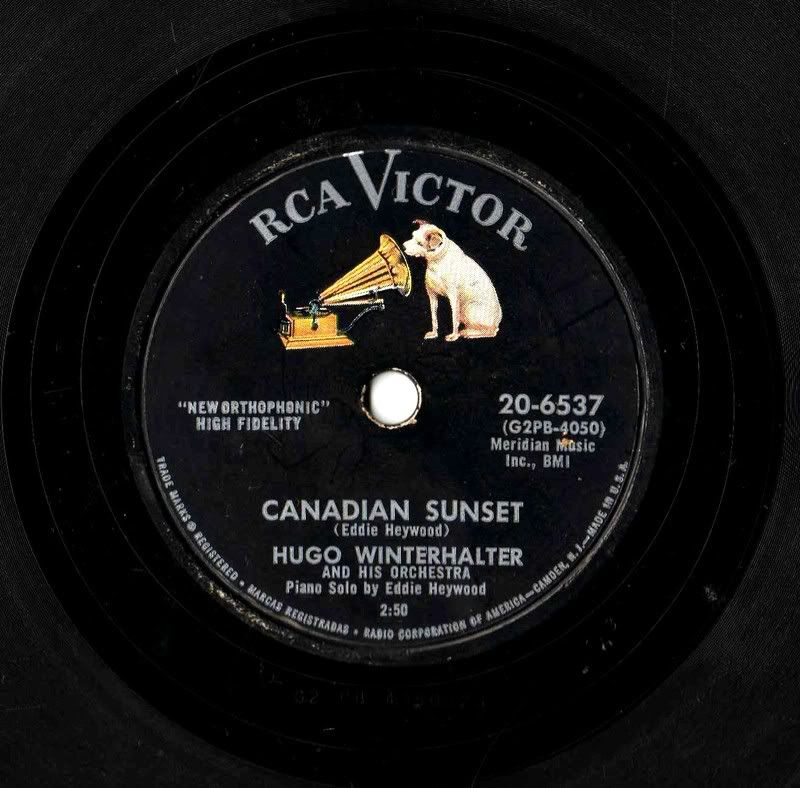
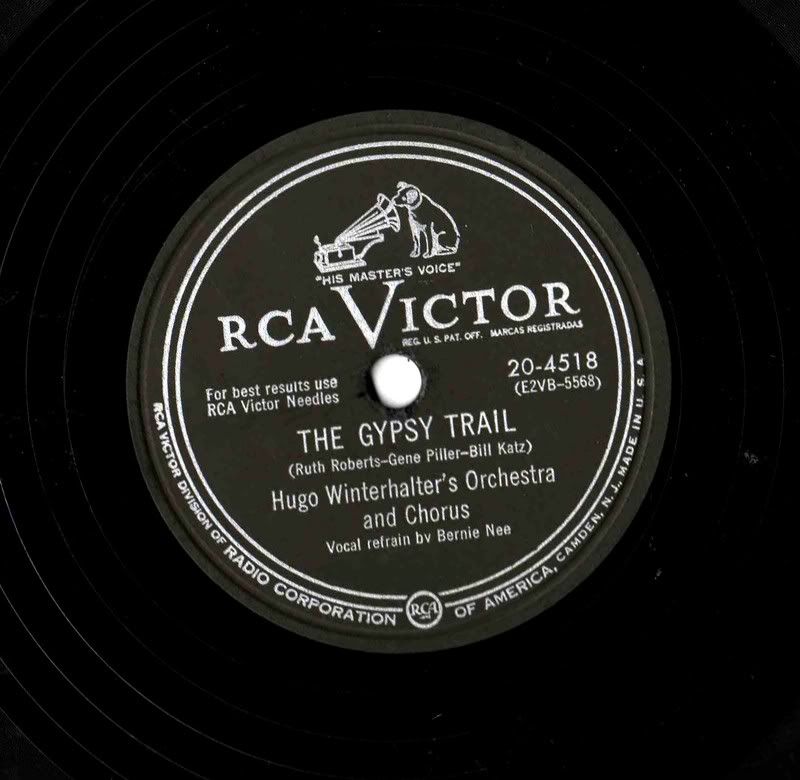
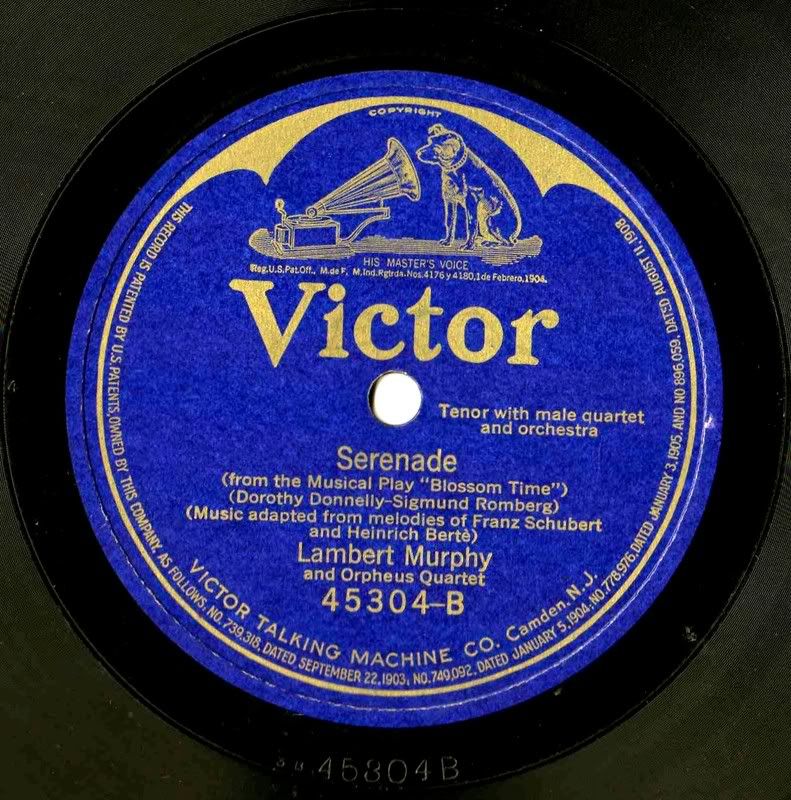
Victor Records, also called Victrola, RCA Victor and the owner of the infamous HMV logo (His Masters Voice). They began in 1901 after the most dramatic start a label could possibly have.
First some preamble: Emile Berliner's Gramophone company started making 78s in 1889. These were mostly for toys, but quickly grew into the real thing. At the same time, Eldridge Johnson was running the Consolidated Talking Machine Company. that company made phonographs to play those aforementioned discs. So far all is well. Then this Zone-o-phone bastard Frank Seaman comes along. He steals design concepts from both companies. The infringements are blatant, and have no hope of standing up to normal legal scrutiny. So Frank goes for an innovative approach.Frankie sues Gramophone and the Consolidated Talking Machine Company for copyright infringement. This is as absurd as it sounds. Then he goes to Columbia records and convinces that their earlier patents are broader than they currently think. He proposes that he pay them royalties if they help with his insane plan. Normally this would be a loss, but Columbia also hopes that they can but Gramophone out of business and take seize some market share. It goes down. Together they actually get an injunction against Berliner and Johnson in 1900.
But they counter sue and they have the patents to prove that Seaman has chutzpaz but is also a nut bar. Columbia Records slinks off and sulks. Berliner and Johnson are victorious and thus form the Victor Talking Machine Company. In 1906 they start producing the very popular Victrola phonograph.
In 1928 Johnson sells his half of the company to RCA and it becomes RCA Victor. In the late 1940s they began releasing the first 45 rpm records. In 1968 RCA phased out the HMV logo and the Victor brand as part of a modernization for the company. The little dog nipper got a reprieve in 1976. In 1985 Bertlesman and RCA formed BMG. It was this company that revived the Victor brand in the late 1980s for the occassional oddball release.