Showing posts with label EAS. Show all posts

Friday, June 22, 2012

EAS mailer


If you live in the blast radius of the Limerick nuclear power plant you get a mailer every year reminding you to hoard food and medical supplies and to always make sure your Iodine tablets haven't expired. It also lists off not just emergency information, not just to have an emergency radio but what radio stations EAS alerts are carried on locally. This is very important and almost nobody pays attention to it. Evacuation is a poor situation to attempt a bandscan.

Wednesday, November 09, 2011

EAS NOT SO EASY


Only two words (and their derivations) in the English language begin with the letters EAS, "east" and "easy." The rest are all acronyms which includes "E.A.S." The Emergency Announcement System. Today at 2:00 PM was the test for that system. For the most part the broadcasters were on the ball. Homeland security however, screwed up. But we all already knew that Homeland Security was incompetent and useless; look at the TSA. There is no reason to expect that FEMA would get this right on the first try.

EAS Test 11/09/2011


What went out sounded like a success at first with the initial data tones but then that was followed by a few seconds of muffled, noisy audio with unintelligible multiple voices, feedback,  then more layers of the data tones and the same mesage. thsi repeated in layers until it was a wall of static, feedback, distortion and white noise. That was followed by a few seconds of staticky silence, and then the closing EOM tones.  Oh well it went better than CONELRAD.

Some areas reported no message, or an inaudible instead of the noisy message. But this clip above is by all reports totally typical coast-to-coast. What happened is that all the networked senders and receivers and all the broadcasters were working fine. There were some metro failures including areas south of Portland, OR. There have been no significant reported problems with either they weekly or monthly required tests prior to this.  So, we know the problem stems from some failure in the EAN on the part of FEMA.  EngineeringRadio.us reported a similar experience, more here.

Wednesday, October 21, 2009

The Amber Alert System

The AMBER Plan was created in 1996. It was named for Amber Hagerman who was abducted and murdered in Arlington, Texas in 1996. These alerts are carried on EAS, NOAA weather radio and some LED billboard signs and some SMS wireless text messages. In some states even the lottery LED displays are tied into the system. Online it's available at CodeAmber.org The website is broken these days so I've copied the "about" section below.  

[The domain expired in 2023 and was bought after a multi-month gap, however it appears not to have been updated since 2012. The new site is registered to an entity that seems to share an address with an identity theft mill. (Kalkofnsvegur 2, Reykjavik, Capital Region, 101)  For that reason I removed the hyper link above.]

The AMBER Plan was created in 1996 as a powerful legacy to 9 year-old Amber Hagerman, a bright little girl who was kidnapped and brutally murdered while riding her bicycle in Arlington, Texas. The tragedy shocked and outraged the entire community. Residents contacted radio stations in the Dallas area and suggested they broadcast special "alerts" over the airwaves so that they could help prevent such incidents in the future.

In August 2002 Bryant Harper, Founder and President of Code Amber was horrified by the viciousness of what seemed to be an epidemic of child abductions around the United States and Canada. Being both a parent and grandparent, Harper like other parents and guardians, is concerned for the safety and welfare of his family.

In response to these crimes he developed the Code Amber Alert Ticker to provide every web site and computer owner with the ability to display Amber Alerts on their web site and their computer desktop by adding a Code Amber Alert Ticker to afford law enforcement with millions of concerned and informed citizens extending their 'eyes on the streets."

The Ticker is a single line of code that loads a Java Script from the CodeAmber News Service servers and is updated anytime CANS is notified of an Amber Alert or CodeAmber Alert in the US and Canada.

On average, 2,185 children under the age of 18 are reported missing each day. That adds up to more than 797,500 children annually. Of that total, almost that 204,000, or about 25 percent, were family abductions. An estimated 58,200 were abducted by someone other than a family member. Of those, 115 were taken by strangers and kept for a period or killed. At least 322 children had been recovered safely through the AMBER Alert program. 

The statistics on child abduction are important because it defines the need for, and importance of, quick action on children's disappearances.

In a country with some 59 million children, abductions by a stranger are perhaps the most terrifying of crimes. But they are also the rarest. There are about 114,600 such stranger abductions attempted each year, and about 3,200 to 4,600 or around 4 percent, are successful, according to a study by the U.S. Justice Department.

The vast majority of missing children are not kidnapped at all. They are runaways and throwaways, kids who leave and don't come back or are told not to come back. about 200 to 300, are what the FBI calls "stereotypical" kidnappings, where a child is gone overnight, transported over some distance, intended to be kept by the perpetrator or even killed. These incidents make up far less than 1 percent of the total stranger abductions.

Advocates for missing children would like to see all cases get the attention that high-profile incidents receive, but the vast majority of abduction cases go relatively unnoticed.

"News directors are first and foremost looking for news," Ernie Allen, president and CEO of the National Center for Missing and Exploited Children, told Court TV. "So if you look at the recent cases that have gotten so much attention ... those children disappeared from their homes and their own beds. It is a scenario that absolutely terrifies every parent. Thus, it's news." 

"All kidnappings are local events," said Klaas, who founded the Klaas Kids Foundation after his 12-year-old daughter, Polly, was kidnapped and murdered in 1993. "You don't turn your back on your local media in an attempt to get more national publicity. As good as he is, Larry King is not going to be around when your story stops making headlines."

Law Enforcement, real time information and the media are your best friends when someone goes missing?  And Code Amber News Service is a media leader dedicated in the aggregation and online syndication of both Amber Alerts and Code Amber alerts in the U.S. and Canada.

The media is a parent's best friend when their child is missing?  Nobody gets the word out faster than the media.


Amber's family organized residents to contact legislators and media outlets about doing something. A reporter at 1080 KRLD-AM suggested they broadcast special “alerts” over the airwaves so that they could help prevent such incidents in the future. Rep. Martin Frost [D] drafted the Amber Alert bill. (For his good works, Tom DeLay re-districted him so severely he lost his seat in 2003.) President Bill Clinton signed it into law in 1996. The first trial runs of the amber alert system were performed at KRLD that same year.

Initially, alerts were sent out manually. But by 1998 it was fully automated and by 2002 the FCC had officially endorsed the system. In 2002 the system had spread to Canada and international expansion has continued to the present day.

Monday, December 01, 2008

NEW TOY!

I want one.

Radio Express is just a small automated radio signal for temporary applications. It's a noncommercial radio information service that can broadcast directions, schedules, safety info, rules and regulations, parking and traffic info.

It's intended for public events such as fairs, festivals, conventions and sports contests can give inbound patrons information on parking, directions and special instructions. Like EAS, it's meant to aid organizers in the case of bad weather, fire or any other emergency.

But nothing says you cant broadcast live programming to listeners and with the allowed signal, that can be 5 miles. It's a license, a tripod antenna and a radio station in a suitcase. It's just badass. Radio

Thursday, August 14, 2008

LP1 and LP2 are SAME

The EAS (Emergency Announcement System) has gone through a number of changes since Conelrad. The currently system debuted January 1, 1997. It's functional, but gets serious criticism over some very real flaws. While reading about this I came across an acronym I didn't' know. It wasn't very arcane in the end, but some of those small details are very revealing to the outsider. So we proceed.Every State has it's own EAS plan. The idea is that a central agency (varies) will arrange for emergency information to be broadcast on radio stations around the state to disseminate critical information. It might be a weather warning, child abduction, chemical spill, riot... etc. But no one central agency should have to tell every radio station individually. That's kind of cumbersome, not any one agency knows everything, and even if they did it'd create one of those dreaded single points of failure we hear so much about.

Instead it's broken down into states, regions, counties and etc. Also multiple agencies can issue alerts. Depending on the state, any number of local authorities, or even the National Weather Service can issue warnings. The president of the United States may as well. (This is a shame since our current one cant be trusted to operate a salad bar.) Depending on the scope of the problem different sets of stations will receive the data first. Obviously a station in San Diego does not need to run an alert for a Mud Slide in Uriah California. One station may be primary for multiple counties, but that's going to vary state to state. So what you get is the following
LP1 - Local Primary 1
LP2 - Local Primary 2

WXR - National Weather service Radio

CIV - Civil Authorities

PEP - Primary Entry Point (30 nationally just for the Prez)


Now the message has all sorts of requirements as will the station itself. San Francisco (for example) does the following:

5.1.2: Write your 50-60 second WARNING message to be broadcast by all AM, FM, TV stations and cable television companies in this FCC Local Area Emergency Alert System plan. To assure broadcast and timely rebroadcasts, you should keep your message under one (1) minute. Be sure to include the Who, What, Where, When, Why, and the How in your message. Never dictate the message to an LP1 employee; you are the announcer.

5.1.3: Telephone the primary (LP1) EAS station KCBS (or KQED) at:
a. KCBS (LP1) xxx-xxx-xxxx or xxx-xxx-xxxx
or if no contact, call:
b. KQED (LP2) xxx-xxx-xxxx
NOTE: If you are equipped with an EAS terminal and a CLERS
radio, separate instructions and procedures below will apply.

5.1.4: Identify yourself by name and title.
State that you want to activate the Emergency Alert System for (give the nature of the emergency). Authenticate in accordance with COO No. 7.
Speak clearly and distinctly.
Say "3 - 2 - 1" and read your message. Remain quiet at the end until the station employee speaks to you. The radio station will now do the rest.

That's actually pretty well thought out. But it's a state with a lot of brush fires so I'm sure they've learned a little. But it does not explain the mechanics so here we go:

All radio stations must have an EAS decoder. It's a rack mountable device that receives the EAS signal on a designated frequency. These decoders continuously monitor the signals from other nearby broadcast stations for EAS messages. For redundancy at minimum of two other LP1 stations must be monitored.

This signal is preceded by a S.A.M.E. header (Specific Area Message Encoding.) The system transmits digital tones over normal audio using AFSK, with a 2083.3 Hz mark tone and 1562.5 Hz space tone, lasting 1920 μs (1.92 ms) each. The data is encoded in 7-bit ASCII but uses all 8 bits, with no parity bit and no stop bit ("8-N-0"), at a bitrate of 520.83 bits per second. the message contains location data, identifies the sender, duration of alert, and event codes.

Wednesday, September 14, 2005

N.E.A.R. weirder than CONELRAD.


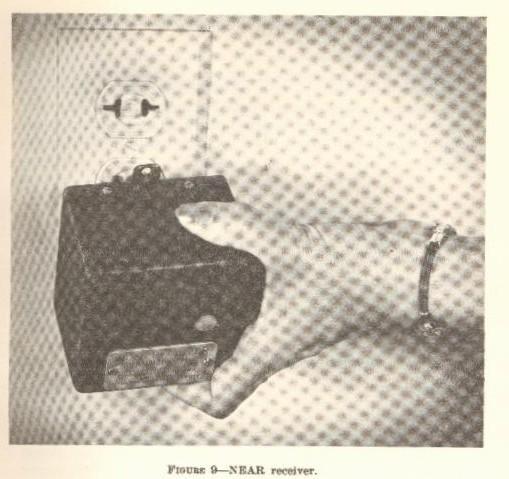
NATIONAL EMERGENCY ALARM REPEATER (NEAR) SYSTEM: United States. 1962. The National Emergency Alarm Repeater was designed to provide near instantaneous warning of nuclear attack to members of the public who were indoors at the time the warning was issued. The system, when activated, transmitted a signal over electric utility lines to receivers plugged into standard 110 volt receptacles. The unit was about 3.5 inches square. It emitted what was described as a "loud, annoying buzzing sound" that could be easily heard over normal indoor noise levels.

The system was intended as a supplement to sirens to provide warning coverage for 96 percent of the population in homes, offices, factories, schools, and in rural areas where installation of outdoor warning systems would have been too expensive. The engineering test phase for the National Emergency Alarm Repeater started in October 1962 with the installation of a converter on the Arizona Public Service Company system in Phoenix, Arizona.

As silly as EAS is somtimes, and as awkward as EBS was, remember that CONELRAD was ridiculous and that we actually considered N.E.A.R. By comparison the system almost seems workable now. This is one case where I can say that the government actually has improved something... and it only took what? four decades?

Friday, June 10, 2005

If the Russians attack? CONELRAD!


radio was an early casualty of the atomic age...


CONELRAD was born in 1951 as an acronym for "Control of Electromagnetic Radiation." The general idea was to deny the Soviets the ability to home in on specific broadcast stations.

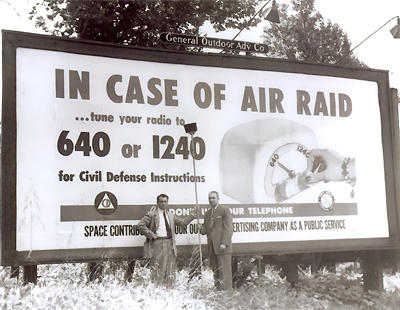
Under CONELRAD all normal broadcasting would stop when a signal was given by the Civil Defense Department. At that time, all broadcasts would either cease or move to the designated frequencies of 640 and 1240 AM. the idea was the if all these transmitters were broadcasting the same synchronized emergency information, they would be unusable for navigation. Stations not broadcasting this signal each were required to monitor that was. (this included even ham radio) CONELRAD had a simple system for alerting the public and other "downstream" stations that consisted of a sequence of shutting the station off for five seconds, returning to the air for five seconds, again shutting down for five seconds, and then transmitting a tone for 15 seconds.

In 1953, all new radios sold were required by law to carry a Civil Defense triangle at 640 and 1240 AM on the dial. The triangles were referred to as CD marks, for Civil Defense. I cant figure out when they were allowed to drop that.

By the early 1960's the development of Soviet missiles had made the CONELRAD system obsolete. This system was succeeded by the EBS system in the 1963. The Emergency Broadcast System, which was less stupid in that stations did not have to change frequencies, some stations still had to be ready to shut down and flip to monitor mode.

Pics of CONELRAD devices: http://www.oldradio.com/current/bc_conel.htm

In 1997 EBS was dropped in favor of an automated system, the Emergency Announcement System or EAS for short. This modern system had the bonus of eliminating the intermediate station monitoring and the reliance on station personel.