Wednesday, November 09, 2011
EAS NOT SO EASY
Only two words (and their derivations) in the English language begin with the letters EAS, "east" and "easy." The rest are all acronyms which includes "E.A.S." The Emergency Announcement System. Today at 2:00 PM was the test for that system. For the most part the broadcasters were on the ball. Homeland security however, screwed up. But we all already knew that Homeland Security was incompetent and useless; look at the TSA. There is no reason to expect that FEMA would get this right on the first try.
EAS Test 11/09/2011
What went out sounded like a success at first with the initial data tones but then that was followed by a few seconds of muffled, noisy audio with unintelligible multiple voices, feedback, then more layers of the data tones and the same mesage. thsi repeated in layers until it was a wall of static, feedback, distortion and white noise. That was followed by a few seconds of staticky silence, and then the closing EOM tones. Oh well it went better than CONELRAD.
Some areas reported no message, or an inaudible instead of the noisy message. But this clip above is by all reports totally typical coast-to-coast. What happened is that all the networked senders and receivers and all the broadcasters were working fine. There were some metro failures including areas south of Portland, OR. There have been no significant reported problems with either they weekly or monthly required tests prior to this. So, we know the problem stems from some failure in the EAN on the part of FEMA. EngineeringRadio.us reported a similar experience, more here.
Wednesday, September 14, 2005
N.E.A.R. weirder than CONELRAD.

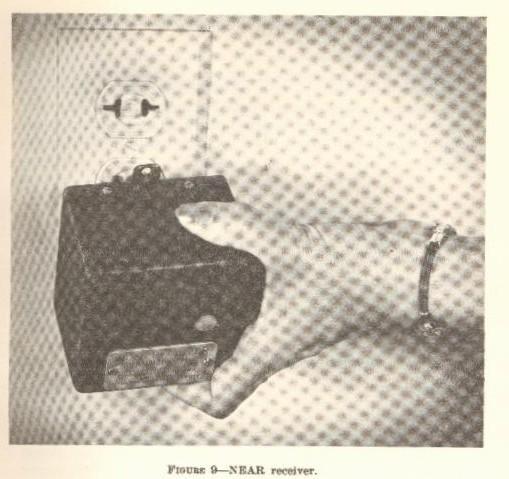
NATIONAL EMERGENCY ALARM REPEATER (NEAR) SYSTEM: United States. 1962. The National Emergency Alarm Repeater was designed to provide near instantaneous warning of nuclear attack to members of the public who were indoors at the time the warning was issued. The system, when activated, transmitted a signal over electric utility lines to receivers plugged into standard 110 volt receptacles. The unit was about 3.5 inches square. It emitted what was described as a "loud, annoying buzzing sound" that could be easily heard over normal indoor noise levels.
The system was intended as a supplement to sirens to provide warning coverage for 96 percent of the population in homes, offices, factories, schools, and in rural areas where installation of outdoor warning systems would have been too expensive. The engineering test phase for the National Emergency Alarm Repeater started in October 1962 with the installation of a converter on the Arizona Public Service Company system in Phoenix, Arizona.
As silly as EAS is somtimes, and as awkward as EBS was, remember that CONELRAD was ridiculous and that we actually considered N.E.A.R. By comparison the system almost seems workable now. This is one case where I can say that the government actually has improved something... and it only took what? four decades?
Friday, June 10, 2005
If the Russians attack? CONELRAD!

radio was an early casualty of the atomic age...
CONELRAD was born in 1951 as an acronym for "Control of Electromagnetic Radiation." The general idea was to deny the Soviets the ability to home in on specific broadcast stations.
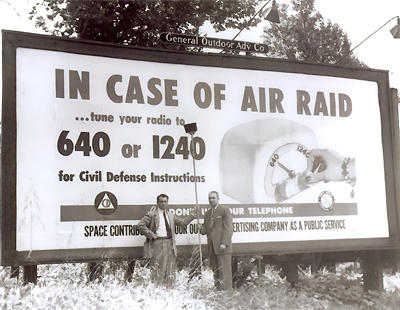
Under CONELRAD all normal broadcasting would stop when a signal was given by the Civil Defense Department. At that time, all broadcasts would either cease or move to the designated frequencies of 640 and 1240 AM. the idea was the if all these transmitters were broadcasting the same synchronized emergency information, they would be unusable for navigation. Stations not broadcasting this signal each were required to monitor that was. (this included even ham radio) CONELRAD had a simple system for alerting the public and other "downstream" stations that consisted of a sequence of shutting the station off for five seconds, returning to the air for five seconds, again shutting down for five seconds, and then transmitting a tone for 15 seconds.
In 1953, all new radios sold were required by law to carry a Civil Defense triangle at 640 and 1240 AM on the dial. The triangles were referred to as CD marks, for Civil Defense. I cant figure out when they were allowed to drop that.
By the early 1960's the development of Soviet missiles had made the CONELRAD system obsolete. This system was succeeded by the EBS system in the 1963. The Emergency Broadcast System, which was less stupid in that stations did not have to change frequencies, some stations still had to be ready to shut down and flip to monitor mode.
Pics of CONELRAD devices: http://www.oldradio.com/current/bc_conel.htm
In 1997 EBS was dropped in favor of an automated system, the Emergency Announcement System or EAS for short. This modern system had the bonus of eliminating the intermediate station monitoring and the reliance on station personel.