Wednesday, September 28, 2005

The First Radio Station

I probably have posted on this before. I may even be contradicting myself.
So who is the oldest radio station in America?
It's an opinionated debate of course; and the usual answer is KDKA-AM in Pittsburgh. But they are only the first commercially licensed station. There were hundreds of experimental radio stations that preceded them. As is typical, technology preceded legislative oversight. The right answer depends on just how you define "radio station."

1290 KUOA-AM is my current favorite vying nominee. An experimental wireless station was constructed at the University of Arkansas in 1897. Professor William Gladson performed this enterprising pioneer work a mere two years after Marconi began his work in Italy. As a result of this pioneer experimentation, the University of Arkansas constructed a wireless telegraph station that was subsequently granted the call sign 5YM.

After WWI University personnel turned their wireless endeavors into the direction of establishing a radio broadcasting station at the university. Thus it was that experimental became professional broadcasting in 1924 . The FCC granted them the calls KFMQ with 100 watts at 1140 kHz.

The call sign was changed to KUOA to better match the university name in 1926. Seven years later, U. of Arkansas sold the station. It changed hands, eventually ending up as the property of John Brown University in Siloam Springs where it remains today.

Most of my info on this is second hand, based on an article in Popular Communications, written apparently by Alice Brannigan. If she made this up, I apologize.

Tuesday, September 27, 2005

The Assasination of the FM Class D license

I have seen many articles heaping praise and laurels upon the LP license. I find it strange that many of these LP radio proponents don't know the sad and sordid tale of our first love affair with the Low power license, the Class D.

The FCC stopped issuing the FM Class D license in 1978. This license allowed schools to own and operate low power FM stations. Between 1978 and 2002 Low power licenses were only issued in Alaska. And as we all know the FCC has no jurisdiction in Alaska anyway. The need for this broadcast license was abated temporarily with the first (and only) wave of LP licenses.
Nifty article here: http://www.hamradio-online.com/library/fm2.html

In 1978 the class Ds were given the official directive "Grow or die" They had to file papers to turn up the power to 100 watts and qualify as a C license or face the inevitably encroaching protected contours of other stations. Often it was not possible for a station to crank up the juice due to other station on the first or second adjacent.

The Class D license was low power license, allowing a maximum of 10 watts output from the transmitter it could even occupy vacant commercial frequencies. The FCC essentially took the position that high-power stations serve the public interest better than low-power stations. They defend this notion with a simple RF over-crowding argument.

It goes like this: Suppose a Class A station covers a an area 500% greater than a Class D station. If a low-power station was using the same or adjacent frequency then the Class A station could not be able to operate due to spacing. Fewer people are served by the available bandwidth.

The flaw in this notion is that the FM Class D license was designed to fit between the high-power stations where no other class of license could be allowed. In the very unlikely chance that the above occurred, a Class D station, having no protected contour, would be forced to cease operation. The reasoning was wrong.

The reason the reasoning was wrong is that it was just a cover story. The real reason that the FCC yanked that license was that NAB, CPB and NPR pressured the crap out of them. As is typical in Washington, the party with the most money won. The only exception the FCC left standing were drive-in movie theaters.

A handful of original Class D's are still out there. Just recently in Philly WHHS was forced off the air by the move in of WSNJ (now WRNB.)

Monday, September 26, 2005

The Art of Radio Jamming

Governments that make use of jamming argue that they have the rights to protect their citizens from dangerous ideas. For me (as a Free-speech minded American) the idea, that some ideas are dangerous, is the most dangerous idea of all.


Radio jamming is an invention of politics and not radio. No radio station (that I know of) ever got jealous at another staitons share and began full-scale jamming operations. Yet there is a massive technological effort directed toward forcibly censoring unacceptable broadcast content in many countries. My short list includes the USSR, Czechoslovakia, Poland, Bulgaria, East Germany, China, Cuba, Iran, Syria, Lithuania, Vietnam and many other countries.

great site here: http://www.radiojamming.info/

The first occasions of jamming of military radio telegraph were recorded back in the beginning of the 20th century. Germany and Russia were the first to engage in jamming. The jamming signal most frequently consisted of co-channel characters. In the late 20’s Berlin started to jam the programs of Radio Komintern. In 1931 the USSR jammed the Romanian radio, in 1934 Austria jammed the German radio. The Lithuanian language broadcasts of the Vatican radio were jammed by the USSR in 1940. By 1940 Everyone was jamming someone else.

What interests me most is Jamming by the U.S. or alternately, jamming of the U.S. Thsi illustrious history starts of course with our infamous Fearsome Communist Nemisis... CUBA!

March 27th 1990 we began broadcasting TV Marti into Cuba from the U.S. air balloon Fat Albert. Thsi was part of the U.S. border surveillance system that floating over Cudjoe Key, South of Florida. The Cuban government had installed many small jamming transmitters beforehand that effectively killed the earlier TV Marti programs.

This jamming became inadequate in the face of fat Albert and his floating transmitter. To extend the jamming range, Castro’s engineers and pilots equipped several Russian made Mi-17 helicopters with jamming equipment. The Cubans got so exited that they even started jamming Radio Marti’s services from transmitters in Greenville, NC, and Bethany, OH. Prior to this Radio Marti had not been successfully jammed by Cubans for at least 5 years.

Nifty how-to info here: http://www.milspec.ca/jammers/jammers.html

Sunday, September 25, 2005

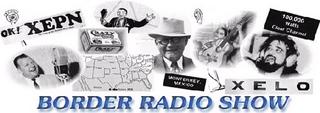
Border Radio

Great Googily Moogily!
http://borderradioshow.com/

I was in Austin. It wasn't really on purpose, but its directly between Dallas and San Antonio on 35 South and there I was. I got off the highway looking for local fun. You know, thrift store guyaberas, and big bins of used CDs...

I bought a guyabera [remember those shirts the cuban barbers wore?] for $2.50 and hunted around for hours at El Cheapo on Lamar Street. http://www.cheapotexas.com/

Then I drove past this theater on Congress street right by the capital. In Big lit-up letters it read BORDER RADIO. The logos on the posters reminded me of a certain book I have on order... but no, its couldn't be, that's a book and this was a show. Well it was. AND I MISSED IT!!! DAMMIT.

Kinky Freidman, Ernesto Guerra, Kitty Scott, mariachi bands.. Whoooo-weee.
It was a stage show based around the book run in conjunction with the Texas folklife institute. www.texasfolklife.org They went on for hours running video and audio and lectures from The carter family, Bob Wills, Cowboy Slim Rinehart, and more. I imagine it's kind of like The Prarie home Companion with a southwestern twist, minus Garrison Keilor and (and any other damn Yankees he may associate with.)

the series is being taped and I am hoping that NPR, Pacifica, PRI or some other large network has the brains to offer the 3 part series as a national feed.

I was deeply amused that the Texasfolk life Inst. ran a disclaimer on their ads. You See Local eccentric and author Mr. Kinky Friendman is very seriously running for governor, and is polling quite well. disclaimer quoted below.

* Kinky Friedman's appearance at the show and on the radio broadcast should not be construed as an endorsement or even approval by Texas Folklife Resources, its Board of directors or staff of his candidacy. Kinky speaks only for Kinky. Texas Folklife Resources is a non-profit cultural organization. Please note that all the gubernatorial candidates Governor Rick Perry, Carol Keeton Strayhorn, Chris Bell, and Kinky Friedman, were invited to come visit with the spirit of Pappy O'Daniel, or send a taped message, to be played on this Border Radio Show. Only candidate Kinky took us up on this offer.

I however, fully endorse Kinky for Governor.

Thursday, September 22, 2005

Thought for the day


While driving through San Antonio... I passed both the main office for MUZAK and Clear Channel? Coincidence? I think not.

http://www.muzak.com/muzak.html
http://www.clearchannel.com/