Friday, July 15, 2005

Parallel Evolution & Nathan B. Stubblefield

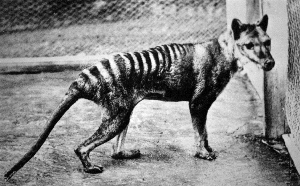
There is a theory of Parallel evolution that states: In separate but similar environments, similar animals may evolve. A prime example of this Darwinian spin off is the Tasmanian Wolf. http://www.vhemt.org/thylacine.jpg It looked and acted very similar to the North American Wolf, but it was a marsupial and therefore more closely related to a rat than a dog. [Eeeeeeeew giant rats] I say looked because it has been extinct since 1936.

So much in that manner, there are historical instances of people claiming to have invented things earlier than the patented or historically known instance. Sometimes this is true, as in the case of "the lost wax process" in ceramics. http://www.andreharvey.com/wax.html For thousands of years humans were too uneducated to write things down. Many an idea was lost only to be rediscovered/reinvented later.

There are cases of this in radio. Most of them seem fairly bogus. Here is one that is possible.

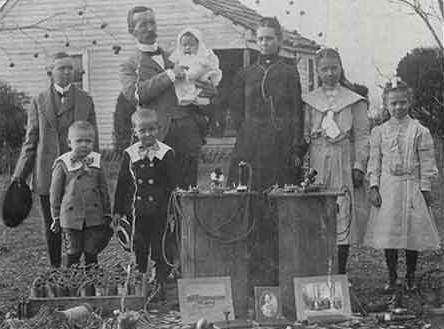
Over one hundred and ten years ago, the school Stubblefield experimented at was called, "Nathan B. Stubblefield's Wireless Industrial School, or "Teléph-on-délgreen". That last part is in French so I have no idea what it means.

As the story goes he made his first demonstration in Murray in 1882. (Even Popov didn't claim to have transmitted a radio wave until 1896!) Stubblefield caused distinct vibration tremors of a compass needle and sent a voice between 2 parallel antennas via an low-frequency undamped electric wave dispersion. It was a short distance, but it was wireless.

Through 1913 Stubblefield made an effort to develop and sell his wireless telephone systems through various companies including: The Wireless Telephone Company of America, The Gehring-Fennell-Stubblefield Group, The Continental Wireless TelCompany, The Collins and The Wireless Telephone Company.

Stubblefield's business partners ultimately left him bankrupt. Stubblefield later lived in self-imposed isolation in a crude shelter and, eventually, starved himself to death. Out of bitterness he destroyed every prototype he had ever made. He was buried in the Stubblefield Cemetery in Murray, Kentucky.

The citizens of Murray , Kentucky erected a monument to Stubblefield in 1930. They still call him The Father of Radio.

Read a good piece here: http://www.wfmu.org/LCD/GreatDJ/Stubble.html
and here: http://en.wikipedia.org/wiki/Nathan_Stubblefield
I hear the book is great: http://www.nathanstubblefield.com/

Thursday, July 14, 2005

American Indian Radio

As you all well know, once this entire continent belonged to The American Indians. They of course did not call them selves Indians, Native Americans or American anythings actually. My best understanding of the word they used was "human beings"

So, these human beings got a raw deal from the incoming Europeans. These days, the descendants of the survivors, those that have not moved into western culture [note irony of wording] live on reservations. I am sure some of you compulsive gamblers think of all Indians as casino owners and well... that's not exactly accurate. To be blunt, thousands of them live in abject poverty. Needless to say, they do not own many radio stations.

Here I list a few I find exceptional

KIDE 91.3 FM Hoopa, CA. They run at a mere 19 watts but are organized enough to report to trade magazines. Their Music director used to be a man named Jay who was a helluva nice guy.You can check them out here:
http://www.hoopa-nsn.gov/departments/kide.htm

KSHI 90.9 Zuni, ND
You can actually hear a show from 1978 here:
http://kennedy.aps.edu/kshi678.mp3

KEYA 88.5 FM Belcourt, ND
A 20,000 watt station almost flush against the Canadian border. They run some NPR programming but primarily focus on the local Turtle Mountain Chippewa culture in their native programming.
http://keya.utma.com/main.html

Below are links to sites that give more complete lists:

http://www.afn.org/~native/radstats.htm
http://www.nativeamericans.com/RadioStations.htm
http://www.hanksville.org/sand/contacts/NAPR.html

Wednesday, July 13, 2005

Moving down the dial.

It was only last year that Nassau made the change. WPST then residing on 97.5 in Philly and WTHK then residing on 94.5 in Trenton switched places. http://www.wpst.com/
http://www.975thehawk.com/

But really what happens when a station moves? The transmitter, the studio, the staff... they don't move anywhere. It's really just the brand that moves. [see prior post mocking brands 6/22]
What happens (in no particular order) is Nassau files a little paper work with the FCC to trade the calls. Because they own both stations this is not a problem. Sometimes, when the calls are not connected to the brand, they dont even bother to do this.

Since both stations are in the same cluster, both studios are usually in the same building. in these cases it's only a matter of reconfiguring some hardware to send the feed of each station to a different transmitter. I am not trying to understate the technical difficulty in this process. I am not exactly a member of the SBE.
But a brand is just intellectual property who's idea was it to move aroud these intangible things like checkers? Well it all started in January of 1977. KUZZ and KZIN-FM officially split on-air at midnight exactly. Prior to that they were running a simulcast. It was the first step in Buck Owens brilliant scheme.

KUZZ 800 AM was now 24-hours, full-time Country music, KZIN 107.9 FM was running rock. http://www.kuzz.com/

AM stereo was brand new a reality for radio. By 1984 he increased KUZZ’s transmitting power to 5,000 watts and had purchased KAFY 550AM. Then like baseball cards he just traded them. At the time this was an unprecedented move in american broadcasting.

There were many prior cases wherein one station had purchased another’s dial position, but none that had ever exchanged brands outright. proving the concept worked, the KUZZ listening audience moved down the dial to 550 AM right along with the station. Ironicly, by 1988 the slow fade of the FM audience led Buck to change 107.9 back into the simulcast.

Tuesday, July 12, 2005

The Blues Radio format

No other genre of music carries such a rich history. Its the genre that birthed rock n' roll. the genre that records the lives of rural americans. It's the music of our true cultural voice, our own actual Americana.

The music descended from songsters playing a mix of hilbilly music, early country and folk. At no time in our history has Blues ever been a dominant radio format. It's red-headed stepchild rock n' roll was the decendant that first made that jump. Later durring the spread of FM radio the public's new intrest in folk music gave a second life even to long dead artists.

I find it appropriate that today it has returned to the rural southern cities where it began.
Today there are only 4 all-blues radio stations. These are:
WDLT 660 AM Fairhope, AL
WKXI 1400 AM Jackson, MS
WKXY/WROX-AM 92.1/1450 FM Clarksdale, MS
http://www.wroxblues.com/

On the bright side there area hundreds of individual blues music programs across America. In fact, It is rare that a city has only one! many have 2 or 3. If you cant find one feel free to ask me.

Monday, July 11, 2005

If you're in New York this weekend...


This is news I feel I must relay to you all.

This weekend, Saturday June 16th the WA2XMN transmitter at the Armstrong Tower in Alpine New Jersey will be active again tune in if you can. The frequency will be 42.8 FM

OK, why should you care?

The alpine New Jersey site is a landmark of American broadcasting. This is the first site that ever broadcast FM. Edwin H Armstong invented FM broadcasting in 1933. His employer RCA was less than interested having been already strongly vested in AM. So in 1937 he did it by himself. Back then FM was 42-50 MHz FM.

This first FM radio station was W2XMN, broadcasting under an experimental license. He eventually built a network of relays taking the signal all the way to New Hampshire. Along the way the calls eventually were changed to KE2XCC and eventually to WFMN.

The fybush tribute to armstong is here: http://www.fybush.com/indexeha.html