The move toward larger and larger networks was a massive influence in future media legislation. It was made possible my a series of changes in media ownership law. this in turn was begat by certain elected officials and their judicial appointees. It is no coincidence that it was in this era that media conglomerates began heavily donating to political campaigns. This trend essentially transformed commercial radio the brand-focal, homogeneous, satellite-fed beast that it is today. Today I would like to remember some of the notable networks that didn't make the cut.
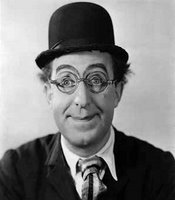 The Amalgamated Broadcast System
In 1933 Comedian Ed Wynn founded the Amalgamated Broadcast System (ABS). it lasted a whopping 10 months and quietly died in November of that year. Ed Wynn was best known as the actor that played the Fire Chief of the Texaco Star Theater program carried on both NBC and CBS. Wynn disliked the power NBC and CBS had over his program and wanted to establish ABS to be an alternative. His vision was a 100-station network with
WBNX out of New York as the flagship.
[Ed Wynn was also a comic book character which could not possibly help his legitimacy.] http://www.beyondbelief72.com/archives/2004/08/on_stage_3.php
But who takes a comedian seriously? The company was badly organized, and Amalgamated went out of business only five weeks after its first broadcast. It served as a bad example by which The Mutual Broadcasting System managed to learn a few things. MBS actually swooped in and snatched up some of the ABS affiliates that winter.
The National Negro NetworkNo, BET was not the first. This could be the first attempt of broadcast media to focus on blacks in America. There has already been very successful books and newspapers marketed to blacks. So why not radio?
In October 1949, becoming the first African-American station owner the National Negro Network was a black-oriented radio programming service founded by W. Leonard Evans in 1954. It was the first black-owned radio network in the country. Only about 200 or so stations had been focusing on the black audience or so before hand. (Compare this to a couple thousand marketing toward whites.) It's programming was initially broadcast on forty member stations. The network featured a variety of different programming, including a popular The network eventually failed due to its failure to attract major advertisers. there would not be another black radio network until 1972, radio One.
FYI: In 1980 were were less than 100 radio stations owned by blacks. The growth of radio one improved things in the next two decades but since 1996 when the Telecommunications Act was passed black ownership of stations has declined. Out of the 12,000 commercial radio and TV stations in the USA, less than 400 are owned by African-Americans. Do the math, That's about 3.3% . This despite the incredible popularity of black-oriented programming.
Amazing article here:
http://www.bjmjr.com/aaradio/part4.htmThe Yankee NetworkThey operated out of 1230
WNAC. In 1932 CBS was looking to cut some of the middle men out of their network deals. They started buying stations up in major markets like Boston. They manged to acquire enough new O&O affiliates to severely limit NBC's future affiliate options. While looking for a new Red network affiliates in this newly limited pool, they turned to John Shepard's Yankee Network to fill in the holes.

With the help of Major E.H. Armstrong, the Yankee Network became the nations first FM network as well. They built a demonstration FM inter-city relay network linking
WNAC by with
WDRC and
WGTR. As I've written before RCA was determined to destroy FM because of the threat that it was to their AM radio business. RCA successfully pressured the FCC to move the FM radio spectrum from (42 to 49 MHz), to (88 to 108 MHz.) The change crippled the FM movement for a decade, and driving Yankee out of business. Driven to despair over the FM debacle, Armstrong jumped to his death from the thirteenth floor window of his New York City apartment January 31st, 1954
It was actually the Yankee network that was on the receiving end of the FCC’s first large-scale act of censorship. In 1938 Yankee was airing editorials against President Franklin Roosevelt. The FCC requested that they provide details about these programs. Yankee got the drift and dropped the propaganda. The agency warned that, as part of a broadcasters public interest requirement, radio stations cannot be editorially devoted to the support of their own principles. In application, this meant that airing Roosevelt's fireside chat was considered nonpartisan, but broadcasting a critique of his proposed legislation would be unacceptably partisan.
Does this remind you of anyone in office today?


 For the Longines-Wittnaur watch company this was just the beginning. They WNBC-AM. This was in addition to two half hours on CBS on Sundays. The Longines Symphonette continued through 1958 rapidly expanded their marketing investments in radio. The Longines Symphonette variety program debuted on CBS in 1943. They also sponsored an off aviation-themed program in 1946 "The World's Most Honored Flights" hosted by Captain Eddie Rickenbacker. In 1950, Billboard reported that Longines bought five half-hour segments a week on CBS.


 In October 1949, becoming the first African-American station owner the National Negro Network was a black-oriented radio programming service founded by W. Leonard Evans in 1954. It was the first black-owned radio network in the country. Only about 200 or so stations had been focusing on the black audience or so before hand. (Compare this to a couple thousand marketing toward whites.) It's programming was initially broadcast on forty member stations. The network featured a variety of different programming, including a popular The network eventually failed due to its failure to attract major advertisers. there would not be another black radio network until 1972, radio One.


 Posts


