Showing posts with label women in radio. Show all posts

Monday, March 16, 2026

The First Female DJ in Los Angeles


In the November 12th, 1977 issue of Billboard you will find the feature "Women Emerging as Format DJs." It's an important reference article in the history of radio, and one of those rare occasions where women DJs get multiple pages of ink in a trade magazine. Unfortunately it's author is unaccredited. 
"At one point in the history of modern radio a female air personality was almost unheard of, and this is quite an interesting psychological aspect of the medium since early radio featured some excellent female entertainers such as Jinx Falkenberg, Jane Ace, Jane Webb, Harriet Nelson, June Foray, Janet Waldo, Molly Jordan (of Fibber McGee & Molly fame) Lillian Randolph, and Alice Reinhart for example." 
This week I'm looking into just one of those DJs histories. Cherie Sannes worked as a registered nurse for six years before she went into broadcasting. None of these primary sources cite her original surname. Originally from Ohio, she got the surname Sannes from her first husband, a doctor at Carmel Community Hospital where she worked as a nurse. In 1975 she began hosting a weekend public-service interview show on 101.7 KLRB-FM. More here.

Monterey Peninsula Herald - August 1974

KLRB (FM102) was a progressive, free-form FM station in the same vein as 106.7 KPPC in Pasadena and 106.9 KMPX-FM in San Francisco. The station originally signed on in 1971. The Monterey Peninsula Herald reported that Cherie joined the staff in October 1973, as "a registered nurse with no broadcasting background."  In May 1983 it flipped to country and the call letters changed...to KWST but Cherie was already long gone. Several of the staffers went on to work at KMBY, like Cherie.

Cherie moved to the Top-40 station 1240 KMBY-AM in 1975 and there she became “Cherie the Midnight Lady” where she worked overnights. One of her listeners was Sonny Melendez of KMPC. He invited her up to Los Angeles to audition on his show. The Billboard article confuses this story a bit but she did not get an offer from 710 KMPC-AM. But perhaps it gave her higher aspirations. When she was told that KFMB in San Diego was looking for a new female voice she flew down to do a live audition for B-100 Program Director Bobby Rich. Cherie became their first female DJ. [SOURCE]
 
100.7 KFMB-FM had only dropped it's Easy Listening format in 1975. In the late 1960s their slogan was"Music Only For A Woman."  [I can't imagine actually saying that into a microphone.]  Suffice it to say that it's Rock format was a huge change. KFMB was competing directly with 1170 KCBQ-AM. In 1975 the B100 original line up was Rob Landree, Dave Conley, Rocketman (aka Scott Wright), Willie B Goode, Jimi Fox, Gary Kelley, Kevin Anderson, Phil Flowers and Billy Martin. Terri Lynn was the news person and the only woman on the air staff. A year later Fox departed taking some staff with him and the playlist was reformulated with more Top-40.  When Cherie was hired about then and the new line up was Gene Knight, Gary Kelley, Danny Wilde, Christopher Lance, Cherie Sannes, Jimmy Rogers, Glen McCartney and Uncle Fred Stemen. [SOURCE


In the Fall 1977 Arbitron ratings, KFMB became the first FM station to be number 1 in a major market. At the time of that "Women Emerging" Billboard article in 1977, Cherie was doing a 2:00 - 6:00 weekday shift and a 7-11 shift on Saturdays. The article also made a point to say she was the oldest DJ on the station at 30 years old. So we know she was born around 1977 and is around 79 today. [The authors need to reveal this detail is how I the piece was written by a man.] 
 
Less than a year later, in 1978 Cherie joined Brian Berne and Brother John Rydgren at 101.1 KRTH (K-Earth) in Los Angeles as their first female jock. R&R announced it in their December 8 issue [SOURCE] with one economical sentence: "Cherie Sannes has joined the staff at KRTH/Los Angeles from B100/San Diego."  Their she worked nights and hosted Spotlight, a celebrity interview program. Air staff at the time included Shotgun Tom Kelley who also tenured at KFMB. She stayed with K-Earth for five years, her longest run at any one station. (Alex Cosper lists Cherie at KHJ in 1979 - 1982. This is because 101.1 KRTH was KHJ-FM from 1943–1972.) [SOURCE]

 
The peak of her popularity was probably at KRTH. Ed Harrison wrote a half-page feature on her for Billboard in June of 1981. In an interview quoted in that article she considered the importance of her role as a feminist trailblazer. she said: 

"Things have changed today to a certain degree, and women deejays are much less of a novelty. My KLRB experience was an exciting opportunity to change attitudes about women disk jockeys. ... Five years ago, we had few female role models and therefore many women, including myself, found it frustrating, but rewarding, to be the so-called 'pioneers' in a traditionally male-dominated field..."
According to most sources, Cherie left KRTH in about 1982. The Carmel Pine Cone [SOURCE] describes her moving directly to "Power 106" KPWR but this is not exactly accurate. Omitted is her short tenure at KOST doing weekends. This is noted in the Dec 4th, 1982 issue of Billboard. Cherie also was at 105.9 before it was KPWR, when it was still KMGG (Magic 106). Billboard reports in February of 1983 that she was working weekends and performing additional duties as their promotion director.

Power 106 didn't exist until 1986 when KMGG flipped from traditional Top-40 to a very 80s dance-forward, almost proto-CHR format complete with with shock jocks. Their playlist concluded disco, dance, urban and Top-40 hits and their new calls were KPWR. The station is still KPWR today but Cherie left the station around that time, probably as part of a staffing shake up. 

After KMGG Cherie left radio to work in healthcare management. She had been the first female DJ in two metros and at least 3 different stations. How does anyone follow up an iconic career like that? She became Cherie Stock when she remarried in 2008. Her husband Bob Stock was a former news anchor at KSBW-TV. She retired in 2009 and took up painting. Good for her. More here and here.

Tuesday, March 21, 2017

The Mysterious Mrs. Redgrave


The very first broadcast in the Philippines, probably in all of Asia was a test broadcast in 1922. According to the book Broadcasting in Asia and the Pacific by John A. Lent, an American woman named Mrs. Redgrave used a five-watt transmitter for a test broadcast from Nichols Field in Manila (Then just Camp Nichols, now Villamor Airbase). Her first name is unknown. A 1973 fire destroyed many records from the period. But the event is corroborated by a 1925 letter from Governor General David Wood to Bureau of Insular Affairs General Chief Frank McIntyre. The book Appropriation of Colonial Broadcasting by Elizabeth Enriquez further reiterates the claim and the lack of information on Redgrave going as far as to check the U.S. National Archive and Records Administration (NARA). Mrs. Redgrave remains frustratingly anonymous.

The surname Redgrave isn't particularly common. It originates from the parish and village of Redgrave, north west of Eye in the county of Suffolk as early as 1050. Author and artist Gilbert Richard Redgrave is even known to have some of his books on the shelves of the American Circulating Library of Manila back in 1907. The sisters Vanessa and Lynn Redgrave crossed the pond and rose to fame in the late 1960s, but were born long after the test.  Roy Redgrave his wife Margaret, and their son Sir Michael Redgrave all were famous on stage, and screen back to the silent film era. [SOURCE] Michael is known to have visited Manila, but not until decades later. He would have been 14 at the time of the broadcast. Margaret Redgrave was performing at a Comedy Theater in London in 1922 and also occupied. Possibly our Mrs. Redgrave was Hope Pillsbury [SOURCE] Redgrave,  the wife of Captain DeWitt C. Redgrave Jr. who christened ships at Evansville shipyard in the 1940s. In 1922 his ship the U.S.S. Montgomery was in the Pacific...

Excluding that unlikely arcane event, radio in the Philippines started in 1924 with establishment of KZKZ-AM in Manila on 729 kHz. The station as run by Henry Herman Sr., owner of an Electrical Supply Company. Mr. Herman was an American and a former soldier in the U.S. Army Signal Corps who fought in the Philippine–American War. He stayed in the Philippines after he was honorably discharged. Like many others he was trying to sell more radios by broadcasting programming for them to receive. His radio career began with a temporary permit in 1922 from the Bureau of Posts for a couple different transmitters one of which was mobile.

Two years into the experiment, Herman replaced the experimental stations with a 100-watt station with the call letters KZKZ. However, Herman soon after gave up on the commercial potential of radio. On October 4, 1924, with KZKZ but a few months old, he sold it to the Radio Corporation of the Philippines (RCP). RCP expanded into Cebu putting up KZRC (Radio Cebu) in 1929, which is now DYRC. It quickly became a free for all, which persisted until a U.S. colonial government instituted frequency assignments in 1931. For what it's worth Henry Herman was forced in WWII to sell electrical supplies to the Japanese military. Charged as a collaborator, he lost his military pension. More here.

Tuesday, March 07, 2017

The First Woman To Own A Radio Station

This is a confirmed well-referenced unchallenged first in the history of radio. That alone is almost a first. Marie Zimmerman received the license for WIAE, Vinton Iowa in 1922. She was only 25 years old. (Donna Halper wrote the definitive article on this topic. You can read it here.) Born in 1894, decades before the rise of radio she was rather taken with it when introduced to radio by her brother-in-law Carroll, in 1920.
Carroll was an electrician, and apparently a compelling ham radio enthusiast. He passed the bug to Marie and her husband Robert. They had built their own amateur receiving set by 1921. They enjoyed it so much that they decided to start their own station. They and Carroll worked with the local Vinton newspaper, the Cedar Valley Times to fund raise the $300 budget it would take. More here.

On July 21st, 1922, the Department of Commerce issued a limited commercial license to “Mrs. Robert E. Zimmerman." It's a little condescending, but that's a Mrs, not a Mr.  So 95 years ago she became the first woman to own a radio station. On the utterly flat terrain of Vinton, Iowa their new 40-watt station operating on 360 meters covered quite an area. Halper summarized their broadcast schedule as follows:
"It broadcast on Tuesdays, Thursdays, and Saturdays, usually from 9 PM to 10 PM, featuring music and news. On Wednesdays at 8 PM, there was a band concert; and on occasional Sundays at 2:30 PM, there was another live concert."
On July 30th 1922, the Cedar Rapids Gazzette station WJAM signed on adding a second radio station to the local dial. That bit of well-funded competition cooled the Zimmerman's ardor for radio. In that era a radio license had to be renewed every 90 days. In April of 1923 Marie chose not renew WIAE's license. The Department of Commerce officially deleted the station in late June; it had lasted almost a year. Neither she nor her husband or even her gearhead brother-in-law returned to radio. Marie Zimmerman died on 23 January 1973, at age 77.

Tuesday, October 06, 2015

The First Woman on Australian Rock Radio


It seems unbelievable but there were no female DJs Australian airwaves before 1975. Rock N' Roll was already (arguably) 25 years old, old enough to buy itself a beer in all 50 states. But in Australia it was still an all-male revue, like a 2.97 million square mile Danzig concert. For reference, 1973 was the 50th anniversary of broadcasting in Australia. No I'm not making that up. They printed stamps and everything...

Perhaps that was unfair. In talk programming ladies had been in radio for years. Olive Mellor was answering gardening queries on 3DB in Melbourne as early as 1950. If you want to go all the way back in 1933, Lynn Foster was writing short radio scripts at 2UE in Sydney. But these weren't all on air jobs, and those that were, often were in acting or ladies advice programs such as Women's Session and Banish Drudgery. And of course, soap operas. Popular pre-1960s radio dramas with female announcers and/or voice actors included Leave It to the Girls, Aunt Jenny's Real Life Stories, When a Girl Marries, and Portia Faces Life. Btu for some reason ladies were not allowed to flip over a record.

In January of 1975 radio station 1540 "Double J" hired Gayle Austin as a DJ. Austin herself claimed that she was the only woman that bothered to to apply for an on-air gig. She was quoted as saying "Radio in those days was like secret men's business... I was given one midnight-to-dawn shift a week, a move so radical that I was the cause of much negative comment after our first survey of listeners." More here.

ABC had the rights to launch two radio stations and they decided to aim one at what they felt was an un-tapped youth market. Within two months of their debut, the general manager of 3XY, described Double J as "the lowest form of radio this country has produced."  Doubel J talked about sex, criticized religion,and  they mocked advertisements. They were sued by a police commissioner and then the Australian Security Intelligence Organisation (ASIO) began investigating the staff.  The result was a 5.4 share in Sydney.

Gayle Austin worked at the Jays until the purge of 1990. Yes the purge. After 15 years of ruffling feathers ABC quietly replaced senior management, who not-so-quietly fired all senior air staff. There was press, and there were protests, and ABC didn't care. Gayle's career survived the culling and she currently hosts an overnight program on 2SER FM in Sydney. More here.

Wednesday, September 02, 2015

The Other Blonde Bombshell at KGB

I don't mean the Russian KGB ( Komitet Gosudarstvennoy Bezopasnosti ) I am referring to 101.5 KGB-FM in San Diego. From the beginning of time, one of the virtues of radio is that the talent is faceless and sometimes even nameless. Talent in radio is a disembodied voice which through personality and character a person can build a relationship and even loyalty with their listeners. When images of a DJ are cynically used as marketing eye-candy, that power is undermined.
The Internet has exacerbated the problem with live studio cams, pin-up calendars, and hot top 50-lists. But exploiting female air-staff for marketing is not new. There are numerous history examples; Anita Gevinson just was one among many.  Sam Phillips did not want to start an all-women radio station to support the ERA.
It happens in other industries and there are reams of serious literature on this topic. But in Radio in particular it seems to be an artifact, not a product of the industry.

What got me on this topic was the recent passing of Sue Delany-Leighton. It's sad because as recently as 2010 the San Diego Troubadour magazine referred to her as "the other blonde bombshell." The original blonde bombshell in their view was Susan Hemphill, another KGB-FM staffer. It was probably the only print media attention either had gotten in years. Delany only managed more print coverage by dying. In her obituary, NBC San Diego called her voice "sultry."  Yes, in her obit. The really sad thing is that Delany was a serious DJ, who was in California broadcasting for decades. Still, R&R spelled her surname wrong almost every time.
After graduating from San Diego State University, Delany went into radio. She started doing a night-shift on KKDJ in Frenso in December of 1979 when the station first flipped to AOR.  Previously it had been KARL, a MOR station going back to 1965. In 1980 she moved on and took the 7:00 PM to 12:00 Midnight shift at KBOS, in Tulare, CA. She left the station in 1981 for a better shift at XETRA "91X."  In 1982 she started hosting the KGB morning show and Jeff Prescott.  This was the show that everyone remembers. There in 1989, Delany was called the “high priestess of afternoon-drive radio..." by the San Diego Tribune. She remained at the station until 1992.

Michael Berger took over her morning show seat in 1986 and in 1990 he and Prescott moved the show to 91X to compete with KGB. The new KGB morning show was Dawn Patrol, lasted two years and then it moved to 105.3 KCBQ. There was a purge going on and that same year Delany fled California moved to Tampa, FL to host an afternoon show on WYNF. Che came back to California in the late 1990s and got a slot at KCLX where she worked a 5:00 PM to 9:00 PM shift on weeknights. Somewhere in there she was also at KUPR.  Her last known radio gig was at 107.1 KLYY before it flipped to KSSE Spanish Contemporary Hits in 1999. She is survived by her husband Doug Leighton and her brother Chris. More here.

Friday, February 14, 2014

Halloween Martin

Halloween Martin was, by most definitions, the first female disk jockey, and quite almost certainly the first in the Chicago metro. She was a former newspaper reporter in the home economic department of the Chicago Herald Examiner Newspaper. She was hired by KYW-AM in 1929 and a year later they made her the host of the Musical Clock. This was a decade before the term disc jockey was coined in the 1940s. Her program was a morning show and she wasn't just an announcer... the format of the program made her one of the first modern DJs ever.  A 1929 issue of radio Digest wrote a little more about her background:
For two and a  half years her time was occupied answering the home decoration problems  that came to the Prudence Penny department, writing her columns and giving her daily Radio talk on interior  decoration. Lectures at cooking schools  and clubs added variety to the daily  grind.

Miss Halloween Martin, was just a 28 years old DePaul University grad with some news paper experience. She gave the time, temperature and weather every 5 minutes from 7:00 AM to 9:00 AM.   The program intermixed segments of music, news and chatter on a schedule like modern commercial radio. At the time tightly scheduled  programs based on an hour "clock" were not yet the norm. The show was certainly tailored after the Alarm Klok Klub on KJBS-AM. Most of these programs seems to descend from Rambling with Gambling"which was also called "The Musical Clock" on WOR-AM in NY. That program debuted in 1925.  In 1931 the Schenectady Gazette wrote the following regarding Miss Martin:
"Listeners-in arise, dress, boil their breakfast eggs and catch the 8:15 to the accompaniment of cheery though persistent time bulletin's sent out on KYW'S musical clock by Halloween Martin. Every five minutes from 7 to 9 O'clock each morning, announcement of the exact time punctuates the program of phonograph records. Miss Martin has been the "clock" for two years, graduating from a series of talks on home decorating. which developed from her writing of household helps for the Chicago Herald-Examiner..." 
It's a tad condescending but you can tell the writer is still equating her with an announcer. Other contemporary articles continually describe her as "cheery," and/or "charming." The program ended when KYW-AM moved to Philadelphia. It was relaunched on WBBM-AM in 1934 due to it's local popularity. There the program stayed for 10 years then moved to WCFL-AM for another two before ending it's run. Through most of those years the show`s theme was a piece called "ln a Clock Store."

Monday, July 01, 2013

Women at the FCC

The FCC has always been a wee bit sexist. I was reading in an article about the AWRT in 1951that they were excitedly expecting the nomination of a woman as an FCC commissioner. It didn't happen. I read a few days later about the first female chairwoman of the FCC... appointed only this year! I got curious as to how many women had been commissioners at the FCC. It turned out to be a very small number an inexcusably small number. The FCC actually was grossly imbalanced until the mid 1980s. More here.


Harry Truman nominated the first woman, Frieda Barkin Hennock to the FCC in 1948. As the FCC (excluding the years it was the FRC) it's leadership had been all male for 14 years. Ms. Hennock served until 1955, a tenure of 23 years. No more women were appointed until 1971, another 16 years —whole presidencies passed. Hennock was the only woman on the commission for a period of almost 40 years.

The situation didn't improve much after Charlotte Reid was appointed in 1971.  Margarite White wasn't appointed until 1976...to replace Reid.  They had agreed to a token woman on the commission, but only one and only one at a time. But in the 1980s it improved. Over the following three decades 29 more commissioners were nominated, 17 male, 12 female — an much closer ratio of 41% to 59%. It's a wild improvement over their historical percentage.  Since 1934 there have been 15 female commissioners out of 80, that's 19%. But before 1980... it was only 8%.  Below I post the entire commissioner list straight form the FCC website for your indignant reference.

Commissioner Party
Affiliation
State
From To
Eugene O. Sykes
  Chairman
Democrat Mississippi Jul 11, 1934
Jul 11, 1934
Apr 5, 1939
Mar 8, 1935
Thad H. Brown Republican Ohio Jul 11, 1934 Jun 30, 1940
Paul A. Walker
  Acting Chairman
  Chairman
Democrat Oklahoma Jul 11, 1934
Nov 3, 1947
Feb 28, 1952
Jun30, 1953
Dec 28, 1947
Apr 17, 1953
Norman Case Republican Rhode Island Jul 11, 1934 Jun 30, 1945
Irvin Stewart Democrat Texas Jul 11, 1934 Jun 30, 1937
George Henry Payne Republican New York Jul 11, 1934 Jun 30, 1943
Hampson Gary Democrat Texas Jul 11, 1934 Jan 1, 1935
Anning S. Prall
  Chairman
Democrat New York Jan 17, 1935
Mar 9, 1935
Jul 23, 1937
Jul 23, 1937
Tunis Craven Democrat DC
Virginia
Aug 25, 1937
Jul 2, 1956
Jun 30, 1944
Mar 25, 1963
Frank McNinch
   Chairman
Democrat North Carolina Oct 1, 1937
Oct 1, 1937
Aug 31, 1939
Aug 31, 1939
Frederic I. Thompson Democrat Alabama Apr 13, 1939 Jun 30, 1941
James Lawrence Fly
  Chairman
Democrat Texas Sept 1, 1939
Sept 1, 1939
Nov 13, 1944
Nov 13, 1944
Ray C. Wakefield Republican California Mar 22, 1941 Jun 30, 1947
Clifford J. Durr Democrat Alabama Nov 1, 1941 Jun 30, 1948
Ewell K. Jett
  Interim Chairman
Independent Maryland Feb 15, 1944
Nov 16, 1944
Dec 31, 1947
Dec 20, 1944
Paul A. Porter
  Chairman
Democrat Kentucky Dec 21, 1944
Dec 21, 1944
Feb 25, 1946
Feb 25, 1946
Charles R. Denny
  Acting Chairman
  Chairman
Democrat DC Mar 30, 1945
Feb 26, 1946
Dec 4, 1946
Oct 31, 1947
Dec 3, 1946
Oct 31, 1947
William H. Willis Republican Vermont Jul 23, 1945 Mar 6, 1946
Rosel H. Hyde
  Chairman
  Acting Chairman
  Acting Chairman
  Chairman
Republican Idaho Apr 17, 1946
Apr 18, 1953
Apr 19, 1954
May 1, 1966
Jun 27, 1966
Oct 31, 1969
Apr 18, 1954
Oct 3, 1954
Jun 26, 1966
Oct 31, 1969
Edward M. Webster Independent DC Apr 10, 1947 Jun 30, 1956
Robert F. Jones Republican Ohio Sept 5, 1947 Sept 19, 1952
Wayne Coy
  Chairman
Democrat Indiana Dec 29, 1947
Dec 29, 1947
Feb 21, 1952
Feb 21, 1952
George E. Sterling Republican Maine Jan 2, 1948 Sept 30, 1954
Frieda B. Hennock Democrat New York Jul 6, 1948 Jun 30, 1955
Robert T. Bartley Democrat Texas Mar 6, 1952 Jun 30, 1972
Eugene H. Merrill Democrat Utah Oct 6, 1952 Apr 15, 1953
John C. Doerfer
  Chairman
Republican Wisconsin Apr 15, 1953
Jul 1, 1957
Mar 10, 1960
Mar 10, 1960
Robert E. Lee
  Interim Chairman
  Chairman
Republican Illinois Oct 6, 1953
Feb 5, 1981
Apr 13, 1981
Jun 30, 1981
Apr 12, 1981
May 18,1981
George McConnaughey
  Chairman
Republican Ohio Oct 4, 1954 Jun 30, 1957
Frederick W. Ford
  Chairman
Republican West Virginia Aug 29, 1957
Mar 15, 1960
Dec 31, 1964
Mar 1, 1961
John S. Cross Democrat Arkansas May 23, 1958 Sept 30, 1962
Charles H. King Republican Michigan Jul 19, 1960 Mar 2, 1961
Newton N. Minow
  Chairman
Democrat Illinois Mar 2, 1961
Mar 2, 1961
Jun 1, 1963
Jun 1, 1963
E. William Henry
  Chairman
Democrat Tennessee Oct 2, 1962
Jun 2, 1963
May 1, 1966
May 1, 1966
Kenneth A. Cox Democrat Washington Mar 26, 1963 Aug 31, 1970
Lee Loevinger Democrat Minnesota Jun 11, 1963 Jun 30, 1968
James J. Wadsworth Republican New York May 5, 1965 Oct. 31, 1969
Nicholas Johnson Democrat Iowa Jul 1 1966 Dec 5, 1973
H. Rex Lee Democrat DC Oct 28, 1968 Dec 31, 1973
Dean Burch
  Chairman
Republican Arizona Oct 31, 1969
Oct 31, 1969
Mar 8, 1974
Mar 8, 1974
Robert Wells Republican Kansas Nov 6, 1969 Nov 1, 1971
Thomas J. Houser Republican Illinois Jan 6, 1971 Oct 5, 1971
Charlotte T. Reid Republican Illinois Oct 8, 1971 Jul 1, 1976
Richard E. Wiley
  Chairman
Republican Illinois Jan 5, 1972
Mar 8, 1974
Oct 13, 1977
Oct 13, 1977
Benjamin L. Hooks Democrat Tennessee Jul 5, 1972 Jul 25, 1977
James H. Quello
  Chairman
Democrat Michigan Apr 30, 1974
Feb 5, 1993
Nov 1, 1997
Nov 28, 1993
Glen O. Robinson Democrat Minnesota Jul 10, 1974 Aug 30, 1976
Abbott M. Washburn Republican Minnesota Jul 10, 1974 Oct 1, 1982
Joseph R. Fogarty Democrat Rhode Island Sept 17, 1976 Jun 30, 1983
Margita E. White Republican Sweden Sept 23, 1976 Feb 28, 1979
Charles D. Ferris
  Chairman
Democrat Massachusetts Oct 17, 1977
Oct 17, 1977
Apr 10, 1981
Feb 4, 1981
Tyrone Brown Democrat Virginia Nov 15, 1977 Jan 31, 1981
Anne P. Jones Republican Massachusetts Apr 7, 1979 May 31, 1983
Mark S. Fowler
  Chairman
Republican Canada May 18, 1981
May 18, 1981
Apr 17, 1987
Apr 17, 1987
Mimi Weyforth Dawson Republican Missouri Jul 6, 1981 Dec 3, 1987
Henry M. Rivera Democrat New Mexico Aug 10, 1981 Sept 15, 1985
Stephen A. Sharp Republican Ohio Oct 4, 1982 Jun 30, 1983
Dennis R. Patrick
  Chairman
Republican California Dec 2, 1983
Apr 18, 1987
Apr 17, 1987
Aug 7, 1989
Patricia Diaz Dennis Democrat New Mexico Jun 25, 1986 Sept 29, 1989
Alfred C. Sikes
  Chairman
Republican Missouri Aug 8, 1989
Aug 8, 1989
Jan 19, 1993
Jan 19, 1993
Sherrie P. Marshall Republican Florida Aug 21, 1989 Apr 30, 1993
Andrew C. Barrett Republican Illinois Sept 8, 1989 Mar 30, 1996
Ervin S. Duggan Democrat Georgia Feb 28, 1990 Jan 30, 1994
Reed E. Hundt
  Chairman
Democrat Maryland Nov 29, 1993
Nov 29, 1993
Nov 3, 1997
Nov 3, 1997
Susan Ness Democrat New Jersey May 19, 1994 May 30, 2001
Rachelle B. Chong Republican California May 23, 1994 Nov 3, 1997
William E. Kennard
  Chairman
Democrat California Nov 3, 1997
Nov 3, 1997
Jan 19, 2001
Jan 19, 2001
Harold W. Furchtgott-Roth Republican Tennessee Nov 3, 1997 May 30, 2001
Michael K. Powell
  Chairman
Republican Virginia Nov 3, 1997
Jan 22, 2001
Mar 17, 2005
Mar 17, 2005
Gloria Tristani Democrat New Mexico Nov 3, 1997 Sept 7, 2001
Kathleen Q. Abernathy Republican Kentucky May 31, 2001 Dec 9, 2005
Michael J. Copps
  Acting Chairman
Democrat Wisconsin May 31, 2001
Jan 22, 2009
Dec 31, 2011
June 28, 2009
Kevin J. Martin
  Chairman
Republican North Carolina Jul 3, 2001
Mar 18, 2005
Jan 19, 2009
Jan 19, 2009
Jonathan S. Adelstein Democrat South Dakota Dec 3, 2002 June 29, 2009
Deborah Taylor Tate Republican Tennessee Jan 3, 2006 Jan 3, 2009
Robert M. McDowell Republican Virginia Jun 1, 2006 May 17, 2013
Julius Genachowski
  Chairman
Democrat New York Jun 29, 2009 May 17, 2013
Meredith Attwell Baker Republican Texas July 31, 2009 June 3, 2011
Mignon Clyburn
  Acting Chairwoman
Democrat South Carolina August 3, 2009
May 20, 2013

Jessica Rosenworcel Democrat Connecticut May 11, 2012
Ajit Pai Republican Kansas May 14, 2012

Monday, September 25, 2006

Radio The 5th Estate

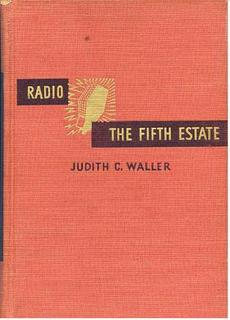
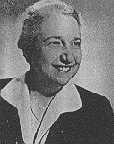
Judith Waller was called Chicago's “First Lady of Radio” You've probably neer heard of her, but she was one of the innovators that combined educational programming and broadcasting. She believed that the new medium should offer more that entertainment. You can also put an asterisk on this as the root idea behind public radio. It all starts here.
She believed that broadcasting had nealy unlimited potential as an educational medium. She developed network programs including the U. of Chicago Roundtable, American Medical Association (AMA) programs, the National Congress of Parents and Teachers series and others. She published a book Radio, the Fifth Estate, in 1946. It's widely considered to be the most thorough text on the broadcast practices of radio's golden age.

We start at a newspaper, the Chicago Daily News, who hired Waller in April 1922 to put its newly licensed radio station WMAQ on the air. This station evolved quickly from a two hour per day schedule with two-person staff into heritage powerhouse wel all know. WMAQ was the home of Amos 'n' Andy and the first station to broadcast a complete home season of a professional baseball team the Chicago Cubs. You can call that the birth of Sports Radio too while you're at it.

NBC purchased WMAQ in November 1931 and Ms. Waller became the director of public affairs programming for the NBC. She held the office for 26 years.

She was born before the last turn of the century, in 1889, and was of the earliest women in radio. Her book: Radio, the Fifth Estate, becomes doubly interesting when you realize that many of the techniques and practices she describes she had, invented herself. In that sense it's autobiographical.

http://www.richsamuels.com/nbcmm/wmaq/waller/contents.html