Wednesday, July 09, 2014
Do Re Mi Fa So La Ti Doremus
His most enduring successful program was "The Passing Parade." It was a series of short radio dramas, but based on true history. He neither wrote nor narrated the program. Actually it was written and narrated by John Nesbitt. You can hear one here. Doremus discovered the program languishing on television and syndicated it to radio. It was counter-intuitive, but he acquired the rights to the series and over 1500 three minute episodes were broadcast in the 1950s.
During the mid-1960s he produced "Patterns in Music" on WMAQ-FM in Chicago. It aired weeknights at 7:00 PM. The syndicated program exploted new hits and amateur teens tryign to sing them. Much reality TV today is based on the same premise. It was later retooled for TV where it was died an untimely death at the hands of disinterested sales clods. The original recordings of Patterns in Music are being aired today by 97.5 KNXR in Rochester, Minnesota.
In 1964, John Doremus Inc pioneered the idea of in-flight music for airlines. the service was called 'Music in the Air" and was the first in-flight audio programming. His first client was United Airlines but soon included others like Braniff, Air Jamacia, Icelandic Air, and Wardair.The project grew to include 14-channels of programming all recorded and produced in-house.
In the 1970s, his company exploded into commercial re-packaged programs. The produced "The Spirit of '76," a radio series for Union Oil Company. By 1979 they also produced "The Innovators" for Amway on NBC, "The Legacy of America" for The Singer Company, This Business of Life and a lot of spokesperson work. He died July 6th, 1995 strangely forgotten for such a prolific content creator.
Friday, January 31, 2014
Art Hellyer is Not Dead
His first show was on WKNA in Charleston, WV in 1947 interviewing auto salesmen. Despite behaving like Art Hellyer, he was not fired from that job. (In his book he actually devotes a whole chapter to what he was not fired for.) It was a theme in his career. His zany behavior got him ratings. WBBM famously fired him over a dress-code violation and then re-hired him. As he told the Chicago Tribune in 1996 more simply that he got fired "a lot."
"...I counted 14 times. It may have been more than that... I always said every one of my battles was over creative control. I wanted to be creative, and they wanted control."
It's hard to say which of his programs was the most important to his career as several of them held the number one slot in one decade or another. In the 1950s his program The Art Hellyer Show aka the Morning Madcap on 1000 WCFL-AM, again on 780 WBBM with his Supper Club shows in the '60s while also doing mornings at WAIT, Then again on WLS-FM in the '70s until they went progressive rock in 1969. He was number one again on 1160 WJJD-AM in the '80s. His time at WOPA straddles some of that doing WOPA Art Hellyer's Memory Lane in the mid sixties.
What probably got his career going the most was his time on on WCFL. There he was given carte blanche for the first time in his career and he more or less ran amok. He offended big sponsors, like Coca-Cola and General Motors but the listeners loved it. In he did spend a few serious on air. He advocated for the seat belts in cars in the 1950s and in 1960 spent time explaining to listeners the importance of the then brand new Polio vaccine to quiet the anti-vaccination nuttters. In 2011 he made another come back of sorts and began Internet radio station Party 934. Not bad for a guy that one quipped that "...the average life of a disc jockey in Chicago is three years."
Monday, November 18, 2013
Everett Mitchell
Everett Mitchell is most famous for his tenure on the National Farm and Home Hour, a NBC program that was on air from 1928 to 1958. Mitchell joined the program in 1932. His trademark line was "It's a beautiful day in Chicago!" He had joined the program after a short whirlwind tenure as a radio singer. He sang on WQJ-AM, WEBH-AM, and WHT-AM all in the Chicago area. WQJ was a short-lived dayshare with WMAQ which was bought out by the latter in bought them out in 1927. WEBH was a short-lived dayshare with WDAP that operated from 1923 to 1928. WHT only was on air from 1926 to 1927. By all appearances that doesn't add up to much experience, but he was also on WENR-AM. More here.
He'd made a small name for himself as a gospel singer, in radio he'd become a lot more. In Mitchells' few biographies it is said that he was first on air in 1923. Most of them fail to note the call letters though it was certainly KYW-AM. The station he would later manage, WENR-AM... signed on a year later. He became it's manager in 1925, he was only 27 years old.
At WENR he had a number of uncorroborated radio firsts: prayer services, holiday programming, children's programming, and what might actually be first first educational program The Air Scouts. Three years later Samuel Insull paid a million dollar for the station. But Insull was in serious money trouble by 1930 and NBC bought the station off him. the great depression had hit him hard, and cleaned out Mitchell as well. the sale was a boon to both. NBC considered Mitchell to be just as valuable as WENR, and put Mitchell in the host chair of National Farm and Home Hour. He stayed with the program for 3 decades.
The Farm Hour was cut to just a small local program called the Farm Forum then incorporated as part of another program Town and Farm. In 1967 the USDA's Great Service to America Award. his replacement Jerry Mitchell (no relation) continued to host Town and Farm for a couple more years. Everett retired that year with his wife to Wheaton, Illinois where he died in 1990.
Monday, June 10, 2013
1160 Club
Garroway wasn't a Chicago local. He was born in Schenectady, NY in 1913. He graduated from Washington University in St. Louis and became a lab assistant. that didn't work out so he tried being a salesman. While pedaling books in New York he had a chance meeting with a woman who ran the pages at NBC. He signed up in 1938 and was running errands in no time. While there he attended NBC's school for announcers. It's been said that he graduated almost dead last in his class; 23rd in a class of 24.
After graduating in 1939, Garroway dumped his page gig got a job at KDKA-AM. He got a reputation there as a roving announcer. He did stories from hot air balloons, a U.S. Navy submarine in the Ohio River, and from inside a coal mine. But in 1941 like many others he enlisted in the Navy in WWII. . While stationed in Honolulu, he hosted a jazz radio show when off duty.
After he returned from WWII, Garroway became a DJ at WMAQ-AM. There he hosted a series of radio programs: The 1160 Club in 1946, the Dave Garroway Show in 1948, Reserved for Garroway in 1952, and Dial Dave Garroway from 1950 to 1953. In 1954 he started another program Fridays with Dave Garroway that ran into 1955. But it wasn't just broadcasting that made Garroway. He also hustled hard to organize jazz concerts, creating what's now described as a "Jazz Circuit" of local clubs in 1947. He brought jazz to a level of prominence in Chicago that it had in few other cities. From 1949 to 1954 he hosted Garroway At Large. a somewhat experimental TV variety program. NBC carried it live from Chicago. In 1951, he became the first host of NBC's Today Show which had had to co-host with a monkey. He stayed on until 1961 despite being bitten by the monkey. He went back to radio and hosted the NBC program Monitor.
He was voted the best DJ in America in Billboard magazine in 1948, 1949, and 1951. He has two stars on the Hollywood Walk of Fame. But despite the success and accolades he suffered form depression. He shot himself on July 21, 1982. He was 69 years old.
Wednesday, January 09, 2013
Daddy-O Daylie
He was a Chicago transplant,born in Covington, Tennessee. He moved to Chicago in 1938 to live with an older brother. the kid had talent, he could rhyme, play piano, and play some basketball. He was even a Harlem Globetrotter. Daylie ended up being "discovered" by a WMAQ legend, Dave Garroway, a newsman and big jazz fan. Garroway met Daylie tending bar at the El Grotto Supper Club in the Pershing Hotel in 1947. (One source says it was the Du Sable Hotel) Garroway told him that he should move his rhyming behind the microphone. By 1948 he had a show on WAIT-AM. By 1955 he was on WGN. More here.
It wasn't long before he started booking shows and doing a little A&R. He got the Ramsey Lewis trio their big break with Argo Records in 1956. He also discovered Nina Simone, and Gloria Lynne. He was a huge proponent of bebop. In 1958 Cannonball Adderly penned an ode to Daylie "One for Daddy-O". That was probably his peak. He went back to WAIT-AM and while there picked a fight with MGM in 1955 over the movie Black Board Jungle. The name Daddy-O is used in the movie, and Daylie had trademarked it in 1948. MGM used the name in a derogatory way and he sued them for Libel asking for $700,000. It didn't go anywhere.
In the 1960s he was on 950 WAAF-AM doing mornings 9:00 AM to noon. In 1967 they changed calls to WGRT. He was cancelled in 1971, then reinstated shortly thereafter. Chicago missed him. They trimmed him back from 2 hours to 30 minutes. They said he talked too much. It was the only jazz morning show left in Chicago. It was old school, and Daylie was old school. In the early 1980s he moved to WJPC-AM which w2s owned by the publisher of Ebony Magazine. They aired a lot of R&B and gospel. Daylie held onto that until about 1986. He died in 2003 at the age of 82.
Wednesday, October 17, 2012
Cliff Arquette's Wild Boat Ride.
He began as a bit-part funny-man hailing from Toledo, OH. He started out doing a vaudeville routine with Lolly Gookins called Cliff and Lolly Nuts of Harmony. He developed a character called Charley Weaver, who was a hapless folksy old man. It caught on. (He later got into a cross-dressing bit that was big for a time.) An issue of Popular Science from 1938 called him a "Radio Comedian" noting that he was playing more than 50 parts in various NBC radio programs. That's a nice early and reliable print source, but it cites no programs or stations!
Below is a partial list of programs he appeared on. I got some from the Radio Gold Index, more from the Encyclopedia of Old Time Radio by John Dunning. I cant' confirm it, but many of those NBC programs were performed at WBCN, the Chicago NBC affiliate. To be honest I can't find 13 programs happening concurrently in the Chicago metro but there are more enough a few to bear this out. His uncredited appearances are surely far greater.
- WGN - Cliff and Lolly, 1933
- WISN - Myrt and Marge, 1933 -?
- NBC - The Fred Astaire (Packard) Show, 1934-1937
- KECA - Hollywood Spotlight, 1935
- NBC - Edgar A. Guest, 1935-1941
- WMAQ - Fibber McGee and Molly, 1936-1954
- NBC Blue - The Jack Benny (Jell-O) Program, 1938
- NBC Blue - The Rudy Vallee (Fleischmann's Yeast ) Hour, 1939
- NBC Blue - Avalon Time, 1939-1941
- NBC Blue - Frank Watanabe and The Honorable Archie, 1939-1940
- ABC - Point Sublime, 1940-1948
- NBC Blue - I Love a Mystery, 1942?
- Mutual - The Adventures of Wild Bill Hickok, 1943-1953
- NBC - The Lifebuoy Show, 1943
- ABC - Glamour Manor, 1944-1945
- NBC - The Dick Haymes (Autolite) Show, 1944-1948
- ABC - Ellery Queen, 1948
- CBS - My Home Town, 1949
- The Dave Willock and Cliff Arquette Show, 1950
- CBS - Lum and Abner Show, 1950
- CBS - The Harold Peary Show, 1951
There is a stretch in his career when he was clearly based in the Chicago area. It starts in 1933 or earlier and running until about 1938 when his career clearly became more mobile. The Chicago river hugs Wacker Drive right through the heart of the city, splitting into the north and south branches at Orleans Street. In that era WGN was in the Drake Hotel on Lakeshore Drive. 14 blocks north of the river—but only two if you boated out and around to the Lake Michigan side. WISN however, is up in Milwaukee. It's a trip not directly traversed by any river route, nor in a time frame allowing one to appear on multiple shows per day.
But WMAQ moved to 400 West Madison in 1928 (today 2 North Riverside Plaza) and that location is 1 block off Wacker drive following the south branch. As of 1935 downtown Chicago had at least 8 commercial radio stations: WCRW, WMAQ, WENR, WGN, WBCN, WBBM, WGES, WHFC, WKBI, and WSBC. WGES was on 2400 W. Madison Street in that era, and the NBC Tower at 454 N. Columbus Drive. I have to say... this at least appears plausible.
Monday, July 30, 2012
The National Farm and Home Hour
The program would continue to run for three decades. It was sponsored by the U.S. Department of Agriculture and American Farm Bureau, 4-H Club, Farmers Union, Montgomery Ward, The Future Farmers of America (FFA) and the National Grange. It's not surprising to see them on a list together, but the program was intended for rural listeners in farming communities. For context try to remember that Rural Free Delivery was only adopted in 1902, and rural electrification only began in 1932. It was a civic-minded era, and the Secretary of Agriculture liked to broadcast the occasional speech from time to time as well.
The program was a true variety show. It had an orchestra, musical guests, comedy skits and a re-occurring park ranger character played by Don Ameche. But it's core was weather and agricultural news which is how the secretary of the Dept of Agriculture coudl act as it's producer. In June of 1945 NBC Blue became ABC and the National Farm and Home Hour moved to NBC as a 30 minute program. It was still being carried on over 100 stations. It remained there until 1958 with Allis-Chalmers as it's primary sponsor. It died with a whimper spending it's last 3 years as a segment on NBC's weekend anthology Monitor. The program was cancelled in 1958.
It's most famous host was Everett Mitchell. He was on the program from 1932 onward. His trademark line was "It's a beautiful day in Chicago!" Mitchell was a former insurance claim adjustor who broke into radio singing part-time at radio station WENR-AM. A belligerent manager made him choose between radio and insurance. He picked the latter. Nemorino writes that over the course of his career he also spent time on WQJ, WEBH, and WHT.
It's hard to find citations but WQJ was a short-lived dayshare with WMAQ owned by the Calumet Baking Powder Company and a local Chicago venue, the Rainbo Gardens Ballroom. WMAQ bought them out in 1927. WEBH was another Chicago station, this one owned by the Edgewater Beach Hotel. WEBH is even more fleeting, a dayshare with WDAP. They signed on in 1923 and were deleted in 1928. (That license became WGN.) WHT was owned by the Radiophone Broadcasting Corporation, in Deerfield, IL a suburb of Chicago. They operated just in 1927 and 1926 as far as I can tell. But it shows that he had at most a few years experience before landing that job as host of the Farm Hour. years after the program ended, in 1967 Mitchell received the Great Service to America Award and retired that year. He died in 1990. Frank Mullen died in 1977 and farm radio continues to wither to this day.
Thursday, May 24, 2012
Floyd Brown wins
Brown was born in Texas in 1930,and moved to Chicago to attend Northwestern University in the 1947. If you're wondering why he went all the way to Chicago for school,. please note that Northwestern was an integrated school ie not segregated. He worked as a porter at the Drake Hotel to pay for school. While in high school he'd considered becoming an engineer. In Chicago his daily commute to the Drake, he went past the the Radio Institute of Chicago. In 1951 he finally enrolled; he took classes in both engineering and announcing.
He got a job that year at 1410 WRMN-AM in Elgin, IL as an engineer. But as is the case, engineers are often expected to step into any job when someone doesn't show up. Eventually he was promoted to chief engineer. He expected a raise, but the General Manager said no. The GM was exploited Brown's lack of career mobility to save money, maybe not because he was a racist, but at least because he was a greedy bastard. This pissed off Floyd Brown big time. In an interview in a 1999 Courier News interview he still had choice words to describe the incident:
"...I was furious enough to strike out in anger... He did that because he knew I couldn't go anywhere because I was black. I got a lump in my throat so big I could hardly swallow. I went out because the tears were coming out. I sat there and I labored with it and I thought, 'I'll show those sons of bitches.'"Brown left WRMN to help start up WYNR, a Chicago rock station but Brown didn't even like rock n' roll. it gave him a headache. What he liked was doubling his salary. But knowing that, it's no surprise he in 1965 to go to WMAQ-AM. That was historical, that was when he became the first African-American hired by a major network because WMAQ was NBC.
Then WGN-AM called in 1971 and made Brown an offer for a Sunday jazz show. He held down that slot for more than a decade.He stayed with the station for almost thirty years. Floyd Brown did a number of different programs. h ehad an afternoon show that some aircheck lists even categorize inexplicably as 'country'. In 1970 Billboard magazine listed his shift as weekdays 1:00 PM to 4:00 PM and 1:00 AM to 6:00 AM. and he was still doing that damn Saturday shift! When was this guy sleeping?
From there he moved to WGN in 1971. He became a sports anchor for WGN-TV. But on 720 WGN-AM he also had a show Sunday nights 11:00 PM to Midnight focused on financial news and investments. That program was followed by his 2-hour jazz program. He interviewed jazz artists like Ella Fitzgerald and Duke Ellington, Lionel Hampton. I've never found an aircheck, but my gut feeling is that it was a bit more of a standards show than a jazz show.
In 1985 started as the host of WTTW-TV’s “30 Good Minutes" A PBS program on personal faith and inspiration. More here. When he finally retired in 1999 he was still doing a program Sunday and Monday nights on WGN and the program at WTTW. Still kicking today he dedicates his time to entrepreneurship and civic organizations.
Monday, April 16, 2012
Mike Wallace RIP
He was born in Brookline, MA and his real surname was Wallik. He attended the University of Michigan, which is how he ended up in Ann Arbor. That will be important in a sec. While he was enrolled as a student, he was a reporter for the Michigan Daily newspaper. It was his first real move toward news. In 1939 he appeared as a guest on the radio quiz show "Information Please." He was a senior at U. Michigan at the time. After graduating he was hired as an announcer at WOOD, but eventually was allowed to do some news casts. He must have done OK because in 1940, just 9 months later, he moved to Detroit for another newscaster job at WXYZ-AM.There he was not just a newscaster but also a voice actor on daytime dramas and action programs. He left WXYZ for a job as a news writer at the Chicago Sun but left in 1943 to enlist.
In WWII he served as a communications officer on the submarine tender, the USS Anthedon. After WWII ended he was discharged and returned to Chicago in 1946. He landed a job as a reporter at WMAQ-AM where later he and his 2nd wife Buff Cobb had a night talk program live from a night club. That show must have caught somebody's ear because CBS grabbed it and tried to convert it into a daytime talk TV program in 1951.Accounts vary on it's end. Some say divorce in 1955 others record an earlier end in 1953, or 1954. It didn't matter, Mike was already hosting schmaltzy game shows including The Big Surprise, Who's the Boss? and Who Pays?.
But that was the end of the fluff programming. In 1956 he got a night interview program on WABD-TV called "Night Beat." It did well enough that he reworked the formula into a new program in ABC "The Mike Wallace Interview" which debuted in 1957. After that it was all about TV news. Well that and about 10 years of Parliament cigarette advertisements. He hosted so many of those ads for so long he had trouble getting back into news. He ended up talking a job in 1963 as an anchor in KTLA-TV. In 1965 he became the morning anchor of the CBS morning news, then a correspondent for the CBS evening news, and in 1968 he started 60 minutes where he stayed for another 37 years.
Thursday, August 12, 2010
Schmaltz In The Air
He started his own ballroom dance band in 1926. His orchestra started playing the venetian room of the Southmoor Hotel in Chicago. That was significant. Ballrooms were a good gig, but hotels were a regular paycheck. In 1928 his band began playing at the Metropole Hotel. (This venue was also the headquarters for Al Capone.) In 1929 he broke into radio. His own Castles in the Air program debuted live at Al Tearney's Grand Auto Inn. It was at Grand Boulevard and 35th street on the South Side of Chicago.This was a live broadcast for WBBM.
That attention got them a gig at a bigger venue before the end of 1929. They were playing at the Terrace Casino room of the Morrison Hotel, still on WBBM. In 1930 they moved to the even bigger place, the Walnut Room at The Bismark Hotel. But I feel the need to remind you that the music was lame. In his book That Toddlin' Town: Chicago's White Dance Bands and Orchestras, Charles Sengstok described the situation thus:
"Since most dance bands sounded alike in those days the challenge for an orchestra broadcasting frequently from one dance venue or another was to develop a special sound that would quickly identify it to listeners. bands introduced theme songs and tag lines The Musical Gems Of Ray Pearl" or "Art Kassel And His Kassels In The Air." But more than that, they hired arrangers to give their music a distinctive sound, which often resulted in music with more style than substance."In 1933 they were playing twice a day on 670 WMAQ-AM; once at 7:15 and again after 12:30 PM. That show was carried on the NBC Red Network. In the 1940s they moved the show to The Aragon Ballroom and WGN-AM carried the program. Then on tour in 1940 they did a set of shows on WOR-AM. On December 22nd, 1944 they returned to the Bismark Hotel still live, but still with WGN-AM. But that was just home base, they toured every year not taking a break until 1952, that's 25 consecutive years. In that time it's also worth noting that one of his vocalists, Billy Leach had his own radio career that took off. I'll have to write about him another day.
In 1951 Art moved to Encino California where he appeared for two years with a new orchestra on a local television program, The Gloria Hart Show. He never went back to radio. He died in 1965 of cancer.
Thursday, April 22, 2010
Chez Show and the Copacabana
The Copacabana Lounge first opened November 10th, 1940. The club was located at 10 East 60th Street in NYC. The owner officially was Monte Proser but the club was in bed with mob boss Frank Costello. Costello installed Jules Podell as his man inside the business. Eventually Podell was the name on the lease.Jack's broadcasting career began a decade earlier at WMCA-AM where he delivered a radio version of a Broadway gossip column he wrote for a New York theatrical publication. Variety claims a plug in an Ed Sullivan column landed him this gig.
But the Copa gig began in 1947. Eigen had a program on WHN cut a deal with Copa boss Jules Podell to do a radio program. It was to be broadcast live from The Copacabana Lounge, one of New York's busiest nightclubs. Podell made arrangements with 1010 WINS-AM to carry it. The whole program was done with 2 turntables, 2 microphones and 2 phone lines. The program ran midnight to four AM, seven days a week. It debuted April 22nd, 1947. Eigen's theme song was "Jack, Jack, Jack" performed by the five DeMarco Sisters. (Interesting to note that in 1944 the club had a no blacks policy, banning African-Americans from the venue and thus the radio show). More here. Fred Allen regularly mentioned Eigen on his broadcasts, adding to his reputation beyond Manhattan. More here.
The program ended in 1950. The Copa started a new show that diminished the role of the disc jockey. New Host Johnny McKnight started in October of 1950 and the new show "Meet me at the Copa" via WVNJ-AM in New Jersey. By Then WINS had backed out and Eigns program was on WMGM. n Chicago Eigen's did a program called "Chez Show" on 670 WMAQ-AM. It was love from the Chez Paree restaurant was was 30 minutes long and ran 6 nights a week. It was similar to his Copa program and began sometime in 1951. More here.
He worked a year in St. Louis radio. Then returned to Chicago in 1960 to resume The Jack Eigen Show on WMAQ. He stayed there until at least 1966. he relocated to Florida in 1971 where he continued to broadcast on local stations. I wish I could say witch ones. He died in Fort Lauderdale in1983. Not bad for a kid from Brooklyn who started out as a pin setter in a bowling alley.
Thursday, October 15, 2009
Radio Music Lessons
"Joe started giving music lessons by radio from Ann Arbor. Nineteen hundred thirty-one was a time long before educational programs on radio and television came into vogue. The University's Director of Broadcasting had first asked Joe to give lessons in music appreciation."In 1928 he began the National Music Camp in Interlochen Michigan. There, in 1932, Joe began teaching music classes by radio. By 1936 Joe was doing
five shows a week. Four of these were from WJR at the University of Michigan over Station in Detroit. The fifth was at WMAQ in Chicago. His WMAQ gig continued for 3 years on the NBC Blue Network. Hundreds of thousands of people were listening and learning.Then James Caesar Petrillo stomped all over it. Petrillo was the head of the American Federation of musicians. Petrillo threatened to organize a strike of all NBC musicians if the program continued. Joe knew Petrillo from his days as the head of the Chicago musicians Union. It was no idle threat. Joe of course had king-size balls and put together his own orchestra of students and scabs. He threatened to tell the world about Petrillo's maneuvers and his friends all counseled him to stand down.
Joe took even odds on the broadcast and steered clear of the loaded topic. Instead he tried to negotiate peace through the Louisville AFM. Petrillo intervened and at a closed door meeting Joe Maddy'd proposals for conduct which while initially well-received got a verdict of inaction. Ultimately NBC picked up the union tab. Eventually The FCC and the Department of Justice got involved, but just the same Joe and James would be at war for 14 years. More here.
Petrillo went after Joe because his orchestra, even though hosted by a school, made a profit. The justice department disagreed and said they fit the definition of a a non-profit educational institution. Petrillo was so pissed he extended the ban to all non-coms. He was way past winning the war. he had fixated on this single battle with Joe. Whatever greater goals Petrillo had set out with.. he had lost sight of them. Senate hearings began. Joe circulated pamphlets accusing Petrillo of being a fiat dictator. More here.

A bill was written by Senator Vandenbergn protecting the rights of the non-commercial license. The the Lea Act, then the Lea Act passed a legal challenge. then they had to go to the supreme court. Petrillo was furious. He kicked Joe out of the union. He banned AFM musicians from teaching at the school in Interlochen where Joe's program resided. It was a phyrric victory. the overt abuses of power unmade himself. Eventually the day came when Petrillo himself had to take the stand and defend his actions. The Supreme court upheld the Lea Act. In July of 1947 Petrillo finally consented to the law and lifted the ban.
1948, Maddy went to NBC seeking to resume the program but was rebuffed. Mutual Broadcasting had to such qualms. But after only a week Mutual backed out. Petrillo was still out there and Joe was still on the Union blackball list. In 1963 Maddy fully realized the dream when His School at Interlochen founded Interlochen Public Radio. WIAA 88.7 FM is still on the air today.
Maddy died in 1966. The National Music Camp is now known as the Interlochen Center for the Arts. He is audible by voice on a CD released by the Center in a farewell from May 11th 1937.
Tuesday, February 20, 2007
WMAQ, the innovator
1160 WMAQ-AM is a pioneering station. They are Chicago's oldest station, starting its first broadcast on April 13, 1922. WMAQ Radio signed off permanently on August 1, 2000, with the final playing of the NBC chimes at 6:00 AM. In the interceeding 78 years they had a lot of firsts.My favorite was The first trans-oceanic news broadcast in history (1928.)
They presented the first music appreciation program on October 12, 1922. It was a series of broadcasts analyzing the opening program of the Chicago Symphony Orchestra. That same year they ran one of the first children's programs. It was called Hearing American First and was hosted by Mrs. Oberndorfer.The success of the program led to a second childrens program with Miss Georgene Faulkner, "the Story Lady" and her "Mother Goose" broadcasts. The next year they began the first educational broadcasts. Not actually classes like on AMRAD, but on November 28, 1922, Prof. Forest Ray Moulton, lectured on astronomy.
In 1925 WMAQ also ran some of the first sports broadcasts. They presented the first daily play-by-play descriptions of major league games ever. The first of these was the Pittsburgh Pirates Vs. the Chicago Cubs. In 1945 WMAQ pioneered the use of the wire recorder for
commercial broadcasting and is the only station that ever presented a daily spot news using the recorder exclusively. Most peopel didn't do that because the device was ridiculous. More here.On March 26, 1925 WMAQ also took part in what is believed to have been the first commercial network broadcast. It was the first of a series of concerts presented by the Victor Phonograph Company over an improvised network of some 20 stations scattered between WNBC in New York amd WMAQ in Chicago. More here:
Monday, September 25, 2006
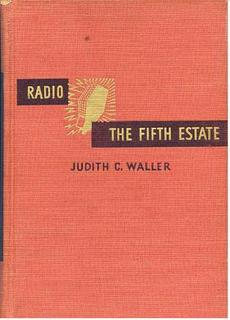
Radio The 5th Estate

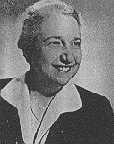
We start at a newspaper, the Chicago Daily News, who hired Waller in April 1922 to put its newly licensed radio station WMAQ on the air. This station evolved quickly from a two hour per day schedule with two-person staff into heritage powerhouse wel all know. WMAQ was the home of Amos 'n' Andy and the first station to broadcast a complete home season of a professional baseball team the Chicago Cubs. You can call that the birth of Sports Radio too while you're at it.
NBC purchased WMAQ in November 1931 and Ms. Waller became the director of public affairs
programming for the NBC. She held the office for 26 years.She was born before the last turn of the century, in 1889, and was of the earliest women in radio. Her book: Radio, the Fifth Estate, becomes doubly interesting when you realize that many of the techniques and practices she describes she had, invented herself. In that sense it's autobiographical.
http://www.richsamuels.com/nbcmm/wmaq/waller/contents.html
Wednesday, August 30, 2006
Radio and Ray Charles
Lots of radio stations play Ray Charles today, his hits are a staple at the oldies format, urban oldies, and even some of the better Urban AC outlets. His rendition of "America the Beautiful" is played at sign off all over the country. His song "Georgia on my Mind" is the official state song of our 23rd state. ...And really, after the movie "Ray" who doesn't like Ray Charles?
And what the hell does this have to do with radio? In the 1940s he spent some time as talent on 1240 WFOY-AM, then just a 250 watt daytimer, but still a CBS radio affiliate. In 1948 he and his Maxin Trio did a few pay-to-play 15 minute spots on KRSC in Seattle. KRSC actually launched an FM stick in 1947, and it was on this brand new FM station they played. After that he used radio more to record than to broadcast.
When Ray Charles' career first began there were not a large number of recording studios around. Recording was expensive and most artists couldn't afford to cut a demo for vanity's sake. While he was on Atlantic records, studio time wasn't really an issue. But he still was using some odd ball studios. Atlantic records was an indie label. It was a move up for him, but he also became their first big artist. Ray Charles' early singles made him the bread winner for that label. Before he made it, they were nothing special. He outgrew the label quickly and moved over to ABC.
So, Ray got started in radio, not as a DJ but by recording his early singles at radio station studios. In Atlanta, Chicago and New Orleans.The classic "Rays Blues" was recorded at WDSU-AM in New Orleans in 1953 as were many other sides. I got a woman was actually recorded at WGST-AM in Atlanta (still owned by Georgia Tech at the time, ...and 4 sides were put to tape WMAQ-AM Miami.
![]() |
| Not this WGST, the other one. |
It was Zenas "Daddy" Sears, then only a local Atlanta deejay, got studio them time for on WGST they recorded some of his all-time classics including I've Got A Woman, Greenbacks, Come Back Baby, and Blackjack. The only reason Ray was in the WDSU studio is that Cosimo's was booked. He still managed to lay down a killer version of Don't You Know with a backing band of hired hands. More here, and here. Sears went on to buy WOAK in 1956
Friday, August 25, 2006
WOMEN in RADIO (pt. 6 BONUS)
Irna Phillips earned the title “Queen of the Soap Operas.”
Born in Chicago in 1901, youngest of ten children, legend has it that Phillips endured her poverty-stricken, lonely childhood by reading and concocting elaborate lives for her dolls. In college she tried her hand at acting. But as they say (those that can, do. Those that can't...)
So she turned to teaching. After graduation, she taught in Missouri and Ohio for several years before returning to Chicago. She fell into a job at There she fumbled her way into a job at WGN doing voice-over. She got lucky and after a few months she was asked her to write a daily program "about a family."
That program became "Painted Dreams" and debuted in October 1930. It has since been recognized as the radio's first soap opera. Phillips wrote and perfromed in the program until 1932 when she left WGN over an ownership dispute. It was a big fight, She wanted WGN to get the program syndicated. Topted not to. It was a power struggle. The ability of the program to seell product was proven. Apparently her boss found her threatening... When they refused Phillips took them to court claiming the show as her own property. Terms of the dispute were settled and sealed... (When Painted Dreams emerged from the courts and was purchased by CBS. )
She crossed the street to WMAQ. There she created "Today's Children" which aired for seven years, and was massive hit on NBC radio ...because WMAQ was ready to syndicate from mthe get go! At WMAQ making money mattered more than personal crap. [somebody at WGN wasn't confident enough in their masculinity] It was followed by a strong of other successfull radio dramas: The Guiding Light in 1937, The Road of Life in 1938, The Right to Happiness in 1939.
She had to give up acting to full-time radio wirting. She had also sold the shows to national networks. She got famous. In 1949 Phillips created the first serial broadcast on a major television network, These Are My Children. The show, tanked. It ran on NBC for only a month.
Phillips returned to TV in 1952 with The Guiding Light in 1952, with The Brighter Day following in 1954. These shows did great. She had learned how to write for the new media. The Guiding Light (later shortened to Guiding Light) remains on the air to this day, making it the longest running program in broadcast history.
However, she has long been known as "hard to work with"
-Phillips fired lead actress Helen Wagner because Phillips said she did not like the way she poured coffee.
-Phillips also fired actor John Beal from Another World one episode because she "didn't like the way he looked
-She demanded her actors, even the stars never go by their real names in public.
-She has also been rumored to have driven some of her stars into thearapy and nevervous breakdowns.
...she's also been called a raving bitch... but she made history but so has synvia Rhone. When a woman makes history in a man's world maybe they need to push a little hard. She retired from soaps completely in 1973 and died later that year. Ever the control freak, Irna had requested that her family not write an obituary upon her death
Recollections of Irna in her final months can be found in Harding Lemay's 1980 memoir, Eight Years in Another World.
Tuesday, August 22, 2006
WOMEN IN RADIO WEEK pt 2
The radio serial Fibber McGee and Molly premiered in 1935. The program struggled in the ratings for 5 long years. When suddenly in 1940 it started picking up steam, in three more years it was the top-rated program in America. (free mp3s of the program here)
Marian Driscoll was a genuine coal miner’s daughter, was born in Peoria, Illinois on November 15, 1898. She toiled and touring in obscurity for years on the small-time show biz circuit with Fibber eventually arriving in Chicago in 1924. It was there in the sindy city that broke into radio. They eventually performed on thousands of shows and developed 145 different voices and characters.
Broadcast to the nation from WMAQ-AM Chicago, the show entertained America for 19 years. Running on WMAQ-AM until March 1956, and then moving to NBC’s Monitor until 1959. Somewhere in the mid fifties the program was cut from 30 mintes to fifteen.
The program was sponsored by Johnson's Wax for most of its long run. Don Quinn, a former cartoonist was the writer of the series. He wrote the sponsors into the script where possible creating some of the earliest product placements in brodcast media history. Marion's poor health prevented her from working much in her later years, and as a result Fibber McGee and Molly ended while other radio serials were making the leap to TV. It was briefly on television with different actors playing the lead roles, but no one could capture the chemistry of Jim and Marion. It tanked.
NBC kept transcription discs from most of the programs that S.C.Johnson's Wax sponsored. Many of these have become available for sale. More than 700 complete shows are currently in the hands of collectors. Marion died in 1965. the notion that people have these old radio serials on their goddamn ipods is very peculiar to me. but it's true.
http://www.athenamama.com/cgi-bin/mt/archives/000055.html
Monday, August 21, 2006
WOMEN IN RADIO WEEK pt 1
The character Ma Perkins was kind and sometimes trusting to a fault. She offered homespun philosophy to any and all who needed it, including her children Evey and Fay, Evey’s husband Willy and Ma’s business partner, Shober. The show was the brainchild of soap opera creators Frank and Anne Hummert. Payne, was only 23 when Ma Perkins first went on the air. She continued to play the title role until the show ended 27 years later. It was one of the longest, running radio dramas ever broadcast. It was imitated for decades, thus paving the way for modern soap operas
It was sponsored by Proctor & Gamble under their dishsoap Oxydol (later Lava Soap). The show ran on NBC and CBS until 1960. Under NBC is ran on both Red and Blue network staitons [47 NBC Red stations, 10 NBC Blue stations] At it's peak of popularity it was airing in Canada and all over Europe. Virginia Payne died on February 10, 1977. She and Ma Perkins were inducted into the Radio Hall of Fame in 1988.
The shows are still available here: http://www.oldtimeradiohome.com/Ma_perkins.htm