Showing posts with label KYW. Show all posts

Monday, October 13, 2025

The Pure Oil Band

Edwin F. Goldman 1929

The Pure Oil Program is a bit obscure but it actually hosted Al Jolson's first radio appearance in 1929. So who was this band which launched such a legendary radio career? In the 1920s it seemed like every sponsor needed to have their own radio band. The book And now, a word from our sponsor, by Dorothy Hoober remarks on the 1920s convention: 

"Each program had its own musical group, and they were some times named after the sponsor of the program. Fran’s favorite was a banjo band called the Cliquot Club Eskimos. Cliquot Club was a brand of ginger ale. The Parkers also listened to the A & P Gypsies, the Pure Oil Band, and the Firestone Orchestra."

In the University of Iowa "Goldman Band Library" is a radio script from the Pure Oil Program as it aired on WJZ on November 11th 1925... almost 100 years ago. I'd love a scan but I don't have plans to go to Iowa this year. Short of getting that transcript, let's piece together the story.  

The first clue there is that the document is in the Goldman Band library. That would be Edwin Franko Goldman. (Sometimes spelled Franco) He was born in 1878. According to Boyd B. Perkins, "He first formed the New York Military Band in 1911 with the goal of employing the finest musicians and repertory possible."  That sentiment is echoed in a 1929 Union Banner article on the band:

"Every member of Mr. Goldman’s celebrated Pure Oil Band is a finish¬ ed solo artist on his particular instru¬ ment, and the ensemble has played together for a good many years. Many of the radio audience who have heard Mr. Goldman’s Band on con¬ cert tour, we believe will find in this weekly Saturday evening program the fulfillment of their desire for fine band music and will dial in any of the following stations Saturday evening: WJZ, WJAX, WBT, KDKA, WLW, WRVA, WSM, WMC, WBAL, WHAS, WJR, KYW, KWK, WREN, WEBC, KSTP, WTMJ, WHAM, WSB."

Previously Goldman had played trumpet in New York municipal bands which performed at the New York City parks and piers. Goldman felt that the musicianship was lacking in some of these groups. He gathered musicians he felt were the leading wind instrument players in New York City to discuss  forming a New York Military Band. After a number of private engagements, the new 40-member band began playing public shows on the Columbia University green in 1918. 

In 1923 construction forced their move from Columbia to the Mall in Central park. Starting in 1924 the Guggenheim family donated 76k to make the programs free to the public. The first show of that season attracted an estimated 30,000 people. That year they began broadcasts on WJZ and WGY. By 1925 WEAF was broadcasting them remotely and NBC began broadcasting them on their then fledgling network. They probably had 150 million listeners by 1928.

In 1929 the New York Times published an article quoted an unnamed NBC representative that the Goldman Band was "the victim of commercialism this season" Fewer program sponsors had signed off for the Summer season." there would not be three weekly concerts by the band, as it had been in 1928. Goldman still had a contract with WJZ with Pure Oil for a half hour on Tuesday nights, but he was retreating from radio. But WNYC did still broadcast their show from the park on Wednesday nights. It's clear that this incarnation of the band still broadcast as the Pure Oil band into November of 1929. 

Edwin's son, Richard became conductor in 1956 following his fathers death. The band also changed their name to the Guggenheim Band after their long time sponsor.  The live programs in the park continued until 1969 when they were moved to the Lincoln center for safety reasons. When the Guggenheim withdrew their funding the band name changed again to the Goldman Memorial Band.  The band finally broke up in 2005, now having no original members over private fund raising and a negotiating stalemate between the band's negotiating committee and the board of directors.  

Curt Peterson 1928
The NBC announcer for the program was Curt Peterson. He also did CBS Radio Mystery Theatre, Jones & Hare: the Interwoven pair, Collier's radio Hour, The Gillette Program, The Atwater-Kent Show, The Dutch Masters Minstrels. He was born in 1898 and other than a story about his bad handwriting, little is recorded about him.[SOURCE]  Peterson announced for Radio Mystery Theatre in 1975 when he would have been 77 years old. There are several other Curt Petersons, including the founder of Sabina records, and an engineer at KOVR to name a few. the disambiguation makes it difficult to track his career. But he does appear in the book Golden Throats and Silver Tongues. I did find a head shot from a 1928 radio mag. (above) 

That New York Times article seems to put an end date to this radio tale. But then I found some loose ends... It appears that in 1930 Pure Oil chose to sponsor a new band.  In the 1931 Chicago News daily Radio Station Directory [LINK] it lists Wayne King's Pure Oil Band on KYW. Those references start in 1930. [SOURCE]  The Encyclopedia of American Radio doesn't record an end to the program either. Strangely they call it a The Pure Oil Brass Band, no other attribution.  The Encyclopedia of Old Time Radio makes a passing reference under Richard Himber on the Pure Oil Hour with Eddie Peabody but that was just in 1933. Himber went on to provide music for The Spartan Hour, The Studebaker Champions, Thirty Minutes In Hollywood, and Melody Puzzles into 1937.  In 1935 Pure Oil sponsored the Vincent Lopez orchestra, but I think the band name was effectively dead by 1933.

Monday, April 16, 2018

The Legend of Chickenman


Chickenman was an American radio series created by Dick Orkin. It spoofed adventure books and comic book heroes. The series was created in 1966 and originally aired on 1000 WCFL-AM, in Chicago, IL. It began as part of the Jim Runyon Show.  The show's protagonist, Benton Harbor, (presumably named for the Michigan town) was a shoe salesman who spent his weekends fighting crime. He also he hangs around the Police Commissioner Benjamin Norton's office and annoyed the Commissioner's secretary, Miss Helfinger.

CHARACTERS:

  • Benjamin Norton, Police Comissioner, -  Dick Orkin
  • Miss Helfinger, Comissioners assistant  - Jane Roberts
  • Chickenman, Benton Harbor - Dick Orkin
  • Chickeman's mother, Mildred Harbor - Jane Roberts
  • Trooper 36-24-36 - Jane Roberts
  • Narrator - Jim Runyon

Each episode began with a four-note trumpet sound from the song Thunderball and Chickenman's Buck-buck-buck-buuuuuck" chicken call. Orkin expected to run with the gag for two weeks. The original series eventually lasted over 5 years! That original 1966 series was released in 2003 as The Original, Complete & Unexpurgated Story of Chickenman, all 273, 2.5 minute episodes in a 14-CD set. Yes it is that popular. This was presaged by the 1966 LP The Best of Chickenman, released first on Spot records then ATCO. More here. Many LPs and posters read "exclusively on..." then a set of local call letters. There was nothing exclusive about Chickenman. By some reports, at it's peak the program was syndicated on 1,500 radio stations.

While the series was the brain-child of Dick Orkin he needed people to voice the parts.  Jane Roberts, a Chicago theater actress who worked at WCFL as the traffic reporter voices almost all the female parts in the series. Dick handled most of the men, Jim Runyon was the narrator. Jane's background was mostly in theater: Kraft Suspense Theatre, and a stretch at the Goodman Theatre in Chicago. Runyon has already been a DJ on WBHT, WHTN, WLW, WLWT, WTVN, WLWD, and KYW before he made it to WCFL.

Orkin began his radio career on WKOK in Sunbury, PA as a teenager. He worked part-time at WGAL while attending Franklin & Marshall college  He graduated in 1956 with a BA in speech and theater and headed for the Yale School of Drama to earn an MFA. He returned to Lancaster in 1959 to be the news director at WLAN. [SOURCE]  He headed off to KYW (back when it was in Cleveland) in 1963. He remained there until In 1967 when he moved to Chicago to work on WCFL. Runyon had already been there for 2 years. Runyon went back to KYW (then WKYC) in 1969. The two had worked at both stations together.

In 1973, Orkin began producing 52 special weekend episodes called Chickenman vs. the Earth Polluters. In 1976, a special LP was created by Orkin and ad man Bert Berdis: Chickenman Returns. This was followed by 65 episodes of an updated radio show in 1977, Chickenman Returns for the Last Time Again. In 1995, for the 30th anniversary of the series, Orkin brought Chickenman out of retirement for a tribute episode on This American Life. This was all in addition to the original 195 episodes. The man was nothing if not prolific.

Weirdly Chickenman never really went away. It is still played on a number of stations regularly AFRTS, 99.3 KPCH in Ruston, LA; 103.3 WFJV in Crystal River, FL, 101.1 WVRE in Dubuque, IA; 1430 WION-AM, Ionia, MI... a couple Canadian stations, and inexplicably several stations in Australia. For these feats and others, Dick Orkin was inducted into the National Radio Hall of Fame in 2014.

Wednesday, November 25, 2015

Specs Howard not Howard Specs

Howard Specs enjoyed a 22-year career on Cleveland radio, and later Detroit, as one-half of the duo "Martin & Howard" throughout the 1950s and '60s. As if that wasn't enough, he founded a broadcasting school in 1970. In a narrowing field of increasingly obsolete broadcasting schools, his continues to survive; re-branded as The Specs Howard School of Media Arts.

For the record, his real name is Julian "Jerry" Liebman. His stage name "Specs" reportedly originated at KYW in Detroit as a reference to his horn rim glasses, the surname Howard was just random... supposedly form a phone book. But he started his career in Kittanning PA, by raising $15,000 dollars to start his own radio station in 1948. In 1951 he relocated to Sharon, PA to work at 790 WPIC-AM. His own biography downplays those first two radio stations. They focus on his very successful times at KYW. It doesn't mention his own station at all, and omits the call letters of WPIC. Actually I had to go back to an issue of the Simpson's Leader-Times newspaper form 1958 to get those calls. Already by then his own station appears to have been deleted. Also note he didn't' go it alone.
"A native of Kittanning, PA, Jerry was graduated from Allegheny College in 1948 and Immediately after, he and two friends started their own 3,000-watt radio station (now extinct) in his home town..."
Then I found the call sign in the classified's section of the weekly magazine Broadcasting back in 1948. They were looking for a commercial manager. Radio station 1600 WKIN-AM broadcasting with 1,000 watts. Some sources (above) list it at 3,000 watts or even signing on as late as 1949. It is also reputed to have been the third station on air in Armstrong county after WACB and WAVL. Regardless it appears in both the 1949 and 1950 Broadcasting Annuals as owned by "WKIN, Inc." located at 122 N. Jefferson Street. Julian Louis Leibman was president and GM, Ernie Klein was PD, Ben A. Franklin was Chief Engineer, Larry Caldwell was Promotions Manager. I expect those were his co-founders. With all that information it was not hard to find the July 21st 1948 FCC docket # 8719 announcement approving his application for a new AM daytimer. There are no records of the station after 1950 so I presume it was deleted.
In 1951 Howard was off to WPIC in Sharon so that at least fits the timeline nicely. He had a degree from Allegheny College in Meadville, PA and 2 years of experience trying to run his own radio station. In 1954 he left PA for a gig at NBC network affiliate WTAM in Cleveland. Two years later, as “Specs Howard,” he became a Cleveland radio legend, remaining on-air until 1967. Westinghouse bought WTAM in 1956, renamed it KYW. In 1962, he joined up with with Harry Martin, launching The Martin and Howard Show, WXZY in Detroit.  The show only aired for about a year in the motor city and was cancelled. After the station pulled the plug, Howard  went back to Cleveland for a slot at at 1100 WKYC-AM. Harry Martin, the other half of the once number-one rated duo went to San Diego, where he worked at 1170 KCBQ-AM and 1460 KPOP-AM. Howard opened his eponymous school in 1970 and left broadcasting.

Friday, February 14, 2014

Halloween Martin

Halloween Martin was, by most definitions, the first female disk jockey, and quite almost certainly the first in the Chicago metro. She was a former newspaper reporter in the home economic department of the Chicago Herald Examiner Newspaper. She was hired by KYW-AM in 1929 and a year later they made her the host of the Musical Clock. This was a decade before the term disc jockey was coined in the 1940s. Her program was a morning show and she wasn't just an announcer... the format of the program made her one of the first modern DJs ever.  A 1929 issue of radio Digest wrote a little more about her background:
For two and a  half years her time was occupied answering the home decoration problems  that came to the Prudence Penny department, writing her columns and giving her daily Radio talk on interior  decoration. Lectures at cooking schools  and clubs added variety to the daily  grind.

Miss Halloween Martin, was just a 28 years old DePaul University grad with some news paper experience. She gave the time, temperature and weather every 5 minutes from 7:00 AM to 9:00 AM.   The program intermixed segments of music, news and chatter on a schedule like modern commercial radio. At the time tightly scheduled  programs based on an hour "clock" were not yet the norm. The show was certainly tailored after the Alarm Klok Klub on KJBS-AM. Most of these programs seems to descend from Rambling with Gambling"which was also called "The Musical Clock" on WOR-AM in NY. That program debuted in 1925.  In 1931 the Schenectady Gazette wrote the following regarding Miss Martin:
"Listeners-in arise, dress, boil their breakfast eggs and catch the 8:15 to the accompaniment of cheery though persistent time bulletin's sent out on KYW'S musical clock by Halloween Martin. Every five minutes from 7 to 9 O'clock each morning, announcement of the exact time punctuates the program of phonograph records. Miss Martin has been the "clock" for two years, graduating from a series of talks on home decorating. which developed from her writing of household helps for the Chicago Herald-Examiner..." 
It's a tad condescending but you can tell the writer is still equating her with an announcer. Other contemporary articles continually describe her as "cheery," and/or "charming." The program ended when KYW-AM moved to Philadelphia. It was relaunched on WBBM-AM in 1934 due to it's local popularity. There the program stayed for 10 years then moved to WCFL-AM for another two before ending it's run. Through most of those years the show`s theme was a piece called "ln a Clock Store."

Thursday, December 05, 2013

The Philco Radio Dial tells All


This is a picture of a nice old Philco I saw at a yard sale. What's interesting about old radio dial presets is that you can use them to determine where the radio came from, and how old it is even without the model number of the radio. The stations listed here are  WOR, WEEU, KYW, WHUM and WRAW.

From even that short list we can limit our time line. 710 WOR-AM signed on in 1922, and is still on air so that's not useful. They encompass the entire consumer-grade history of radio. KYW-AM is in the same bucket. At first I thought WHUM was actually WHOM, but there was actually a WHUM in reading, PA. WHUM-AM changed calls to WAGO-AM in late 1986 and then WIOV-AM in  about 1990. So we know this device had to have been set up prior to at least the mid 1980s. Seems late but you'd be surprised.

The real  deal closers are WEEU and WRAW. There is a 1340 WRAW-AM in Reading today; where they have been since before 1950. WEEU has a tenure in reading just as long.  So what we have here are two clear channels stations audible anywhere in the north east (KYW, and WOR) and three much smaller AM stations providing local service to the Reading area. I'm pretty confident this radio spend most of it's life on a kitchen table in Reading probably prior to 1960.

Thursday, February 16, 2012

Nocturnal Nighthawks

The story starts with the Coon-Sanders Original Kansas City Nighthawks.  The orchestra began broadcasting in 1922 on WDAF-AM. At the time they were a share time on 730 AM with WHB-AM. They were broadcast live from the Muehlebach Hotel, which still exists today. More here. The group started in 1919, as the Coon-Sanders Novelty Orchestra.  There's nothing racial about the name, Mr. Coon is Carleton Coon and Sanders is pianist Joe Sanders. They took the name Nighthawks because their program aired late at night an approach they took around the country with them on tour in 1924. They first played in Chicago on KYW-AM. More here.

The group left Kansas City for the first time in 1924 for a three-month engagement in a roadhouse in Chicago. WBBM specialized in local, live programming, including a station promotion called the "Nutty Club." With over a million listeners in the US and Canada wiring, phoning or writing in for membership, it was clear that Program Director Charlie Garland, aka "Colonel Nut," and his crew had something good going.Guy Lombardo and the Royal Canadians, who were named as the official "Nutty Club" orchestra. I'll quote teh St. Petersburg times from 1927...
"...the Nutty Club of WBBM, the Stewart-Warner Air theater known from coast-to-coast for its "Cuckoo Signal" and the other is the orchestra that has made insomnia a famous indoor sport Coon-Sanders Original Kansas City Nighthawks. Under an arrangement just completed this orchestra is to broadcast exclusively over WBBM by remote control from the Blackhawk Grill; Chicago. It will be heard during the three weekly sessions of the Nutty Club, which start at midnight Wednesday, Saturday and Sunday Nights."
They actually played quite regularly on WBBM and were syndicated coast to coast on CBS after 1928. A 1926 news article described them as playing nightly there at 8:00 PM and again from 11:00 PM to Midnight Tuesdays and Thursdays. the band recorded a large number of sides for Victor, and at lease a few furtively for Vocalion. In 1928 Henry Sellinger made them an offer to bring their late night shindig over to WGN-AM. For the next twenty years they performed at the the Blackhawk Restaurant live on that Chicago Tribune radio station. More here.

In 1932 Carelton Coon came down with a jaw infection and died. He was only 38 years old. Joe Sanders tried to keep the band together, but failed. He started his own group and stayed in music until his death in 1965. The band is celebrated annually at the The Coon Sanders Nighthawks Fans' Bash in in Huntington, WV. Why it's not held in Kansas City or Chicago... I have no idea.

Monday, November 28, 2011

The Alarm Klok Klub

 That this show ever existed at all is baffling, that it ran for 30 years is even more unusual, that there were others just like it is inexplicable. Because of his tenure on the program, it's host, Frank Cope is recognized by some as the nation's first disc jockey. In 1930, KJBS-AM was purportedly running an an all-music format. That sounds non-specific by modern standards, but things were different then. KJBS-AM was an oddly licensed station, with two tower sites.  It wasn't granted authorization to operate full time at 50 kw until 1977. So the Alarm Klok Klub didn't sign on in Hayward until 5:00 AM, but it ran until 8:00 AM.  Like a normal daytime the station signed off at sunset. But then they signed on again from San Francisco at 10:00 PM, and off again at 3:00 AM. [info courtesy of David Kaye] This was to avoid interference with WTAM. More here.

The Author of Raised on Radio, Gerald Nachman grouped the program alongside the Milkman's Matinee, and with other early DJs like Jack Sterling, John Gambling, Al Jarvis, and Peter Potter.Frank Cope  was born in Utah, and had previously worked at KLO-AM, which signed on in 1929. He started on "The Alarm Klok Klub" on San Francisco's KJBS on March 3rd, 1930. The program ran 6 days a week, only sitting out Sundays. Some sources claim that Cope left KJBS in 1952, but I prefer the date given by Bayarearadio.org, coinciding with the sale of KJBS to Argonaut Broadcasting in 1959. Rumor has it that he tried out at KSFO-AM but didn't fit in and moved on to the car business. He died in 1974, he was 72. 

1020 KYW-AM launched a similar program in 1930, no doubt influenced by the Alarm Klok Klub. Theirs was called the "Musical Clock."  It debuted on April 14th, sponsored by the Marshall Field Company.   Sears picked up the sponsorship in 1935. It's host, Miss Halloween Martin, was just 28 years old. She was a DePaul University grad with a little acting experience who was then working at a news paper. She gave the time, temperature and weather every 5 minutes from 7:00 AM to 9:00 AM, and spun light classical, pop and jazz. In 1934, when KYW-AM moved to Philadelphia, the "Musical Clock" moved to WBBM-AM.  The show was finally cancelled in 1944, and Martin crossed the street to WCFL-AM.

Chicago had at least two other "clock-type" morning shows concurrent with Martin's. WMBI a Morning Clock program that started no later than the mid 1940s. It was still running in 1986 hosted then by Bob it ran from 6:30 to 8:00 AM. On November 18th 1941, W75C began simulcasting WMBI’s programs on the FM band. they later changed calls to WDLM and they too carried the Morning Clock. According to author Arnold Passman, writer of The Deejays (mandatory reading) there were plenty more. At WBT-AM, Lee Everett was hosting the "Morning Clock" starting in 1934. At about the same time, in New York, John B. Gambling was hosting the "Morning Clock" on WOR-AM. Some of the programs were more zany than others. At WDAE-AM  in Tampa, there was another musical clock program. This one had a time signal on the program which was the sound of a guy grinding his teeth. Ugh.

The Variety Radio Directory of 1938, lists yet more for which I have no other corroborating reference, "Alarm Clock" on KWTN and CJOC, 'The Alarm Clock Club" on CKCK, the "Alarm Clock Frolic" on WPTF, another "Alarm  Clock" on KWOS, the "Alarm Clock Program" on KFJB, "Alarm Clock Revue" on WBRC,  "Alarm Clock Salute" on WNAC, the "Alarm Klock Klub" on KIEV, and a different "Alarm Klock Klub" on KVOG in Salt Lake City. There was even an "Alarm Clock Serenade" on WICC. I'm sure there were even more, but this programming novelty has been dead for decades. In it's place we have the morning zoo, which is less novel but more local.

Monday, June 07, 2010

Eveready Wendell Hall

78 rpm records of the 1920s usually had a brief description of the sides contents: waltz, foxtrot, humorous dialogue, march  etc.  This particular 78 (which I own) describes him in three words "Comedian with Ukelele." In 1923, Victor Records released  #18171 "Red Headed Music Maker/It Ain't Gonna rain No Mo."  It scored 20 weeks on the U.S. charts, six of which were spent at number one.  That was the tipping point for the career of Wendell Hall. 

Hall started out as a singing xylophonist. I'm not even making that up. Eventually he segued to the ukulele to much more success.  In 1922 he began playing on KYW then still a Chicago station three nights a week.   Being a vaudevillian he also hammed it up and cracked jokes. In 1923 his single "It Ain't Gonna rain No Mo" took off eventually selling 2 million copies.  He embarked on a U.S. tour with stops at 35 radio stations.That led to a signing with the N.W. Ayer Talent Agency in 1924 who set him up with the National Carbon Company to become the host of the EverReady Hour.  That same year he was married on air at WEAF to Ms. Marion Martin.  It has been claimed to be the first on-air wedding. I find that dubious.
 Wendell Hall became "Eveready Red" and the the EverReady Hour variety program launched on WEAF in New York.  Eveready even painted their batteries with a red top for a better tie-in to Wendell's ginger locks.  In 1928 Wendell moved on over to host the Majestic Theatre Hour which was sponsored by Grundig-Grunow, the makers of Majestic radios. That program ran into 1930.  In 1936 he appeared as a regular on Gillette's Community Sing. It was a Sunday night show on CBS hosted by Milton Berle. That program ran until at least 1937.

After his fame faded and Wendell moved form host to talen, he eventually moved to writer.  In the 1940s Hall wrote commercials for radio.In the 1940s Ludwing made a series of ukuleles bearing Wendells signature and approval. In 1950 he Copyrighted a book of ukulele cords called "Know Your Ukulele Chord and Fingering Chart."  Later that same year he copyrighted the "Know Your Ukulele Simplified System" both through Forester Music Publishing.  Even though his fame had faded, he knew how to make a buck. He died in 1969 at the age of 73.

Thursday, October 16, 2008

Jean Shepherd lives!

No one that listened to Jean "Shep" Sheppard will ever forget him. His career spanned decades and included tours on WOR-AM, KYW-AM, WLW-AM. He died in October of 1999. But he lives on at a single Class-D radio station in Dudley, Massachusetts. they transmit from the campus of Nichols College.At a barely audible 14 watts, 95.1 WXRB run real rock n' roll 24 hours a day, 7 days a week. Today these are considered oldies, but it's not your uptight Jones Network sat-fed oldies format. The WXRB playlist is possibly three-times as deep, and focused on the first 25 years of rock n' roll. I'll admit now that it's automated, but in a very conscious and deliberate way somewhat reminiscent of WRKO's "arko-matic" system. On their own website they say the following:
"WXRB-FM showcases Rock & Roll's FIRST 25 years, to preserve its' place in mainstream America and to bring these special songs to a new generation of listeners, to young and old alike. We're a totally NON-COMMERCIAL EDUCATIONAL FM station, dedicated to keeping this special music alive and available for everyone to enjoy."
But back to Jean Shepard. Every Sunday evening at 11:00 PM DJ Max Schmid hosts the program "Mass Backwards"featuring the voice of the deceased Jean Shepherd. What great shtick for a tribute station dedicated to the love of an era... including one of the DJs, nto just the music. Mass Backwards actually comes out of WBAI in New York.

Wednesday, July 27, 2005

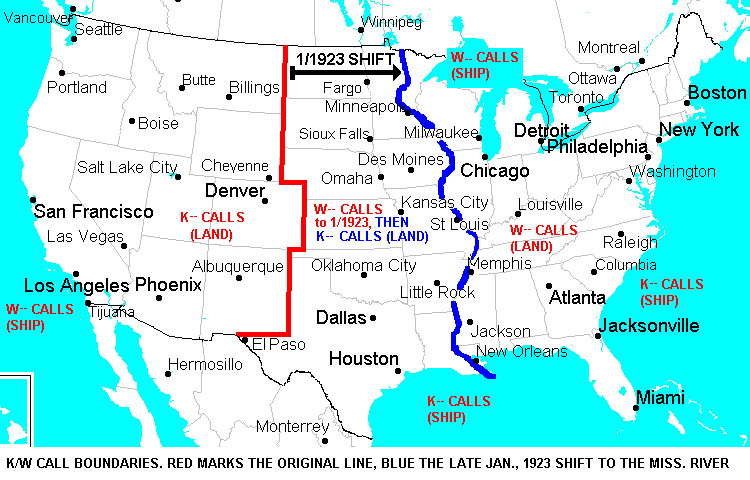
K, W & the mighty Missisippi

In the 1800s broadcasters adopted call signs to aid in signaling. This practice continued when ships began to use radio. [popularized by the sinking of the titanic] Initially brodcasters determined their own calls. This led to duplication and confusion.

In 1884 the first effort to standardize this occurred. The head of the Federal Bureau of Navigation, (FBN) Eugene T. Chamberlain, exorcised a new vaguely worded statute and assigned marine-radio call letters. His previous career as Ships on the Atlantic and gulf coasts were assigned calls beginning with K, and those on the Pacific coast and Great Lakes were assigned calls beginning with W. It is unknown why he chose K and W.

In 1906 Berlin International Wireless Telegraph Convention (BIWTC) declared that all ship and shore stations should have unique call signs consisting of three letters. The U.S. did not ratify the BIWT convention until 1912. (why are we always behind Europe?) That year Congress empowered the FBN to license land stations in addition to the marine stations. Official documents issued in 1913 confirmed the practice of assigning W calls to stations in the west and K calls to stations in the east.

The following year Congressimproved the system slightly deciding that the Pacific coast would get W for ships and K for land stations, the Atlantic and gulf coasts would get K for ships and W for land stations. This made it more simple to distinguish a marine broadcast from a land broadcast.

It was not until 1923 that the missisippi became the dividing line. Prior to that Texas as a gulf coast state had W's! The dividing line started at El Paso and worked its way east the then north.
see map: http://earlyradiohistory.us/kwbigmap.gif

There are many exceptions to the K&W rules even today. Below are some contemporary examples. These are all considered "heritage" call letters and they are highly valued.
KYW-AM 1060 Philadelphia, PA ...the K furthest to the east
WIL-AM 1430 St. Louis, MO
WOAI-AM 1200 San Antonio, TX ...the furthest W to the west.
WOI 90.1 Des Moines, IA

Exceptions along the border are commonplace as the calls are assigned by city of license and not the location of the transmitter. Minneapolis , Memphis, New Orleans and other markets straddle the line and each contain multiple exceptions. A simple explaination here:
http://www.dxing.com/callsign.htm

For all of his trouble-making, eventually the Navy named a ship after Mr. Chamberlain. It is a Liberty Model.