Showing posts with label WCFl. Show all posts

Monday, June 16, 2025

Superjock!

Doesn't that picture (above) of Larry Lujack just look like a DJ?  (The shot reminds me of Buster Poindexter for some reason.) He's got the coffee and cigarette, the open collar, the tousled hair and that smarmy smile that screams 100% rock n' roll, drink tickets, dirty cab rides and a hotels bars doing ludes with David Brenner.  If you've heard an aircheck before you know he's got that perfect 1970s rock DJ voice all the morning guys were still aping in the 1980s, and that includes me. 

Born Larry Lee Blankenburg, he changed his name to Larry Lujack for football hero Johnny Lujack. That Lujack played for Notre Dame, won the Heisman Trophy in 1947 and went on to play for da' Bears. Why would Larry think of that particular college football player? A man born in Pennsylvania, playing in Indiana?  You may not know it but Johnny Lujack had a radio program in 1949. The "Johnny Lujack of Notre Dame" program was a daytime adventure show, which aired as a Summer season replacement for Jack Armstrong. 

It aired three days a week: Monday, Wednesday, Friday from 5:30 - 6:00 EST on ABC. Lujack starred as himself with Ed Prentiss as a sidekick. A few different radio show directories say that Boris Aplon provided music, but I suspect he may have actually been the announcer. He did radio and TV acting, but was mostly a Broadway actor but he had one of those resonant voices. I find nothing about him as a composer. An article about Chicago radio is one of the few sources that describe him at all, in this case, in a Chicago Tribute radio special [LINK]. 

"Our main villain at the time was Ivan Shark, played by a fellow of Russian descent named Boris Aplon, a fine character actor who was also a fop. He dressed fantastically, drove enormous, beautiful cars., sported a thin, sweeping mustache, and carried a cane." 

Prentis has a much longer radio career. He was the announcer on Jack Armstrong so there was some continuity there. Prentis later played Captain Midnight. More here. But let's get back to the younger Lujack.

Planters is not a sponsor, not yet anyway. 

Larry was born in Quasqueton, IA. That town had a population of 570 at the time of the 2020 census.  It's about 45 minute north of Cedar Rapids which is still not a whole lotta city. The family moved to Caldwell, ID when he was 13. It's not the big city but at least it has sidewalks. He was a small town guy that decided to go to Washington State University, probably to get the hell out of doge. But looking for work he took a summer job at 1490 KCID-AM in Caldwell, ID at the age of 18 in 1958. From there he did a stint at 1140 KGEM-AM, which is even recorded in the 1974 book Who's Who In The Midwest.

Though an influence on some of the biggest egos in radio, notably Rush Limbaugh and Howard Stern, Lujack was not a shock jock. His own delivery leaned more onto sarcasm and cynicism. But that big ego was real. At the height of his popularity, his day his Midwestern popularity was probably second only to Dick Biondi; and only maybe. The Encyclopedia Britannica actually uses the word "braggadocio" to describe him. The 1977 book This Business of Radio Programming in a soliloquy about ego could not resist  the reference "disk jockey should enjoy being egotistical as does Larry Lujack..."  He was like Don Imus but kinda charming. 

So it's no surprise that his self-appointed nickname was Superjock, Which later became the title of his autobiography.  He had other nicknames: Lawrence of Chicago, Uncle Lar, and King of the Corn Belt app were used at different times. I've also seen "Superjerk" some were less polite.  But Superjock... he actually trademarked that one. No really.  [SOURCE]  [Didn't know you can do that? Yes, DJs can do that.  Let me know if you need help.

Superjock: The loud, frantic, nonstop world of a rock radio DJ

Between 1960 and 1964 Lujack managed to work at KNEW, KPEG, KRPL, KFXM, KJRB and then in 1964 landed at KJR in Seattle. [SOURCE] He used the Lujack name at KJR and in some ways it starts his big "rock n' roll" image. Then he switched coasts completely and worked at WMEX in Boston starting in 1966.  Lujack joined WCFL-AM in 1967 and moved to WLS-AM four months later. Lujack returned to WCFL for four years before going back to WLS for the next two decades. This time period was his golden era, mostly doing mornings. That's where all his famous bits happened, the best quotes, and most of the classic collectible airchecks. [More here]

In 1984 WLS-AM gave him a twelve year, $6 million contact, making him one of the highest-paid radio personalities ever. That's 18 Million in 2025 dollars. When their ratings declined in 1987, the station’s owner, Capital Cities-ABC, bought out his contract. The buy out was a motherlode, but it included a non-compete which locked him out of the Chicago market for 5 years. Lujack shrugged it off and retired to New Mexico. 

The end of WLS as a rock station was largely the end of Lujack's golden era. After moving to New Mexico in 1987 he only occasionally did radio work. R&R quipped "Lujack won't be able to work elsewhere in Chicago, but is accepting offers for foursomes at the golf links."  Rather than rehash the programming mistakes of Capital Cities I'll quote the FMedia Newsletter column "AM Happenings" from September 1989. They hit it on the nose. 

"WLS 890 AM is scheduled this month to switch from music to all talk. "It brings an end to what was once one of the Midwest's most popular and most successful AM rock stations. During its heyday in the '60s and early 70s, WLS was THE station for the most popular rock and roll hits of the day. It boasted such legendary disc jockeys as Dick Biondi, Art Roberts, Clark Weber, Ron Riley, Larry Lujack, Fred Winston, Bob Sirott, John (Records) Landecker and Yvonne Daniels. But it wasn't until the '80s that age and FM radio were starting to creep up to WLS. Younger listeners turned off by the station's conservative music mix defected to upstart WBBM-FM with its high-energy sound. By the mid-'80s, morning man Lujack switched to afternoons, and things went downhill from there. The station couldn't make up its mind whether to play music or to go all-talk. This ill-conceived middle-of-the-road format did in the 'Big 89'. And now, the owners of Capital Cities/ABC are finally going to switch the format to all-talk. I only wish they could've done it sooner. Everyone here in Chicago will have their own memory of WLS in its glory years as an AM powerhouse..." 

Locked out of the Chicago market by his buy-out deal he subsequently worked at a few other radio stations in new markets including a breif return to KJR-AM in Seattle. In 2000 long after the non-compete was expired, he tried a slot at WUBT in Chicago. Then in 2003, Larry and his long time partner Tommy took a show together at 1690 WRLL-AM. But that was short-lived.  Lujack did his show remotely from home, and the 1,000 signal barely covered Chicago. The older, more sedate Lujack didn't rekindle much fanfare. He still sounded great though. More here

Larry Lujack died in 2013 of esophageal cancer, probably from smoking. In a fit of irony, his own namesake outlived him by 10 years. Johnny Lujack died in Naples, FL in July of 2023, at the age of 98. Larry would have liked the irony.

Monday, April 16, 2018

The Legend of Chickenman


Chickenman was an American radio series created by Dick Orkin. It spoofed adventure books and comic book heroes. The series was created in 1966 and originally aired on 1000 WCFL-AM, in Chicago, IL. It began as part of the Jim Runyon Show.  The show's protagonist, Benton Harbor, (presumably named for the Michigan town) was a shoe salesman who spent his weekends fighting crime. He also he hangs around the Police Commissioner Benjamin Norton's office and annoyed the Commissioner's secretary, Miss Helfinger.

CHARACTERS:

  • Benjamin Norton, Police Comissioner, -  Dick Orkin
  • Miss Helfinger, Comissioners assistant  - Jane Roberts
  • Chickenman, Benton Harbor - Dick Orkin
  • Chickeman's mother, Mildred Harbor - Jane Roberts
  • Trooper 36-24-36 - Jane Roberts
  • Narrator - Jim Runyon

Each episode began with a four-note trumpet sound from the song Thunderball and Chickenman's Buck-buck-buck-buuuuuck" chicken call. Orkin expected to run with the gag for two weeks. The original series eventually lasted over 5 years! That original 1966 series was released in 2003 as The Original, Complete & Unexpurgated Story of Chickenman, all 273, 2.5 minute episodes in a 14-CD set. Yes it is that popular. This was presaged by the 1966 LP The Best of Chickenman, released first on Spot records then ATCO. More here. Many LPs and posters read "exclusively on..." then a set of local call letters. There was nothing exclusive about Chickenman. By some reports, at it's peak the program was syndicated on 1,500 radio stations.

While the series was the brain-child of Dick Orkin he needed people to voice the parts.  Jane Roberts, a Chicago theater actress who worked at WCFL as the traffic reporter voices almost all the female parts in the series. Dick handled most of the men, Jim Runyon was the narrator. Jane's background was mostly in theater: Kraft Suspense Theatre, and a stretch at the Goodman Theatre in Chicago. Runyon has already been a DJ on WBHT, WHTN, WLW, WLWT, WTVN, WLWD, and KYW before he made it to WCFL.

Orkin began his radio career on WKOK in Sunbury, PA as a teenager. He worked part-time at WGAL while attending Franklin & Marshall college  He graduated in 1956 with a BA in speech and theater and headed for the Yale School of Drama to earn an MFA. He returned to Lancaster in 1959 to be the news director at WLAN. [SOURCE]  He headed off to KYW (back when it was in Cleveland) in 1963. He remained there until In 1967 when he moved to Chicago to work on WCFL. Runyon had already been there for 2 years. Runyon went back to KYW (then WKYC) in 1969. The two had worked at both stations together.

In 1973, Orkin began producing 52 special weekend episodes called Chickenman vs. the Earth Polluters. In 1976, a special LP was created by Orkin and ad man Bert Berdis: Chickenman Returns. This was followed by 65 episodes of an updated radio show in 1977, Chickenman Returns for the Last Time Again. In 1995, for the 30th anniversary of the series, Orkin brought Chickenman out of retirement for a tribute episode on This American Life. This was all in addition to the original 195 episodes. The man was nothing if not prolific.

Weirdly Chickenman never really went away. It is still played on a number of stations regularly AFRTS, 99.3 KPCH in Ruston, LA; 103.3 WFJV in Crystal River, FL, 101.1 WVRE in Dubuque, IA; 1430 WION-AM, Ionia, MI... a couple Canadian stations, and inexplicably several stations in Australia. For these feats and others, Dick Orkin was inducted into the National Radio Hall of Fame in 2014.

Friday, February 14, 2014

Halloween Martin

Halloween Martin was, by most definitions, the first female disk jockey, and quite almost certainly the first in the Chicago metro. She was a former newspaper reporter in the home economic department of the Chicago Herald Examiner Newspaper. She was hired by KYW-AM in 1929 and a year later they made her the host of the Musical Clock. This was a decade before the term disc jockey was coined in the 1940s. Her program was a morning show and she wasn't just an announcer... the format of the program made her one of the first modern DJs ever.  A 1929 issue of radio Digest wrote a little more about her background:
For two and a  half years her time was occupied answering the home decoration problems  that came to the Prudence Penny department, writing her columns and giving her daily Radio talk on interior  decoration. Lectures at cooking schools  and clubs added variety to the daily  grind.

Miss Halloween Martin, was just a 28 years old DePaul University grad with some news paper experience. She gave the time, temperature and weather every 5 minutes from 7:00 AM to 9:00 AM.   The program intermixed segments of music, news and chatter on a schedule like modern commercial radio. At the time tightly scheduled  programs based on an hour "clock" were not yet the norm. The show was certainly tailored after the Alarm Klok Klub on KJBS-AM. Most of these programs seems to descend from Rambling with Gambling"which was also called "The Musical Clock" on WOR-AM in NY. That program debuted in 1925.  In 1931 the Schenectady Gazette wrote the following regarding Miss Martin:
"Listeners-in arise, dress, boil their breakfast eggs and catch the 8:15 to the accompaniment of cheery though persistent time bulletin's sent out on KYW'S musical clock by Halloween Martin. Every five minutes from 7 to 9 O'clock each morning, announcement of the exact time punctuates the program of phonograph records. Miss Martin has been the "clock" for two years, graduating from a series of talks on home decorating. which developed from her writing of household helps for the Chicago Herald-Examiner..." 
It's a tad condescending but you can tell the writer is still equating her with an announcer. Other contemporary articles continually describe her as "cheery," and/or "charming." The program ended when KYW-AM moved to Philadelphia. It was relaunched on WBBM-AM in 1934 due to it's local popularity. There the program stayed for 10 years then moved to WCFL-AM for another two before ending it's run. Through most of those years the show`s theme was a piece called "ln a Clock Store."

Friday, January 31, 2014

Art Hellyer is Not Dead

Art Hellyer, said in a 1993 interview on 97.1 WNIB that he wasn't really a DJ he just "played music as a fill between commercials." Hellyer was a mainstay of Chicagoland radio starting back in the 1940s and lasting for five decades. His zany off-beat humor was part of what shaped our modern radio gestalt bridging the gap between guy s like J. Aku Head Pupule and the modern morning zoo. He was on air at WGN, WJOL, WLS, WMAQ, WJJD, WOPA, WIND, WAIT, WOWO, WCFL, WBBM and certainly others. His biography The Hellyer Say is not to be skipped. 

His first show was on WKNA in Charleston, WV in 1947 interviewing auto salesmen.  Despite behaving like Art Hellyer, he was not fired from that job. (In his book he actually devotes a whole chapter to what he was not fired for.) It was a theme in his career. His zany behavior got him ratings. WBBM famously fired him over a dress-code violation and then re-hired him. As he told the Chicago Tribune in 1996 more simply that he got fired "a lot."
"...I counted 14 times. It may have been more than that... I always said every one of my battles was over creative control. I wanted to be creative, and they wanted control."

It's hard to say which of his programs was the most important to his career as several of them held the number one slot in one decade or another. In the 1950s his program The Art Hellyer Show aka the Morning Madcap on 1000 WCFL-AM, again on 780 WBBM with his Supper Club shows in the '60s while also doing mornings at WAIT, Then again on WLS-FM in the '70s until they went progressive rock in 1969. He was number one again on 1160 WJJD-AM in the '80s. His time at WOPA straddles some of that doing WOPA Art Hellyer's Memory Lane in the mid sixties.

What probably got his career going the most was his time on on WCFL. There he was given carte blanche for the first time in his career and he more or less ran amok. He offended big sponsors, like Coca-Cola and General Motors but the listeners loved it.  In he did spend a few serious on air. He advocated for the seat belts in cars in the 1950s and in 1960 spent time explaining to listeners the importance of the then brand new Polio vaccine to quiet the anti-vaccination nuttters. In 2011 he made another come back of sorts and began Internet radio station Party 934. Not bad for a guy that one quipped that "...the average life of a disc jockey in Chicago is three years."

Thursday, October 03, 2013

1967 WCFL tornado coverage

With Tornado season at it's anti-climatic end this season I happened to find a recording of a WCFL broadcast covering the terrible tornadoes of April 21st 1967 in Oak Lawn, IL. It's a true historical artifact. Give this a listen.


Monday, November 28, 2011

The Alarm Klok Klub

 That this show ever existed at all is baffling, that it ran for 30 years is even more unusual, that there were others just like it is inexplicable. Because of his tenure on the program, it's host, Frank Cope is recognized by some as the nation's first disc jockey. In 1930, KJBS-AM was purportedly running an an all-music format. That sounds non-specific by modern standards, but things were different then. KJBS-AM was an oddly licensed station, with two tower sites.  It wasn't granted authorization to operate full time at 50 kw until 1977. So the Alarm Klok Klub didn't sign on in Hayward until 5:00 AM, but it ran until 8:00 AM.  Like a normal daytime the station signed off at sunset. But then they signed on again from San Francisco at 10:00 PM, and off again at 3:00 AM. [info courtesy of David Kaye] This was to avoid interference with WTAM. More here.

The Author of Raised on Radio, Gerald Nachman grouped the program alongside the Milkman's Matinee, and with other early DJs like Jack Sterling, John Gambling, Al Jarvis, and Peter Potter.Frank Cope  was born in Utah, and had previously worked at KLO-AM, which signed on in 1929. He started on "The Alarm Klok Klub" on San Francisco's KJBS on March 3rd, 1930. The program ran 6 days a week, only sitting out Sundays. Some sources claim that Cope left KJBS in 1952, but I prefer the date given by Bayarearadio.org, coinciding with the sale of KJBS to Argonaut Broadcasting in 1959. Rumor has it that he tried out at KSFO-AM but didn't fit in and moved on to the car business. He died in 1974, he was 72. 

1020 KYW-AM launched a similar program in 1930, no doubt influenced by the Alarm Klok Klub. Theirs was called the "Musical Clock."  It debuted on April 14th, sponsored by the Marshall Field Company.   Sears picked up the sponsorship in 1935. It's host, Miss Halloween Martin, was just 28 years old. She was a DePaul University grad with a little acting experience who was then working at a news paper. She gave the time, temperature and weather every 5 minutes from 7:00 AM to 9:00 AM, and spun light classical, pop and jazz. In 1934, when KYW-AM moved to Philadelphia, the "Musical Clock" moved to WBBM-AM.  The show was finally cancelled in 1944, and Martin crossed the street to WCFL-AM.

Chicago had at least two other "clock-type" morning shows concurrent with Martin's. WMBI a Morning Clock program that started no later than the mid 1940s. It was still running in 1986 hosted then by Bob it ran from 6:30 to 8:00 AM. On November 18th 1941, W75C began simulcasting WMBI’s programs on the FM band. they later changed calls to WDLM and they too carried the Morning Clock. According to author Arnold Passman, writer of The Deejays (mandatory reading) there were plenty more. At WBT-AM, Lee Everett was hosting the "Morning Clock" starting in 1934. At about the same time, in New York, John B. Gambling was hosting the "Morning Clock" on WOR-AM. Some of the programs were more zany than others. At WDAE-AM  in Tampa, there was another musical clock program. This one had a time signal on the program which was the sound of a guy grinding his teeth. Ugh.

The Variety Radio Directory of 1938, lists yet more for which I have no other corroborating reference, "Alarm Clock" on KWTN and CJOC, 'The Alarm Clock Club" on CKCK, the "Alarm Clock Frolic" on WPTF, another "Alarm  Clock" on KWOS, the "Alarm Clock Program" on KFJB, "Alarm Clock Revue" on WBRC,  "Alarm Clock Salute" on WNAC, the "Alarm Klock Klub" on KIEV, and a different "Alarm Klock Klub" on KVOG in Salt Lake City. There was even an "Alarm Clock Serenade" on WICC. I'm sure there were even more, but this programming novelty has been dead for decades. In it's place we have the morning zoo, which is less novel but more local.

Thursday, November 17, 2011

The Wax And Needle Club!

The Wax and Needle Club ran for about two years. DJ Bill Evans ran this top 10 count down show of sorts. The station was 1000 WCFL-AM and the program was a half hour program that aired at 7:30 PM on weekdays running after a sports program and followed by a live concert in Grant Park. In 1949 it was preceded by news and followed by news and a serenade. A June issue of Billboard from 1948 describes the program cynically but with some detail:
" ...Bill Evans, the Wax and Needle Club, WCFL, reports a good mail pull on his quiz disk gimmick in which he invited teen-agers to submit the reasons why they'd like to guess the title of a different quiz disk on his show each night. Evans interviews the youngster and, if he can identify the disc, he receives a special Bill Evans album of current pops..."
Let me state for the record now that DJ Bill Evans is not the jazz pianist Bill Evans. Accept no substitutions. Which Bob Evens he was remains unconfirmed.  My theory is that our Bill Evans is the one that was on 720 WGN-AM for years. [more here]. It was the right place at the right time, and it's very rare a market will allow two DJs to use the same name at the same time. My "evidence" is a 1948 advertisement in Billboard listing both WGN and WCFL net to Bill Evans name.
If I'm right, he was running the Bill Evans' Show 6:30 AM to 8:00 AM weekday mornings as early as 1953. A 1955 issue of Billboard put the start of his career as 1943 which works with the timeline as well. His morning program was re-named "Morning Reveille" and ran into the 1950s. His career started in Duluth, Minnesota. Teasingly his 1995 obit confirms that and at least two other stations. "After leaving WGN-AM, he purchased a radio station in Ames, Iowa. He later sold it and bought one in Lakeland, Fla."  I confirmed in a 1958 issue of Radio Daily-Television daily that the station in Ames was 1430 KASI-AM. Interestingly they also state he quit 560 WIND-AM that same year... so we must add more to the resume.

As successful as these early teen target programs were, they also didn't fit the format of the era. Program Directors from the 1940s didn't know what to do with direct audience engagement. For them, getting fan letters was the full extent of quantifiable success... unless you showed up in the Crosley ratings. Call in shows were relatively new. Teens as a marketing demographic were strictly a post-WWII phenomena. They were totally unprepared. I found a few winners of his polls:  Peggy Lee, Herbie Fields, Eddy Howard, and Mel Torme, This was no hot jazz or R&B program. This was safe, wholesome, harmless, homogenized white pop.  Just marketing to teens was edgy enough back then.

Thursday, February 03, 2011

Radio Amway

Amway is infamous the world over as a direct-sale pyramid scheme. They are not generally known as a media company, but they once dabbled in that market. By once I mean from 1977 to 1983, the experiment lasted over a decade. More here.
It began on September 30th 1977 when Amway bought the Mutual radio Network. MBS had been founded in 1934 and by the late 1940s they were the largest radio network in America at least in terms of the raw number of members. In reality CBS and NBC were the Coke and Pepsi of radio networks. They had the lions share of the market, and most of the powerful stations. To quote Elizabeth McLeod
"Mutual shows were produced by the stations on a cooperative basis, and the stations paid the productions costs and furnished the facilities, not the network. This setup was radically different from that used by the Major Networks, so in that sense, one could call Mutual small."
 MBS kept trying to make itself into a bigger player. One of the biggest mistakes it made was in 1960 selling out to 3M. The adhesive company was a poor fit. 3M didn't damage the company but it left it directionless, and sold it to a group of mixed investors in 1966. Two of the shareholders, Mr. and Mrs. Benjamin F. Gilbert bought out the other share holders then sold MBS to Amway and turned a profit in the process.

Before this all Amway had done was underwriting and advertising. To be succinct, they had no idea what they were doing. But they certainly had gumption. About two months after the buy, they announced they were dropping landlines, and moving to satellite distributon via Western Union's Westar I.  The system went live in 1981. They were the first radio network to go to satellite.

Launched in 1973, Westar I was America's first domestic communications satellite. It was designed to operate for 7 years, but was removed from orbit in 1983 and replaced with Westar II. While the plans continued, Amway expanded MBS. They bought purchased WCFL in 1979 in 1980, Amway purchased WHN in New York and added affiliates. They peaked at 950, less than ABC, but more than NBC or CBS.  Amway may have been novices, but they were aggressive novices.

But being a novice has a downside.  Despite all these very exciting changes and expansions, Amway was taking a bath on the project. The move to satellite cost them 10 million dollars. When they dabbled in changing programming they experienced epic fail. they changed slots wrecking the ratings of highly rated show, change line ups, and tried to take shows on the road for no reason whatsoever. One of their few successes was the Larry King show on WIOD but that was probably because for the most part, they left Larry alone. For the most part, what they touched, they destroyed.

In 1984 they sold off WCFL to Statewide Broadcasting.  That same year they did a re-org and fired a number of executives and laid off over 20 Mutual staff. In September 1985 they sold the whole enchilada to Westwood One. The only thing they held back was their satellite services division and up-link facility. Amway went back to what they knew, they started making and selling satellite dishes.  But even that still had the stink of failure on it and they sold off the division was in 1989.

Thursday, June 17, 2010

Cardiologist Radio

In the September 1924 issue of Popular Mechanics (a fine periodical) noted a very peculiar event in radio. Bear in mind that this was only 4 years after the first non-experimental calls were issued. According to this list compiled by Jeff Miller there were only 545 radio stations in the entire country at the time. Programming was novel because radio was still quite novel as a whole. Experiments and "firsts" were happening all over the country. But the description of this one just strikes me as peculiar:
"Seven Hundred and fifty stethoscopes connected by radio, enabled as many physicians to study the heart beats of one patient in the lecture hall on the Municipal Pier, Chicago at the recent convention of the American Medical Society."
The calls are not mentioned but its location was. They broadcast from Municipal Pier in Chicago. Chicago only had eleven radio stations at the time and several operated share-time:  560 KYW-AM, 810 WEBH-AM, 833 WDAP-AM, 670 WMAQ-AM, 670 WQJ-AM, 870 WLS-AM, 1050 WAAF-AM, 1120 WTL-AM, 1120 WJAZ-AM, 1160 WDBY-AM, and 1210 WCBZ-AM. That's it. But the article does not describe a city-wide broadcast. It was a private affair for the benefit of the AMA.  that indicates it was probably at low power and certainly indoors.

Municipal Pier was constructed in 1914. More here.The pier was renamed Navy Pier in 1927 to honor the Navy veterans of World War I.  It was designed by Charles Sumner Frost.  The huge pier is 3,000 feet long and 292 feet wide. But this pier was so massive it had buildings on it.After reading about them individually I am certain that it was held at "the Hall."  I read a description here.
"Located at the east end of the Pier, the third section housed a half-domed shell, 150 feet by 138 feet with a domed ceiling 100 feet high. Known as the Hall, architects used radial steel trusses shaped in half arches to provide a wide, open area for civic functions or entertaining. Windows located in a 180-degree half-circle enabled a spectacular view of Lake Michigan."
That building opened in 1916, not only making this possible but much more likely. Where else would you put 750 physicians and their stethoscopes?  reading further, they also note that they used "three element vacuum tubes."  Those would certainly be a triode, an early tube based on the Audion. There were severla brands at the time: Crysleco, Marconi-Osram, Ediswan, Wecovalve, Triotron etc. There's vircutlaly no way to know what they actually used. It's highly likely that some Chicago radio station had somthgin to do with the engineering but that is omitted from the story.
I will note that in 1926 WCFL-AM the Chicago labor radio station began broadcasting from the North Tower on Municipal Pier. It's possible that cozy deal had some ties from a bit further back. I easily found announcements for the impending launch of WCFL in 1925. The navy Pier continues to be a landmark today, but nobody broadcasts heartbeats... unless they're stunting.

Tuesday, December 25, 2007

Elvis Banned on xmas!

Elvis got a rough shake at radio. He was banned a few times for his hip-shaking in a time that was so uptight you'd think Jedediah Bush was president too. Thankfully Elvis overcame adversity got fat and has a successful career complete with the comeback tour. What you didn't know was that among all his trouble was that even one of his Christmas songs got banned. It was that famous year that Ed Sullivan cut off Elvis at the hips...

The hubub went down even later than you might expect. In 1957 Elvis was recording his first of several Christmas-themed releases. But it was released at the peak of Elvis's renegade status. Some stations in a fit of wholesomeness banned the album. WCFL-AM in Chicago banned all records by Elvis entirely. KMPC-AM and KEX-AM in Portland followed suit. But at KEX, DJ Al Priddy played his version of "White Christmas." anyway and was fired. In response DJ Allen Brooks of CKWS in Kingston, Ontario, played the entire LP.

The problem was that a secular and sex-crazed rock n' roller was playing sacred music. Fanning the flames was none other than Irving Berliner. Irving ran amok writing letters to radio stations. Elvis had recorded a version of his "White Christmas" a song that Berliner had written. Royalties be damned, it was too much for him to bear. I'm sure his estate has no problem depositing the checks today.

Friday, October 06, 2006

ALL TRIBUTE RADIO

It began on 02/02/2006, a new Low Power station 104.5 KCFL-LP in Fall City right outside Seattle, WA founded itself as a tribute to Chicago's WCFL. WCFL was a union owned radio station in Chicago with it's own rich history. So Rich I wrote it up last year in this post.

Only months ago this oddball archive format switched to become a tribute to KYA, complete with vintage KYA jingles. Their current site here. They snuck through in the very last LP FM window and now appear to be changing format to become a tribute to a new classic station every 6 months. I wish I knew more.If you look here you can see they intend to blanket NW Washington with repeaters...
They're already operating a number of these already.
KCFL 104.5 Fall City / Sammamish / Snoqualmie
KYAO 89.5 Ocean Shores / Westport
KATO 94.3 Aberdeen / Hoquiam
K233BU 94.5 Seattle/Bellevue/Kirkland (temporarily off the air)
K249DX 97.7 Redmond/Bellevue - coming August 2006

Those last two repeaters at least used to belong to Skagit Valley College radio station KSVR a bastion of weirdness in the valley. That is a tad sketchy. More here.

Wednesday, August 23, 2006

WOMEN OF RADIO WEEK pt 4


Yvonne Daniels was known as “The First Lady of Chicago Radio,” Her silky smooth professional speaking voice garnered ratings wherever she worked. Her knowledge of jazz made her a listener favorite throughout America’s Midwest. Here's my favorite part: Most people outside of Chicago and across the country did not know that Yvonne Daniels was Black.

She began on a local AM station in jacksonville, IL but for the life of me I cant figure out if its WLDS or WJIL... Yvonne appeared on the national radar when she moved to Chicago. She joined WYNR-AM to DJ a jazz show that competed with popular disc jockey Sid McCoy on WCFL-AM. WCFL couldn't take the pressure and at McCoy’s own urging WCFL-AM eventually hired Daniels. Within two years the duo was heard in 38 states. She stuck with that station until they went Top 40.

In 1964 Daniels picked up a spot at WSDM-AM one of the nation’s first all-female radio station. Her program Daniels’ Den consistently beat out the rest of Chicago radio in it's time slot. In 1973, she moved on to WLS-AM, a big 50,000-watt powerhouse, where she became the station’s first female disc jockey. WLS beat out WCFL for number one in Chicago that year and every year for years after. You can hear clips of her at WLS here and here. Daniel's owned the overnights, her playlists remain WLS collectibles today.

hercshideaway.blogspot.com

During the 1980s, Daniels worked Chicago morning shows on WVON-AM, WGCI-AM and eventually on “Smooth Jazz WNUA.” Her career ran for more than three solid decades. Daniels is rightly credited with paving the way for future generations of both female radio personalities and specficly black women. She was a role-model and a blueprint. She died of cancer June 21, 1991. The city of Chicago named a downtown street in her honor.

Monday, November 21, 2005

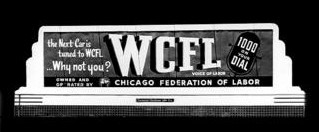
Chicago's Voice of Labor

On Wednesday night-July 21, 1926 WCFL 620AM , Chicago's Voice of Labor, premiered over the airwaves with two hours of music. This event marked the beginning of the first radio station in the United States dedicated solely to the cause of labor unions and their members. The driving force behind the creation of WCFL was a man named Edward Nockels.

WCFL continued to survive and even flourish over the following decades even were publishing a magazine. In the fall of 1927, Nockles introduced the quarterly publication of the WCFL Radio Magazine for it's listeners and union workers.

WCFL's General Manager Ken Draper altered the format in 1966. He captured the 18-35 year old audience, with the introduction of rock n' roll, and and the station beame even more successful. In 1967, WCFL was Chicago's number 1 CHR outlet!

It was in the late 1970's that things began to fall apart. As the organized labor movement in the United Stated began to decline, so did the Voice of Labor. The decision was made to sell WCFL because the finances were running low, and a progressive decline of community interest around their home base Chicago.

WCFL's ratings had tumbled by 1975. Lew Witz announced that on March 15, 1976, they would change from Top 40 to the dreaded beautiful music format. Most announcers were fired or quit. In April 1978, WCFL, the Voice of Labor, was sold to MBS (Mutual Broadcasting System)which was owned by Amway [Michigan-based pyramid-sceme marketing Co.] for $12 million. The sale of WCFL in 1978 marked the end of labor radio. But even without radio, the legacy of the labor movement lives on today. [Ex. I had to deal with a union shop just last month in Philly.]

In the fall of 1980, WCFL changed to a adult contemporary format. Then in 1983, MBS sold WCFL to Statewide Broadcasting and it hit the ratings bottom as a religious talk station. These days AM 1000 is currently ESPN Sports Talk...WMVP Chicago

Hear clips here: http://www.radiotimeline.com/am1000wcfl.htm

sombody wrote a book: http://www.press.uillinois.edu/s97/godfried.html