Monday, September 14, 2015
AMTOR and SITOR
AMTOR was developed by single person, Peter Martinez G3PLX. His first successful AMTOR contact was with David Wicks G3YYD on the 2 meter band in 1978. It's unclear what contributions to the code base Wicks may have made, but he later wrote his own AX25 software to run on the same machine used in the AMTOR test, a home brew Motorola 6800. In 1980 the FCC granted an STA to four hams to use AMTOR: William Meyn K4PA, Charles Roettcher K3FLS, Marvin Leibowitz W3KET, and Walter Kaelin KB6BT.
Peter Martinez was a genius in his own right. (In print appearances prior to 1987 he went by J. Peter Martinez.) His hobbies are so complicated I honestly don't understand what he's doing; such as using pulse generators as ionospheric sounding transmitter to build ionograms of frequency reflection height. By comparison AMTOR was a small undertaking. He also developed PSK31 in 1998, another teletype communications protocol. And in 2010 he wrote part of a book on Cave radiolocation. His name appears in a number of IEEE texts. Martinez states in one of his many papers that he had been involved in RTTY in the 1960s but his pre-AMTOR resume is not well known. He has kept busy since then.
There are 32 characters in the RTTY teleprinter system. These are rendered by 32 combinations of 5 data bits. the problem is that the total number of combinations of 5 bits (in binary) is 32 [25]. So any bit error can transform a character into some other character. This error would be undetectable, a huge problem. AMTOR uses 7 data bits which renders 128 combinations. In a random data set only 25% of those would be recognizable as the 32 characters. But AMTOR uses only combinations made of three zeros and four ones. So as a result errors are easily detected. There are 35 of these combinations leaving three extra to be used as controls. The result is so rugged that random noises generates a character less than 2% of the time.
Wednesday, June 24, 2015
SITOR and AMTOR
NOAA uses 24 transmitters at 7 cost guard stations to communicate it's weather messages. Originally developed as a commercial maritime radio service.. this is all that's left. It sends sends 7-bit characters as a bit stream at rate of 100 baud. At 100 bits per second that works out to 10 milliseconds per bit, or 70 milliseconds per character. The bitstream is FSK (frequency-shift key) modulated with a 170 Hz frequency shift. There are two SITOR modes:
SITOR-A is used for point to point links. SITOR-A uses automatic repeat request (ARQ) to gain reliability. If the receiver detects an error, it requests a retransmission.
SITOR-B is used for broadcast links. SITOR-B transmits each character in a message twice to gain reliability. If the receiver detects an error in the first character, it uses the copy. If both characters are garbled, the receiver won't know what was sent. SITOR-B by definition uses forward error correction (FEC), versus ARQ for SITOR-A.
Actually in 2007 the USCG was freely admitting the system was becoming hard to maintain and parts hard to find. Specifically an unnamed official said the system had "exceeded it's life expectancy." Desipte that assessment 8 years ago, Amateur radio still uses SITOR under the name AMTOR, AMateur Teleleprinting Over Radio
Monday, May 24, 2010
Fidelipac Fun #1
I found three old Fidelipac carts in a box, amongst my other archival audio. This one had some real winners so I will be posting a few of those this week. I selected these three because they are very different and will allow me to wander freely into completely different radio-related topics. For the record, Lou at Rollin' Recording in Boerne, TX handled the digitization. The label Broadcast Supply West was not the maker of the Fidelipac, but the label. they still exist today under the name BSW. They no longer make labels for carts.WECS News Intro
WECS News Outro
Until the the 1940s the sound of news was Morse Code. Walter Winchell tapped a Morse code key through his news & gossip program. I cant even guess why, as the teletype was being used by the AP was early as 1914. The Teletype Corporation closed up in 1990 leaving a nine decade window that should have known the sound. Over time the more common sound of the news did become the teletype. The effect usually sounds like something cruising between 60 and 80 wpm. This recording seems to be that or a similar model. They used an nearly identical sound on CKLW. You can hear that here.
Thursday, November 02, 2006
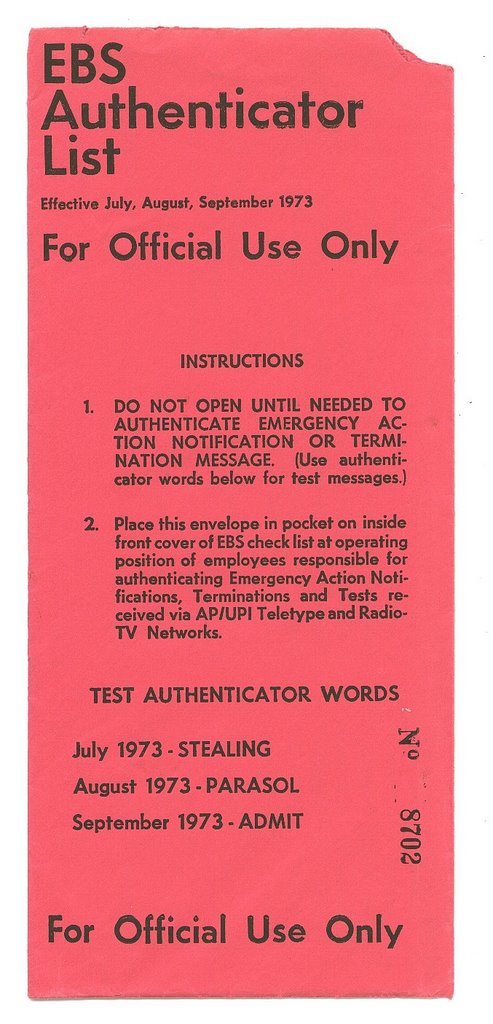
The EBS Authenticator Word List
It was a slow peice of crap. It ran at 50 baud, about 66 words per minute, that's slightly over six characters per second at full speed. These puppies were replaced by 1200-baud "high speed" dot matrix printers in about 1978.) The paper rolls in a teletype machine did't come from Office Max. They were supplied by the wire service. It was usually light yellow or beige and came on a thick roll about 8½ inches wide. The thick cylinder-o-peper weighed about four pounds. And it only lasted about a day.
The machine printed all the time because of the slow print speed and was always warm to the touch. But the smell is the memorable part for me. The fragrance was a mixture of lubricating oil and ink like the inside of an old electric cash register.
But unlike the cash register, changing the ribbon or the paper meant losing information forever. This was before PC's .. it had no memory at all. Why am I telling you this?
At every station, somewhere close to the teletype machine, there was an envelope containing the Authenticator Words for activation of the E.B.S. The list was a pointless security measure, even more so than random bag checks. For them to be used illegitamately woudl first require a fake message to come across the teletype, which is unlikely. But if they did, the sender would likely have a superior level of access to the man receiving the teletype. i.e. they already have the Authenticator Words .
As usual there is some killer stuff at Old Radio: http://www.oldradio.com/current/bc_conel.htm