Showing posts with label radio fax. Show all posts

Tuesday, July 21, 2015

Photoradiogram, Rangertone and NBC

Q:   What does a fax machine, an electric organ and the NBC chimes all have in common?  
A:  Richard Howland Ranger
Born in Indianapolis, IN in 1889, Richard Ranger would become a strangely successful engineer.  He served in the U.S. Army Signal Corps during World War I, and attended the Massachusetts Institute of Technology (MIT) from 1919 to 1923. (It does not appear he actually graduated.)

After leaving MIT, Ranger became an engineer at RCA in 1924. There he conceived his first major accomplishment: the photo-radiogram aka radio fax. It was also called the transoceanic radio facsimile.  In 1924 he sent a photograph of President Calvin Coolidge from New York to London as a demonstration.There were other systems: the Denison facsimile as early as 1901, the Korn system in 1922, the Jenkins process and Bart-Lane systems were also around by 1922,  the Belin and Feree Systems by 1924. But RCA system developed by Ranger is the one today's fax is descended from.

In 1930 he left RCA and founded his own company, Rangertone Inc, in Newark, NJ. His company manufactured and sold his electronic organ the "Rangertone."  It wasn't the first electric organ, other less elegant devices predated the Rangertone by decades. It was a electronic tone-wheel based organ. Related tone-wheel organs go back to at least 1897 and the Telharmonium. In truth Rangertone didn't made big money until the late 1940s when they got into audiophile equipment. More here.

In 1932, Ranger his his third big hit. He invented the NBC chime machine. Undoubtedly growing out of his work developing electric organs, Ranger solved the problem of their manual chimes. Starting as early as 1929 the NBC had been striking their chimes by hand, and irregularly with as many as seven chimes before settling eventually on three. But a novice can screw up anything, and in music, timing is everything. Ranger invented an automatic device to reproduce the NBC chimes perfectly. It was a rack-mounted device containing three rotating wheels with rods attached, like a music box. These short rods plucked tuned metal reeds that reproduced the sound. NBC ordered several of these machines from Ranger which were installed at the studios of major affiliates in Los Angeles, New York City, Chicago and San Francisco. More here.

Monday, June 01, 2015

Weatherfax Maps by Radio

There are people who fax weather maps via radio. You probably don't even have a fax anymore. Who faxes anymore? Apparently the answer to that rhetorical question is the coast guard. There is a coast guard station on shortwave radio station from Boston that faxes weather maps to ships at sea. The call letters are NMF.
For this strange practice we can actually thank Prohibition. Prior to prohibition, the Coast Guard (USCG) had more-or-less the same radio equipment as the navy: marine telegraph.. just Morse code.

So in 1924, about 3 years after crime surged, there was a response from the Coast Guard. They opened shore radio stations at a dozen ports: Fort Tilden, NY, Nahant, MA; New London, CT; Cape May, NJ; Cape Henry, VA; Fernandina, FL; Fort Lauderdale, FL; Mobile, AL; San Francisco CA; San Pedro, CA; Port Angeles, WA; and Anacortes, WA. All of this was to help handle all the communications from all of their new ships. More here.
This was all deployed in about 5 years; a very short period of time. The base on New London signed on in 1924 with the calls NLO. That station in Nahant signed on in 1926 with the calls NCP. In 1931 that station in Nahant was moved and reestablished at Fort Heath, Winthrop, MA. It's new calls were NMF. It was closed from 1934 - 1936 then reestablished, again. Then in 1939, the site was taken over by the U.S. Army. The Cost Guard radio equipment was relocated to North Truro, MA. The NMF calls reappeared on a base in Marshfield, MA. This continued at least 1942 - 1972.  In 1975 it relocated to Otis Air National Guard Base on Cape Cod.  By then the station was processing over 30,000 radio messages per month. More here. NMF was decommissioned in November 18th, 1996. It's last broadcast words were as follows:
"Camslant Chesapeake this is commsta Boston, transferring communications watch at this time, over. Camslant's reply: "Roger, we have the watch, thank you for you dedicated service throughout the years - out."

The NMF calls are still used by NMN Chesapeake, VA when sending Boston Weatherfax. Some marine Radio texts, such as Reed's Nautical Almanac even note those calls for that purpose. NMG in New Orleans delivers similar maps by radio fax for the Gulf region. You can see the NOAA weather maps here.

Thursday, June 26, 2014

The Screwtape Fascimilie Broadcasts

Note the variation on the Quick Brown Fox line above. That exact sentence was the first message sent on the Moscow–Washington hotline in 1963. It was sent by "secure" fax over land line, two decades after the death of facsimile broadcasts. More here.

It was imagined in the 1930s as a tool to communicate stock quotations, a news service, aircraft communications and as a home news service. I debate whether this was a gamble a farce or charity. R.C.A. invested a huge amount of money, time, and research into this technology in the middle of the great depression— an era when it was least likely to succeed commercially. It eventually produced a functional system which while commercially unfeasible, at least produced patentable technology that was later used in early television.

The technology of image transmission begins with Alexander Bain in 1842.  It was almost another 100 years before they got even close to a commercial service. In 1935 RCA was performing long-distance tests of facsimile transmissions up to 375 miles out from their transmitter in Rocky Point, NY (Long Island.) Yes that's approximately from New Haven, CT to Pittsburgh, PA. the AM transmissions worked best in the daytime due to multi-path interference effecting their signal on 38.6 Mc/s.  Portable receivers were installed in an automobile for continuous mobile testing. 

In 1936 the moved onto courting the airlines. A test was set up with 6 sets of receiving equipment for American Airlines hubs in Newark and Chicago. A 1Kw transmitter w2as set up on 10190 kc but testing ended after only 2 weeks because of interference from another unnamed station on the same frequency. The system was tested again with Western Airlines in Chicago and Kansas City on 2710, 4110, 6510 and 8015 kc. Tests again had difficulty with multi-path, and ignition noise. A further test in 1936 with Eastern Airlines in Miami and Atlanta was plagued by echo effects.

Enter the government. The Bureau of Air Commerce (established 1934) was excited about the idea and wanted to transmit weather reports on UHF between all airports.  Test equipment was installed in Maryland at Silver Hill and Sparrows Point on 61 and 65 mc. It was somewhat more of a success. The equipment was moved to Reading and Harrisburg for a test on 1674 kc and 190 kc in use by the state police. 

Later test tried to send weather maps to ships at sea, transmit newspapers to homes and even less plausible schemes. In the end it proved to be a solution looking for a problem.  The Bureau of Air Commerce was split into the Civil Aeronautics Administration (CAA) and the Civil Aeronautics Board (CAB) which collectively lost interest. RCA saw quickly that television was the future and wisely changed strategy.

Monday, January 16, 2006

News Paper, via Radio Fascimile

Yes this really happened.
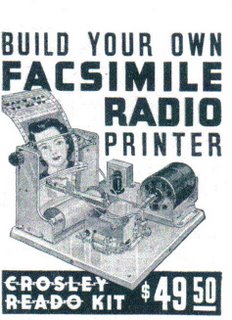
A odd-ball radio service that peaked 1950's was facsimile transmission. this was primarily pushed by stations owned by newspapers as they tried new ways to deliver the news. More here.

Alexander Bain was granted a patent for creating the fax in 1843. Little has changed to his model even after the invention of computers and electronics. Let me point out that the fax predated both Morse code, the telephone, and even radio itself. In 1843 Bain introduced his first primitive facsimile machine. The sending device used a stylus attached to a pendulum, which passes over metal type to sense light or dark spots on a metal plated document. A pendulum on the receiving device makes a stain on a chemically treated paper when an electric charge is sent down a telegraph line. More here.

In 1903 Prof. Dr. Arthur Korn modified this system to established that same fax communication by broadcast instead of over a wire. He transmitted pictures between the cities of Paris, London and Berlin. That was the first radio-fax.

By 1922 the first transatlantic facsimile services were being provided by RCA. Their primary competitor was Western Union. both had developed “high-speed” radio fax systems. This was a big deal back then. With this system a picture could be sent over the Atlantic ocean and published the same day it was taken. Prior to this advance, news pictures had to travel by plane and ship.

By 1939 there were even daily newspapers available by fax . More than 1,000 U.S. households were experimentally equipped with fax receivers that electronically printed morning newspapers overnight. Station W9XZY, the experimental radio facsimile broadcasting station operated by the St. Louis Post Dispatch, inaugurated the world's first regular broadcast on ultra-high frequencies of specially prepared facsimile newspapers. The broadcasts continued daily for and Sunday at 2 p.m. I have read some notes that 93.7 KSD may have picked up the service from there but eventually this service ground to a halt.

In 1947, 98.1 WCAU debuted the service in Philadelphia (now WOGL)
In 1948 the New York Times owned 96.3 WQXR also offered the service.

This service died out in the 1950s. as fax over telephone lines became more affordable, and more regions were wired. As a lone hold out, Kyodo News in Japan still broadcasts whole newspapers over JJC-FM in Singapore. More here.