Showing posts with label RCA. Show all posts

Friday, March 24, 2017

Behold The RIAA Curve!


The RIAA has a bad reputation. But despite all of the horrible, unethical, hypocritical, soulless, malicious and devious things that RIAA has done... they still deserve credit for the RIAA curve. Prior to 1954, recorded audio had a problem. A world of wholly un-standardized playback and recording  equipment used across independent recording studios, radio studios etc had led to a wild west of audio quality. Differences between needles, reproducers, cartridges, microphones, and recording media made for mixed audio characteristics everywhere. Today the RIAA equalization specification permits longer playback times, and better, more consistent sound quality.  More here.

The RIAA 500R-13.7 equalization curve has operated as a de facto global industry standard for the recording and playback of vinyl records for over half a century. Before 1954 (especially from 1940) each record company applied its own equalization, each pressing plant, and recording studio... it has been estimated that there were over 100 combinations of turnover and roll-off frequencies in use.  (Audacity software actually has a EQ library you can install to emulate the numerous differing curves.) Below are just some of the more common standards.
  • Columbia-78
  • Decca-U.S.
  • London LP
  • BBC 2dB
  • Bartok 629C
  • NBC Ortacoustic
  • NAB/NARTB
  • RCA Orthacoustic
  • Columbia LP
  • Decca-FFRR-78
  • AES

Each EQ curve is a combination of two filter characteristics: a bass boost curve which is defined by a Bass Turnover frequency, and a treble cut curve, defined by a Gain Rolloff parameter. Early 78s, especially in the US had no curve. (Not on purpose anyway). The EQ is flat and to the modern ear it sounds like it. This is unsurprising when you recall that the speed wasn't even consistent between record labels leading to utterly unavoidable differences in pitch. This was exacerbated by excessive patent hoarding wherein each company felt what they were doing used proprietary technology they often wouldn't license.

The earliest EQ standard I know if is the European 78, which dates to at least 1926. It had a pronounced boost in the bass range at 50 Hz. Nearly as old is the Blumlein 300, which has no boost in the high frequencies and a turnover at 300 Hz. It's named for Alan Blumlein a genius electrical and audio engineer at EMI. (He may have also invented stereo sound.)  But these (and many others) had developed for different purposes. The NAB standard was for radio transcriptions. RCA developed a standard for it's "Orthophonic" recordings in 1947 only to change it in 1952 to find a happy medium to pair with their new 45 rpm recordings.  More here.

The NAB standard was probably key to the later standards. The lateral cut NAB curve was remarkably similar to the NBC Orthacoustic curve. They were both boosting low frequencies not for mathematical reasons but to over equipment hum. When the Columbia LP was released in June 1948, it's EQ drew heavily on the former and used a bit more bass boost. The took the unusual step of publishing the information. AES followed suit in 1951 with the explicit goal of standardizing home stereo systems. But RCA and Columbia were adhering to dissimilar standards and it went nowhere.

Then in 1952 RCA published their EQ standard, with an article by R.C. Moyer claiming a technical lineage back to the Western Electric "rubber line" recorder in 1925. This argument was clearly intended to establish theirs as a "historical" standard. That Western Electric Rubber line was a magnetic disc cutter to which we can attribute the birth of EQ. It was a well engineered cutter, and maintained a constant velocity. This allowed engineers to detect a correlation to amplitude and frequency. So with the goal of avoiding amplitude distortion bass was boosted after recording the first deliberate EQ manipulation. This is credited to Joseph P. Maxwell and Henry C. Harrison of Bell Labs.


Then in July of 1954, the Engineering Committee of the RIAA published the RCA standard attempting to standardize all their member labels. Electronic Industries and Tele-tech magazine published a rebuttal claiming it was the same as the NARTB standard, an update of the NAB curve. This was not exactly true. But in reality the Columbia, RCA and RIAA curves were all similar by this time [What's a couple kHz between friends?] If anything the RIAA closed the gap between the other standards, a political decision as much as an engineering decision, but all three standards (RCA, Columbia, and NARTB) were totally workable. It was more important at that time to pick one and move forward.


Tuesday, July 21, 2015

Photoradiogram, Rangertone and NBC

Q:   What does a fax machine, an electric organ and the NBC chimes all have in common?  
A:  Richard Howland Ranger
Born in Indianapolis, IN in 1889, Richard Ranger would become a strangely successful engineer.  He served in the U.S. Army Signal Corps during World War I, and attended the Massachusetts Institute of Technology (MIT) from 1919 to 1923. (It does not appear he actually graduated.)

After leaving MIT, Ranger became an engineer at RCA in 1924. There he conceived his first major accomplishment: the photo-radiogram aka radio fax. It was also called the transoceanic radio facsimile.  In 1924 he sent a photograph of President Calvin Coolidge from New York to London as a demonstration.There were other systems: the Denison facsimile as early as 1901, the Korn system in 1922, the Jenkins process and Bart-Lane systems were also around by 1922,  the Belin and Feree Systems by 1924. But RCA system developed by Ranger is the one today's fax is descended from.

In 1930 he left RCA and founded his own company, Rangertone Inc, in Newark, NJ. His company manufactured and sold his electronic organ the "Rangertone."  It wasn't the first electric organ, other less elegant devices predated the Rangertone by decades. It was a electronic tone-wheel based organ. Related tone-wheel organs go back to at least 1897 and the Telharmonium. In truth Rangertone didn't made big money until the late 1940s when they got into audiophile equipment. More here.

In 1932, Ranger his his third big hit. He invented the NBC chime machine. Undoubtedly growing out of his work developing electric organs, Ranger solved the problem of their manual chimes. Starting as early as 1929 the NBC had been striking their chimes by hand, and irregularly with as many as seven chimes before settling eventually on three. But a novice can screw up anything, and in music, timing is everything. Ranger invented an automatic device to reproduce the NBC chimes perfectly. It was a rack-mounted device containing three rotating wheels with rods attached, like a music box. These short rods plucked tuned metal reeds that reproduced the sound. NBC ordered several of these machines from Ranger which were installed at the studios of major affiliates in Los Angeles, New York City, Chicago and San Francisco. More here.

Thursday, June 26, 2014

The Screwtape Fascimilie Broadcasts

Note the variation on the Quick Brown Fox line above. That exact sentence was the first message sent on the Moscow–Washington hotline in 1963. It was sent by "secure" fax over land line, two decades after the death of facsimile broadcasts. More here.

It was imagined in the 1930s as a tool to communicate stock quotations, a news service, aircraft communications and as a home news service. I debate whether this was a gamble a farce or charity. R.C.A. invested a huge amount of money, time, and research into this technology in the middle of the great depression— an era when it was least likely to succeed commercially. It eventually produced a functional system which while commercially unfeasible, at least produced patentable technology that was later used in early television.

The technology of image transmission begins with Alexander Bain in 1842.  It was almost another 100 years before they got even close to a commercial service. In 1935 RCA was performing long-distance tests of facsimile transmissions up to 375 miles out from their transmitter in Rocky Point, NY (Long Island.) Yes that's approximately from New Haven, CT to Pittsburgh, PA. the AM transmissions worked best in the daytime due to multi-path interference effecting their signal on 38.6 Mc/s.  Portable receivers were installed in an automobile for continuous mobile testing. 

In 1936 the moved onto courting the airlines. A test was set up with 6 sets of receiving equipment for American Airlines hubs in Newark and Chicago. A 1Kw transmitter w2as set up on 10190 kc but testing ended after only 2 weeks because of interference from another unnamed station on the same frequency. The system was tested again with Western Airlines in Chicago and Kansas City on 2710, 4110, 6510 and 8015 kc. Tests again had difficulty with multi-path, and ignition noise. A further test in 1936 with Eastern Airlines in Miami and Atlanta was plagued by echo effects.

Enter the government. The Bureau of Air Commerce (established 1934) was excited about the idea and wanted to transmit weather reports on UHF between all airports.  Test equipment was installed in Maryland at Silver Hill and Sparrows Point on 61 and 65 mc. It was somewhat more of a success. The equipment was moved to Reading and Harrisburg for a test on 1674 kc and 190 kc in use by the state police. 

Later test tried to send weather maps to ships at sea, transmit newspapers to homes and even less plausible schemes. In the end it proved to be a solution looking for a problem.  The Bureau of Air Commerce was split into the Civil Aeronautics Administration (CAA) and the Civil Aeronautics Board (CAB) which collectively lost interest. RCA saw quickly that television was the future and wisely changed strategy.

Monday, July 23, 2012

1929 Air Telephone Directory

This is my 1929 Air Telephone Directory. The brand name originates in 1889 with the founding of the Dayton Fan and Motor Company. Day Fan was printing these bi-monthly and mailing them out at 50 cents for a 1-year subscription. This one describes itself as number 6, Volume 6. So Presumably that's last issue of year 6. So issue one, year one would have been February of 1924. I've scanned it below. It contains 38 pages of domestic radio stations and frequencies, even some international broadcasters.

The company only made fans until 1922, when they started to sell radio components, then whole radio units around 1924, which lines up nicely with my math. The company was bought in 1929 by General Motors and thus was became the General Motors Radio Corp. I've never found a directory any later than 1929, but I suspect they were printed into 1930 since that's only 30 days after this issue. But later than that is unlikely as the company was liquidated in 1931 as a result of an antitrust suit.

This of course was back in an era when we actually prosecuted anti-trust cases.  The General Motors Radio Corporation was owned 51% by GM the other 49% was owned by Westinghouse, RCA and GE. But why did they buy it?  By 1929 the company was a total money loser, it was insolvent, and funded by Charles Kettering, a VP at GM. It's likely that they bought Day Fan just because they had an existing license from RCA for their radio patents. It further concentrated market share in the hands of a few. But it was very late in a game they were about to lose.

In 1930, the DOJ filed their antitrust suit against against RCA, General Electric and Westinghouse. They lost and the DOJ divided up the pie. GE and Westinghouse had to give up their shares of RCA. RCA stayed in the radio business and GE and Westinghouse had to get out of the pool. They couldn't even compete in that industry for almost 3 years. As a result the majority of the shares in Day Fan were owned by companies no longer allowed to sell radios or GM for whom it was ancillary to their core business. The General Motors Radio Corp. was liquidated in 1931.  You can read more here  here.

Download all 29MB

Thursday, October 08, 2009

Radio Theatre

A noun is a person, place or thing. Radio theater is normally thought of as a thing. A number of actors, foley men, musicians hosts announcer etc. gather and perform a play. But there were such places as radio theaters. The terminology is long departed, but there were once many.Many radio programs and play groups used the nomenclature: Lux Radio theatre, Mutual Radio theatre, Sears Radio theatre, The California Artists Radio Theatre, the American Radio Theatre, Midwest Radio Theatre Workshop, Riders Radio Theater, NBC Radio theater... the list goes on

But movie houses called themselves "theaters" as they most often were formerly hosting vaudeville. They were theaters in the true original sense. But how did radio figure into it? It all goes back to RKO. It stands for Radio Keith-Orpheum. Even Radio City Music hall was a RKO theatre.

They were one of the original Big-5 studios in the 1930s. David Sarnoff through RCA bought and merged The Keith-Albee-Orpheum Theater chain merged with Joseph P. Kennedy's Film Booking Offices of America. The new company name was RKO. Their films became "RCA Radio Pictures." Their physical movie houses re-branded as we'd say these days. The original RKO closed up shop in 1957. Some movie houses still hang onto their name from that era. I present here a short list. I've not confirmed in person.. it could be an AMC by now. I wrote abotu their demise once before in connection to another topic.

Harrisburg, AR Radio Theatre 210 N Main St
Chicago, IL Radio Theatre
Baltimore, MD Radio Theatre 629 N Eden St
Ferndale, MI Radio City Theater 22875 Woodward Ave
Minneapolis, MN Radio City Theatre 36 S Ninth St
Saint Paul, MN Radio Theatre 1195 E Seventh St
Saint Louis, MO Radio Theatre
Saint Louis, MO Radio-Orpheum Theatre
New York, NY Radio City Music Hall 1260 Avenue of the Americas
New York, NY Radio Theatre 4113 13th Ave.
New York, NY Radio Theatre 1348 Southern Blvd

Friday, May 26, 2006

A History of Vinyl

It was the year 1950 that improvements in the manufacture of Polyvinyl Chloride (also called PVC or vinyl finally spelled the death of Shellac records. Here.

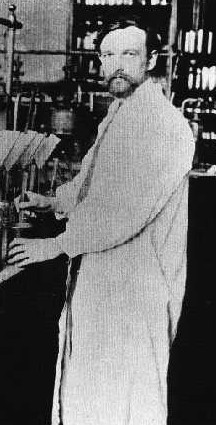
Vinyl was initially discovered by was discovered by French physicist Henri Victor Regnault, and it's first practical production process designed by Fritz Klatte (pictured) in 1912. He discovered that the reaction between acetylene and acetic acid could be catalyzed to produced vinyl chloride. This predated it's use in media by such a long period of time that his patent expired in 1925. One year later it was rediscovered by Waldo Semon, who recognized its potential and patented it for the second time. His employers at B.F Goodrich used it for insulation, raincoats, shower curtains and gaskets. More here.
After it's benefits were demonstrated, (durability, flexibility and longevity) it was adopted as the new material for record production. On June 26th 1948 in New York CBS called a press conference to announce the introduction of the LP or long player. 12 inches wide, turning at 33 1/3 and using the innovation of vinyl had resulted in a record that could hold up to 30 minutes of music per side! It was called "microgroove" technology.

RCA retaliated by bringing their own vinyl medium to the market, a 7-inch 45 rpm micro-groove vinyl single and compatible turn table.

By 1954 45 rpm singles were out on vinyl making available a higher fidelity single and then about 8 years later RCA debuted the stereo LP, an innovation that would have been impossible on shellac.

Wednesday, May 17, 2006

The Transcription Disc

It looks like a record, but it's not exactly a record. It spins at 33 &1/3 rpm like a record but it's about 16" in diameter, that's 4 inches wider than your record crates, but could only hold about 15 minutes of audio per side. But the upside was the audio quality was better than a 78.

It was the year 1929. The great depression changed everything. Leisure items became luxury goods. Thomas Edison's cylinders and discs ceased production entirely. Conglomerates bought up smaller failing independents. Mass production made possible the reduced price of LPs of all kinds. And for radio stations the ability to replay programs was a huge cost-saver.

In 1929 RCA/Victor began making discs from "Vitrolac" (the precursor to vinyl.) It was picked up as a professional medium for radio transcription discs and the Library of Congress also used Vitrolac for talking books for the blind.

Two years later they took that magic material and introduced a type of long-playing record that allowed long form radio programs to fit on a manageable number of discs. These records held between double and triple the amount of music as a standard 78rpm disc. RCA's long-playing format apparently did not catch on. Introducing it in the middle of the Depression cannot have helped.

Prior to the vitrolac disc, the primary purpose of the aluminum disc was for advertiser program reviews. The aluminum discs were only good for a couple plays. Previous to this there were only aluminum transcription discs. These could only be played with a bamboo needle and in fact would be destroyed by a traditional steel needle. In Instead of aluminum discs, the RCA system used recording blanks made of a plastic material, either solid or bonded to a cardboard core. RCA issued blanks with pre-cut grooves which guided the tone arm along the surface of the disc. It was big improvement over the groove-less aluminum blanks.

By 1931 RCA was trying to market these discs to consumers but the idea was a bust. Consumers didn't like the 33 & 1/3 playing speed. But as a commercial product it stuck. The professional transcription disc the standard transcription disc for radio station recording until magnetic tape gained dominance around 1948.

Transcription discs probably peaked 942-1946 when AFRN (Armed Forces Radio Network) was created to distribute programs to soldiers overseas. By January 1946, 1030 vinylite 16-inch transcription discs of 8240 popular and classical songs had been produced as part of the Basic Music Library for the AFRN.

In the middle of this, the head of the American Federation of Musicians, James C. Petrillo, banned the use of transcriptions, insisting that all radio shows be performed live. This begat a musicians' strike that dragged all the way into 1945! ...But that's another story...

Thursday, August 04, 2005

NOT LICENSED FOR RADIO BROADCAST

In the 1920s the RIAA sued broadcasters to get them to STOP playing music. That's right kids. The record industry's "anti-airplay" platform lasted well into the 1930s.

We begin at the beginning... By the early 1920s, RCA was mass-producing commercial radios. While the radio didn't sound as good as the phonograph, it was still free. The recording industry was incensed and attempted to sue the radio stations to prevent them from playing recordings on the air. The first judges presented with this issue decided that if the radio station had purchased a copy of the recording they had a right to play it; since there was no law preventing it. It was a big set back for the RIAA.

In general, the 1930s were a tough period for the record industry. It was competing against the free content offered by radio stations in the great depression. The industry, dominated by 78 RPM records with a playing time of as little as three minutes per side, hit bottom around 1935. The juke box offered them something of a last minute reprieve. Yet the situation continued to be hampered in the 1940s by the wartime shortage of raw materials. The record industry concluded that they suffer when stations broadcast pre-recorded music. Their conclusion rested on two primary assumptions:
ONE - Consumers will not buy records when they could hear them on radio.
TWO - U.S. copyright law required that radio stations pay royalties to composers, lyricists, and publishers but not to record companies.

First, the New York Supreme Court ruled that if radio stations purchases a record, they were free to broadcast it ­ even when it bore a "Not Licensed for Broadcast" inscription. Displeased with this ruling, the dominant record firms pursued plans for obtaining fees from stations that broadcast pre-recorded music. To this day, they have still failed to get radio to pay the record labels for airplay.
In 1942, arguing that the new jukeboxs were putting live musicians out of work, the American Federation of Musicians declared a ban on recording. The AFM went on strike on August 1, 1942 in an attempt to get record companies to establish a fund for unemployed musicians. Most of the smaller and independent companies signed new contracts almost immediately; Decca signed a contract in September 1943, and the other major labels followed suit in November 1944.

Moving against the popular corporate wisdom, Capitol Records believed that broadcasting recordings would stimulate rather than harm sales. In search of airplay, Capitol promoted its records at radio stations. It was the first record firm to service free recordings to disk jockeys. it caused a dramatic increase in record sales. Unable to ignore Capitol's successful "pro-airplay" model, other dominant record firms followed suit.

Sounds familiar yet? The free music, doesn't sound as good as the original recorded media, but its popular, because its free. The then RIAA tries to sue the "offender" into submission...etc. A lots of bright folks see a parallel between the RIAAs recent desperate assaults on P2P platforms and their previous 1930s foolishness. I tend to agree. They've had a long history of resisting change, litigious zeal; and selective perception. Great article here.