Showing posts with label WCAU. Show all posts

Monday, February 16, 2026

Find That Zenith


I do like it when I find a radio with identifiable presets. It means we get to play a game I call Find That Radio. It also helps that this Zenith is gorgeous, though I think it's been refinished. This looks like someone stripped it and put on a thick coat of modern polyurethane. Looks good though, nice job.  It's a model 5S319 made in 1939. [SOURCE] Zenith made a few Art Deco models mostly in the late 1930s and early 1940s: 5S126, 5S218, 7S323, 7SC33R, 6R631, 6S632 and the 5F233 which this one also resembles. 

The call signs on the 5 preset buttons are WJZ, WORK, WLW, WCAU and WGR.  The WJZ-AM of today is on 1300 in Baltimore as it has been since 2008. But this is definitely the earlier WJZ. The original WJZ was out of Newark from 1921 - 1923 on 833 kHz. Based on the age of the radio, 1940s this is the WJZ in New York City that operated from 1923 - 1953 on 660 kHz. It's a 30-year window of time, but we can narrow that down I think.

1000 WORK-AM was a station in York, PA. They signed on March 17, 1932. After NARBA in 1941 they moved to 1350. They kept the calls until 1973 which narrows our time frame significantly on the bottom end. Despite using the call letters for over 40 years there is very little written about WORK. Most of what you will find focuses on Shorty Fincher and his Prairie Pals. This 1,000 watt station would have been mostly a local or regional station even in 1940. 


Station WLW began as experimental station 8XAA around 1921. That start date is somewhat debated.  More here. Putting that aside, WLW became WLW in March,1922 and operated on 833 kHz. It moved to 970 in 1923, then 710 where it stayed until 1927 when it made the move to 700 kHz where it remains today. This completely envelops the time frame and adds little to the story. Except for adding a pin to the map in Cincinnati, OH. 

This WCAU is not the 98.1 WCAU-FM but the AM station which began broadcasting in 1922. It operated as WCAU from 1922–1990, almost 70 years. The frequency would have been 1170 when this radio was first plugged in. It was probably listened to before and after WCAU both the AM and FM sides were sold to The Philadelphia Record in 1946.  After 1990 it became WOGL, then WGMP and is today WPTS, a news-talker on 1210. 

The last station on the list is 550 WGR-AM in Buffalo, NY today.  There is no debate on the frequency, they have been on 550 since 1928. It's interesting that the frequencies hop back and forth and aren't in any particular order on the presets. This 5,000 watt station would have been audible for hundreds of miles back in 1940, whereas WLW at 50,000 watts would have had it's frequency to itself across the whole east coast and been heard clear across the Mississippi river. 


Looking at the pins on a map I think the radio was East of Pittsburgh, PA but north of Baltimore, MD. There are just no local station in these presets except for WORK. If it was in a major city we might see local calls from those cities like WBAL or even WKBO if it was in Harrisburg. This really has to be in some reasonable distance from York, PA probably in a square between York, Hagerstown, Lancaster and Reading. Strangely I found this radio in Georgia. 

Monday, October 06, 2025

Pat Delsi and WCAM


In 1973 Pat Delsi aka (Pasquale Del Signore) inherited the Camden city albatross, a city-owned radio station, 1310 WCAM-AM. Municipal commercial band radio stations have always been rare but they're not unheard of in the course of radio history. The station was the oldest in Camden. It signed on in 1924 as 1270 WFBI-AM owned by Robert Galvin of the Galvin Radio Supply Company. But it became WCAM, owned by the city by March of 1926.  The studios moved to the top floor of the City Hall building at 520 Market Street after it's construction completed in 1931. 

Until 1948 the station shared time on its frequency with 1300 WTNJ in Trenton and WCAP in Asbury Park. Despite the protests of WDEL and WTNJ, the FCC allocated WTNJ to move to 1170 AM in 1949 ending the time-share and allowed WCAM and WCAP to become a full-time stations on 1310, albeit at reduced power. More here. The transmitter was in a brick building in the north west corner of Pyne Poynt Park. It was not a very secure location. The building was broken into multiple times, vandalized and finally experienced arson in 1982. WSSJ operated at low power, without staff for weeks. the transmitter building was demolished after 2003.


Delsi, that poor bastard. In 1973 he was promoted to General Manager but he was still also a DJ, talk show host, and sports announcer. If you were curious, Pat did not host the weekly Italian program “Spectrum Italiano,” on WSSJ. That was hosted by Pat’s friend Frank Medori. Seemingly he did everything else. Pat was given the mission to make WCAM profitable; a station which already had the marketing problem of being confused with WCAU in Philadelphia. But by 1978 he had succeeded. WCAM was in the black. 

Back in the 1960s, when Pat was just a DJ, WCAM was doing great. It was a strong rock n' roll station with a big local audience. But then after the payola scandal hit in 1961 they made the mistake of firing populat DJs like Hy Lit, and Jerry Blavat and basically declaring rock n' roll to be dead. They made the very progressive decision in 1963 to drop all cigarette advertisements, and gave up $13k of annual revenue. It sounds manageable, but in today's dollars that's 137k! The station also subscribed to no ratings services and had no metrics on listenership. That's a real obstacle to selling ads.


The station was losing money and by the late 1960s the city was trying to sell it off. A series of four deals fell through which notably included Jerry Wollman, then owner of the eagles, and another a private company owned by William F. Buckley. Delsi had been with the station since 1953. Mayor Angelo Errichetti told Delsi to do everything he could to stop the bleeding.  He became their 8th general manager in a period of 5 years. He chose to stabilize the station, retain all staff and focus the daytime music programs on oldies. It worked... But it couldn't stop Camden from selling off the station. 

A deal was finally made in the late 1970s and the station was sold to Philadelphia-based Wade Communications. Wade changed the call sign to WSSJ in 1980. Then that fire I mentioned in 1982. Pat decided to take back the station. Delsi started WSSJ Broadcasting Ltd. with some business partners and they bought the station back from Wade for $850k. After the 1984 purchase, he managed to hold on to it for another 15 years, finally selling WSSJ in 1999 to Mega Communications.

In 2001 Mega Communications changed the calls to WEMG spinning Spanish oldies. But in 2005 they sold it to Davidson Media. Today it's a mix of Spanish language and brokered programming. Today the original WCAM calls reside on 1590 in Camden, SC.  Pat Delsi died in 2021. Delsi's first job in radio was in 1953 at WWBZ in Vineland, NJ in 1953, and about a year later went to WCAM. It was his baby. He had been in radio for 67 years. 

Note: There are a surprising number of Airchecks on YouTube from WCAM and WSSJ but none of Pat Delsi:

  • Mitch Ryder WCAM 1980 [LINK]
  • Rick Anthony WSSJ 1980 [LINK]
  • Nikki Duval WSSJ 1980 [LINK]
  • Nikki Duval WSSJ 1982 [LINK]
  • Unknown DJ WSSJ 1994 [LINK]


Thursday, April 23, 2015

Send Lawyers, Guns and Money

It was the end of the era when Philly was still a music city. It was a different time. Joni Mitchell and Tom Rush hung out there. The studios of WMMR overlooked Ritenhouse Square for many years from the third floor of the Wellington Building. From 1983 to 1984 Warren Zevon lived in a hotel on Rittenhouse Square, in the heart of the city. But Zevon was born in Chicago, why was he in Philly while disco was king?

Zevon was a born musician. He studied classical music as a child, even studying under Igor Stravinsky briefly. At the age of 16 he quit school and moved to New York to become a working musician. The year was 1963. He recorded his first solo album in 1969, with Kim Fowley acting as producer. In the 1970s he toured with the Everly Brothers as keyboard player after which he briefly moved to Spain. He then relocated to Los Angeles, finding work as a song writer. He married Crystal Brelsford briefly in 1974. They got a divorce in 1979. The marriage produced one son, Jordan and the ballad "Empty-Handed Heart." Afterward he relocated to Philadelphia. Enter Anita Gevinson and the shortest commute to work ever.

At the time Anita was a DJ on rock station, WMMR. She was on air there from 1978 to 1982. (With a short break to spin at KLOS in 1980, and WCOZ in 1979.) In December of 1982 she crossed the street to WYSP for an afternoon slot. Program director Michael Picozi proposed that she start taking live calls. The "Ask Anita" segment was born. Picozi, clearly a patient boss, even later let her take time to tour with Zevon.  He moved into Gevinson's apartment at Rittenhouse Sq.  But when Picozi was unexpectedly fired in 1984, the good times ended.  In May of 1985 a new PM Andy Bloom started, and Gevinson was cut along with several other staffers. The station began syndicating Howard Stern in mornings to replace some of them. The papers called it the "Labor Day Massacre." Gevinson went to WCAU and Zevon went to rehab.

In August Gevinson moved to 1210 WCAU-AM and took on a talk program that ran from 9:00 AM to noon, followed by the hour-long "Ask Anita" segment reminiscent of  her WYSP bit. It wasn't bloodless, she replaced Maxine Schnall and Ron Eisenberg.  More here. But rocker talk wasn't the right demographic for WCAU. The AM band was already going gray. She tried out the west coast again with a spin at KMPC where she stayed from 1988 - 1990, then added a second slot at 101.9 KSCA. She dumped both those gigs to work at 97.1 KLSX in 1997. She remained there until 2009.

Warren Zevon died of inoperable lung cancer on September 7, 2003, shortly after the release of his last album "The Wind." Gevinson published a memoir in 2012, You Turn Me On, I'm A Radio. The book focuses heavily on her time at WYSP and WMMR, and her deceased rocker fiancĂ© Warren Zevon.  More here and here.

Tuesday, June 03, 2014

Transcription Mystery Disc #216

This is a 10-Inch Silvertone transcription disc. It spins at 78 rpm, has an outer edge start and has a metal core. It's very heavy gauge which makes sense with the date inscribed on each side 11-19-40. Both sides are labeled. One as "ELIZA GERSHWIN" the other as "I LOOK AT YOU."  It might look at first like dubs of commercial releases but it's not.  These are 74 year old radio broadcast recordings. Awesome.

WCAU WGAR

The Gershwin side had nothing more interesting than a Christmas shopping spot. But the other side is a winner. At 1:22 an announcer cuts in to say that "You've been listening to the music of Clyde Lucas and the California Dons playing in the garden terrance of the Benjamin Franklin hotel in Philadelphia. This program came to you through the facilities of WCAU Philadelphia. Harry Mcalvain speaking, this is the Columbia broadcasting system." Then at 1:52 there is another radio recording. This one from WGAR-AM with another CBS program with the Paul Pendarvis Orchestra at the Browns' room at the Hotel Cleveland.

There is a lot of history here. In the 1930s Clyde Lucas and the California Dons were playing at Chicago area hotels like the Morrison Hotel and the Terrace Garden. They were as schmaltzy as they came. IN the 1940s they evolved into more of a swing band. They were playing the Biltmore in Providence, RI but broke up sometime before 1950. Paul Pendarvis actually cut 12 sides for Columbia records in the 1930s. None of them include this song "I Look At You." It may well be the only extant recording of the tune.  After quitting the whole bandleader thing, in 1946 Pendarvis became the music director at KLAC-AM. The great circle of radio has claimed another.

Friday, March 16, 2012

The Fraser Radio Gospel Hour


There is scant information out there regarding the Fraser Radio Gospel Hour. It started in 1925 and ran possibly as late as 1973 and was hosted by Rev. Robert Fraser a Blind Radio Evangelist in Philadelphia. He headed several related charities including the Fraser Home for Elderly Ladies, the Fraser Mission and the Fraser Home for Girls.

He was born on March 14th 1906, and attended Overbrook school for the blind also in Philly. The book Undaunted by Blindness by Clifford E. Olstrom claims that he was singing on the radio by the age of 16. That seems dubious as that'd be in 1922, but there were at least a few stations in Philadelphia at that time: WFI-AM, WOO-AM, WGL-AM, WCAU-AM, and WDAR-AM, so it is possible. The Olstrom reference I found for this seemed weak. The book does got the man's age wrong a sentence later claiming he was 19 in 1923... oops.  Fraser  wrote his autobiography in 1936 titled Overcoming Obstacles, chapter 4 is "Growing up with radio." It ironed out the specifics.

It details his early radio appearances. He worked with Christopher W. Graham (Uncle WIP) on WIP-AM, and on WCAU-AM he played the character "Sunshine Boy." He sang with Dumont and Emmett Welsch's  Minstrels on WFI-AM and WDAR-AM.  But in 1924 he was converted and gave up jazz and vaudeville for gospel and preaching. It's unclear where he might have preached on the radio in the early years but he and his wife Ella Stark were married in the studio of WCAU, so it's probably that station.

Another book, 30 Years With Radio looks back at the program over it's history. It was published in 1955 to commemorate 30 years of his radio program. It lists WLBR, WIBG, WNAR, WVCH and WKAP among others but often lacking dates. But the autobiography  noted that they broadcast 532 shows on WIP-AM. If the Fraser Radio Gospel Hour was always weekly program, that means spent the better part of a decade on WIP before appearing on any of those other stations.

******
Updates in PART TWO HERE

Friday, April 29, 2011

Delaware Valley Radio Ephemera

This is an odd one. This is some kind of business card for C.H. Davis, Inc a stereo and television store in Ardmore, PA. Inexplicably the store still exists today, just a few blocks away from the junk shop where I bought the book that contained the card; presumably as a book mark. But this is an old card. They were still selling portable radios and phonographs when this card was made.I do notice there are no Am stations listed. That indicates that it's after 1960 —during the ascension of FM.

The call changes can narrow the date of this scrap of paper. Some isn't helpful.  WJBR is still on 99.5 unchanged since 1956. WPEN became WMGK only in 1975. WFIL only became WIOQ in 1971.We know it's older than that.  92.5 FM was WIFI back then and is WXTU now. They changed format from pop to country before 1984. WIP-FM hasn't been on 93.3 since 1965, after which it has been WMMR. On 93.7 these days we have WSTW, it hasn't been WDEL-FM since abotu 1966. (WDEL-AM remains on 1150.) WFLN-FM is now WBEN, it only dropped the heritage FLN calls in 2006. WHAT-FM also changed calls in the late 1960s when it dropped it's jazz format. 98.1 FM is now WOGL as it has been since 1987. Back in the 1960s WCAU-FM  was simulcasting MOR with WCAU-AM 

WSNJ-FM 98.1 helps narrow the date a bit. That station signed on in 1946 as WSNJ. (FYI: Wikipedia incorrectly dates that to 1961) What happened in 1961 was that WSNJ swapped calls with 107.7 WPBS. they had already been on air for 5 years.  They changed calls to WUSL in 1976. WSNJ remained on 107.7 until about 8 years ago. So, it had to be printed before 1961 the date of that call swap and after 1956 the date WJBR signed on. (Math corrected by Fybush)

WXPN, WHYY and WRTI are about all where they were even if the programming has changed a lot. WHYY has a typoed frequency. But WPWT is more of a mystery. they were a share-time with WKDU on 91.7 from the1950s into the 1980s. I hear they were a crazy psychedelic hippie station. I'd love to hear an aircheck.  I'll have to write a post about them sometime.

Monday, March 22, 2010

McMahon

Ed McMahon had a strange job while he was alive. His job was to laugh at Johnny Carson. Plenty of people already did that for free. From 1962 to 1992 his job was to sit on stage and laugh like a monkey. It's no where near where he began his career. He began as a carnival barker in Mexico, Maine about 50 miles from Augusta. He put himself through college as a pitchman for vegetable slicers on the Atlantic City boardwalk. Somewhere in the middle of all that, he did some work in radio.
His first broadcasting job was at 1400 WLLH-AM in his native Lowell, Massachusetts. He studied electrical engineering at Boston College and it enabled him to do his remotes solo, a plus for hiring managers. McMahon's voice was heard on WLLH doing station IDs in the 1980s, and he returned to Lowell in 1994 to be honored with a live broadcast on WLLH alongside then-morning host Paul Sullivan. WLLH-AM was a whopping 250 watt station back in those days. Today it's an ESPN affiliate with a more substantial 1000 watts. More here.

In 1949 Ed scored a gig doing overnights at WCAU-AM in Philadelphia where he was the announcer for The Ol' Night Owl, Powers Gouraud . He also co-hosted an afternoon program. He also did some announcing on WCAU-TV. Nobody is proud of it now, but he also was a clown on Saturday Mornings. He was drafted twice. Once in WWI and once in the Korean war both tours flattening his broadcasting career. This second tour was when he was at the peak of his work in Philadelphia. By 1952 he had bits on 13 different programs; new game shows, and the late night movie program. He had learned to fly in WWII so now they wanted him to bomb small islands in the pacific. When he got back they were all cancelled. He got a little piece on the nightly news. Philly was over he started looking at New York. But in 1958 he was still in Philadelphia, still on WCAU. but Agent Chuck reeves set him up with an audition for announcer on Johnny Carson's show on ABC. It was called "Who Do you trust." It was in actuality a game show but most of it was Carson being a funny man in the classical sense. That show ran for four years. In 1962 the two of them started on the tonight show replacing the twitchy Jack Paar on NBC.

For Ed that was really the end of radio. He came back to WLLH a couple times to do some station IDs as a favor to be friendly to the station that started him at $10 a week. He came back again when they celebrated Ed Mcmahon day with a parade. In the 1990s, on the USA Radio Network he hosted a weekend talk program called "Lifestyles Live." I think that was his last spin in radio. He died June 23, 2009. He was at 86.

Monday, January 16, 2006

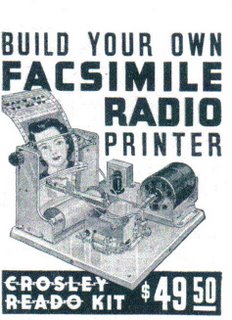
News Paper, via Radio Fascimile

Yes this really happened.
A odd-ball radio service that peaked 1950's was facsimile transmission. this was primarily pushed by stations owned by newspapers as they tried new ways to deliver the news. More here.

Alexander Bain was granted a patent for creating the fax in 1843. Little has changed to his model even after the invention of computers and electronics. Let me point out that the fax predated both Morse code, the telephone, and even radio itself. In 1843 Bain introduced his first primitive facsimile machine. The sending device used a stylus attached to a pendulum, which passes over metal type to sense light or dark spots on a metal plated document. A pendulum on the receiving device makes a stain on a chemically treated paper when an electric charge is sent down a telegraph line. More here.

In 1903 Prof. Dr. Arthur Korn modified this system to established that same fax communication by broadcast instead of over a wire. He transmitted pictures between the cities of Paris, London and Berlin. That was the first radio-fax.

By 1922 the first transatlantic facsimile services were being provided by RCA. Their primary competitor was Western Union. both had developed “high-speed” radio fax systems. This was a big deal back then. With this system a picture could be sent over the Atlantic ocean and published the same day it was taken. Prior to this advance, news pictures had to travel by plane and ship.

By 1939 there were even daily newspapers available by fax . More than 1,000 U.S. households were experimentally equipped with fax receivers that electronically printed morning newspapers overnight. Station W9XZY, the experimental radio facsimile broadcasting station operated by the St. Louis Post Dispatch, inaugurated the world's first regular broadcast on ultra-high frequencies of specially prepared facsimile newspapers. The broadcasts continued daily for and Sunday at 2 p.m. I have read some notes that 93.7 KSD may have picked up the service from there but eventually this service ground to a halt.

In 1947, 98.1 WCAU debuted the service in Philadelphia (now WOGL)
In 1948 the New York Times owned 96.3 WQXR also offered the service.

This service died out in the 1950s. as fax over telephone lines became more affordable, and more regions were wired. As a lone hold out, Kyodo News in Japan still broadcasts whole newspapers over JJC-FM in Singapore. More here.