Showing posts with label WQXR. Show all posts

Thursday, August 22, 2024

Radio House Books

This is more obscure than it probably should be. I found a book on the imprint "Radio House Books." It's publisher was George W. Stewart, Inc. His operated from at least 1936 and 1951. The earliest book I found was The Stewart Simplified Method of Mimicry and Parlor Amusement. I suspect that's a different Stewart. The other works are all primarily from the 1940s and also primarily non-fiction: history, criticism, economics, sociology and a little bit of English drama. The address in the book plate is 67 W. 44th Street, New York, NY. Note on disambiguation: there was a well-published professor at the University of Iowa by that name, a few notable military men, and a newspaperman. These are all different George Stewarts.

But then there is our George W. Stewart. He was the author of "I Have a book" published in 1940. I found a copy of the Who What Why Is radio text scanned on line. [SOURCE] It refers to the Jerome Still book as "Still in preparation."  


In the introduction of The Radio Station, Jerome Still thanks Robert J. Landry which is an interesting connection. Landry even writes the introduction to the book. Landry himself is a mystery. In 1963 - 1979 the editor of Variety was a Robert J. Landry. He also wrote a book This Fascinating Radio Business, published by Bobbs-Merrill in 1946. Back in the 1940s he was the Director of Program writing at CBS.  The 2004 Encyclopedia of Radio confirms they are one and the same. Jerome Sill also thanks Sherman Marshall at WOLF, Nathan Lord of WAVE, and Joseph Creamer of WOR, all unknown radio men today.

Title Author
Year
link
 Who, What, Why Is Radio?
 Robert J. Landry
1942
 LINK
 All Children Listen
 Dorothy Gordon
1942 N/A
The Radio Station: Management, Function, Future
Jerome Sill
1946
 LINK
Time For Reason About Radio
Lyman Bryson
1948
LINK

The three books are all rare, but none more so than the Dorothy Gordon text. She was the moderator of The New York Times Youth Forum, a weekly radio and television program on WQXR. It aired from 1943 to 1960. In 1960 it was picked up by WNBC-TV and aired until her death in 1970. The program brought together a panel of high school AND/or college students and an adult guest in discussion. Gordon won a McCalls Golden Mike award in 1952 [SOURCE] and a Peabody award in 1963 [SOURCE]. In 1942 the book some classroom discussion guides mention Gordon's book. All together she wrote at least 7 books.

  • Sing It Yourself - 1928
  • Around The World In Song - 1930
  • Dorothy Gordon's Treasure Bag Of Game Song 1939
  • Come To France 1940
  • Knowing The Netherlands - 1940
  • All Children Listen 1942
  • You And Democracy - 1951

The Jerome Sill book is easier to find, and will cost half as much as the Gordon text. I saw one with the dust jacket on eBay. This appears to be his only book, thought it's widely quoted in other radio station management texts. A similar Jerome Sill worked in advertising in the 1930s into 1940s writing for Advertising & Selling magazine. There was  Jerome Sill of WMLO Milwaukee who led an independent station revolt in 1947 against a new NAB code. Jerome Sill pops up as the Promotions director of WNEW in 1944, formerly of the Aarons, Sill & Caron an ad agency in Detroit. I think these are all the same man. His letter of protest was widely quoted:

"Should this code be adopted in it's preset form, we might be in the position of being forced to withdraw from the NAB or be dishonest in our tacit acceptance of a code to which we could not sincerely subscribe. We would choose the former course."
If it's him he appears as the general manage of WMIL in Milwaukee in 1953, part owner of WREX in Duluth. He founded WAGE-TV in Greenbay in 1954. There was a Jerome Still who owned WFPG in Atlantic City, New Jersey 1960 and 1961, perhaps the same man. as the primary share-holder of WFPG Inc. he acquired the station in 1956,


The interval between the book publishing dates is peculiar. Two books the first year, then none for 3 years, and then one for another two. The Lyman Bryson book does advertise the prior three titles but it's unlike them in other ways. The first three books analyze radio management, and radio programming. Bryson's book is a transcript from a series of talks on CBS from the series "Time For Reason."  The show ran for 27 weekly episodes airing Sunday afternoons from December 1946 to June 1947. Bryson went on to become a frequent guest on the radio game show Information, Please. 

Bryson had been a teacher at Columbia University, but he also moderated The American School of The Air, Invitation to Learning and from 1938 to 1946 he hosted the publish affairs program The Peoples Platform. In many ways it was the adult version of Youth Forum, assembling a panel of laypeople to discuss areas of national interest. Publishers Weekly wrote a review in 1948 in advance of it's February 19th release date.

Some mysteries persist. There was never a fifth book in the series and George W. Stewart seems to stop operating in the early 1950s. The latest books are in a new series, a "Cookery Library" with a series of specialized cook books on coffee and cheese and a random Bible Quiz. In 1951 he published a book about war propaganda and by all appearances, nothing after that.

Monday, October 17, 2011

The Poet Laureate Of Radio

Surprisingly, Norman Corwin is not dead. He is in fact 101 years old as of May 3rd 1911. At this point we have to accept that the poet laureate of radio may well me immortal like the Count of St. Germain. Since we cannot be certain we might as well discuss how radio ends up having a poet laureate at all.

Corwin began as a newspaperman at the Greenfield Recorder and in 1926, and moved on to the Springfield Republican newspaper in 1929. (Both of which sort of still exist.) Westinghouse contacted the Republican seeking to assemble a regular fifteen-minute 10:30 PM newscast. This was to air on WBZA-AM. Somehow this job went to the new kid. He was only 18 years old. Ballsy kid that he was, several months later he pitched them on a regular poetry program. The resulting series was called "Rhymes and Cadences."

In 1936 he moved to New York City and began working at 20th Century Fox.  But the a poet laureate cant just work in publicity. He called up WQXR and pitched them on a show just like the one he had at WBZA. His program "Poetic  License" ran Tuesday nights at 9:15.  Then he started subbing for A.M. Sullivan, host of The new Poetry Hour on WOR-AM.

In 1938, he jumped to CBS. VP William B. Lewis heard an episode of  "Poetic  License" and was impressed. How impressed?  Impressed enough that within a week Corwin was radio director for the Columbia Workshop.  Another version of the story has him making a guest appearance on the RCA program "The Magic Key Of RCA" courtesy of his brother Emil Corwin who worked in the publicity department at NBC. Both tales are believable for different reasons. Both versions end the same way. Corwin with his own series which he wrote and directed "Norman Corwin's Words Without Music."  Starting in 1941, he was writing, casting, and directing a new play every week. He had just turned 31!

That constitutes an accomplished career on it's own. But his work in WWII is what endeared him to many. He wrote and produced a number a very patriotic works before, after and during the war effort. personally I find these works trite, jingoistic and trite. It's all very Stephen Vincent BenĂ©t. But it was popular and it fit the mood of the nation at the time. In the 1940s America was in an isolationist mood, and had a very real and vocal fascist political minority.  Things could have gone the other way. Readers of history who ultimately see our role in WWII as having any valor must give some credit to the rallying writers who helped turn public opinion toward the allies. For that reason, I find Corwin's accolades totally valid.  More here.

Anyway, Corwin was a hot ticket after the war, he did screen plays, books, magazine articles, and a torrent of plays. He left radio for the most part but still wrote the occasional radio drama until the format petered out in the 1960s. In 1971 he was heading up "Norman Corwin Presents" on CBC. Then in 1995 Corwin returned radio. He wrote and directed a whole series for NPR titled "More by Corwin." 

He has received the One World Award, two Peabody Medals, an Emmy, a Golden Globe, and was inducted into the National Radio Hall of Fame in 1993. At least two documentary films have been made on the topic of his life and career. He has authored 19 books, five stage plays, and innumerable film and TV works. Today he lives in Los Angeles and  is still writing.

Monday, February 01, 2010

The QXR Network

There is so little Classical music in commercial radio now that the idea of a Classical network seems at first ludicrous. NPR of course provides a litany of classical programs on it's network. Most of them are run at night, or interspersed between talk programs. The format is all but dead. It's rare stations who totally ignore their ratings like WRTI who opt to run classical in the day to the detriment of their other programming. But 60 years ago it was all different.
WQXR first tried network programming in 1948. It didnt' work out. they might have stayed away from it but in 1950, WFMZ in Allentown, PA approached WQXR with the possibility of rebroadcasting WQXR's programs. Tests were conducted and WFMZ became an "affiliate". I use the term loosely. They received the AM signal of WQXR and re-broadcast. More here.

In 1953 The Rural Radio Network was falling apart and its affiliates looked into becoming a part of this new QXR Network. WBIB New Haven, joined QXR in July of 1950. WQXR eventually absorbed most of the RRN stations. But off air relay has it's problems. If one station goes down, everybody in line behind them loses the feed. Despite technical problems, the network manged to grow. But something was wrong. James Sondheim the Network manager admitted that until 1958 the network didn't even attempt to become profitable. Stations included: WTAG, WFLY, WFFM, WFMZ, WASH, WITH, WFIL, WJTH, WROC, WGR, WNBF, WIOV, WRUN, WSYR, WHDL and many others. By 1960 there were 20 stations on board. This was out of hand. They needed to make some money. In 1962 The New York times sold the network to the Novo Industrial Corporation. Novo president William Romain was very quiet through out the partnership. At the time this was billed as an expansion. The then 36-station network was to expand to 50 within a year and 100 within 2 years. They were to add talk programming, interview shows, and refocus on spot sales. None of those things happened. On October 21st 1963 the network planned to go live coast-to-coast. But the music programming was distributed by tape. Some of the business programs were syndicated over landlines.

But the math was all wrong. Affiliates saw that they weren't making the cash on the network programming that they did on local programming. the network peaked at about 44 stations. By the fall of 1963 the QXR Network was history.

Monday, December 07, 2009

The binaural Emory Cook

For a number of years, Emory Cook was considered a truly exceptional audio engineer. He was born and raised in Albany, NY and attended Cornell University. He worked for the Audio Engineering Department at Western Electric. He was a strong proponent of binaural sound, an inventor and audiophile. He once described binaural sound thusly:
"Stereophonic recording differs from Binaural in that the microphone placements are selected for loudspeaker reproduction. Binaural properly applies to a two-channel system designed for headphone reproduction. It thus requires the use of two channels fed by microphones spaced about seven inches apart."
Those magic 7 inches represent the average distance between a pair of normal human ears. it's the founding idea behind binaural sound. It is supposed to put the listeners perspective sonically where the sounds on the recording or broadcast originated. I consider it a subtype of stereo sound. Stereo sounds being if nothing else.. at least less specific. More here.

It's strange, but binaural sound actually predates stereo. In 1881 Clement Ader installed pairs of carbon mics on a Paris opera stage for telephone subscribers to listen in. How is this separate from the evolution of stereo? It's not. They're inextricably linked. Every step in the evolution of stereo sound can also be claimed by the evolution of binaural sound. The only difference is snobbery. There is a gri-gri quality to binaural sound that stereo lacks. But let's get back to Emory. There was a lot of gri-gri to him as well.

Emory created a record player with two needles meant to play records with two parallel grooves. He founded Cook records in 1949 and eventually put out more than a hundred binaural LPs. His plant was based in Stamford Connecticut. Emory was using his personal brand recognition to hype a series of binaural LPs: Sounds of the Sea, Nightmare in the Mosque, Speed the Parting Guest. He demonstrated them at the Worlds Fair. They're all over eBay now for the kitsch.

But there were also radio broadcasts were live like Toscanini, WQXR string quartet and the Godina opera hour. But this was 1952. stereo sound was entirely new in broadcasting. WQXR was achieving "stereo" by using it's using its AM and FM stations towers as separate Left and Right audio channels. Was it stereo, was it binaural? I don't distinguish a difference. Binaural enthusiast will tell you this was the first binaural broadcast. I think it's bunk. In 1925, on 5XX the BBC had broadcast stereo with the Left channel on medium wave and the right channel on long wave. That's 27 years before WQXR. WGN-AM and WGNB-FM did the same thing in 1952 just a few months before WQXR. All they're beating their chests over is microphone positioning in the source audio. It's bunk; clever bunk, but bunk nonetheless.
The irony is that in the process of supporting the bunk idea of binaural audio the very educated and clever Cook actually made other developments. He made microphone and amplifier improvements that made it possible to record audio above 20,000 cycles, he even developed a process to press vinyl in a powdered form to reduce surface noise. Previous to this they were always pressed starting with a preheated puck of vinyl, a technique based on shellac 78s. He called the new technique “microfusion.” Sadly it didn't catch on.

Emory Cook died in 2002 at the age of 89. Emory donated his master tapes, patents, and papers to the Smithsonian Institution in 1990. Obit here.

Monday, January 16, 2006

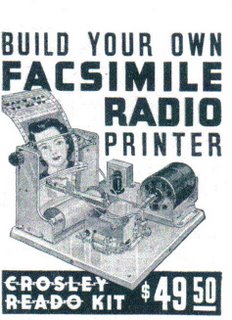
News Paper, via Radio Fascimile

Yes this really happened.
A odd-ball radio service that peaked 1950's was facsimile transmission. this was primarily pushed by stations owned by newspapers as they tried new ways to deliver the news. More here.

Alexander Bain was granted a patent for creating the fax in 1843. Little has changed to his model even after the invention of computers and electronics. Let me point out that the fax predated both Morse code, the telephone, and even radio itself. In 1843 Bain introduced his first primitive facsimile machine. The sending device used a stylus attached to a pendulum, which passes over metal type to sense light or dark spots on a metal plated document. A pendulum on the receiving device makes a stain on a chemically treated paper when an electric charge is sent down a telegraph line. More here.

In 1903 Prof. Dr. Arthur Korn modified this system to established that same fax communication by broadcast instead of over a wire. He transmitted pictures between the cities of Paris, London and Berlin. That was the first radio-fax.

By 1922 the first transatlantic facsimile services were being provided by RCA. Their primary competitor was Western Union. both had developed “high-speed” radio fax systems. This was a big deal back then. With this system a picture could be sent over the Atlantic ocean and published the same day it was taken. Prior to this advance, news pictures had to travel by plane and ship.

By 1939 there were even daily newspapers available by fax . More than 1,000 U.S. households were experimentally equipped with fax receivers that electronically printed morning newspapers overnight. Station W9XZY, the experimental radio facsimile broadcasting station operated by the St. Louis Post Dispatch, inaugurated the world's first regular broadcast on ultra-high frequencies of specially prepared facsimile newspapers. The broadcasts continued daily for and Sunday at 2 p.m. I have read some notes that 93.7 KSD may have picked up the service from there but eventually this service ground to a halt.

In 1947, 98.1 WCAU debuted the service in Philadelphia (now WOGL)
In 1948 the New York Times owned 96.3 WQXR also offered the service.

This service died out in the 1950s. as fax over telephone lines became more affordable, and more regions were wired. As a lone hold out, Kyodo News in Japan still broadcasts whole newspapers over JJC-FM in Singapore. More here.