On April 20th 1926 a check was sent by radio for the first time ever. So don't go feeling smug just because you can check your bank balance on your iPhone. This check was sent 88 years ago without the aid of TCIP, CDMA, lithium-ion batteries, or even solid state electronics. For this feat we can thank the utterly obscure Richard Howland Ranger. He is usually the man credited with inventing the fax a.k.a. the wireless photoradiogram, or the the transoceanic radio facsimile. That's him in leaning left in the center.
Captain Richard H. Rager was an electrical engineer born in 1889 in Indianapolis, IN. He was a member of the U.S. Signal corps in WWI, and served again in WWII. He graduated from MIT in 1923. He had all the credentials of a boy genius. That image I cropped below is from the famous Einstein group photo at RCA here. He fit in with that line up of brilliant inventors.
So back to that check. In 1924 he sent a photograph of President Calvin Coolidge from New York to London. It was the first radio facsimile. The RCA book Radio Facsimile published in 1938 covers this in great detail but the first name on page one is Richard H. Ranger. Now bear in mind the fax already existed, Alexander Bain patented his Electric Printing Telegraph in 1843. Ranger had to convert this to a broadcast-able code that could be received and reconstructed over wireless. He summarized the image as 65 dots per square inch, that's about the same as news print of that era.
So two years after the first "test" broadcast of President Coolidge's mug they were ready to try a bit of online banking. The president of RCA, Gen. James G. Harbord wrote a check to RCA for $1,000.00. Within 20 minutes they confirmed receipt of all messages by Morse code. The chairman of the board of Directors of RCA Owen D. Young sent greetings to Vice President Charles G. Dawes. A newspaper article of the day noted that the check would be honored if there were no "legal impediments."
Ranger also had a number of other really notable inventions. He invented the Rangertone, an early electronic organ in 1932. The organ was marketed directly by his company Rangertone Inc. on Verona Ave. in Newark, NJ. He also invented the NBC chime machine which generated those three tones we all know so well. He was inducted into the New Jersey Inventors Hall of Fame in 1997. He died in 1962.
Showing posts with label fax. Show all posts
Monday, December 15, 2014
Thursday, June 26, 2014
The Screwtape Fascimilie Broadcasts
Note the variation on the Quick Brown Fox line above. That exact sentence was the first message sent on the Moscow–Washington hotline in 1963. It was sent by "secure" fax over land line, two decades after the death of facsimile broadcasts. More here.
It was imagined in the 1930s as a tool to communicate stock quotations, a news service, aircraft communications and as a home news service. I debate whether this was a gamble a farce or charity. R.C.A. invested a huge amount of money, time, and research into this technology in the middle of the great depression— an era when it was least likely to succeed commercially. It eventually produced a functional system which while commercially unfeasible, at least produced patentable technology that was later used in early television.
The technology of image transmission begins with Alexander Bain in 1842. It was almost another 100 years before they got even close to a commercial service. In 1935 RCA was performing long-distance tests of facsimile transmissions up to 375 miles out from their transmitter in Rocky Point, NY (Long Island.) Yes that's approximately from New Haven, CT to Pittsburgh, PA. the AM transmissions worked best in the daytime due to multi-path interference effecting their signal on 38.6 Mc/s. Portable receivers were installed in an automobile for continuous mobile testing.
In 1936 the moved onto courting the airlines. A test was set up with 6 sets of receiving equipment for American Airlines hubs in Newark and Chicago. A 1Kw transmitter w2as set up on 10190 kc but testing ended after only 2 weeks because of interference from another unnamed station on the same frequency. The system was tested again with Western Airlines in Chicago and Kansas City on 2710, 4110, 6510 and 8015 kc. Tests again had difficulty with multi-path, and ignition noise. A further test in 1936 with Eastern Airlines in Miami and Atlanta was plagued by echo effects.
Enter the government. The Bureau of Air Commerce (established 1934) was excited about the idea and wanted to transmit weather reports on UHF between all airports. Test equipment was installed in Maryland at Silver Hill and Sparrows Point on 61 and 65 mc. It was somewhat more of a success. The equipment was moved to Reading and Harrisburg for a test on 1674 kc and 190 kc in use by the state police.
Later test tried to send weather maps to ships at sea, transmit newspapers to homes and even less plausible schemes. In the end it proved to be a solution looking for a problem. The Bureau of Air Commerce was split into the Civil Aeronautics Administration (CAA) and the Civil Aeronautics Board (CAB) which collectively lost interest. RCA saw quickly that television was the future and wisely changed strategy.
It was imagined in the 1930s as a tool to communicate stock quotations, a news service, aircraft communications and as a home news service. I debate whether this was a gamble a farce or charity. R.C.A. invested a huge amount of money, time, and research into this technology in the middle of the great depression— an era when it was least likely to succeed commercially. It eventually produced a functional system which while commercially unfeasible, at least produced patentable technology that was later used in early television.
The technology of image transmission begins with Alexander Bain in 1842. It was almost another 100 years before they got even close to a commercial service. In 1935 RCA was performing long-distance tests of facsimile transmissions up to 375 miles out from their transmitter in Rocky Point, NY (Long Island.) Yes that's approximately from New Haven, CT to Pittsburgh, PA. the AM transmissions worked best in the daytime due to multi-path interference effecting their signal on 38.6 Mc/s. Portable receivers were installed in an automobile for continuous mobile testing.
In 1936 the moved onto courting the airlines. A test was set up with 6 sets of receiving equipment for American Airlines hubs in Newark and Chicago. A 1Kw transmitter w2as set up on 10190 kc but testing ended after only 2 weeks because of interference from another unnamed station on the same frequency. The system was tested again with Western Airlines in Chicago and Kansas City on 2710, 4110, 6510 and 8015 kc. Tests again had difficulty with multi-path, and ignition noise. A further test in 1936 with Eastern Airlines in Miami and Atlanta was plagued by echo effects.
Enter the government. The Bureau of Air Commerce (established 1934) was excited about the idea and wanted to transmit weather reports on UHF between all airports. Test equipment was installed in Maryland at Silver Hill and Sparrows Point on 61 and 65 mc. It was somewhat more of a success. The equipment was moved to Reading and Harrisburg for a test on 1674 kc and 190 kc in use by the state police.
Later test tried to send weather maps to ships at sea, transmit newspapers to homes and even less plausible schemes. In the end it proved to be a solution looking for a problem. The Bureau of Air Commerce was split into the Civil Aeronautics Administration (CAA) and the Civil Aeronautics Board (CAB) which collectively lost interest. RCA saw quickly that television was the future and wisely changed strategy.
Labels:
Alexander Bain,
fax,
radio fax,
RCA
Monday, January 16, 2006
News Paper, via Radio Fascimile
Yes this really happened.
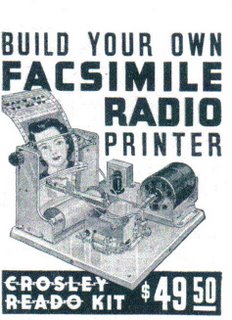
A odd-ball radio service that peaked 1950's was facsimile transmission. this was primarily pushed by stations owned by newspapers as they tried new ways to deliver the news. More here.
Alexander Bain was granted a patent for creating the fax in 1843. Little has changed to his model even after the invention of computers and electronics. Let me point out that the fax predated both Morse code, the telephone, and even radio itself. In 1843 Bain introduced his first primitive facsimile machine. The sending device used a stylus attached to a pendulum, which passes over metal type to sense light or dark spots on a metal plated document. A pendulum on the receiving device makes a stain on a chemically treated paper when an electric charge is sent down a telegraph line. More here.
In 1903 Prof. Dr. Arthur Korn modified this system to established that same fax communication by broadcast instead of over a wire. He transmitted pictures between the cities of Paris, London and Berlin. That was the first radio-fax.
By 1922 the first transatlantic facsimile services were being provided by RCA. Their primary competitor was Western Union. both had developed “high-speed” radio fax systems. This was a big deal back then. With this system a picture could be sent over the Atlantic ocean and published the same day it was taken. Prior to this advance, news pictures had to travel by plane and ship.
By 1939 there were even daily newspapers available by fax . More than 1,000 U.S. households were experimentally equipped with fax receivers that electronically printed morning newspapers overnight. Station W9XZY, the experimental radio facsimile broadcasting station operated by the St. Louis Post Dispatch, inaugurated the world's first regular broadcast on ultra-high frequencies of specially prepared facsimile newspapers. The broadcasts continued daily for and Sunday at 2 p.m. I have read some notes that 93.7 KSD may have picked up the service from there but eventually this service ground to a halt.
In 1947, 98.1 WCAU debuted the service in Philadelphia (now WOGL)
In 1948 the New York Times owned 96.3 WQXR also offered the service.
This service died out in the 1950s. as fax over telephone lines became more affordable, and more regions were wired. As a lone hold out, Kyodo News in Japan still broadcasts whole newspapers over JJC-FM in Singapore. More here.
A odd-ball radio service that peaked 1950's was facsimile transmission. this was primarily pushed by stations owned by newspapers as they tried new ways to deliver the news. More here.Alexander Bain was granted a patent for creating the fax in 1843. Little has changed to his model even after the invention of computers and electronics. Let me point out that the fax predated both Morse code, the telephone, and even radio itself. In 1843 Bain introduced his first primitive facsimile machine. The sending device used a stylus attached to a pendulum, which passes over metal type to sense light or dark spots on a metal plated document. A pendulum on the receiving device makes a stain on a chemically treated paper when an electric charge is sent down a telegraph line. More here.
In 1903 Prof. Dr. Arthur Korn modified this system to established that same fax communication by broadcast instead of over a wire. He transmitted pictures between the cities of Paris, London and Berlin. That was the first radio-fax.
By 1922 the first transatlantic facsimile services were being provided by RCA. Their primary competitor was Western Union. both had developed “high-speed” radio fax systems. This was a big deal back then. With this system a picture could be sent over the Atlantic ocean and published the same day it was taken. Prior to this advance, news pictures had to travel by plane and ship.
By 1939 there were even daily newspapers available by fax . More than 1,000 U.S. households were experimentally equipped with fax receivers that electronically printed morning newspapers overnight. Station W9XZY, the experimental radio facsimile broadcasting station operated by the St. Louis Post Dispatch, inaugurated the world's first regular broadcast on ultra-high frequencies of specially prepared facsimile newspapers. The broadcasts continued daily for and Sunday at 2 p.m. I have read some notes that 93.7 KSD may have picked up the service from there but eventually this service ground to a halt.
In 1947, 98.1 WCAU debuted the service in Philadelphia (now WOGL)
In 1948 the New York Times owned 96.3 WQXR also offered the service.
This service died out in the 1950s. as fax over telephone lines became more affordable, and more regions were wired. As a lone hold out, Kyodo News in Japan still broadcasts whole newspapers over JJC-FM in Singapore. More here.
Subscribe to:
Posts (Atom)