Showing posts with label WOKO. Show all posts

Friday, March 25, 2016

WOKO Soap Box Derby

The WOKO on air today went on the air in 1962 as WJOY-FM. The station was also known as WQCR from 1972 to 1990, when it became WOKO, the country station in Bernie Sander's back yard. It is not related to the former WOKO which started in the 1920s in New York City and operated for many years in Albany; that station is now WOPG. Is that that New York WOKO that entered a soap box derby back in 1959.

It is however interesting to me that they chose the British spelling of "Radio Centre."  It's been  250 years since the colonies and United Kingdom were ruled by the crown. According to many sources, it was the either the 1806 or 1828 edition of Webster's dictionary that was so responsible for standardizing these "Americanized" spellings. His dictionary came to be seen in the UK as Americanized and became less popular.  Incidentally the word "Center" passed the tipping point in the US in 1910. SOURCE [HERE]

In 1939 WOKO published a radio guide which highlighted their new Radio Centre on Elk Street. If it was new that year, then it was already 20 years old when that Soap Box racer hit the pavement. SOURCE [HERE]

Harold E. Smith bought 1460 WOKO-AM when it was still a New York City station.  He moved it to Peekskill, NY then later in 1931 Albany, NY. In 1934, he bought 1400 WABY-AM.  When the Radio Centre was complete his CBS and NBC affiliates now shared studio space. (WOKO was CBS, WABY was NBC) Though they never shared a radio tower.  The WOKO transmitter was on Central Avenue, and the WABY transmitter was near Colonie, NY. It is probably one of the earliest instances of radio stations sharing studio space but not programming.

Tuesday, June 03, 2008

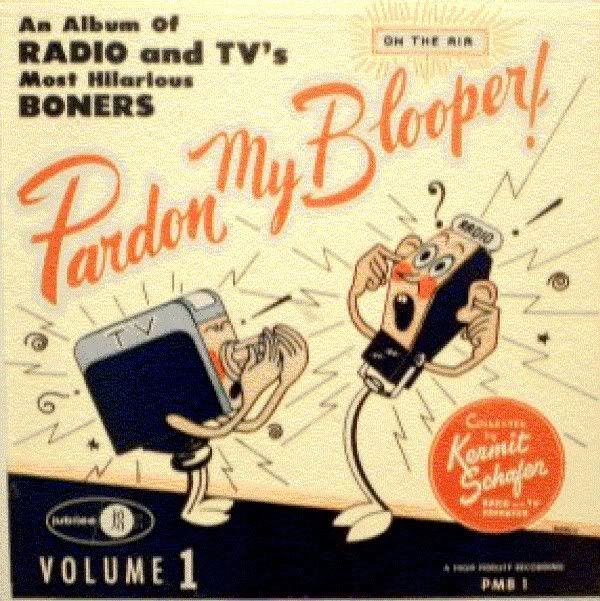
Pardon my Blooper

Blooper: / ˈbloōpər/ "blunder," 1947, either from Amer.Eng. baseball slang, "a fly ball missed by the fielder" (1937) or "radio receiver that interferes with nearby sets" (1926).
With an etymology like that, it's not a surprise that radio was the medium that popularized the term. It was Kermit Schaefer (no relation to the frog) that re-coined the term to mean blunder. The word may have made the transition earlier, but it was this popular 1960s series that brought it into popular use. The only let down for me is that after 40 years it's hard to attribute the clips without program names or calls. On the LP he mentions very few call letters and only a few programs specifically. WOR-AM and WOKO-AM get outed for example.

Jubilee records put out at least 5 LPs of radio bloopers. I only own one LP-2011 from Volume 4. Mine is thankfully a 33 that I can play on my old Technics 1200. It makes the MP3 rip so much easier. Pardon My Blooper's first LP was rocketed to popularity because of a libel case over the release.

Not all bloopers were from source audio. If Kermit couldn't get the real deal he'd just recreate it. Radio host "Uncle Don" Carney, was less than pleased about one recreation, and he sued. There were many other accusations that the "re-creations" were inaccurate. But this only increased demand of course. But some of the audio was real. He had an infamous clip of Paul Harvey giggling like a stoned sorority girl. The albums were re-released in the 1970s by K-tel. They're out of print today of course. and in today's syndicated, time-delayed, prerecorded voice-tracked radioland bloopers are very rare indeed.