Wednesday, July 31, 2013
I AM THE BRUCE!
Jet magazine called Ramon Bruce Philadelphia's first negro disk jockey. It was a damn shame when WHAT-AM later fired him for "flagrant neglect of duty" and "insubordination." Bruce claimed that they fired him for joining AFTRA because he was fired by telegram "55 minutes" after joining the union. For his part Bruce filed charges with the local labor board. It was a dirty public fight. Station Manager Dolly Banks even claimed that his absenteeism required that they hire Cal Williams and Jocko Henderson to fill in...and that they were the only staff that had joined any union.
Every biography says that Bruce was a former pro football player but they never say for what team. But, starting in December of 1945 on WHAT, Ramon Played Jazz and Rhythm and Blues all week then Gospel on Sunday. His show was initially called "Snap Club " and later "Ravin with Ramon." He broadcast live from Club 421 and later Powelton's Cafe and Paul's Carnival Club. He was an amazingly popular DJ in a time when segregation was legal. He was receiving 1,000 letters a week by some reports and earning $50,000 dollars a year in an era when that was a CEO salary. He owned restaurants and a record store. He also released some very bad recordings that Billboard dismissed as the "delusions of Ronald Colman." People bought them anyway. In 1949 still on the upswing WHAT gave him an afternoon show as well.
The root cause of his firing is uncertain but in 1949 the FCC reported that Bruce "belongs to a number of negro and other organizations..." The language is vague but that sounds slightly accusatory. Ramon wrote a column for the paper the Philadelphia Afro-American. That kind of black pride was new and not welcome in all quarters. Maybe joining the union was the last straw for management.
Mr. Bruce went from WHAT to a new program 1230 WCMC-AM in Wildwood, NJ where he broadcast live from the Riptide Club. He was known as "The Bruce" which to my mind was the superior stage name anyway. He was making more money on the side booking R&B tours milking that growing audience for R&B in New Jersey. In 1954 he joined WNJR-AM, a bigger signal covering better parts of the Jersey market. He stayed there for about 3 years.
WAAT-AM in Newark, New Jersey, where he took off again. He continued to book theater tours Heartbeats, Cadillacs, Valentines, the Avalons, LaVern Baker, the Clovers and many others, they toured in the region playing shows in Pennsylvania, New York and New Jersey. He stayed on at WAAT until at least 1957 when he was listed in Sponsor magazine as having the best ratings of any program on the station. He was dead less than 5 years later after what the papers called "a long illness." He was only 39 years old. By 1968 Robert St. John was already describing Ramon Bruce in print as a "pioneer negro deejay." He certainly was that.
Thursday, August 11, 2011
Radio On Strike
My gut feeling was that they were very rare. Strikes are traditionally the tool of people that perform manual labor, blue collar workers. In general, white collar workers don't strike. It's a generalization, but it's fairly accurate. So to that end I have compiled a list of Radio-related strikes and their dates. This is limited to white collar staff: writers, producers, announcers, musicians etc. I have excluded the strikes of TV staff, radio manufacturers, and telegraph operators as those are not strictly radio-related. This is an incomplete list, but I have hopes that readers may make a few additions. I found many of these in the book The Encyclopedia Of Strikes In American History By Aaron Brenner. Also excluded are the occasions when a union threatened to strike and management made concessions. Those events are poorly recorded, and I am not confident I coulld make a proper list of those.
2011 - AFTRA strike on record labels [here]
2005 - CBC Radio Strike
1982 - AFTRA strike on WINS-AM
1978 - AFTRA strike on advertising agencies
1977 - WBAI Pacifica Radio strike
1974 - WAOK-AM
1974 - AFTRA strike WWDJ
1970 - KZAP-FM staff sit down strike
1968 - KMPX-AM
1967 - AFTRA100 radio station strike
1965 - WSIM-AM, Radio and Television Broadcast Technicians
1962 - KFWB-AM
1958 - CBFT(Radio-Canada CBC) Radio producers strike
1958 - MGA Studio Musicians (later re-merged into AFM)
1948 - AFM recording ban
1948 - The Radio Writers' Guild
1947 - WCKY-AM Radio technicians strike (IBEW)
1944 - NABET engineers at NBC
1942 - AFM recording ban (2 years)
1941 - ASCAP radio strike
1936 - Marine Radio Operator Strike (MEBA)
1938 - WTCN-AM News Staff
1935 - ARTA strike at Macay Radio & Telegraph Co.
1921 - Marine Radio Operator Strike (MEBA)
I keep this list updated at a static page here
Monday, November 21, 2005
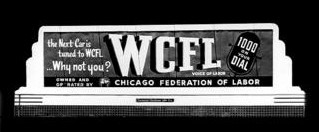
Chicago's Voice of Labor
On Wednesday night-July 21, 1926 WCFL 620AM , Chicago's Voice of Labor, premiered over the airwaves with two hours of music. This event marked the beginning of the first radio station in the United States dedicated solely to the cause of labor unions and their members. The driving force behind the creation of WCFL was a man named Edward Nockels.
WCFL continued to survive and even flourish over the following decades even were publishing a magazine. In the fall of 1927, Nockles introduced the quarterly publication of the WCFL Radio Magazine for it's listeners and union workers.
WCFL's General Manager Ken Draper altered the format in 1966. He captured the 18-35 year old audience, with the introduction of rock n' roll, and and the station beame even more successful. In 1967, WCFL was Chicago's number 1 CHR outlet!
It was in the late 1970's that things began to fall apart. As the organized labor movement in the United Stated began to decline, so did the Voice of Labor. The decision was made to sell WCFL because the finances were running low, and a progressive decline of community interest around their home base Chicago.
WCFL's ratings had tumbled by 1975. Lew Witz announced that on March 15, 1976, they would change from Top 40 to the dreaded beautiful music format. Most announcers were fired or quit. In April 1978, WCFL, the Voice of Labor, was sold to MBS (Mutual Broadcasting System)which was owned by Amway [Michigan-based pyramid-sceme marketing Co.] for $12 million. The sale of WCFL in 1978 marked the end of labor radio. But even without radio, the legacy of the labor movement lives on today. [Ex. I had to deal with a union shop just last month in Philly.]
In the fall of 1980, WCFL changed to a adult contemporary format. Then in 1983, MBS sold WCFL to Statewide Broadcasting and it hit the ratings bottom as a religious talk station. These days AM 1000 is currently ESPN Sports Talk...WMVP Chicago
Hear clips here: http://www.radiotimeline.com/am1000wcfl.htm
sombody wrote a book: http://www.press.uillinois.edu/s97/godfried.html