Showing posts with label Chuck Lakaytis. Show all posts

Wednesday, January 29, 2014

MDCL on the Radio

MDCL is a power-saving standard for amplitude modulation on FM radio. The acronym stands for Modulation-Dependent Carrier Level. It's been used abroad for years but until 2011 it wasn't used in the US at all. That would be because it's against FCC regulations. To implement MDCL technology, AM licensees need a waiver of rules. ON September 13th 2011 the FCC media Bureau put out release DA 11-1535 stating the following.

"...the Media Bureau (Bureau) announces that it will permit AM stations to use transmitter technologies that reduce power consumption while maintaining both audio quality and licensed coverage areas. Such technologies, known generally as Modulation Dependent Carrier Level (MDCL) control technologies or algorithms, have long been used by international broadcasters operating high-powered AM transmitters."
 The total number of stations using the tech is now 52, with the majority of those using a Nautel or Harris-based solution. Most of them are in Alaska, and California. This makes more sense when you look back and see the technology being pioneered by none other than Chuck Lakaytis, director of engineering with Alaska Public Broadcasting. At the NAB conference in 2011 Chuck did a presentation entitled “Reduce Power Costs of AM Transmitters using Carrier Control Techniques." Sations continue to seek waivers to reduce operating costs. You can see a list in excel here


With experimental authorization from the FCC, Alaska Public Radio tested MDCL on two stations. their test monkeys were 720 KOTZ-AM in Kotzebue, AK and and 670 KDLG-AM in Dillingham, AK. Both are 10 Kw stations. Lakaytis estimated that over a 3-month trial that his stations had a power savings of 30% with no loss of coverage of clarity. More here.

But there is a downside. MDCL technology can cause a transmitters power to drop below the minimum threshold of 90% hence the waiver requirement. It also diminishes the signal to noise ratio in a way that can be audible... though I'll be the first to admit that on the AM band that would be nearly impossible to detect. It may also effect IBOC, but nobody really cares about that anyway.

Tuesday, January 03, 2006

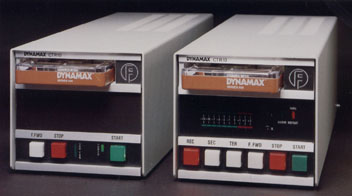
Goodbye to the Cart Machine

Chuck Lakaytis of CML Broadcasting in Anchorage claims that a 325 grain, .375 H&H Magnum will penetrate 73 carts. I don't contest it, but I would like to see pictures.


No it's not an 8-track tape. Cart Machines played endless-loop tape cartridges also called carts or Fidelipacs. These were historically used to hold commercials, jingles, announcements and promos of all sorts. Audio was recorded in mono usually and 1 KHz cue tones were recorded on a separate track. This second track indicated to the playback deck where to stop rewinding or playing.

The tape format was introduced to the (NAB)National Association of Broadcasters by Collins Radio in 1959 with it's first model, the Spotmaster. later versions of the Cart machine had stereo capability, additional cueing tones and even timers.

For the past twenty years, broadcasters have used cart machines as a standard playback device for in-house audio. Only the infiltration and growth of digital audio in radio studios really put an end to it. The cart machine was reliable and functional. Before cart machines, commercials were played back via reel to reel machines. The DJ had to thread the tape, then manually cue, and rewind the tape.

The cart machine solved these problems but brought along it’s own issues. No two brands of cart are made exactly the same. The small differences caused by the manufacturing processes prevented exact alignment of the cart machine to more than one cart! The irregularities of each cart usually cause phase problems between the left and right channels in stereo models, and in severe cases a miss-cue.. As the lifetime of the Cart wore on, it also became clear that we all were recycling our carts for far too long. Old carts sounded worse than a beat up 78 rpm platter. But at least I never had to reboot a cart machine during my show. More here and here.